
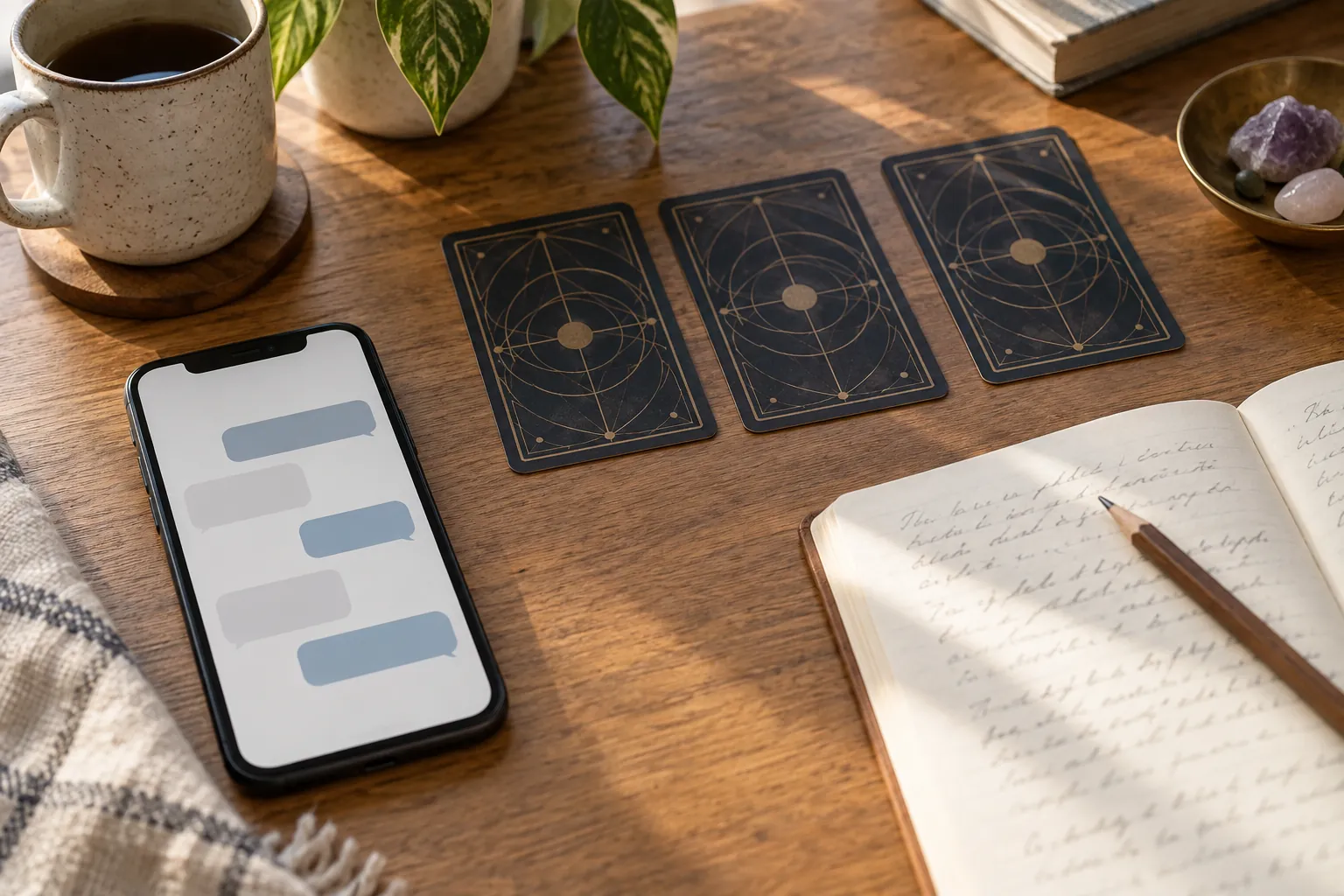
An AI tarot or psychic reading is text written by a language model. It predicts which words usually follow your question and the card names, so it is quick, cheap, always awake and good at explaining what a card traditionally means. It has no knowledge of your life beyond what you type, and it tends to agree with you. A human reader is slower and costs more, but can ask what you meant, notice what you skipped and push back. Neither one has been shown to predict the future. So the useful question is which tool fits your question, and whether you know which one you are paying for.
You have seen AI tarot and psychic apps, or asked a chatbot about your cards, and want to know how that compares with paying a person, and how to tell which one you are getting.
This guide compares the two plainly, sums up what reporting in October 2026 found about AI psychic apps, and gives you a short test and a checklist you can use on any reading, ours included.
What a chatbot is doing when it reads your cards
A large language model has read a huge amount of text, including tarot books, card-meaning websites and forum posts. When you type "I drew the Tower, the Star and the Six of Cups, what does it mean for my job?", it writes the kind of answer that usually follows a message like yours. That is why the card meanings it gives are often textbook-correct. It has seen them thousands of times.
Three things follow from how it works.
- It only knows what you tell it. If you leave out that you resigned last week, the reading will not include it. Some apps store your past chats and feed them back in, which can feel like being remembered. It is still your own words coming back.
- The cards may not be drawn at all. In a general chatbot, nothing shuffles unless you draw the cards yourself or the app runs a random draw. Ask a chatbot to "pull three cards" and it writes three card names. Whether that counts as random is a question to put to the app, not to the bot.
- It leans toward agreement. Language models tend to tell users what they seem to want to hear. Researchers call this sycophancy, and the tarot study below found readers noticing it. In a tarot reading it looks like a hopeful interpretation whenever your question sounds hopeful.
The anthropologist Sally Applin put the bigger point simply when the Guardian asked her about AI oracles: "The meaning is always coming from the inside of the person's head." That is true of a human reading too. What differs is who else is in the conversation.
AI reading vs a human reader, side by side
| Question | AI reading | Human reader |
|---|---|---|
| How fast? | Seconds | Minutes to a day, depending on the format |
| What does it cost? | Often free, or cents per question in coin-based apps | Usually a fixed fee per reading or per minute |
| Does it know your situation? | Only what you type, plus any chat history the app keeps | What you tell them, plus follow-up questions they choose to ask |
| Can it notice what you left out? | No. It answers the words on the screen | Sometimes. A reader can ask why you avoided a topic |
| Will it disagree with you? | Rarely, unless you ask it to | A careful one will, gently |
| Same answer twice? | No. Asking again usually gives a new wording, sometimes a new meaning | Usually one reading, though readers differ from each other |
| Who is accountable? | The app company, if you can find it | A named person or business with an offer page and a refund policy |
| Where does your text go? | To the app and often to its AI provider. Check the privacy policy | To the reader and their business. Check the privacy policy |
| Can it predict events? | No controlled evidence that it can | No controlled evidence that they can |
The last row matters most. A human voice proves nothing about foresight. Digital Trends made the same point in its coverage: having a person do the reading "doesn't establish whether anyone can predict the future." What you can expect, if you pay for a human, is that a human actually does the work. Our guide to whether tarot works covers the evidence side in more detail.
What the October 2026 reporting found
On October 29, 2026, the Guardian published a long piece by Kari Paul on psychics pushing back against AI readings, and Digital Trends followed it the same day. A few findings are worth knowing before you try an app.
- Coin pricing. The app Your AI Psychic offers more than a dozen bot "psychics" by chat, voice and video. Each question costs 4.06 coins. Packages run from $9.99 for 82 coins to $99.99 for 1,180 coins. By our arithmetic that is about 20 questions for the small pack and about 290 for the large one, roughly 50 cents and 34 cents a question.
- Thin disclosure. The Guardian found that the same app's privacy policy did not mention AI at all and referred only to "psychic advisors". It named no AI provider.
- What one company does say. MystiCall told the Guardian it uses ElevenLabs for live voice and OpenAI for post-call summaries, and that it does not sell conversations or let those partners train on them. Its co-founder added: "We do not claim that our technology possesses supernatural abilities or can reliably predict the future."
- Human readers responding. Some readers have added "no AI" lines to their adverts. One app, Psychic Vision, promises a live person and rejects AI-generated readings, according to Digital Trends.
- Digital doubles. A start-up called MysticTwin is recruiting psychics to train AI versions of themselves that would answer clients while the human is offline. Its site says it would keep 50 percent of chat revenue and that customers would know they are talking to AI. Digital Trends reported it was still advertising a planned launch.
The practical upshot is that "AI or human" is no longer obvious from a profile photo and a name. You have to ask, and read the small print.
How tarot readers use AI themselves
A study presented at the CHI 2026 conference, written up in The Conversation in May 2026 by three of its authors, interviewed 12 tarot practitioners who already used AI for their own readings. It is a small group of people who had chosen AI, so it describes them and not tarot readers in general.
The researchers found these readers pulled two ways. Some used the chatbot to settle readings they found hard to interpret, and liked what the authors called its "yes man energy" because it made them feel more confident. Others did the reverse. They asked the AI for alternative readings of the same cards, to catch their own blind spots, and then judged which one rang true. The authors' conclusion was that AI works better as a prompt for your own reflection than as a substitute for it.
That second habit is the one worth copying. It keeps the interpreting with you.
A 15-minute test you can run on any AI reading
If you are curious about an AI reading, try it with a little structure. You need one real question and a notebook.
- Draw your own cards. Use a physical deck or a random card generator you trust, and write the cards down before you open the chatbot. That way you know the draw was random.
- Ask it straight. Type the question and the cards. Save the answer.
- Ask it hopeful. Open a fresh chat. Same cards, but phrase the question the way you would if you were sure of a good outcome. Save that answer.
- Ask it worried. Fresh chat again. Same cards, phrased as a fear. Save the answer.
- Compare. Underline the sentences that changed with your mood and circle the ones that stayed the same across all three. The circled lines are roughly the cards' textbook meanings. The underlined ones came from your phrasing.
An invented example, to show the shape. Someone asks about a job offer and draws the Eight of Cups, the Page of Pentacles and the Two of Swords. The straight answer talks about leaving something behind, a new skill and a decision put off. The hopeful version calls the offer "a fresh start you deserve". The worried version warns about "walking away too soon". The circled lines, the ones in all three, are leaving, learning and indecision. Those three words are the useful part. They make a better prompt for a talk with a friend than any of the three verdicts.
You can run the same test on yourself after a human reading. Ask whether the reader's main points would still stand if you had told them less.
Is the "psychic" a person? Questions to ask before you pay
You cannot prove from outside who wrote a reading. You can make it easy for an honest seller to tell you and hard for a vague one to dodge.
- Ask in writing. "Is my reading written by a person, by AI, or by a person using AI?" A straight answer is a good sign, whichever it is. A dodge is not.
- Read the privacy policy. Look for the words "artificial intelligence", "machine learning" or the name of an AI company. If the app sells bot readings and the policy says none of this, you have learned something about the company.
- Check who is accountable. Is there a business name, a contact address and a refund policy you can find before paying? Our guide on how to choose a psychic reader walks through reading an offer page.
- Notice the speed and the sameness. A long, polished reply in a few seconds was not typed by hand. Readings that open with the same paragraph for different questions are probably a template, whoever wrote them.
- Treat "no AI" as a claim. A badge or a line in an advert is a promise, and it proves nothing on its own. It is still worth having in writing, because it gives you something to hold the seller to.
If you already think a seller misled you, the email readings guide has four checks for spotting a template, and they work on chat readings too.
Before you type anything personal
People tell readers things they tell nobody else. With an app, that text may pass through more than one company. MystiCall's own policy, as quoted by the Guardian, says conversations may touch on users' "relationships, mental state, health, sexuality, beliefs, finances". That is an honest list, and a good reason to think before you type.
- Leave out full names, phone numbers, addresses, ID numbers and bank details. A reading does not need them.
- Describe other people in general terms. "My manager" works as well as their full name.
- Check whether the app lets you delete your history, and whether it says your chats are used to train models.
- Keep health and money decisions out of it. On TikTok Live, the Guardian noted, many human psychics refuse those questions as a rule.
The general privacy steps in our reader-choosing guide apply to human readers as well.
When neither is the right tool
Some questions should not go to a card reading of any kind, human or machine. If you are asking about symptoms, a legal case, a large loan or whether you are safe at home, a doctor, a lawyer, your bank or the police can act on what you tell them. A reader cannot.
The Guardian also reported a warning from practitioners and researchers that chatbots can make things worse for people in a mental health crisis, and that studies have found language models can amplify paranoia in users vulnerable to psychosis. If you notice yourself asking the same question again and again until the answer feels right, that is a sign to step away from the screen and talk to someone. Tele MANAS in India is free and open around the clock on 14416 or 1-800-891-4416. The US crisis line is 988, by call or text, and Samaritans in the UK take calls on 116 123.
If a reading of either kind tells you that you are cursed and offers a paid fix, read what to do when you are told you are cursed before you pay anything.
Common questions
Is an AI tarot reading accurate?
It is usually accurate about what the cards traditionally mean, because it has read a great deal about them. There is no controlled evidence that it can tell what will happen to you, and the same is true of human readers. Treat both as prompts for reflection.
Can ChatGPT do a real tarot reading?
It can explain cards you draw yourself and suggest how they might relate to your question. If you ask it to pick the cards, it usually just writes card names unless the tool runs a random draw, so draw them yourself if randomness matters to you.
Why does an AI reading feel so personal?
It builds the answer from your own words, and language models tend to agree with the person asking. The result sounds tailored even though it only knows what you typed.
How can I tell if a psychic is AI or a person?
Ask in writing who writes the reading, read the privacy policy for any mention of AI or an AI company, and look for a named business with a refund policy. Very fast, very long replies and identical opening paragraphs are warning signs.
Is it safe to share personal details with an AI psychic app?
Share as little as you can. Leave out names, contact details and money or health information, check whether the app uses chats for training, and delete your history if it lets you.
Are human psychics better than AI?
Better at some things. A careful human reader can ask follow-up questions, notice what you avoided and disagree with you. An AI is faster and cheaper. Neither has been shown to predict events, so pick the one that suits your question and your budget.
Sources
- Kari Paul, Computerized clairvoyance: psychics push back against AI-generated readings, The Guardian, October 29, 2026.
- Paulo Vargas, AI has come for the psychics' jobs and they are not happy about it, Digital Trends, October 29, 2026.
- Ziv Epstein, Farnaz Jahanbakhsh and Vana Goblot, How tarot readers are using AI, The Conversation, May 13, 2026, and the paper Interpretive Cultures: Resonance, randomness, and negotiated meaning for AI-assisted tarot divination, CHI 2026.
- Helplines: Tele MANAS, 988 Lifeline, Samaritans.
- Per-question prices: our arithmetic from the coin figures the Guardian reported.