
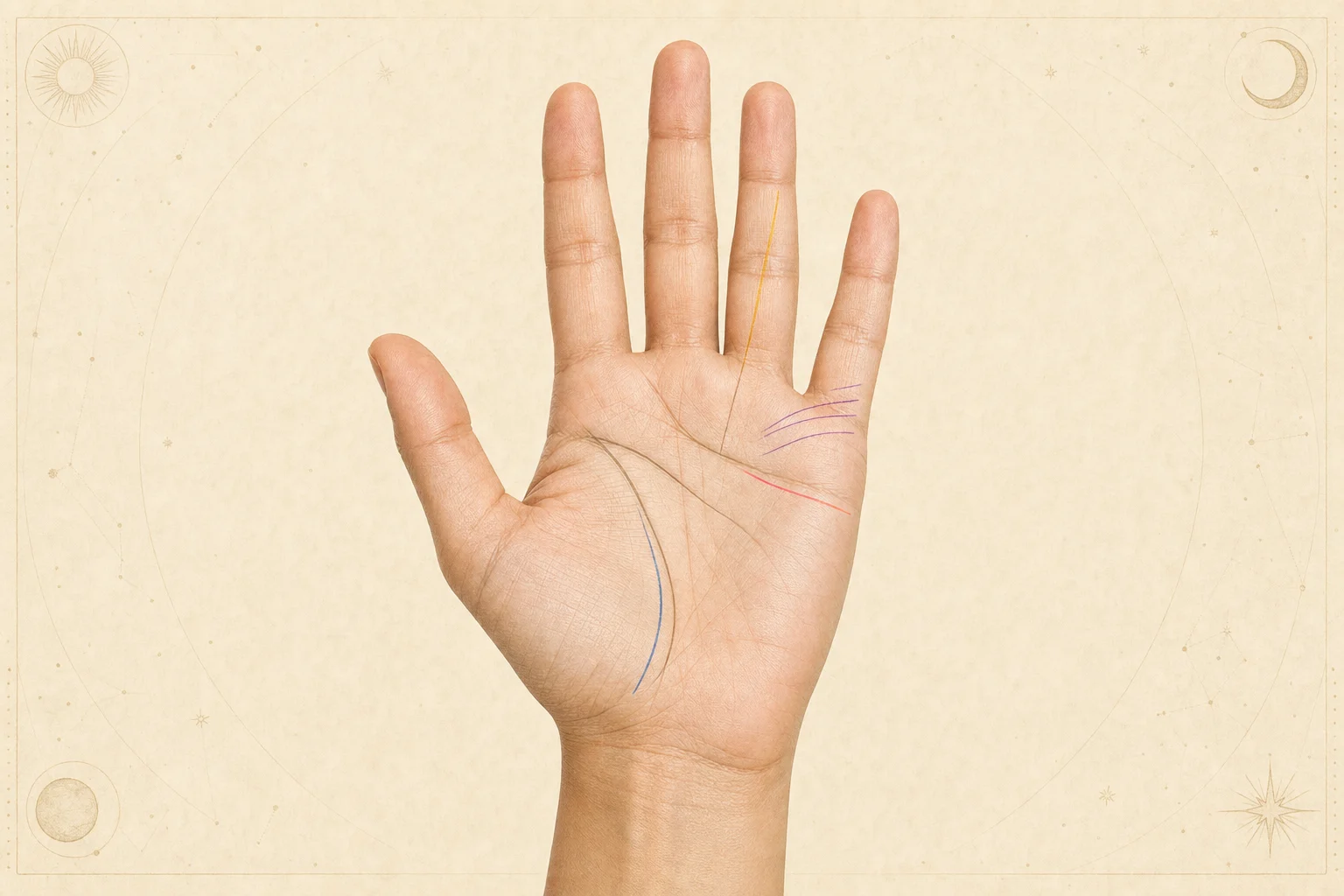
Minor lines in palmistry are secondary creases that may be faint, partial, or absent. Common examples include the Sun or Apollo line, Mercury line, Girdle of Venus, Mars line, and relationship lines. Their absence is normal. Read them only after locating the life, head, heart, and fate lines, and never use them for health or event predictions.
The line that draws your attention often arrives with a real question beneath it—about love, purpose, work, or the next turning point. Let the pattern invite a deeper conversation with yourself.
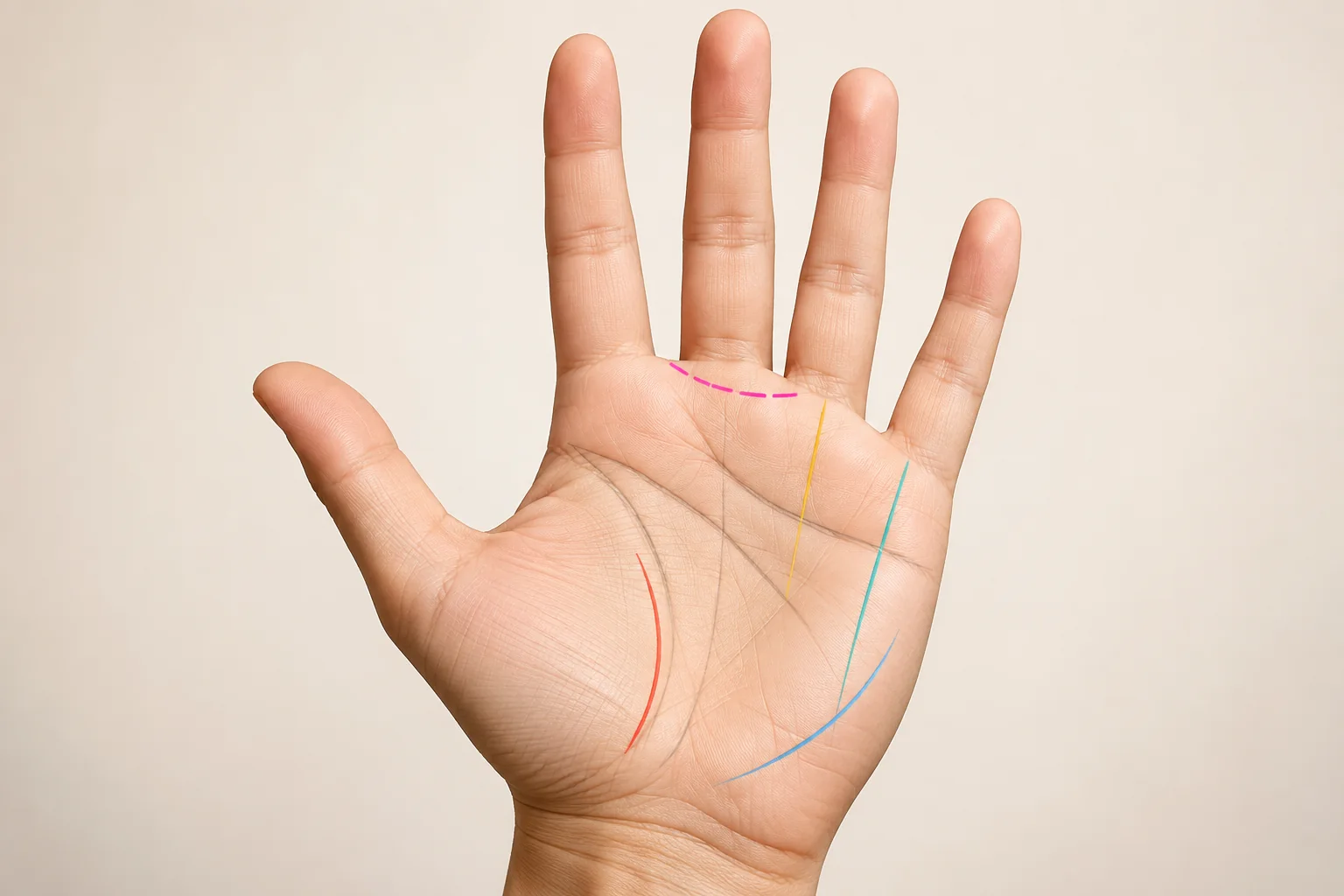
How to identify a true minor line
- Relax the hand and use soft, even light.
- Locate the three principal creases first.
- Follow a candidate line from start to finish.
- Check that it has a coherent path, not just two unrelated creases.
- Compare the other hand and a straight-on photograph.
Minor lines are usually finer than the major lines. A barely visible scratch, temporary skin fold, scar, or random intersection need not receive a name.
The main minor palm lines
- Sun or Apollo line: runs vertically toward the ring finger; traditionally associated with expression, recognition, satisfaction, or absorption in a craft.
- Mercury line: travels toward the little-finger mount; historically called the Health or Hepatica line, but it cannot assess health. Some schools instead emphasize communication and ideas.
- Girdle of Venus: a curved or segmented arc above the heart line; traditionally linked with heightened feeling, imagination, or sensory responsiveness.
- Mars line: a supporting line near and inside the life line; symbolically associated with reserve, courage, or reinforcement.
- Relationship lines: short horizontal lines on the outer edge below the little finger. They cannot count marriages, children, or separations.
How to read a minor line in context
Describe location, length, depth, continuity, and direction before meaning. Then ask how the line relates to a major line or mount. A Sun line that begins near the head line, for example, is traditionally discussed differently from one rising from the wrist, but neither start point supplies a reliable date or career outcome.
Use a three-level priority:
- Whole-hand observations and clear major lines.
- One or two definite minor lines.
- Small marks only if their shape and location are unambiguous.
Common minor-line mistakes
- Assuming everyone must have every named line.
- Calling normal fine creasing a broken line.
- Turning “Health line” into a diagnosis.
- Using the Mars line as a promise of protection.
- Using relationship lines to forecast marriage or divorce.
- Letting one small line contradict several clearer observations.
An absent minor line means only that the optional crease is not clearly present. It is not a missing quality or a bad omen.
How minor lines relate to anatomy
The life, head, and heart lines broadly correspond to principal flexion creases described in anatomy. Named minor lines do not form one universal set found on every hand. They are selected from secondary creasing, which varies substantially. Palmistry groups some visible paths and gives them symbolic names; anatomy does not assign them predictive meanings.
Should you read a line that appears on only one hand?
You can record it, but compare carefully. A modern active/passive convention might frame a line found only on the dominant hand as a developed or outward emphasis. That remains a palmistry convention. Hand use, asymmetry, scars, and visibility can also differ. Do not invent a developmental story without asking what the person has actually experienced.
A sample minor-line reading
Suppose a clear Sun line appears, the Mercury line is absent, and a short Mars line parallels the life line. A restrained synthesis might say: “Traditional palmistry emphasizes a private or creative outlet and a theme of reserve; there is no clear Mercury line to add.” It would be wrong to conclude that the person will become famous, lacks communication skill, or is protected from illness.
When to stop looking
If you have to rotate the image repeatedly, trace over compression artefacts, or connect widely separated scratches, the line is not clear enough to read. A shorter, honest reading is better than filling every empty area with a sign.
Study each clear line separately
Continue with the dedicated guides to the Sun line, Mercury line, Girdle of Venus, and Mars line.
Research and source note
The line list and top-to-bottom inspection order draw on modern palmistry practice. Anatomical context comes from the PMC review of palmar crease classification.
The bottom line
Minor lines are a second layer, not the foundation. Name only clear paths, accept absence as normal, and use each line as a modest symbolic prompt rather than evidence about health or fate.
A Full Palm Reading
See which minor lines actually matter in your palm
Your reading begins with the major structure, then maps the visible Sun, Mercury, Mars, relationship, travel, and influence lines where they add context to your question.
Your Full Palm Reading maps all the important features—hand shape, skin texture, thumb, fingers, mounts, major and minor lines, markings, and the differences between both palms—and brings them together in a holistic reading focused on your questions.