Palm reading for love and relationships
Combine the heart line, Venus mount, little finger, and relationship lines to read emotional and intimacy patterns.
Read your love pattern →
Divine Glows Guide
Learn how palmistry reads love, marriage, children, career, money, and future direction by combining the life, heart, head, fate, and minor lines.
Explore your question ↓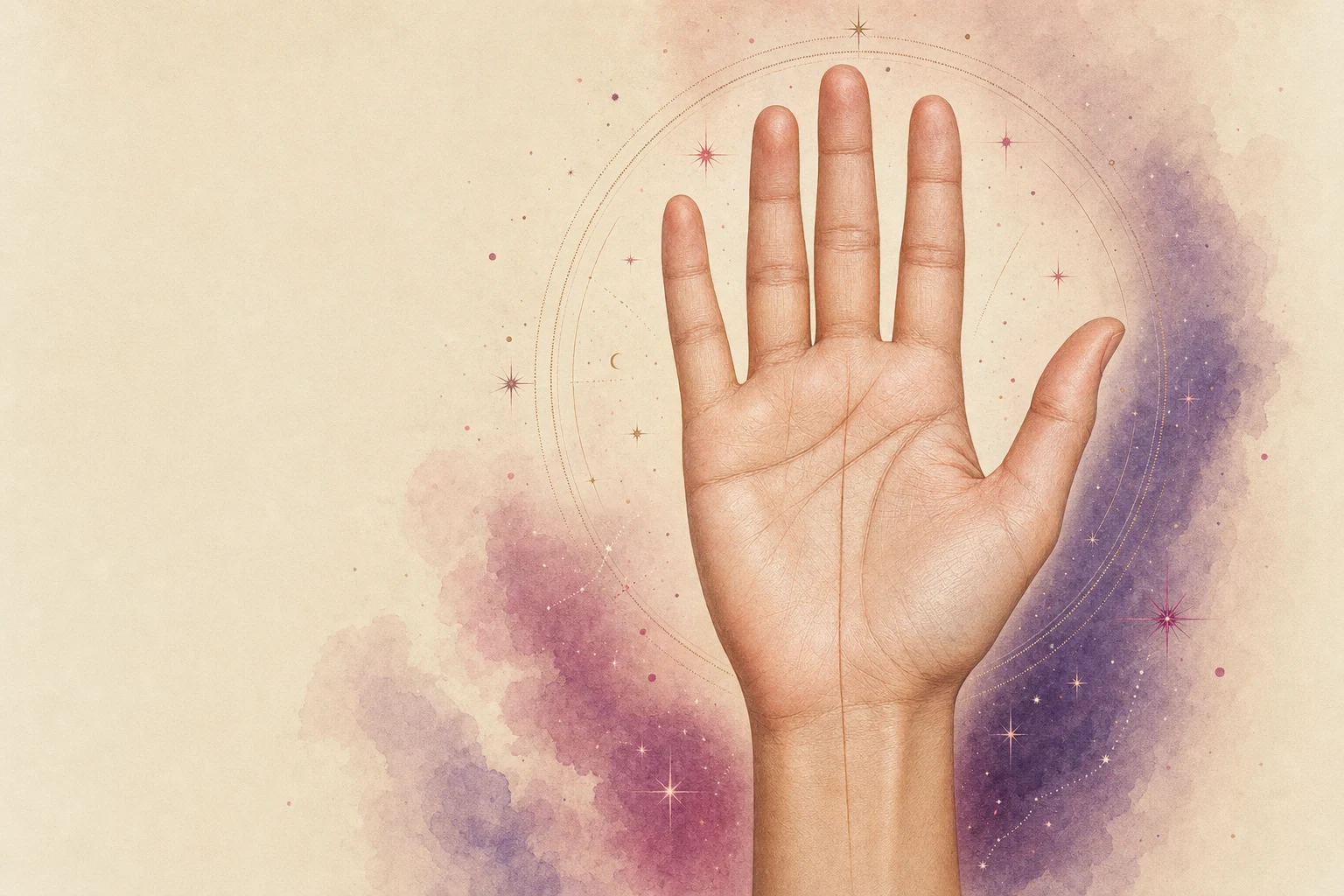
The foundation
Palm reading, also called palmistry or chiromancy, is a divination tradition that interprets the shape of the hand, the major creases, finer lines, mounts, fingers, and markings. Different schools connect these features with themes such as emotion, thought, vitality, direction, and change.
The hand features are real, but the predicted meanings are traditional and symbolic. Palmistry is not a scientifically validated way to determine personality, lifespan, health, fertility, marriage, or future events.
Treat a palm reading as a structured prompt for self-reflection. Avoid fear, certainty, diagnosis, and decisions that should involve qualified medical, legal, mental-health, or financial advice.
Historical palmistry manuals survive in major collections, including a late-medieval illustrated Chiromantia at the Library of Congress and early works held by the Wellcome Collection. The meanings have changed across time and cultures, which is one reason no single chart should be treated as universal.
Read by life question
Start with the outcome on your mind. Each guide shows the exact combination of lines, mounts, fingers, and hand views used for that reading.
Combine the heart line, Venus mount, little finger, and relationship lines to read emotional and intimacy patterns.
Read your love pattern →See how palmists place a relationship line in earlier, middle, or later adulthood and add wider relationship context.
Explore marriage timing →Find the fine vertical marks below the little finger and distinguish them from relationship lines and skin folds.
Find the children-line area →Combine the fate, Sun, Mercury, and head lines with the thumb instead of searching for one universal money line.
Read the money pattern →Trace where direction strengthens, branches, or changes across the fate, Sun, and head lines.
Explore future success signs →See how a full reading covers emotion, decisions, work, relationships, communication, and changing direction.
See the complete answer →Prepare both full palms and both side views so an online reading can identify the complete pattern.
Take clear palm photos →Verify stars, triangles, circles, Solomon rings, teacher squares, Samaritan lines, and other uncommon signs.
Identify a rare marking →A blind test you can run in an evening, what researchers found when they checked the life line, and how to hold palmistry's other claims.
Explore the guide →From uncertain beginnings to medieval manuals and the Victorian palm reader, plus what the history explains about why palmists disagree.
Explore the guide →The basic map
Start with location and direction. Interpret variations only after you can trace the main creases confidently.
Curves around the base of the thumb. Traditionally associated with energy, grounding, support, and major changes—not lifespan.
Explore the life line →Runs beneath the fingers across the upper palm. Traditionally read for emotional expression and relationship style.
Explore the heart line →Crosses the middle of the palm. Traditionally linked with attention and decision style, not intelligence or mental health.
Explore the head line →An optional vertical line toward the middle finger. Traditionally connected with direction, responsibility, and outside influence.
Explore the fate line →A simple process
Use the same sequence every time so one dramatic-looking mark does not control the interpretation.
Many modern readers use the dominant hand for current patterns and the other for background tendencies, but traditions differ.
Find the life, head, and heart lines first. Look for the fate line only after the three main creases are clear.
Compare depth, path, breaks, and branches. Present a possible theme and let lived experience remain the final authority.
Begin here
These beginner guides separate process, hand choice, and line-specific search intent.
Follow a seven-step process, learn the four-line map, combine clues, and avoid the most common beginner mistakes.
Read the beginner guide →Compare dominant-hand and traditional approaches, including why gender-based rules are not required.
Choose a consistent method →Understand long, short, deep, faint, broken, forked, chained, and doubled variations without lifespan myths.
Read the life-line guide →Explore traditional meanings for length, curve, ending point, forks, branches, and breaks without relationship predictions.
Read the heart-line guide →Learn how palmists discuss length, direction, a joined starting point, forks, and breaks without judging intelligence.
Read the head-line guide →See what an absent, faint, deep, interrupted, forked, or doubled fate line traditionally represents.
Read the fate-line guide →Observe thumb length, proportions, angle, and flexibility without treating anatomy as a personality test.
Study the thumb →Compare the traditional Jupiter, Saturn, Apollo, and Mercury finger themes with careful measurement.
Compare the fingers →Learn loops, whorls, arches, and tented arches while separating scientific classification from symbolism.
Explore fingerprint patterns →Find the small relationship lines and understand why they cannot count weddings or predict marriage age.
Read the relationship-line guide →Identify crosses, stars, islands, squares, forks, and bars without overreading random creases.
Identify palm markings →Classify elemental hand shapes by palm proportion and finger length while understanding the method’s limits.
Compare hand shapes →Locate the seven planetary regions and learn why palmistry schools disagree about their importance.
Explore the mounts →Observe fine, medium, grainy, and coarse textures without confusing symbolism with health or character.
Understand skin texture →Map the Sun, Mercury, Girdle of Venus, Mars, and relationship lines after the major creases.
Map the minor lines →Explore clear, faint, broken, forked, doubled, and missing forms without fame or wealth promises.
Read the Sun line →Learn the line’s traditional names and meanings—and why it cannot reveal organ function or illness.
Read the Mercury line →Identify the optional arc above the heart line and compare complete, broken, doubled, and absent forms.
Find the Girdle of Venus →Locate the supporting line near the life line without treating it as a supernatural shield.
Read the Mars line →Combine fate, head, Sun, Mercury, finger, and thumb themes without predicting jobs or income.
Explore career themes →Compare the fate line, head line, thumb, mounts, and both hands to weigh structure against independence.
Compare job and business signs →Combine the fate line, Jupiter, Saturn, Sun, head line, thumb, and both hands for public-service questions.
Read government-career signs →Distinguish breaks, shifted continuations, strengthening lines, and upward branches before applying broad age zones.
Read career turning-point signs →Locate Moon-mount travel lines, life-line branches, and fate-line connections that distinguish journeys from relocation.
Read travel and settlement signs →Combine the fate line, money triangle, Sun, Mars, and Venus influences to read funding, support, and broad timing.
Read property-purchase signs →Find the central formation, verify three connected sides, and compare closed, open, broken, small, and large triangles.
Verify your money triangle →Combine relationship lines, emotional style, Venus, Jupiter, communication, and fate influences to read partner and meeting themes.
Read future-spouse signs →Trace Moon and Venus influences, then combine the heart, relationship, Jupiter, and fate patterns to compare personal and family-led paths.
Compare marriage-path signs →Separate a later relationship line from starting forks, bars, islands, faintness, and the wider patterns that can slow commitment.
Read marriage-delay signs →Distinguish two significant bonds from forks, broken continuations, parallel support lines, and ordinary edge creases.
Compare second-marriage patterns →Compare ending forks, gaps, overlaps, bars, islands, and the signs that shift a reading toward repair or a different path.
Read separation and repair signs →Connect horizontal relationship lines with vertical children marks, timing, Venus, heart, fate, and both-hand family patterns.
Read marriage and family signs →Trace the life, head, heart, and fate lines that create the M, then compare clarity, balance, variations, and both hands.
Verify and read the M sign →Distinguish a complete single crease from partial joining, then read its height, depth, branches, markings, and both-hand pattern.
Identify and read a simian line →Locate the quadrangle, verify an independent two-stroke X, and compare its clarity, supporting signs, and both hands.
Verify and read a mystic cross →Find the curved arc beneath the index finger, separate it from ordinary folds, and read its variations and supporting signs.
Identify and read the Ring of Solomon →Verify the enclosed body and attached tail, separate common lookalikes, and read the sign through its location and direction.
Identify and read a fish sign →Confirm that three or more lines share one center, distinguish common lookalikes, and read the star through its mount or parent line.
Identify and read a star marking →Separate stable major-crease routes from changing visibility and fine lines, then compare matched photographs before interpreting a difference.
Verify and read a palm-line change →Use landmark crossings and proportional sections to estimate broad timing on the fate, life, Sun, heart, and relationship lines.
Learn the palmistry timing method →Combine fate-line shifts, life-line overlaps and branches, influence lines, destinations, and both hands into one turning-point pattern.
Read the major life-change signs →Combine hand shape, texture, thumb, fingers, mounts, lines, fingerprints, and both palms into a coherent personality profile.
Read the whole-hand personality guide →Verify the intuition line, Moon and head-line pattern, fingerprints, mystic cross, Ring of Solomon, and Mercury support.
Read the eight intuition signs →Verify fish, stars, tridents, triangles, squares, upward branches, Jupiter, Sun, and the supporting whole-hand pattern.
Read the ten lucky-sign patterns →Verify three closed sides, rule out open angles and ridge triradii, and read the triangle through its mount, parent line, timing, and both hands.
Identify and read a palm triangle →Verify four closed sides, identify what the enclosure contains, and read protection or organization through its mount, parent line, timing, and both hands.
Identify and read a palm square →Verify one stem and three shared-junction prongs, then read the parent line, each branch destination, timing, and both hands.
Identify and read a palm trident →Verify two strokes and four arms, identify every parent line, and read the exact mount, continuation, timing, and both hands.
Identify and read a palm cross →Verify a closed crease boundary, separate islands, ridge loops and spots, then read the exact line, mount, timing, and both hands.
Identify and read a palm circle →Separate skin pigment from crease symbols, map its center by mount and line proximity, and compare the complete pattern across both hands.
Map a mole's palmistry location →Use the life-line boundary to compare width, height, firmness, influence lines, markings, thumb support, and the pattern across both hands.
Read your Mount of Venus →Locate Luna below Upper Mars, then compare height, firmness, travel lines, head and fate connections, markings, and both hands.
Read your Mount of Moon →Compare development, firmness and apex, then add the index finger, thumb, rising lines, Ring of Solomon, markings, and both hands.
Read your Mount of Jupiter →Compare development, firmness and apex, then add the ring finger, Sun line, recognition themes, markings, and both hands.
Read your Mount of Apollo →Compare development, firmness and apex, then add the little finger, vertical lines, communication and applied-skill themes, markings, and both hands.
Read your Mount of Mercury →Compare development, firmness and apex, then add the middle finger, fate-line destination, responsibility, sustained focus, markings, and both hands.
Read your Mount of Saturn →Locate the wrist bands, then read their count, clarity, chains, breaks, arches, rising lines, major-line connections, and both hands.
Read your bracelet lines →Verify one parent line splitting around an enclosed space, then read the island by its line, position, size, continuation, combinations, and both hands.
Identify and read a palm-line island →Verify one parent line dividing into two endpoints, then read each prong's strength, direction, destination, timing, and supporting pattern.
Identify and read a forked line →Verify a true gap, then compare clean breaks, overlaps, shifted restarts, replacement routes, repair signs, timing, and both hands.
Identify and read a broken line →Separate linked island loops from grilles and fine texture, then read the chain's parent line, length, position, continuation, and both hands.
Identify and read a chained line →Trace upward, downward, and incoming offshoots by their parent line, destination mount, strength, timing, supporting pattern, and both hands.
Identify and read palm-line branches →Verify a true endpoint against a faint continuation, break, overlap, or support line, then interpret the complete pattern across both hands.
Understand a short life line →Verify true absence against faint, fragmented, late-starting, and displaced routes, then see which other features organize work and direction.
Understand an absent fate line →Verify a true sister or inner Mars line, then read its length, strength, timing, interruptions, support context, and appearance on both hands.
Understand a double life line →Verify two independent Saturn-bound routes, then compare their origins, destinations, strength, overlap, timing, dual-role themes, and both hands.
Understand two fate lines →Separate depth from width, clarity, color, and continuity, then compare changing line quality by subject and across both hands.
Compare deep and faint lines →Verify a true multi-cell lattice, distinguish similar markings, then read its mount, density, boundaries, connected lines, and both hands.
Understand a palm grille →Compare a shared point, brief or long join, narrow gap, and wide separation, then read decision style with supporting features and both hands.
Compare the line origins →Verify one shared parent and two endpoints, then read each prong by destination, strength, opening width, direction, timing, and both hands.
Read a forked heart line →Verify a true relationship-line fork, locate it at the outer start or inner end, then compare width, direction, timing, continuation, and both hands.
Read a relationship-line fork →Count only independent edge-origin lines, rank their depth and length, then compare spacing, condition, timing, and both hands.
Count relationship lines correctly →Verify a Moon-origin route that reaches Saturn, then read public contact, clients, imagination, travel, timing, destinations, and both hands.
Trace a Moon-origin fate line →Verify a true life-line junction, then read personal effort, family foundations, emergence timing, destinations, combinations, and both hands.
Trace a life-origin fate line →Verify a true stop, then read the decision boundary, broad timing, possible continuation, later routes, and both hands.
Read a head-line fate endpoint →Distinguish a true stop from a crossing or heart-line start, then read values, relationships, timing, later routes, and both hands.
Read a heart-line fate endpoint →Rule out a faint lower route, locate the true mid-palm start, then read later direction, line strength, timing, combinations, and both hands.
Read a late-starting fate line →Verify one terminal junction and two connected prongs, then read practical and imaginative destinations, relative strength, timing, and both hands.
Read a forked head line →Confirm the life line continues past each junction, then read direction, destination mount, strength, timing, support signs, and both hands.
Read life-line branches →Verify one outward branch while the life line continues, then compare its Moon endpoint, strength, timing, travel evidence, and both hands.
Read a Moon-bound life-line branch →Confirm one parent ends in two prongs, then compare Venus and Moon directions, fork width, relative strength, timing, and both hands.
Read a forked life line →Locate one true endpoint, then compare Jupiter, the space between the fingers, and Saturn with curve, quality, supporting features, and both hands.
Read your heart-line endpoint →Verify one descending parent route, then compare a gentle or deep slope with line quality, grounding, work and communication features, and both hands.
Read a Moon-directed head line →Verify an independent start above the bracelet, then trace the route through the head and heart levels, quality, destination, timing, and both hands.
Read a wrist-origin fate line →Confirm true absence below Apollo, then read talent, fulfillment, recognition, direction, communication, ambition, timing, and both hands.
Read an absent Sun line →Verify one Moon-to-Apollo route, then read audiences, clients, imagination, travel, line quality, timing, supporting features, and both hands.
Read a Moon-origin Sun line →Verify a true head-line junction, then read learned skill, planning, expression, upper-line quality, broad timing, support, and both hands.
Read a head-line-origin Sun line →Confirm a true upper-palm start, then read mature values, appreciation, creative satisfaction, line quality, broad timing, and both hands.
Read a heart-line-origin Sun line →Verify one life-line junction and Apollo route, then read personal effort, roots, family context, quality, timing, support, and both hands.
Read a life-line-origin Sun line →Confirm a Fate parent continuing to Saturn and one Apollo branch, then read career direction, visibility, quality, timing, and both hands.
Read a Fate-to-Sun branch →Verify two independent Apollo-bound lines, then compare origins, spacing, strength, duration, overlap, focus, and both hands.
Read two Sun lines →Prove a true empty gap, then compare the lower route, upper restart, timing, Fate support, Apollo condition, and both hands.
Read a broken Sun line →Verify a true empty gap, reject the lifespan myth, then compare the restart, support lines, timing, related features, and both hands.
Read a broken life line →Verify a true upper-palm gap, then compare its mount location, restart, timing, Head-line support, relationship features, and both hands.
Read a broken heart line →Verify a true central gap, then compare the upper restart, origin, destination, career context, broad timing, support signs, and both hands.
Read a broken Fate line →Verify a true middle-palm gap, then compare the restart toward Mars or Moon, supporting features, broad timing, and both hands.
Read a broken Head line →Verify one shared parent and two upper arms, then compare their destinations, balance, timing, supporting career signs, and both hands.
Read a forked Fate line →Verify one Apollo parent and two connected arms, then compare their destinations, balance, timing, supporting features, and both hands.
Read a forked Sun line →Compare a level parent with a sustained upward arc, then separate emotional expression from endpoint, length, quality, and both-hand differences.
Compare Heart-line paths →Measure the true parent route across the upper palm, then add endpoint, curve, quality, supporting features, and both-hand differences.
Read a long Heart line →Verify a genuine early endpoint, then exclude faint continuation and a broken restart before adding quality, supporting features, and both hands.
Read a short Heart line →Measure one parent across the middle palm, then separate mental range from intelligence and add direction, quality, supporting features, and both hands.
Read a long Head line →Verify a genuine early endpoint, then separate concentrated thinking from ability and add direction, quality, supporting features, and both hands.
Read a short Head line →Verify a level route toward Upper Mars, then add length, quality, starting geometry, supporting features, real decisions, and both hands.
Read a straight Head line →Verify several linked loops within the Heart-line parent, then add their location, clear sections, supporting features, relationship behavior, and both hands.
Read a chained Heart line →Verify several linked loops within the Head-line parent, then add direction, clear sections, supporting features, real decisions, and both hands.
Read a chained Head line →Verify one closed oval within the Head-line parent, then add position, line quality before and after, direction, timing, and both hands.
Read a Head-line island →Verify one closed oval within the Heart-line parent, then add its mount, continuation, relationship context, timing, and both hands.
Read a Heart-line island →Verify one closed oval within a Saturn-bound Fate line, then add Head and Heart landmarks, continuation, career context, and both hands.
Read a Fate-line island →Verify one closed oval within the Life-line arc, then add location, continuation, Mars support, lifestyle context, timing, and both hands.
Read a Life-line island →Verify one closed oval within a true relationship line, then add position, continuation, Heart-line context, timing, and both hands.
Read a relationship-line island →Verify several linked loops in the Life-line parent, then add the affected span, clear sections, Mars support, routines, timing, and both hands.
Read a chained Life line →Verify linked loops in one Saturn-bound Fate line, then add Head and Heart landmarks, continuation, supporting lines, real work, timing, and both hands.
Read a chained Fate line →Verify one closed oval in an Apollo-bound Sun line, then add location, continuation, Fate, audience, real work, timing, and both hands.
Read a Sun-line island →Verify linked loops in one Apollo-bound Sun line, then add the affected span, continuation, supporting lines, real output, timing, and both hands.
Read a chained Sun line →Verify linked loops in one Mercury-bound route, then add the affected span, clear sections, Head, business context, real habits, timing, and both hands.
Read a chained Mercury line →Verify one compact X touching the Life-line arc, then add arm origins, exact position, continuation, Mars support, real transitions, timing, and both hands.
Read a Life-line cross →Verify one compact X centered on the Head line, then add arm origins, mount position, line direction, continuation, real decisions, timing, and both hands.
Read a Head-line cross →Verify one compact X centered on the Heart line, then add mount position, continuation, Venus, Head, relationship context, real behavior, timing, and both hands.
Read a Heart-line cross →Verify one compact X centered on a Saturn-bound Fate line, then add position, continuation, Sun, Jupiter, Mercury, real work, timing, and both hands.
Read a Fate-line cross →Verify one compact X centered on an Apollo-bound Sun line, then add position, continuation, Fate, Mercury, Jupiter, real output, timing, and both hands.
Read a Sun-line cross →Verify one compact X centered on a Mercury-bound route, then add position, continuation, Head, Fate, Sun, real habits, timing, and both hands.
Read a Mercury-line cross →Verify at least three strokes sharing one center on a true relationship line, then add position, continuation, Heart, Venus, behavior, timing, and both hands.
Read a relationship-line star →Move from consent and whole-hand observations to major lines, minor lines, and balanced synthesis.
Use the complete checklist →Common questions
Compare both. Many modern palmists use the dominant hand for present patterns and the less-active hand for inherited tendencies or potential, but this is a convention rather than a scientific rule.
No. A palm crease cannot determine lifespan. Palmists may interpret the life line symbolically for energy or transitions, but it must not be used to predict illness or death.
A faint, partial, or absent fate line is normal. In palmistry it may be framed as flexibility or a path that changes over time; it does not mean you lack purpose or success.
No palm-reading method can guarantee those outcomes. Keep palmistry within entertainment and reflection, and use qualified professionals for medical, legal, financial, and mental-health decisions.
A Full Palm Reading maps all the important features—hand shape, skin texture, thumb, fingers, mounts, major and minor lines, markings, and the differences between both palms—and brings them together in a holistic reading focused on your questions.
Get your full palm reading