
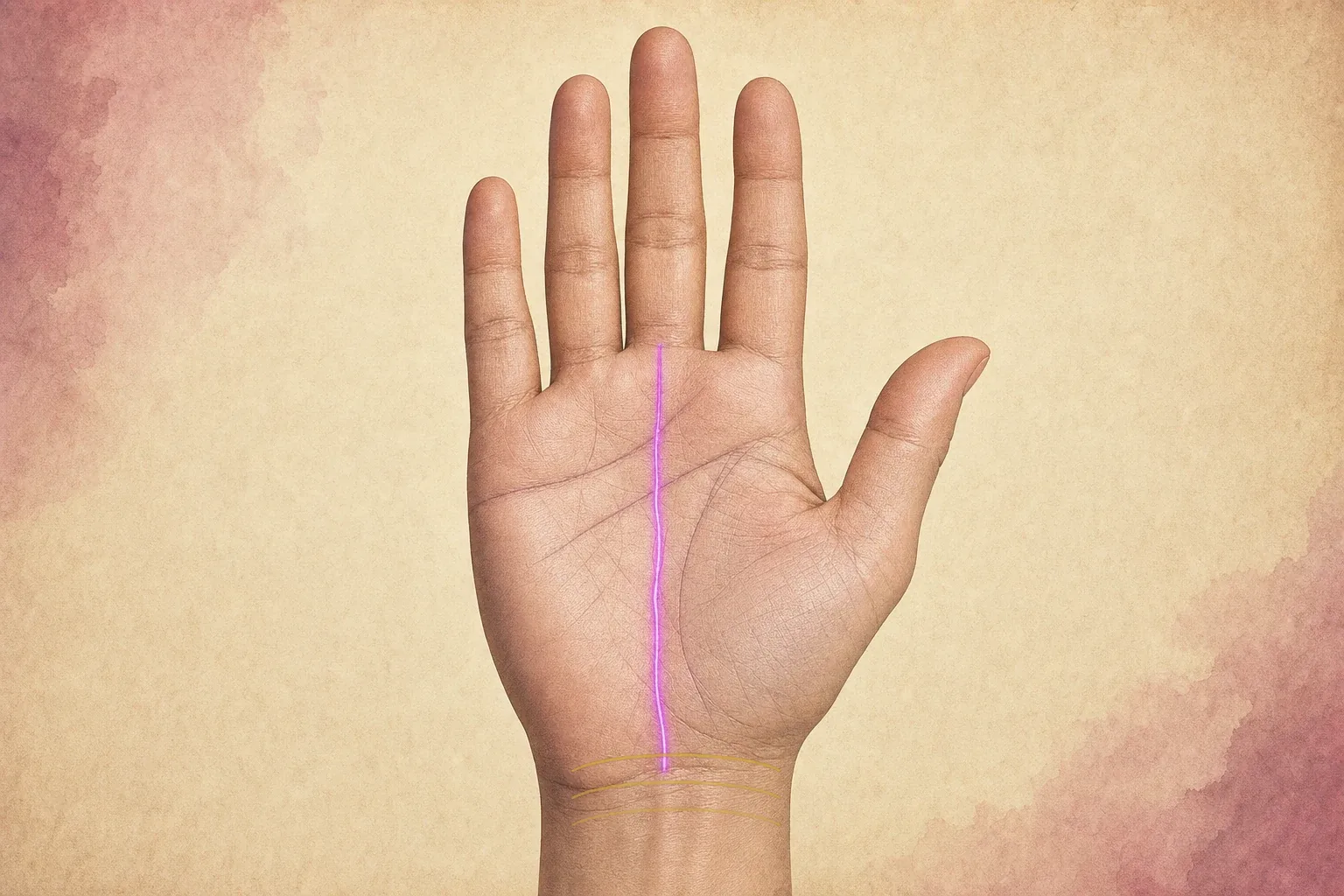
Bracelet lines are the horizontal or gently curved creases at the junction of the palm and wrist. They are also called wrist lines or rascettes. Most hands show one to three clearly visible bands, while a fourth may be faint or incomplete. Traditional palmistry reads their clarity, continuity, chains, breaks, arches, branches, and lines rising into the palm. Counting the bands alone gives a weak reading.
A bracelet-line reading becomes useful only after the wrist boundary, distinct bands, chains, breaks, arches, forks, rising routes, destination mounts, major-line connections, and both hands are compared. A whole-hand reading can show how the wrist foundation connects with work, travel, change, family, recognition, purpose, or direction.
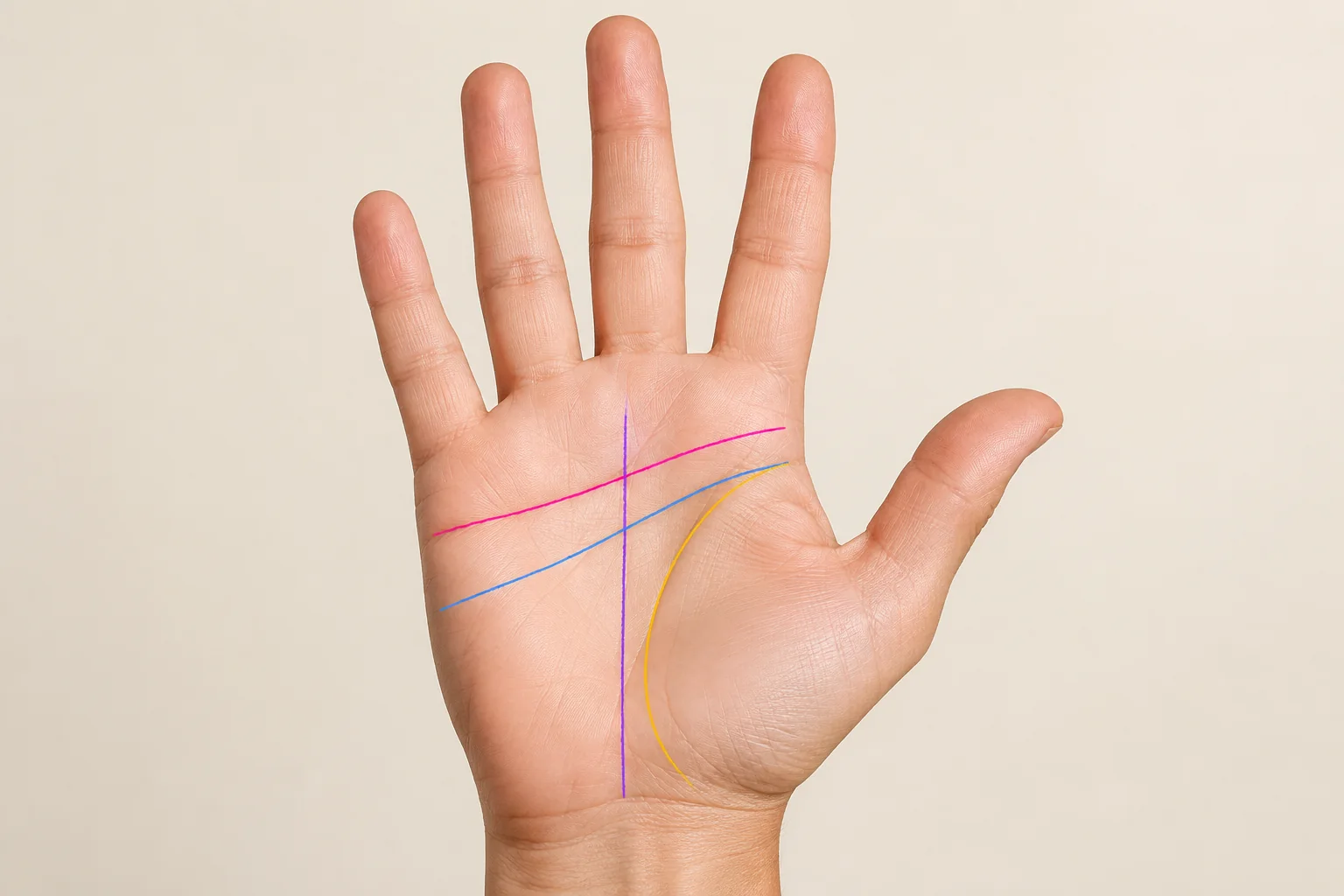
Use a six-part bracelet-line reading method: confirm the wrist boundary, count only distinct bands, inspect each line's form, trace rising branches, connect them with major lines and mounts, then compare both wrists under the same pose. Traditional claims that each bracelet equals a fixed number of life years should not be used to calculate lifespan or health.
Bracelet lines form the base of the palm pattern
The wrist bands show the condition of the palm's foundation in traditional reading. A fate, Sun, travel, or influence line rising from them is usually more informative than the number of bracelets because it connects the wrist with a visible route and destination.
Where are bracelet or rascette lines?
Relax the hand with the palm facing upward and the wrist straight. The first bracelet sits immediately below the heel of the palm. The second and third lie farther down the wrist toward the forearm. Do not confuse a bracelet with the lowest curve of the life line, a temporary pressure fold, a watch mark, or a tendon shadow.
| Feature | Location test | Common confusion |
|---|---|---|
| First bracelet | Crosses the wrist directly below the palm heel | Life-line ending above it |
| Second bracelet | Separate band below the first | A fold created by bending the wrist |
| Third bracelet | Distinct lower band nearer the forearm | Skin compression or a watch mark |
| Rising line | Begins on or between bracelets and travels upward | Short hairs, veins, scars, or surface texture |
| Break | Visible gap with continuation on the same route | A weak section hidden by glare |
This article owns bracelet-line intent. For routes inside the palm, use the minor-lines map and the relevant major-line guide.
What do one, two, three or four bracelet lines mean?
Count a line only when it forms a distinct horizontal band across a meaningful part of the wrist. Faint fragments that never align should not be promoted into extra bracelets. Traditional systems often assign progressively broader material, practical, and social themes to successive bands, but readers disagree on fixed labels. The whole pattern matters more than the ordinal number.
| Visible pattern | Traditional emphasis | What to check next |
|---|---|---|
| One strong bracelet | A clearly defined base with the upper wrist carrying most of the pattern | Rising lines and major-line starts |
| Two clear bracelets | Two layers of support or development are emphasized | Whether they stay parallel and unbroken |
| Three clear bracelets | A fuller traditional foundation pattern | Do not convert the count into lifespan |
| Faint fourth bracelet | An additional lower band, interpreted only if genuinely continuous | Separate it from forearm folds |
| Different counts on each hand | Possible development or visibility difference | Pose, pressure, lighting, and wrist flexion |
Do more wrist lines mean a longer life?
No reliable palm reading should calculate lifespan from bracelet count. Historical traditions sometimes assign a block of years to each band, but the lines vary with anatomy, wrist position, skin texture, and visibility. Use them as symbolic parts of the complete hand, not as a clock or medical measure.
Clear, chained, broken, arched and forked bracelet lines
Line quality changes the reading. Examine one bracelet at a time from thumb side to outer edge, then compare its continuation and neighboring bands.
| Form | How to verify it | Traditional reading | Next check |
|---|---|---|---|
| Clear and continuous | One visible band crosses without a true gap | Stable, concentrated foundation | Rising routes |
| Fine or faint | Route remains traceable under neutral light | Theme is quieter or less emphasized | Compare both hands |
| Chained | Repeated small linked loops form the band | Foundation develops through many adjustments | Skin texture and other chains |
| Broken | A genuine gap separates aligned segments | Interruption or change in the band's theme | Overlap and bridging lines |
| Arches upward | Band rises into the heel of the palm | Traditional writers give varied meanings; read cautiously | Venus, Moon, and life line |
| Forked ending | One bracelet divides into two branches | Foundation or direction separates into alternatives | Where each branch travels |
| Cross or grille | Independent strokes interrupt the band | Competing pressures or a concentrated junction | Verify every parent line |
A temporary crease from bending the wrist is usually shallow and changes when the hand straightens. A stable bracelet remains visible across several relaxed photographs. The same verification principle used for changes in palm lines applies here.
Lines rising from bracelet lines into the palm
Trace every rising line to its destination. The start at the wrist gives the foundation; the mount or major line it reaches gives the subject. A route ending below the middle finger belongs to the fate pattern, while one ending below the ring finger belongs to the Sun pattern.
| Destination | Traditional connection | Guide to add |
|---|---|---|
| Saturn below middle finger | Direction, responsibility, vocation, long-term work | Fate line |
| Apollo below ring finger | Expression, fulfillment, appreciation, recognition | Sun line |
| Mercury below little finger | Communication, applied skill, exchange | Mercury line and mount |
| Jupiter below index finger | Ambition, leadership, learning, advancement | Jupiter mount |
| Moon on lower outer palm | Travel, environment, imagination, public influence | Travel and relocation |
| Life line or Venus | Personal effort, family influence, support, or change | Life line and Venus mount |
Do not name a short vertical fragment before following it through the palm. A fate line may begin from the first bracelet, between two bracelets, or above the wrist entirely. The meaning comes from the complete route, not from touching a rascette.
How bracelet lines connect with major-line questions
| Question | Bracelet clue | Whole-hand context |
|---|---|---|
| Career direction | Clear rising route toward Saturn | Fate line, head line, Saturn, timing |
| Recognition | Rising route toward Apollo | Sun line, Apollo, fate line |
| Travel or relocation | Outer-wrist branch toward Moon | Travel lines, life-line fork, fate influences |
| Family influence | Branch entering Venus or life line | Venus texture, influence lines, both hands |
| Major change | Break, fork, or new rising line | Destination, continuation, and several timing clues |
If a rising route is used for timing, compare several landmarks rather than treating the wrist as an exact birth date. The palmistry timing guide explains proportional windows and their limits.
Compare bracelet lines on both wrists
Photograph both wrists straight, relaxed, and at the same distance. Flexion can create or hide bands. Traditional readers often use the less-active hand for the underlying pattern and the active hand for qualities expressed through use. A clearer rising line on the active hand may be read as developed direction, but only after pose and visibility differences are excluded.
| Two-hand pattern | Traditional interpretation | Verify first |
|---|---|---|
| Similar bands on both | Stable foundation pattern | Equal wrist angle |
| Clearer active-hand bracelet | Theme appears more defined through use | Pressure and skin condition |
| New active rising line | Direction or outlet may have developed | Full destination and older photos |
| Different apparent count | Possible visibility or development difference | Temporary folds and lighting |
| Break on one hand only | More changeable expression on that hand | True gap and bridging line |
Worked bracelet-line combinations
Three clear bands with a fate line from the first
The bracelets form a defined base and the rising route connects it with sustained direction. Saturn, the head line, and fate-line continuation show how responsibility develops.
Chained first bracelet, clearer second
The upper foundation looks complex while the lower band is more stable. Read the transition rather than calling the entire wrist weak.
First bracelet breaks, then overlaps
The overlap preserves continuity through a change. A branch rising from the overlap shows where the new emphasis moves.
Outer branch rises toward Moon
The wrist connects with environment, movement, public contact, or travel themes. Life-line branches and the fate line distinguish a journey from a larger relocation pattern.
Different counts in two photographs
If one wrist was bent, the difference is not yet readable. Retake matched images before applying any symbolic interpretation.
Photo checklist for bracelet lines
- Photograph both palms from fingertips through at least five centimeters of forearm.
- Keep both wrists straight and relaxed.
- Use soft neutral light plus one gentle side-light image.
- Take a close-up centered on the palm-wrist junction.
- Remove watches and bracelets before photographing.
- Trace rising lines to their destinations without drawing on the image.
- State hand dominance and the work, travel, change, family, or direction question.
Read the wrist inside the complete hand
Map each bracelet's position, clarity, continuity, chains, breaks, forks, and rising lines, then add the life, fate, Sun, and head lines, mounts, hand shape, timing, and both palms. This shows how the wrist foundation connects with the question you are asking.
The complete answer
Bracelet lines, wrist lines, or rascettes are the horizontal bands at the base of the palm. Traditional palmistry reads their clarity, continuity, chains, breaks, arches, forks, and rising branches. One to three distinct bands are common, while a fourth may be faint; the count should not be converted into lifespan or health predictions. A clear bracelet suggests a defined foundation, a chained line adds repeated adjustments, a genuine break adds change, and a rising route gains meaning from the line or mount it reaches. A Full Palm Reading maps bracelet lines and all other important features across both hands and combines them into a holistic reading focused on your questions about work, travel, change, family, recognition, purpose, and direction.
A Full Palm Reading
Ask what your bracelet lines mean across the complete hand
Your reading maps each wrist band's position, clarity, continuity, chains, breaks, arches, forks, and rising lines, then adds the life, fate, Sun, and head lines, destination mounts, hand shape, timing, and both palms into one holistic reading focused on your questions about work, travel, change, family, recognition, purpose, and direction.
Your Full Palm Reading maps all the important features—hand shape, skin texture, thumb, fingers, mounts, major and minor lines, markings, and the differences between both palms—and brings them together in a holistic reading focused on your questions.