
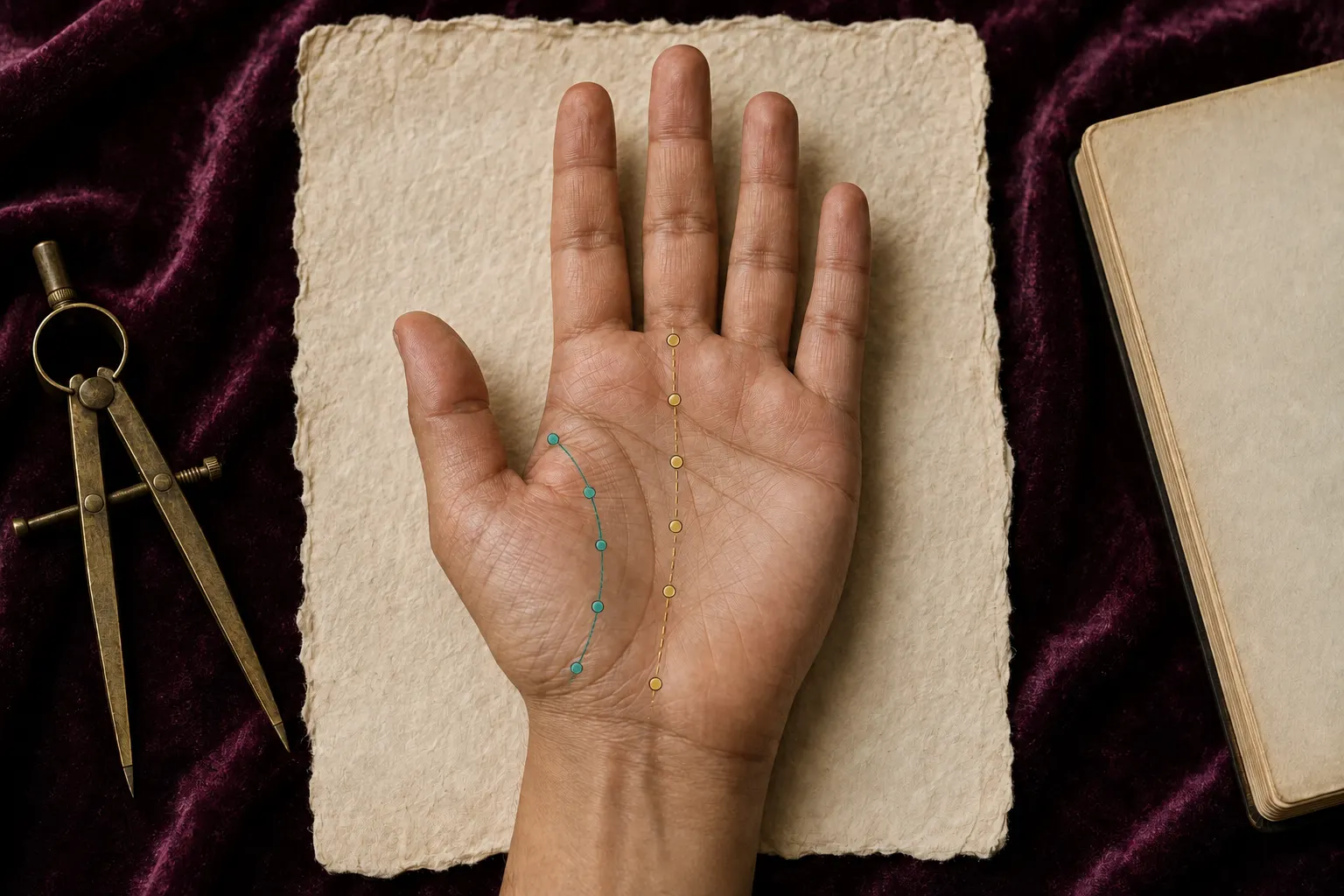
Palmistry age calculation places a line event within a broad life period; it does not produce a reliable exact age from one mark. Palmists first identify the correct line and its direction, then use landmark crossings or proportional sections to estimate where the mark sits. The fate line has the clearest common anchors: its crossing with the head line is often placed around ages 35–40, and its crossing with the heart line around 55–60. Other lines are divided more approximately.
A branch, break, start, or ending can be placed only after the line, direction, landmark crossings, and proportional position are clear. A whole-hand reading can compare several timing clues across both palms around the life question you want to explore.
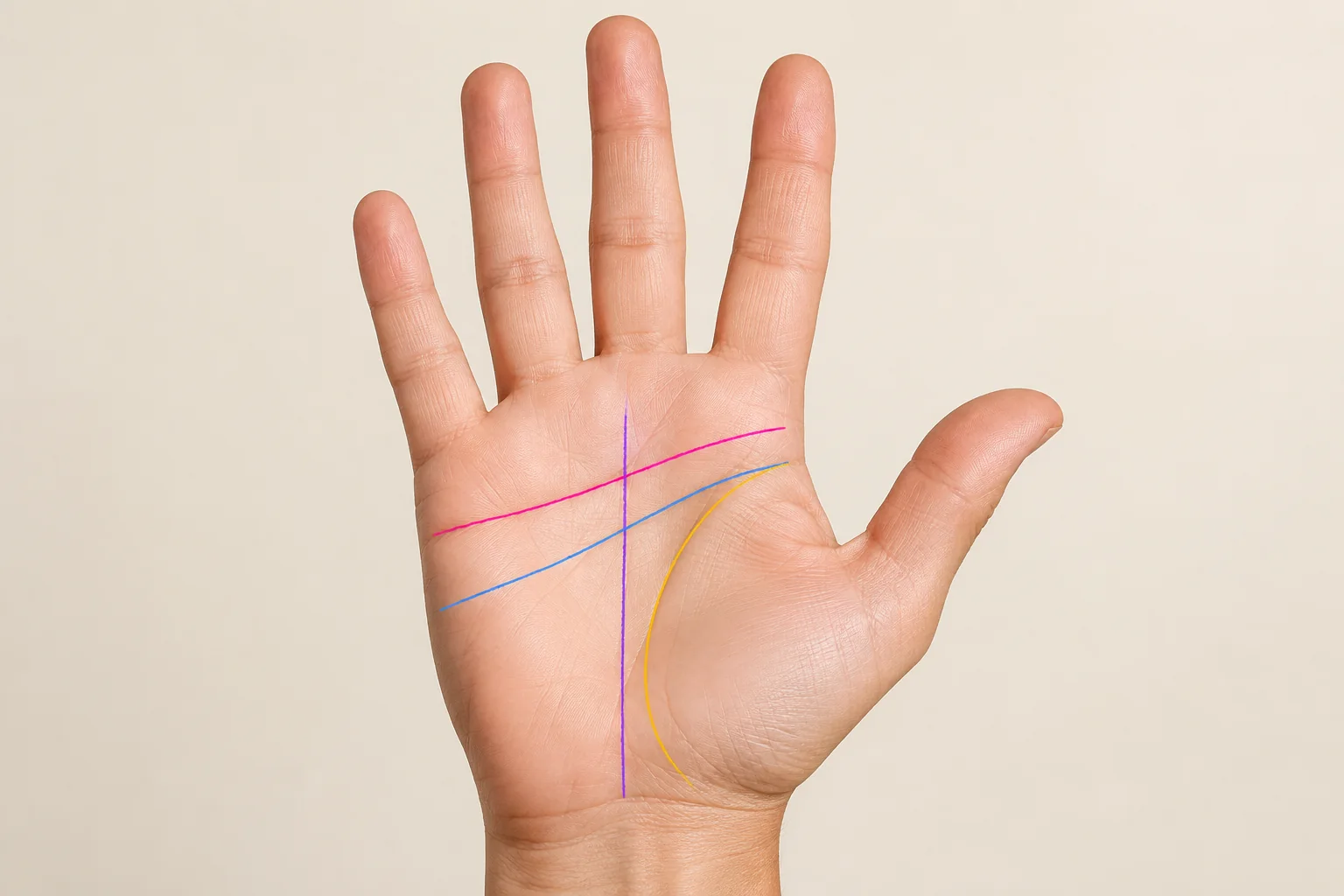
A useful timing answer is therefore a window such as “late thirties,” not “age 37 years and four months.” The estimate becomes stronger when a branch, break, start, or change appears in a similar period on another line and makes sense beside the question being asked. A date read from a ruler alone ignores line curvature, hand proportions, different timing systems, and the fact that fine lines may change in visibility.
| Line or area | Direction normally timed | Best anchors | Useful precision |
|---|---|---|---|
| Fate line | Wrist upward toward Saturn | Head-line and heart-line crossings | Broad age range |
| Life line | Origin between thumb and index downward around Venus | Whole arc divided proportionally | Decade or life-stage zone |
| Sun line | Lower palm upward toward the ring finger | Head and heart crossings when present | Broad period of recognition or expression |
| Heart line | Outer edge below little finger toward index side | Proportional sections and branches | Earlier, middle, or later emotional chapter |
| Relationship zone | From heart line upward toward little-finger base | Lower, middle, and upper thirds | Earlier, middle, or later adulthood |
The eight-step palmistry timing method
Use the same sequence for any timing line. It prevents a dark spot, photograph shadow, or approximate scale from becoming an unsupported date.
- Identify the line. Trace its complete route before naming it. A central vertical line may be fate, Sun, Mercury, an influence line, or a short fragment.
- Confirm the direction. Fate and Sun lines are usually timed from the lower palm upward; the life line runs from its upper origin down around Venus; the heart line runs from the little-finger edge across the upper palm.
- Name the feature to be timed. Mark the exact start, branch, break, overlap, island, join, strengthening point, fading point, or endpoint.
- Find fixed landmarks. Use major-line crossings, the wrist, line origin, endpoint, or the boundaries of the relationship zone.
- Measure along the route. Judge distance along a curved line rather than drawing a straight shortcut between its beginning and end.
- Convert position into a broad window. Use years only as a guide, then round to a range that reflects the uncertainty of the method.
- Calibrate with a known event. If a clearly remembered change matches a nearby shift, use it as a local reference while keeping the rest approximate.
- Cross-check the whole hand. Look for another line, mount, branch, or opposite-hand feature that repeats the same period and subject.
Why measuring along the line matters
A life line is an arc. Measuring directly from its start to its end with a straight ruler shortens the route and moves every proposed age. Follow the visible curve with a flexible thread, a series of small equal steps, or a photograph annotation. On a fate or Sun line, measure each segment between reliable intersections separately when the route shifts.
How to turn a position into a window
Suppose a fate-line branch lies roughly halfway between the wrist and head-line crossing. If that crossing is treated as the late-thirties anchor, the branch belongs broadly to the late teens or twenties rather than one certain birthday. Hand shape, the exact starting point, and the chosen school can move the estimate, so widen the range instead of adding false precision.
Use timing as a coordinate, not a verdict
The age estimate says where a feature sits in the traditional sequence. Its subject still comes from the parent line, the branch destination, the continuation after the mark, nearby mounts, supporting lines, and the question being explored. Use the palm-mount map to name the destination before assigning meaning.
How to calculate age on the fate line
The fate line offers the most usable timing map because it commonly crosses two other major lines. Trace it upward from the lower palm toward the Saturn area below the middle finger. A line beginning mid-palm does not need to be extended invisibly to the wrist; record the actual start and place it within the map.
| Fate-line position | Traditional timing zone | How to read a change there |
|---|---|---|
| At or just above the wrist | Childhood and earliest years | Background direction, family setting, or an early-established route |
| Lower palm before the head line | Teens through early or middle adulthood | Education, first work direction, independence, or early outside influence |
| At the head-line crossing | Approximately 35–40 | A decision, mental redirection, skill change, or responsibility shift |
| Between head and heart lines | Approximately forties to mid-fifties | Development, consolidation, a second path, or changed priorities |
| At the heart-line crossing | Approximately 55–60 | Emotional, family, relationship, or values-based influence on direction |
| Above the heart line | Later life | Continuing purpose, recognition, responsibility, or a later chapter |
Interpolating between fate-line anchors
If a mark lies one quarter of the route from the head-line crossing toward the heart-line crossing, place it in the early-to-mid forties. If it lies three quarters of that segment upward, place it closer to the early fifties. Use the actual segment length on that hand. A slanted, broken, doubled, or shifted fate line should be followed through its continuation rather than measured as one imaginary straight line.
What if the fate line starts late?
A fate line that becomes visible near the head line is traditionally read as direction becoming clearer around that timing zone. It does not mean nothing happened before then. Earlier years may have been flexible, privately directed, centered on study or family, or shown by another faint segment. The career-change timing guide explains how to distinguish a start, break, overlap, branch, and shifted continuation.
How to calculate age on the life line
The life line begins between the thumb and index finger and curves around the Venus mount toward the wrist. Traditional timing divides that full curve into equal proportional sections. Because there is no universally accepted anatomical year scale, use decades or broad stages and never use line length to calculate lifespan.
| Life-line section | Broad life stage | Features commonly timed |
|---|---|---|
| Upper origin and first curve | Childhood through early adulthood | Joined or separated start, early influence lines, initial branches |
| Upper-middle arc | Early adult development | Rising branches, support lines, local weakening, new direction |
| Middle arc beside Venus | Middle adult chapter | Overlaps, islands, influence joins, inward or outward branches |
| Lower-middle arc | Later adult development | Changes in environment, responsibility, family, travel, or priorities |
| Lower arc and ending | Later-life themes | Forks toward Moon, continued support, fading, or multiple endings |
A practical decade method
Trace the complete life-line arc and divide it into ten equal route sections. Treat each section as roughly a decade only when the line is long enough to support that convention. The first tenth does not automatically equal age ten on every hand: use the division as a relative map, check a known event, and report a range. If the line ends high or continues into the wrist, avoid stretching the same scale to force a conclusion.
What a timed life-line mark means
Timing locates the period; geometry gives the meaning. A rising branch may emphasize effort, progress, or movement toward its receiving mount. An outward branch toward Moon can add travel, relocation, or a pull beyond the familiar. A break with overlap differs from a clean termination because the second segment preserves continuity. The line does not diagnose illness or forecast death.
Timing the Sun, heart, head, and relationship lines
These maps are useful when their line routes are clear, but they have fewer shared anchors and greater variation between palmistry systems. Keep the timing broad and say which method you used.
| Feature | Timing method | What the period may describe | Common error |
|---|---|---|---|
| Sun line | Lower palm upward; use head and heart crossings when present | Visibility, creative expression, fulfillment, reputation, or recognition | Calling every start a guaranteed fame date |
| Heart line | Outer edge toward index side in broad proportional sections | Changes in emotional expression, attachment, standards, or communication | Converting one branch into a marriage date |
| Head line | Origin outward toward its ending in broad sections | Education, thinking style, decisions, focus, or a mental redirection | Using line length as a measure of intelligence |
| Relationship-line zone | Lower third near heart line to upper third near little-finger base | Earlier, middle, or later significant relationship chapters | Assigning exact ages from a tiny edge distance |
Sun-line age calculation
Read the Sun line upward toward the ring finger. When it crosses the head and heart lines, those intersections can borrow the fate line's approximate late-thirties and late-fifties anchors. A Sun line beginning above the head line can suggest that visibility, creative satisfaction, or public expression becomes more prominent after that zone. Check the fate line to see whether the period is supported by a change in direction or responsibility.
Heart-line timing
The heart line is often timed from the outer edge below the little finger across toward Jupiter. Because schools reverse or subdivide this route differently, state the direction and use early, middle, and later chapters. A branch receives its subject from its direction: toward Jupiter can emphasize ideals, while a fine downward branch may show emotional energy drawn toward the head-line area.
Relationship-line timing
For the short horizontal lines on the edge below the little finger, use the heart line as the lower boundary and the little-finger base as the upper boundary. The lower third is read as earlier adulthood, the middle third as mid-adulthood, and the upper third as later. The full marriage timing method combines this zone with line depth, branches, both hands, and the wider relationship pattern; this master guide should not replace that outcome-specific reading.
Which marks can be timed on a palm line?
Time a clearly defined change in the line, not an isolated speck or skin texture. First verify the formation using the markings guide.
| Timed feature | Question it answers | What to inspect next |
|---|---|---|
| Line begins | When does this theme become visibly organized? | Its source, early depth, and supporting line |
| Line becomes clearer | When does the theme gain focus or consistency? | Whether the route remains clean above the point |
| Upward branch | When does a new direction or opportunity emerge? | The mount or line receiving the branch |
| Join or influence line | When may another person, place, or responsibility enter the pattern? | Source, direction, and the parent line after contact |
| Break with overlap | When does one route transition into another? | Gap size, overlap, alignment, and continuation |
| Island or chained section | When is a theme divided, diffuse, or prolonged? | Length of the section and line quality afterward |
| Line fades or ends | When does the visible emphasis reduce or change form? | A replacement line, branch, or new destination |
Timing a branch
Place the age at the point where the branch leaves its parent line, then trace the branch to its destination. A fate-line branch toward Jupiter may be read through ambition, leadership, or advancement; one toward Sun through visibility or creative fulfillment; one toward Mercury through communication, trade, or specialist skill. Timing without destination gives only half the answer.
Timing a break
Use the end of the first segment for the transition's opening and the start of the continuation for its next phase. If the segments overlap, the change may begin before the earlier route fully closes. If the continuation shifts toward another mount, that destination describes the new emphasis. Check whether the same period appears as a life-line branch or Sun-line start.
How both hands refine a timing estimate
The two-hand reading convention compares the less-active hand as an underlying pattern with the active hand as its present development and expression. Measure the same feature independently on each palm; do not copy an age across because the lines look similar.
| Two-hand pattern | Traditional interpretation | Timing response |
|---|---|---|
| Same change in a similar zone | The theme is repeated in background and present expression | Use the overlapping broad window |
| Active-hand feature appears later | The quality may take longer to become consciously developed | Describe the shift rather than choosing one exact age |
| Active-hand route is clearer | Current effort or circumstances may strengthen the theme | Time the point at which clarity begins on that hand |
| Only less-active hand carries the mark | A potential or background pattern may be less visible in current action | Look for a related active-hand feature before forecasting |
| Hands show different destinations | The original direction and present path may have diverged | Time and interpret each route separately |
Lines may also look different over time. Before interpreting a newly visible branch or shifted continuation, repeat photographs under matched light and pose using the palm-line change checklist. A feature that exists only in one processed photograph is not ready for timing.
Worked palmistry age-calculation examples
Example 1: a fate-line branch before the head line
A clear branch leaves the fate line about three quarters of the way from the wrist to the head-line crossing and rises toward Jupiter. The estimate belongs broadly to the late twenties or early thirties. The Jupiter destination adds ambition, leadership, study, or advancement; a strong thumb and supporting Sun line can show how the change is expressed.
Example 2: a shifted fate line at the head-line crossing
The lower fate line ends at the head line while a second segment begins slightly beside it and continues upward. The late-thirties anchor places the transition around a major decision period. Overlap suggests continuity; the new segment's destination distinguishes promotion, a changed employer, self-directed work, or another path.
Example 3: the Sun line begins above the head line
No Sun line is visible below the head line, but a clean segment rises from just above it to Apollo. Traditional timing places the stronger visibility or creative-fulfillment theme after the late-thirties zone. It does not guarantee fame; line clarity, fate-line support, the ring finger, and the person's actual work question determine its practical meaning.
Example 4: an outward life-line branch in the lower-middle arc
A branch leaves the life line in the lower-middle section and travels toward the Moon mount. A proportional division places it in a later adult chapter. Moon adds distance, travel, relocation, imagination, or a wider environment. Fate-line influence from Moon and travel markings would strengthen a relocation reading.
Example 5: a heart-line branch in the middle section
A fine branch rises from the central heart line toward Saturn. The broad heart-line method places it in a middle emotional chapter, while Saturn adds seriousness, duty, or reserve. Relationship lines, Venus, the little finger, and the opposite hand show whether it belongs to commitment, standards, communication, or an internal shift.
Example 6: a relationship line in the middle third
One clear edge line sits near the center between the heart line and little-finger base. It is read as a significant relationship chapter in mid-adulthood. Its depth and continuation matter more than a millimeter-based age, and marriage, partnership, and formal commitment remain separate questions.
Common palmistry timing mistakes
- Giving an exact age without naming the line, direction, scale, and landmark.
- Measuring a curved life line with a straight shortcut.
- Extending a missing fate or Sun segment as though it were visible.
- Using the fate-line scale unchanged on every other line.
- Timing a shadow, scar, fold, or chance crossing before verifying it.
- Reading a branch without tracing its destination.
- Treating the life line as a lifespan scale.
- Turning a relationship-zone estimate into a guaranteed marriage date.
- Ignoring the continuation above a break or join.
- Choosing one hand without comparing the corresponding period on the other.
Photo checklist for timing palm lines
- Photograph both full palms from fingertips through wrists.
- Keep each hand relaxed, flat, and parallel to the camera.
- Use bright indirect light plus one gentle side-lit image.
- Include the complete start and endpoint of every line being timed.
- Add close-ups of the exact branch, break, join, island, or relationship-line zone.
- Do not crop out the head or heart line when timing a fate or Sun line.
- Keep images in color and avoid filters, tracing, sharpening, or contrast edits.
- Use the same angle and scale for the matching area on both hands.
- State hand dominance, current age, known timing anchors, and the question you want explored.
Questions that make a timing reading useful
- Which exact line and feature are you trying to time?
- Where does the line begin, travel, cross other lines, and end?
- Which direction and timing system are being used?
- What are the nearest reliable landmark crossings?
- Is the mark a start, branch, break, overlap, join, island, strengthening point, or endpoint?
- Where does the branch or continuation go?
- Does a known past event help calibrate the local scale?
- Does another line repeat the period and the same subject?
- What appears in the corresponding zone on the other hand?
- Is your real question about career, marriage, family, money, travel, recognition, purpose, or another change?
Read the date through the complete pattern
Start with the major-line map, place the feature between real landmarks, use a broad range, then connect its parent line and destination with the mounts, fingers, thumb, supporting signs, and both palms. The complete reading checklist keeps that wider sequence consistent.
The complete answer
Palmistry age calculation works by placing a verified start, branch, break, join, island, strengthening point, or ending within a line's traditional time sequence. On the fate line, the head-line crossing is commonly placed around ages 35–40 and the heart-line crossing around 55–60; positions between them are estimated proportionally. The life line is divided along its curved route into broad stages or decade sections, while Sun, heart, head, and relationship lines use crossings or proportional zones with less precision. A sound estimate names the scale, measures along the line, calibrates with a known event when possible, gives a broad window, traces the feature's destination and continuation, and compares both hands. A Full Palm Reading maps all these important features across both hands and combines them into a holistic reading focused on the person's questions about career, marriage, family, money, travel, recognition, purpose, and life changes.
A Full Palm Reading
Ask where your question sits across the complete hand
Your reading places starts, branches, breaks, joins, and endings between real timing landmarks on the fate, life, Sun, heart, and relationship lines, then adds their destinations, mounts, fingers, thumb, supporting signs, and both palms to explore career, marriage, family, money, travel, recognition, purpose, and life changes.
Your Full Palm Reading maps all the important features—hand shape, skin texture, thumb, fingers, mounts, major and minor lines, markings, and the differences between both palms—and brings them together in a holistic reading focused on your questions.