
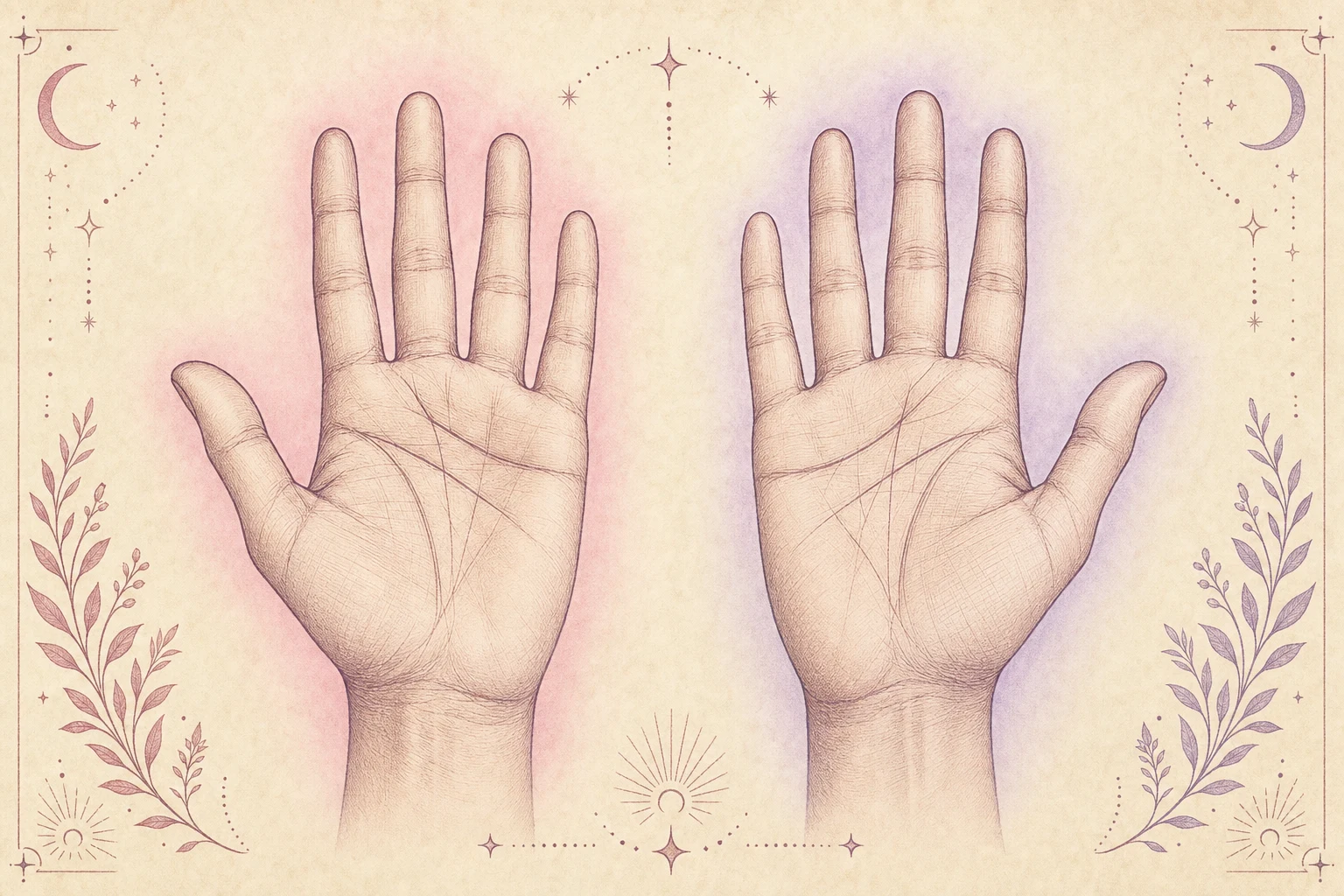
The short answer: look at both hands. A widely used modern convention reads the dominant or most-active hand for present habits and developed choices, while the less-active hand represents inherited tendencies, potential, or earlier patterns. Palmistry has many schools, however, and there is no scientifically validated rule that makes one hand predictive.
The line that draws your attention often arrives with a real question beneath it—about love, purpose, work, or the next turning point. Let the pattern invite a deeper conversation with yourself.
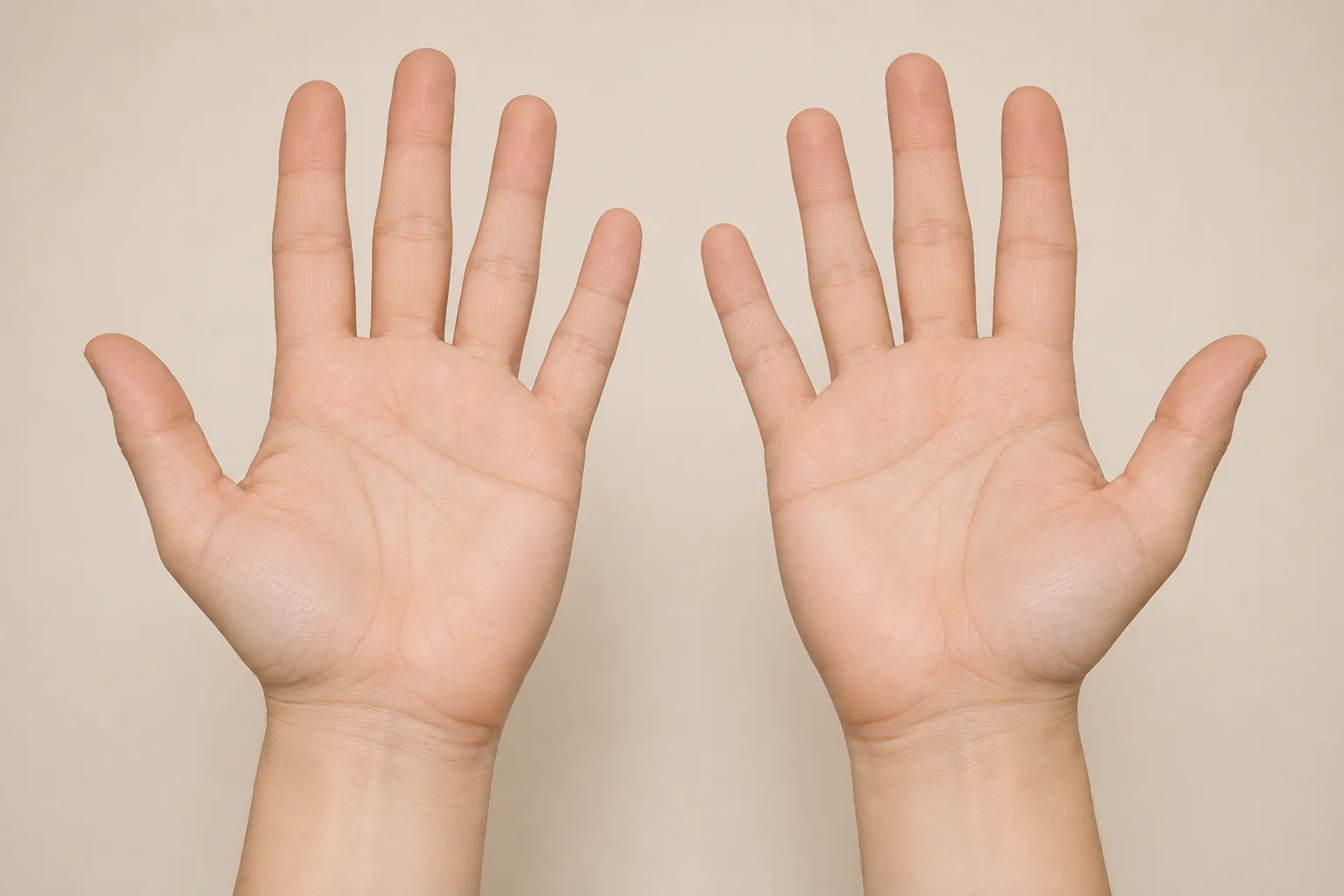
If you are reading for reflection, comparing both hands is more useful than choosing one based only on sex or a rigid left-versus-right rule. The comparison gives you more observations and makes changes in line depth, direction, and emphasis easier to discuss.
Three common ways palmists choose a hand
Dominant hand as the active hand
This method asks which hand a person writes, throws, or performs precise tasks with most often. The dominant hand is interpreted as the life being actively shaped; the other is read as background tendencies. For a left-handed person, the left palm is the active hand under this system.
Right hand as present, left hand as potential
Some Western guides assign the right palm to conscious or outward life and the left to receptive or inner potential. This is easy to remember but can ignore left-handedness and cultural differences. Use it only as an explicitly stated convention.
Traditional gender-based rules
Some traditions prescribe one hand for men and another for women, or change the chosen hand by age or marital status. These rules differ across authors and eras. They should not be presented as anatomy or universal truth, and a modern reader does not need them to compare two palms.
How to compare the two palms
- Place both hands in the same relaxed position and light.
- Locate the life, head, and heart lines on each palm.
- Compare direction and continuity before focusing on tiny marks.
- Note which features are shared and which are more pronounced on one side.
- Describe differences with neutral language rather than “good” and “bad.”
Suppose the head line is fine on the less-active palm and deeper on the active palm. A palmist might frame that symbolically as a capacity for focus that became more practiced. That is a reflective story, not evidence that the crease recorded a psychological change.
What if you use different hands for different tasks?
Many people are cross-dominant or ambidextrous. Ask which hand handles fine motor tasks and which feels most natural, then record the choice. You can also call them “more active” and “less active” instead of forcing a dominant label. The important thing is to use the same method throughout the reading.
Does palm reading use a different hand for men and women?
It does not have to. Search suggestions often ask which hand to read “for male” or “for female,” but sex does not turn one palm into a more reliable record of destiny. Gender-based hand rules are traditional conventions, not scientific findings. Reading both hands avoids the assumption and includes people who do not fit a binary rule.
Choose a method, explain it, and compare both palms. Consistency is more useful than claiming that one tradition has the only correct hand.
Do palm lines change?
The main palmar creases form before birth and serve anatomical functions, while fine creases, skin texture, injuries, and visibility can change. A difference between hands should not automatically be treated as a record of fate. Lighting, hand tension, dryness, and image quality can also make a line seem stronger or weaker.
Which hand should you photograph for an online reading?
Photograph both palms if the service allows it. Use indirect daylight, hold the camera parallel to the palm, include the wrist and fingertips, and keep the hand relaxed. Send one clearly labeled image of each hand rather than a collage that reduces detail. If only one image is accepted, use the dominant or most-active hand and tell the reader which hand it is.
A palm image can reveal fingerprints, scars, jewelry, and other identifying details. Check how the service stores and deletes uploads before sending one, remove location metadata if privacy matters to you, and never include identity documents in the frame. A professional reader should be able to explain what image quality they need without requesting unrelated personal information.
If an injury, limited mobility, or missing hand changes what can be shown, say so rather than treating the difference as a sign. A symbolic reading should adapt to the person. It should never turn disability, scarring, or an anatomical variation into a negative judgment about character or destiny.
Continue with the major lines
Once you have chosen an active-hand convention, use the same approach in the life-line guide and the full beginner palm-reading process.
The bottom line
There is no single required hand in palmistry. For the clearest, least dogmatic approach, inspect both, treat the dominant hand as the active hand if that convention suits you, and explain that the meanings belong to a symbolic tradition. Do not choose a palm solely by gender.
A Full Palm Reading
See what changes when both hands are read together
Your reading compares the same features on both palms, distinguishing the underlying pattern from the qualities that appear more strongly in your active hand.
Your Full Palm Reading maps all the important features—hand shape, skin texture, thumb, fingers, mounts, major and minor lines, markings, and the differences between both palms—and brings them together in a holistic reading focused on your questions.