
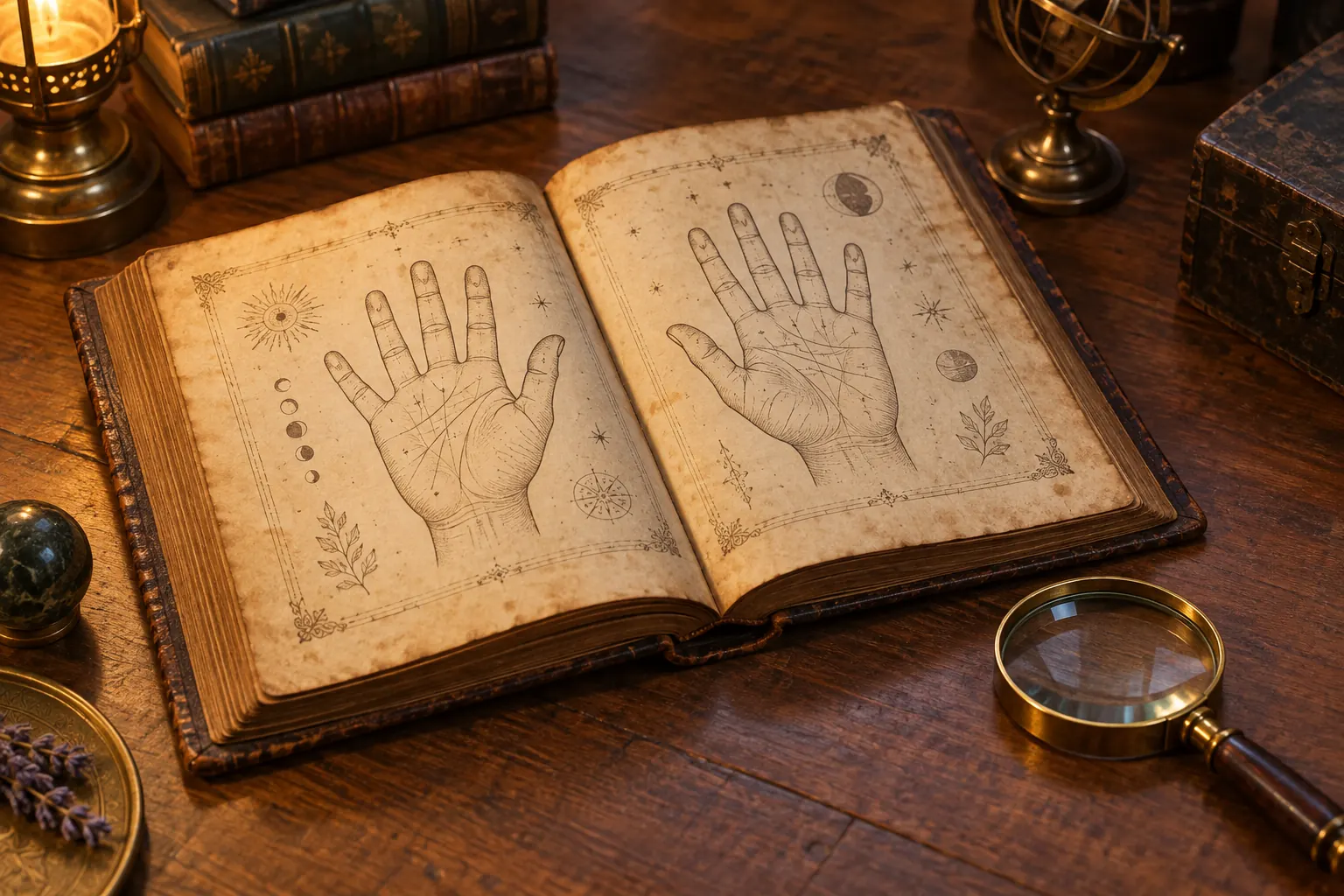
Palmistry is old, but nobody knows exactly how old or where it began. Historians point to several early traditions rather than a single source, then a long medieval European manuscript tradition, and then a 19th-century revival that made palm reading the form most people recognise. That patchwork explains a lot, including why two palm charts can give different meanings for the same line.
You have seen three palm charts that give three meanings for the same line. History explains why.
Three terms you will see
- Palmistry is the general word for reading the hand.
- Chiromancy is the older term, from Greek roots for "hand" and "divination." It usually means reading the lines to say something about character or the future.
- Chirognomy refers to reading the shape of the hand, fingers and mounts. Chirology is a later word that is often used for the whole study of the hand.
You do not need these words to read your palm. They help when you search old books.
Origins are uncertain
Reference works agree that the origins of palmistry are unclear. Britannica says it may have begun in ancient India and that hand reading was known in China, Tibet, Persia, Mesopotamia and Egypt. In India, hand reading belongs to a wider tradition of reading the body's marks, called Samudrika Shastra, with Sanskrit texts written in the medieval period.
Greece has its own thread. Aristotle makes a brief remark about the lines of the palm in his Historia animalium, which gave the subject a little respectability. But no classical treatise survives. The only Greek text on the subject is known from two manuscripts, one from the thirteenth century and one from the fifteenth, and there is no way of knowing how much older the text is. Stories that Aristotle found a palmistry treatise and gave it to Alexander the Great are legend, and texts under his name are generally judged not to be his.
So the honest summary is this. Several cultures read the hand. We cannot say which came first, or that they are one tradition.
Medieval Europe and the manuscript tradition
The earliest surviving European chiromantic text was written in England around 1160. Over the next few centuries, copyists produced many Latin manuals, and a study of 27 surviving British Latin texts from 1160 to 1500 shows them circulating in the libraries of the learned. Chiromancy was sometimes listed among condemned "dark arts" but was largely not censored. Britannica notes that in a darker strand, some witch-hunters read marks on the skin as signs of a pact with the Devil.
Palmistry flourished again in the Renaissance, fell back during the Enlightenment, and returned. The Library of Congress and the Wellcome Collection hold early illustrated manuals, as our palm reading guide notes.
The nineteenth-century revival
The version most people know was shaped in the 1800s.
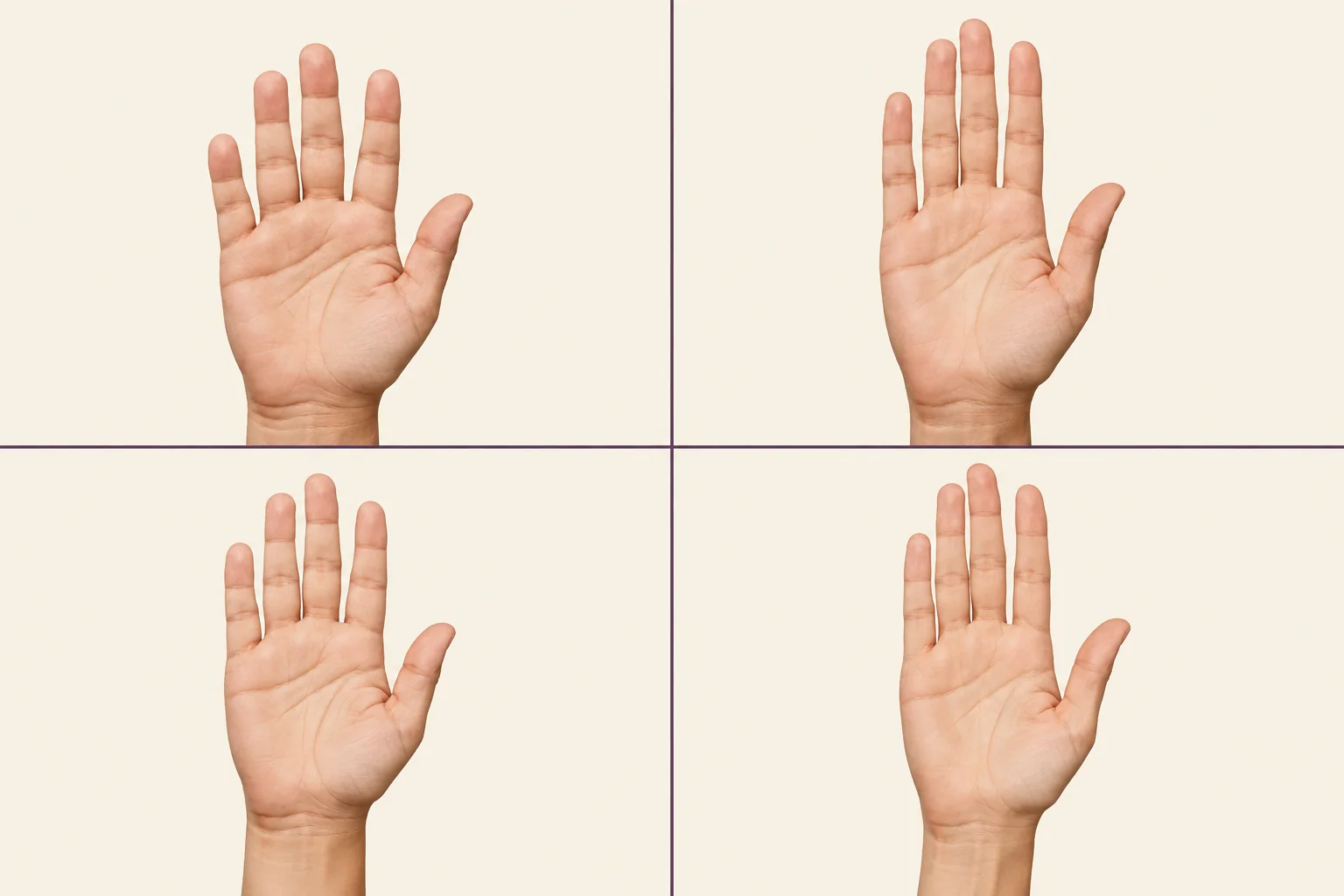
- 1839: Casimir d'Arpentigny published La Chirognomie, which classified hand shapes. Some sources give 1843 for later editions. His shape types are the ancestors of the "four elements" hands that palmists use today. Our guide to palmistry hand shapes covers the modern version.
- Later in the century: Louis Hamon, who wrote as "Cheiro," became a fashionable "society palmist" in Britain and the United States and helped make palm reading a popular entertainment.
- 1889: The Chirological Society of Great Britain was founded in London, with the stated aim of systematising palmistry and keeping out charlatans. An American society followed in 1897.
The effort to "systematise" is worth noticing. It created the tidy charts, line names and mount maps that you see in books today. Those charts were assembled in the nineteenth century from earlier material, not handed down whole.
Why palmists still disagree
| Question | Why traditions differ | Where to read more |
|---|---|---|
| Which hand should I read? | Different schools assign different roles to the dominant and non-dominant hand | Which hand to read |
| What does this line mean? | Meanings were merged from several sources and rewritten by later authors | How to read palms for beginners |
| How are timing and ages marked? | Different charts divide the lines with different scales | Check the chart's source before using it |
| Does it predict the future? | Premodern authors assumed so. Modern readers mostly use it as reflection | Is palm reading real? |
The pattern is that disagreement is built in. There was never one original rulebook, so there is no master chart to check a claim against.
How to use the history
History gives you three practical habits.
- Ask where a claim comes from. A confident statement with no source is one author's convention.
- Treat charts as one tradition among several. If your chart and a friend's differ, both are following a book.
- Keep symbolic meaning separate from evidence. Age does not make a claim true. For what researchers have checked, see is palm reading real?.
Used this way, the history makes palmistry more interesting and less of a command.
See how a modern reading works
Divine Glows offers a Full Palm Reading that compares both palms and answers your questions. It is a structured prompt for reflection, not a prediction.
- Both palms compared, not one hand alone.
- Focused on the questions you bring.
- Details on the palm reading page.
Sources
- Britannica, "Palmistry" (britannica.com/topic/palmistry).
- C. S. F. Burnett, "The Earliest Chiromancy in the West" (Routledge, 2024 reprint of an earlier article).
- "Stars in the Hand: The Manuscript and Intellectual Contexts of British Latin Medieval Chiromancy" (University of Saskatchewan thesis, hdl.handle.net/10388/9539).
- Wikipedia, "Palmistry," for the 19th-century dates (d'Arpentigny 1839, Chirological Society 1889, American Chirological Society 1897). Confirm against a printed source before publication.
Common questions about the history of palmistry
Where did palmistry come from?
Nobody knows for certain. Reference works point to several early traditions, including India, China, Greece and others, rather than a single source.
What is the difference between palmistry and chiromancy?
Chiromancy is the older term for reading the lines of the hand, usually with a divinatory purpose. Palmistry is the general modern word. Chirognomy refers to reading hand shape, and chirology is a later word for the study of the hand as a whole.
Who was Cheiro?
Cheiro was the pen name of Louis Hamon, a late nineteenth-century palmist who became a fashionable "society palmist" in Britain and America.
Is palmistry thousands of years old?
Parts of the idea are old, and hand reading is mentioned in classical and Indian sources. The tidy charts used today were largely assembled in the nineteenth century.
Does an old tradition mean it is accurate?
No. Age is not evidence. Palmistry has not been validated as a way to predict events, personality or lifespan.
A Full Palm Reading
Curious how it works today?
Our palm reading page explains what a structured reading looks at and how it is offered. Read it with the history above in mind and decide for yourself.
Your Full Palm Reading maps all the important features—hand shape, skin texture, thumb, fingers, mounts, major and minor lines, markings, and the differences between both palms—and brings them together in a holistic reading focused on your questions.