
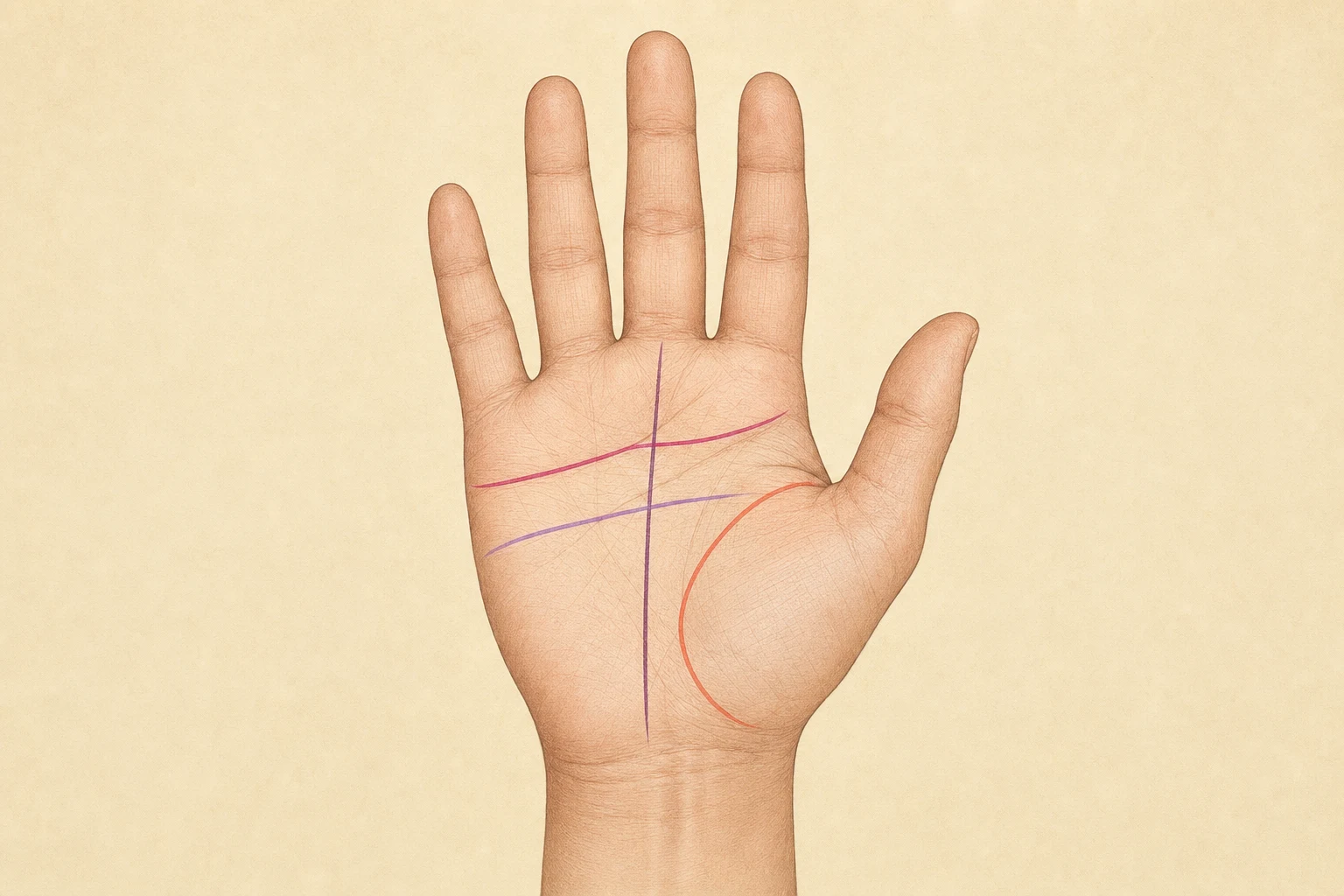
To read a palm, first look at both hands as a whole. Then identify the three major creases—the life, head, and heart lines—and the optional fate line. Compare each line’s location, depth, curve, continuity, and branches before combining the observations into a theme. Palmistry is a symbolic divination tradition, not a scientific way to measure personality or predict events.
The line that draws your attention often arrives with a real question beneath it—about love, purpose, work, or the next turning point. Let the pattern invite a deeper conversation with yourself.
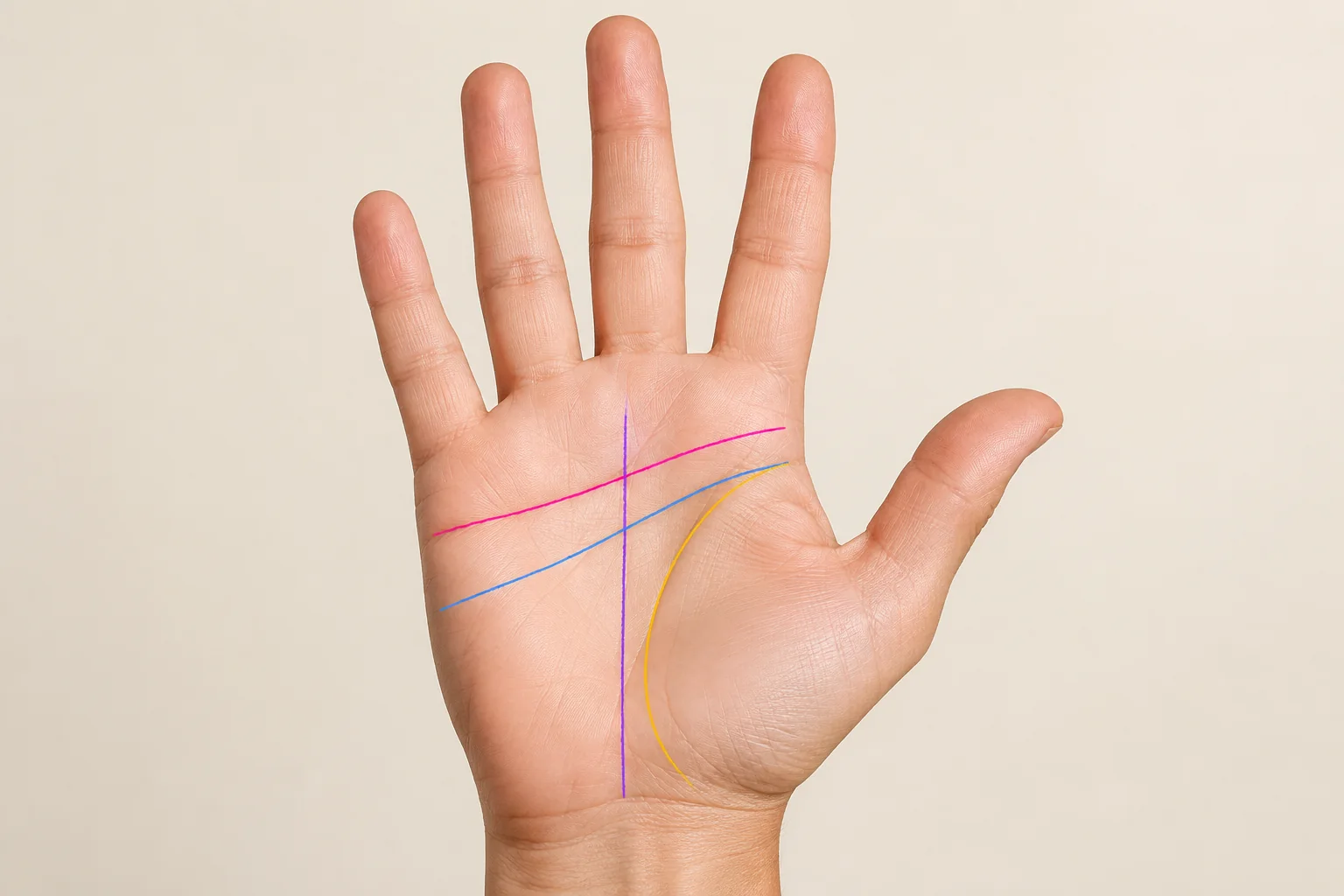
This order matters. A common beginner mistake is to spot one short or broken line and jump to a frightening conclusion. Real hands contain overlapping creases, scars, fine lines, and natural variation. Traditional palmists read features in context rather than treating one mark as a verdict.
Before you begin
Use natural light and ask permission before touching or photographing another person’s hands. Relax the hand instead of stretching the fingers tightly, because tension can change how shallow creases appear. Look at both palms and note which hand the person uses most often.
Keep two ideas separate:
- Anatomy: palmar creases are real folds in the skin that help the hand bend. Medical literature calls the three familiar creases the distal transverse, proximal transverse, and thenar creases.
- Palmistry: heart, head, life, and fate are traditional symbolic names. Their claimed meanings have not been established as predictive facts.
How to read a palm in seven steps
1. Compare the active and less-active hands
Many modern readers use the dominant or most-used hand for present habits and choices, and the other hand for inherited tendencies or earlier patterns. That is a convention, not a universal rule. Some schools reverse it, so state the method you are using.
2. Notice the overall hand
Before reading lines, observe the proportions of palm and fingers, flexibility, and the natural resting position. Palmistry systems attach elemental or planetary meanings to these features, but beginners can simply note them without forcing a category.
3. Find the life line
The life line begins between the thumb and index finger and curves around the base of the thumb. In palmistry it is associated with vitality, grounding, and major transitions. Its length does not tell you how long someone will live.
4. Find the head line
The head line crosses the middle of the palm. Traditional readers associate a straighter path with practical focus and a downward slope with imagination. The interpretation should describe a possible style, not label intelligence.
5. Find the heart line
The heart line is the upper horizontal crease beneath the fingers. It is traditionally read for emotional expression, closeness, and relationship style. Do not use it to claim that someone will marry, separate, or remain faithful.
6. Look for the fate line
The fate or destiny line, when visible, runs vertically toward the middle finger. Not everyone has a clear one. Palmists commonly connect it with direction, work, and outside responsibilities; an absent line is not a bad sign.
7. Describe each line consistently
Use the same checklist for every line: where it starts, where it ends, whether it is deep or fine, straight or curved, continuous or interrupted, and whether branches move upward or downward. Consistency prevents a dramatic marking from taking over the whole reading.
How to combine the clues
Turn separate observations into one cautious theme. For example, a straight head line and a curved heart line might be described traditionally as practical decision-making alongside expressive feelings. Then ask whether that language feels useful to the person. Their lived experience carries more weight than a diagram.
A thoughtful palm reading uses conditional language: “This is traditionally associated with…” rather than “This proves that you will…”
Five beginner mistakes to avoid
- Reading only one hand without explaining why.
- Confusing line length with quality or lifespan.
- Turning natural breaks, scars, or faint areas into warnings.
- Using gender to decide which hand matters.
- Making medical, fertility, death, or financial predictions.
How to practice without overclaiming
Write observations in two columns. In the first, record only what you can see: “the head line slopes downward,” “the heart line ends below the index finger,” or “the fate line is faint.” In the second, add the traditional association and phrase it as a question. This makes the difference between evidence and interpretation visible.
Practice on several willing people instead of memorizing one palm. Ask what fits, what does not, and whether a different wording would be fairer. Do not change an interpretation merely to please the person, but do correct assumptions that came from poor lighting, the wrong crease, or an overly rigid chart. A useful beginner session can be ten minutes: two minutes for the whole hand, five for the major lines, and three to summarize one or two themes.
Start with the four-line map
Learn each feature separately in our guides to the life line, head line, heart line, and fate line.
Sources and further reading
- NCBI: anatomical analysis and classification of palm creases
- Library of Congress: historical Chiromantia collection
The bottom line
Good beginner palm reading is observation first and interpretation second. Read the whole hand, follow a consistent sequence, explain that meanings vary by tradition, and keep predictions modest. The result should create a reflective conversation, not fear or certainty.
A Full Palm Reading
Go from identifying separate lines to understanding your whole palm
A personal reading connects the life, head, heart, and fate lines with your hand shape, mounts, fingers, and markings, showing which themes support or change one another.
Your Full Palm Reading maps all the important features—hand shape, skin texture, thumb, fingers, mounts, major and minor lines, markings, and the differences between both palms—and brings them together in a holistic reading focused on your questions.