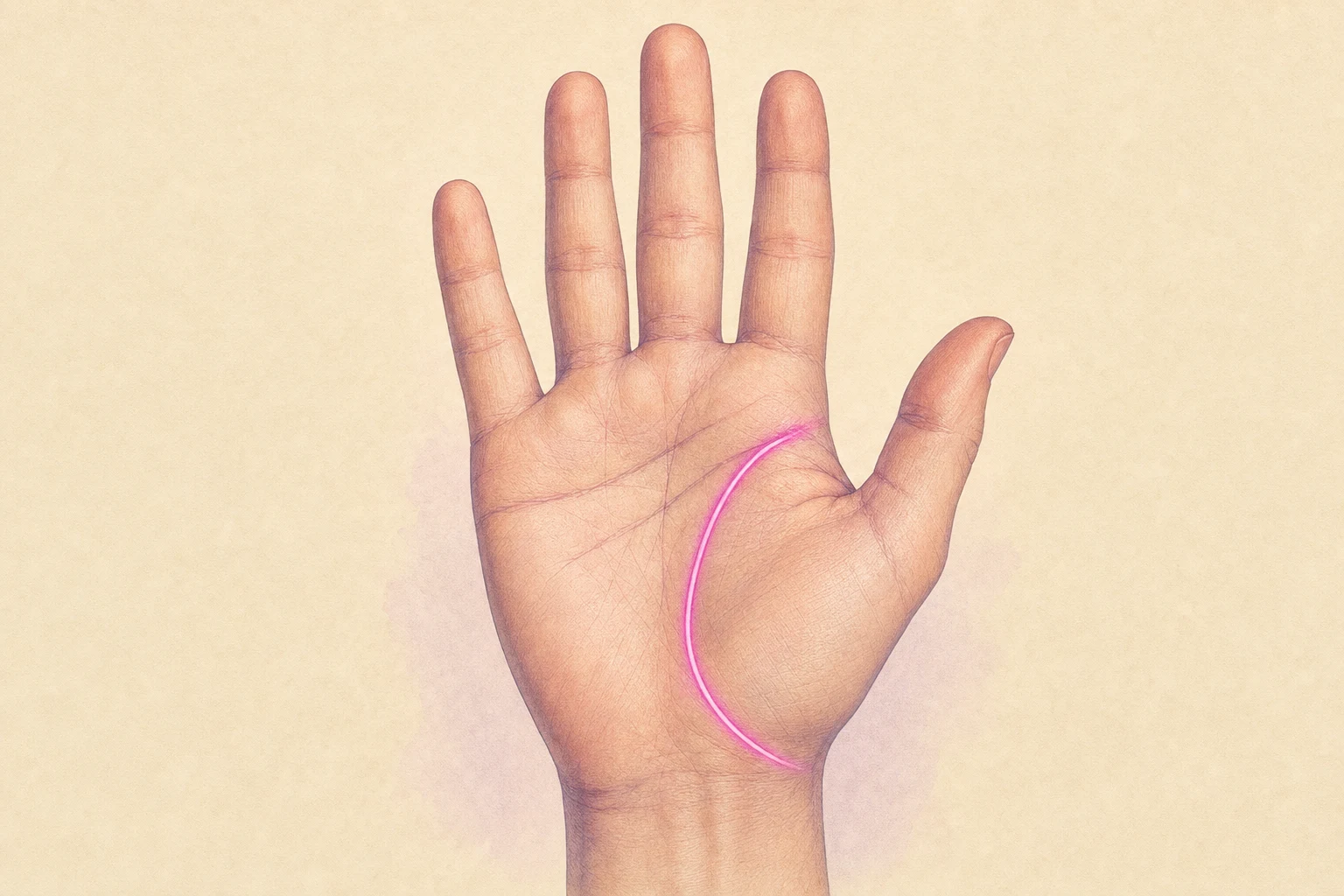
The life line is the curved crease that begins between the thumb and index finger and sweeps around the base of the thumb toward the wrist. In palmistry, it is traditionally associated with physical energy, grounding, support, and major changes. A short life line does not mean a short life, and the line should never be used to predict illness or death.
The line that draws your attention often arrives with a real question beneath it—about love, purpose, work, or the next turning point. Let the pattern invite a deeper conversation with yourself.
Anatomically, this familiar fold is the thenar or radial longitudinal crease. It helps the skin fold as the thumb and palm move. Palmistry adds symbolic interpretations to its shape, but those interpretations are not a medical assessment.
How to find your life line
- Open your hand naturally with the fingers relaxed.
- Find the crease beginning near the web between thumb and index finger.
- Follow it as it arcs around the fleshy base of the thumb.
- Do not confuse it with the head line, which travels across the center of the palm.
On some palms, the life and head lines share a starting point before separating. On others, a visible gap appears between them. Traditional readers may discuss that relationship, but neither arrangement is inherently better.
What do a long or short life line mean?
Long life line
A line that makes a wide, long arc toward the wrist is often read as steady energy, endurance, or attachment to familiar foundations. It does not provide a lifespan. Length mostly describes how far the crease travels across the hand.
Short life line
A line that ends higher on the palm is sometimes interpreted as independence, energy used in concentrated bursts, or a life shaped less by conventional roots. It is common natural variation and is not an omen of early death.
Wide or narrow arc
A wide curve that leaves space around the thumb mound is traditionally associated with outward energy and exploration. A line hugging the thumb is sometimes read as a more measured or private use of energy. Hand proportions influence the curve, so compare it with the rest of the palm.
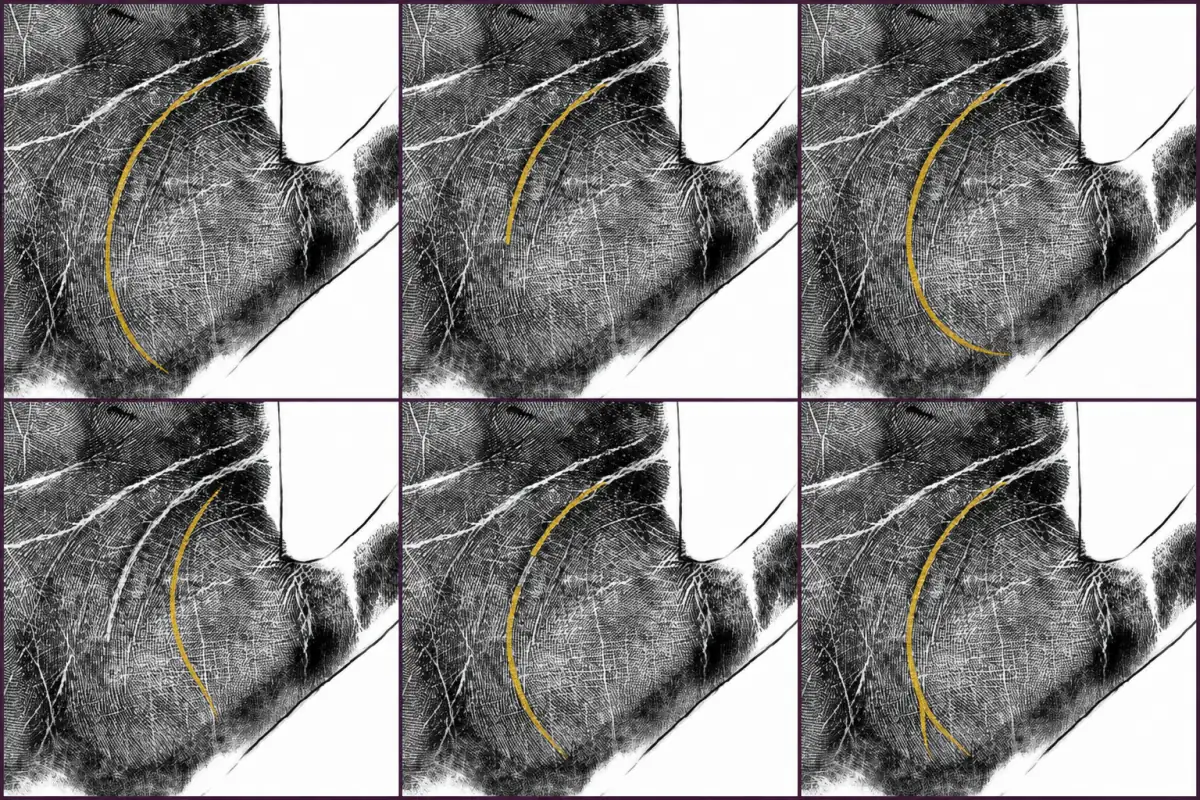
Traditional meanings of common life-line variations
- Deep and clear: sustained energy, resilience, or a strong sense of grounding.
- Fine or faint: sensitivity, variable energy, or a need for deliberate rest and boundaries.
- Chained: changing demands or periods that feel less settled.
- Break: a transition, interruption, relocation, or reset—not disaster.
- Overlapping break: continuity through a change, with one pattern replacing another.
- Upward branch: ambition, initiative, or energy moving toward a new aim.
- Downward branch: energy spread across obligations or a period of withdrawal.
- Fork near the wrist: two directions, travel, or a change in environment in some traditions.
- Parallel “sister” line: support, recovery, or a reinforcing influence.
These meanings differ among Western, Indian, and other palmistry schools. Read a variation alongside the head and heart lines rather than assigning it a complete story on its own.
What if the life line is broken?
First check whether fine connecting lines continue through the area and whether a scar, callus, lighting, or hand position affects visibility. In responsible palmistry, a break is framed as a possible transition or change in rhythm. It should not be used to predict an accident, diagnosis, or death.
Three life-line myths to leave behind
- Myth: a short line means a short life. It does not. Crease length cannot calculate longevity.
- Myth: a break predicts tragedy. Breaks are common variations and receive different symbolic readings.
- Myth: a deep line guarantees perfect health. Palm creases cannot diagnose health or replace a clinician.
How to compare the life line on both hands
Place both palms side by side and compare the main arc rather than counting tiny cross-lines. Notice whether one line is clearer, curves farther from the thumb, or has a branch that the other does not. Under the dominant-hand convention, a palmist may describe the more-active hand as current expression and the other as background potential. That is an interpretive framework, not proof that choices physically rewrote the line.
Finish with one neutral summary. For example: “The broad arc is traditionally connected with outward energy, while the fine section suggests a period when energy may need more deliberate attention.” Avoid attaching an exact age or future event to the feature. If fatigue or health is the real concern, the appropriate next step is evidence-based care, not a stronger palmistry claim.
The safest life-line reading speaks about pace, transitions, and reflection—never lifespan, disease, or doom.
Read the whole palm
Compare the life line with the head line and use our left-versus-right hand guide before drawing a broader theme.
Source note
The anatomical description follows published research on major palm creases from NCBI/PMC. The symbolic meanings above summarize palmistry traditions and should not be treated as medical evidence.
The bottom line
The life line maps a real crease and a traditional symbol. Palmists associate it with energy, support, and transitions, but it cannot reveal lifespan. Look at the full arc, depth, continuity, and nearby lines, then keep any interpretation flexible and free of fear.
A Full Palm Reading
Place your life line inside the complete pattern
Your life line gains context from its branches, the space around the thumb, the head and fate lines, and the differences between your two hands.
Your Full Palm Reading maps all the important features—hand shape, skin texture, thumb, fingers, mounts, major and minor lines, markings, and the differences between both palms—and brings them together in a holistic reading focused on your questions.