
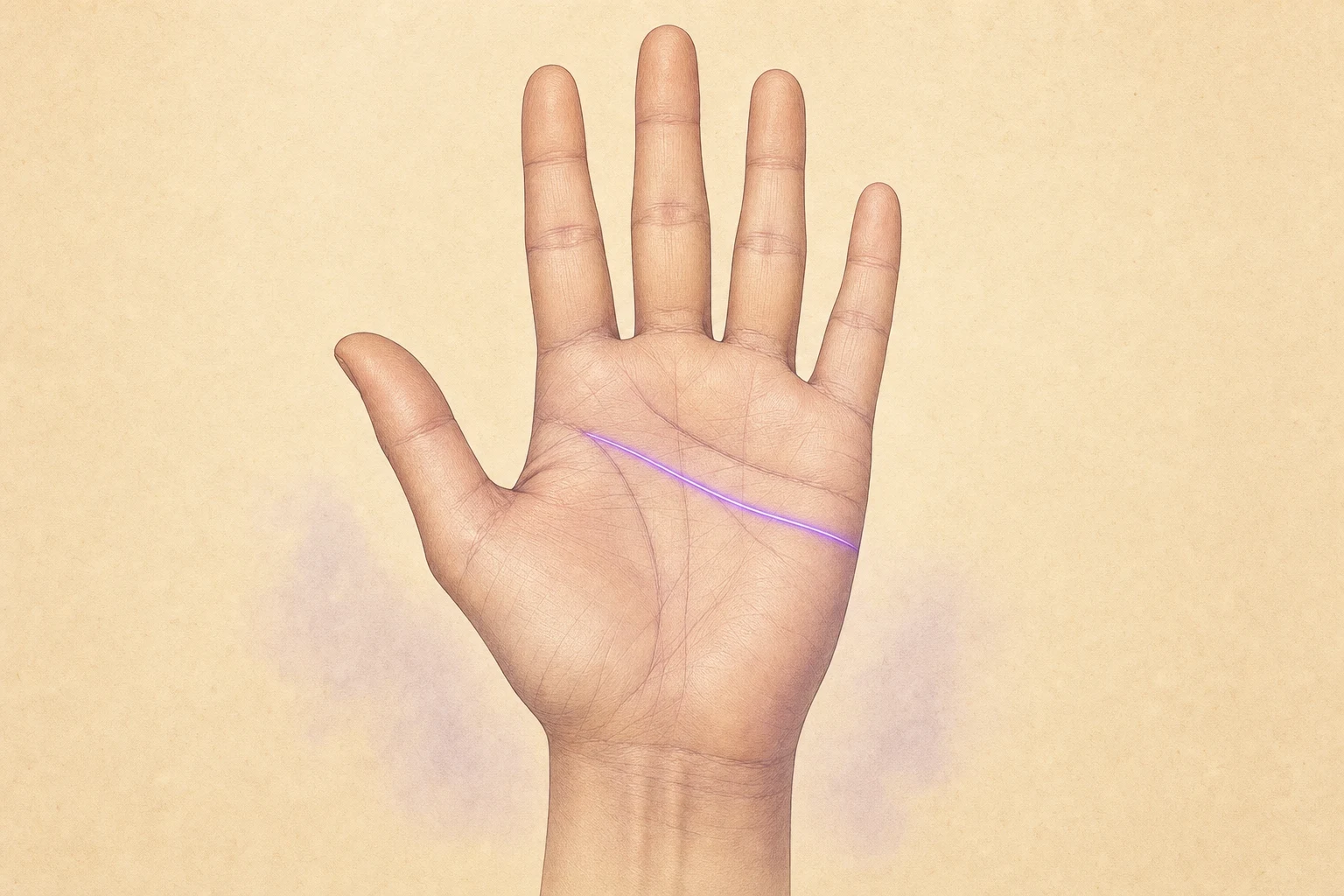
The head line is the major crease crossing the center of the palm, usually beginning near the life line and moving toward the outer edge. Traditional palmistry associates it with how someone directs attention, processes ideas, and makes decisions. It does not measure IQ, prove a talent, or diagnose a mental-health condition.
The line that draws your attention often arrives with a real question beneath it—about love, purpose, work, or the next turning point. Let the pattern invite a deeper conversation with yourself.
Its anatomical counterpart is generally called the proximal transverse palmar crease. Like other palm creases, it helps the skin fold as the hand moves. Symbolic meanings vary across palmistry schools.
How to find the head line
Start near the space between the thumb and index finger. The head line normally begins beside or briefly joined to the life line, then crosses the middle of the palm. The heart line sits above it. On some hands, the head line slopes down toward the outer lower palm; on others, it runs almost straight.
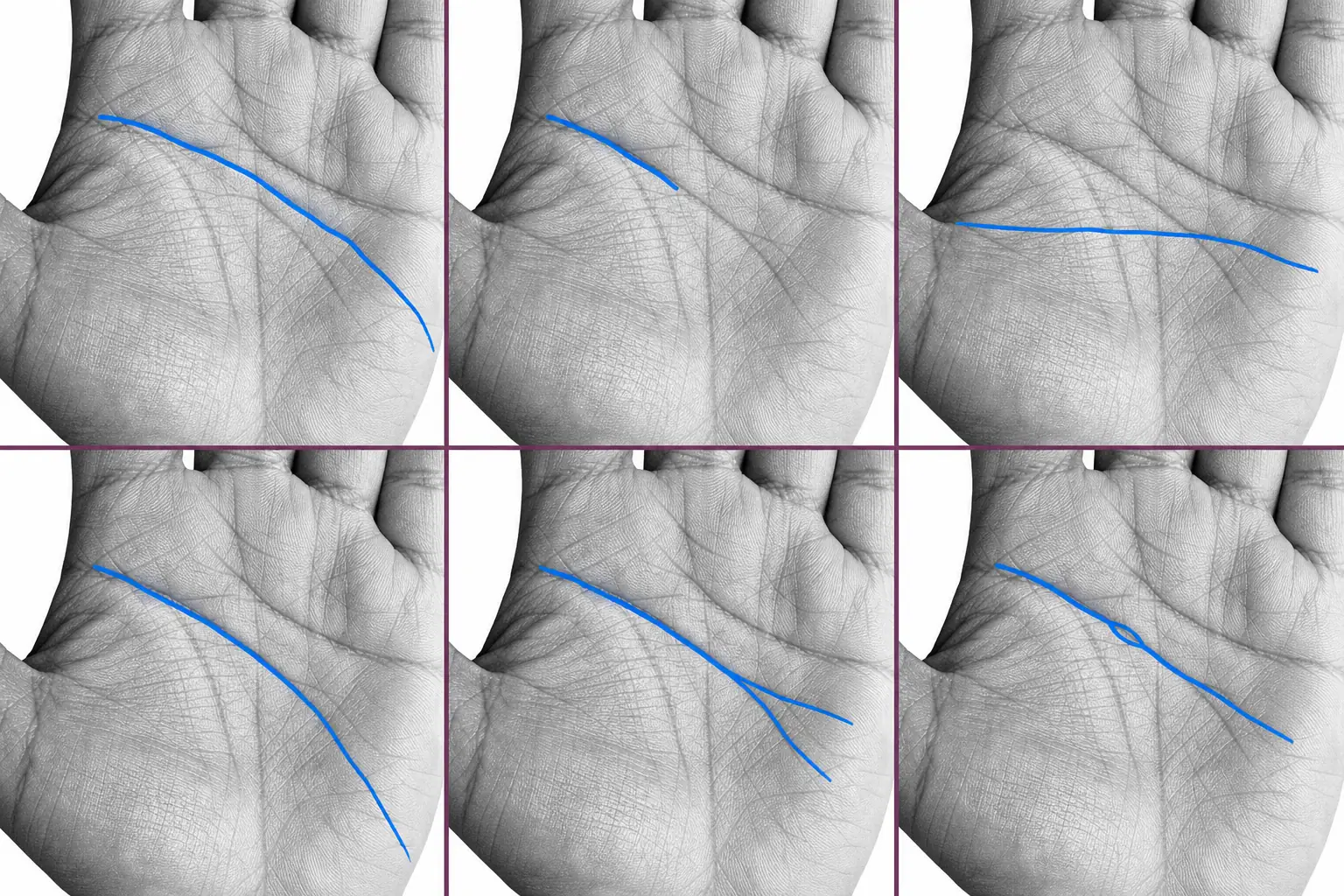
Long, short, deep, and faint head lines
Long head line
A line extending far across the palm is traditionally associated with sustained focus, detailed thinking, or a tendency to examine many angles. It does not automatically mean greater intelligence and may also be framed as over-analysis when the surrounding reading supports that theme.
Short head line
A shorter line is commonly read as quick decisions, practical focus, or preference for direct experience. It should not be described as limited ability. Different tasks reward different thinking styles.
Deep or clear head line
Traditional readers connect a well-defined line with concentration, conviction, or consistency in decision-making. Depth can also be affected by skin structure and hand use.
Fine or faint head line
A finer line may be read as mental flexibility, sensitivity to context, or attention moving among several interests. Avoid turning it into a claim about poor memory or health.
Straight, sloping, and curved head lines
- Straight: practical organization, preference for clear facts, or linear problem-solving.
- Gentle downward slope: a blend of practical and imaginative thinking.
- Strong downward slope: symbolism, imagination, intuition, or absorption in ideas.
- Upward direction: ambition, application, or attention to tangible outcomes in some systems.
Direction is relative to the person’s hand. Trace the main crease rather than every fine branch, and compare it with both palms under the same light.
What does it mean when the head and life lines are joined?
A shared starting section is traditionally linked with careful beginnings, awareness of security, or considering consequences before acting. A visible gap is often associated with independence, initiative, or comfort making autonomous choices. Neither formation is better, and neither proves whether someone is cautious or impulsive.
Forks, breaks, chains, and double head lines
- Forked ending: ability to translate between practical and imaginative viewpoints; sometimes called a writer’s fork.
- Break: a change in outlook, priorities, study, or decision-making approach—not brain injury or illness.
- Chained line: many simultaneous thoughts, changing focus, or a period of mental complexity.
- Upward branch: an idea applied toward a goal or opportunity.
- Downward branch: imagination, private reflection, or attention drawn inward.
- Two visible head lines: two strong modes of thinking or an unusual ability to switch perspectives in traditional readings.
How to phrase a responsible interpretation
Use possibilities and questions. “This straight path is traditionally linked with structured decisions—does that fit how you approach work?” is more respectful than “You are purely logical.” Do not infer neurodivergence, trauma, dementia, anxiety, or another condition from a crease.
Compare the head line across both palms
Start at the thumb side and trace the same main crease on each hand. Compare its direction, not just its darkness. If one slopes more while the other travels straight, a modern reader might discuss a tension between imaginative exploration and practical execution. If one has a fork and the other does not, the fork can be framed as an additional way of approaching decisions rather than a superior feature.
Ask for a real example before expanding the theme. Someone may think analytically at work and intuitively in relationships, or focus deeply on one subject while moving quickly through another. That context prevents the reading from reducing a flexible person to one adjective. The purpose is to create language for reflection, not to claim that the palm has completed a psychological assessment.
When writing notes, separate the visible feature from the meaning: “long, gently sloping line” first, then “traditionally linked with sustained imaginative attention.” This small habit makes it easier to revisit the observation without mistaking a symbolic association for an established fact.
The head line is a symbolic prompt about thinking style, not a test of intelligence or mental health.
See the line in context
Compare the head line with the heart line and life line before building a broader interpretation.
The bottom line
Palmists traditionally read the head line for mental approach, using its length, depth, direction, starting point, and branches. Keep the language flexible and strengths-based. A hand crease cannot measure intelligence or diagnose the mind.
A Full Palm Reading
See how your thinking style connects with the rest of your hand
Your reading follows the head line's length, direction, branches, and starting point, then connects them with your thumb, fingers, fate line, and dominant-hand pattern.
Your Full Palm Reading maps all the important features—hand shape, skin texture, thumb, fingers, mounts, major and minor lines, markings, and the differences between both palms—and brings them together in a holistic reading focused on your questions.