
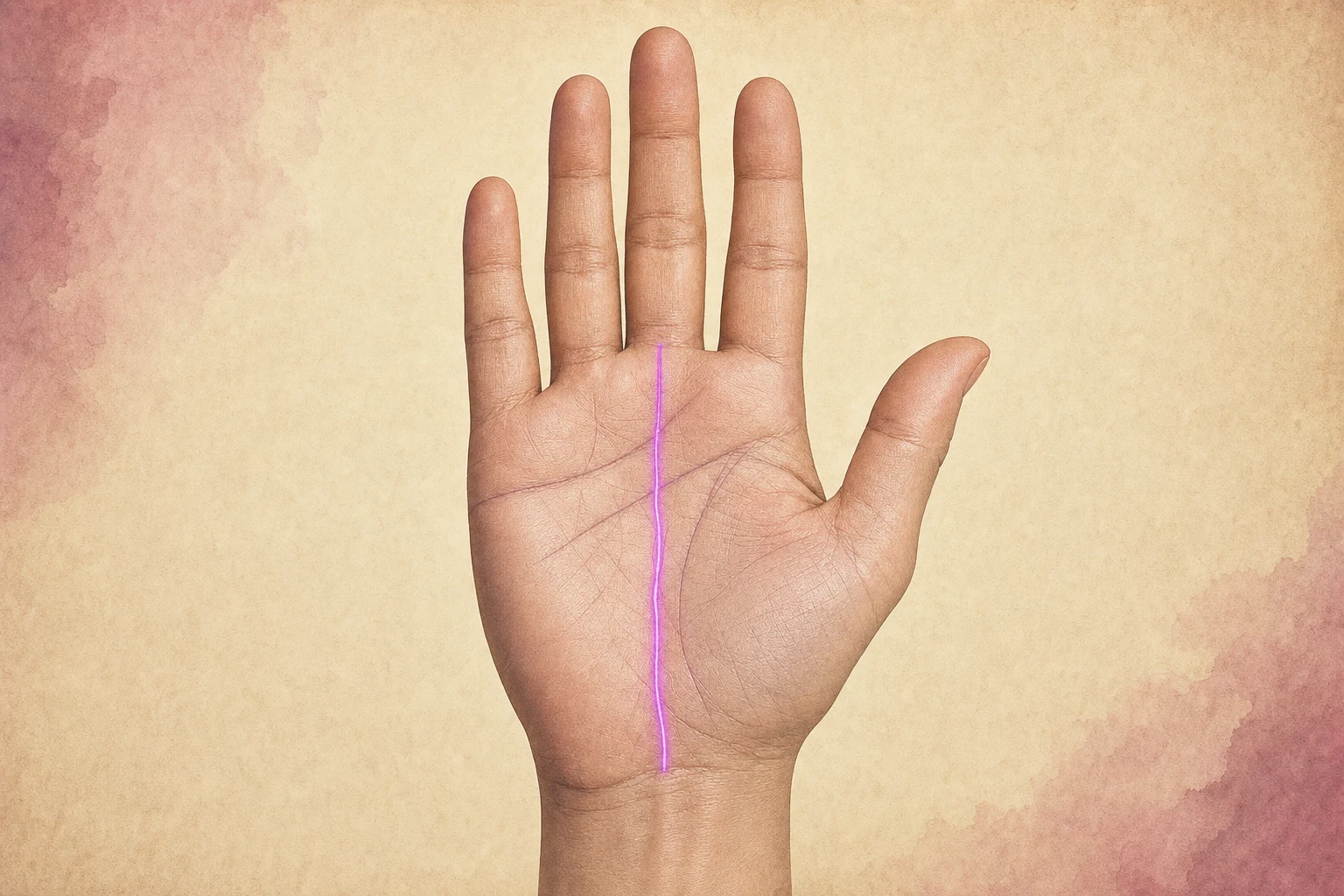
The fate line—also called the destiny or career line—is a vertical crease that may rise from the lower palm toward the middle finger. Traditional palmistry connects it with life direction, work, responsibility, and the influence of circumstances. Many people have a faint, partial, or absent fate line, and none of those forms determines success.
The line that draws your attention often arrives with a real question beneath it—about love, purpose, work, or the next turning point. Let the pattern invite a deeper conversation with yourself.
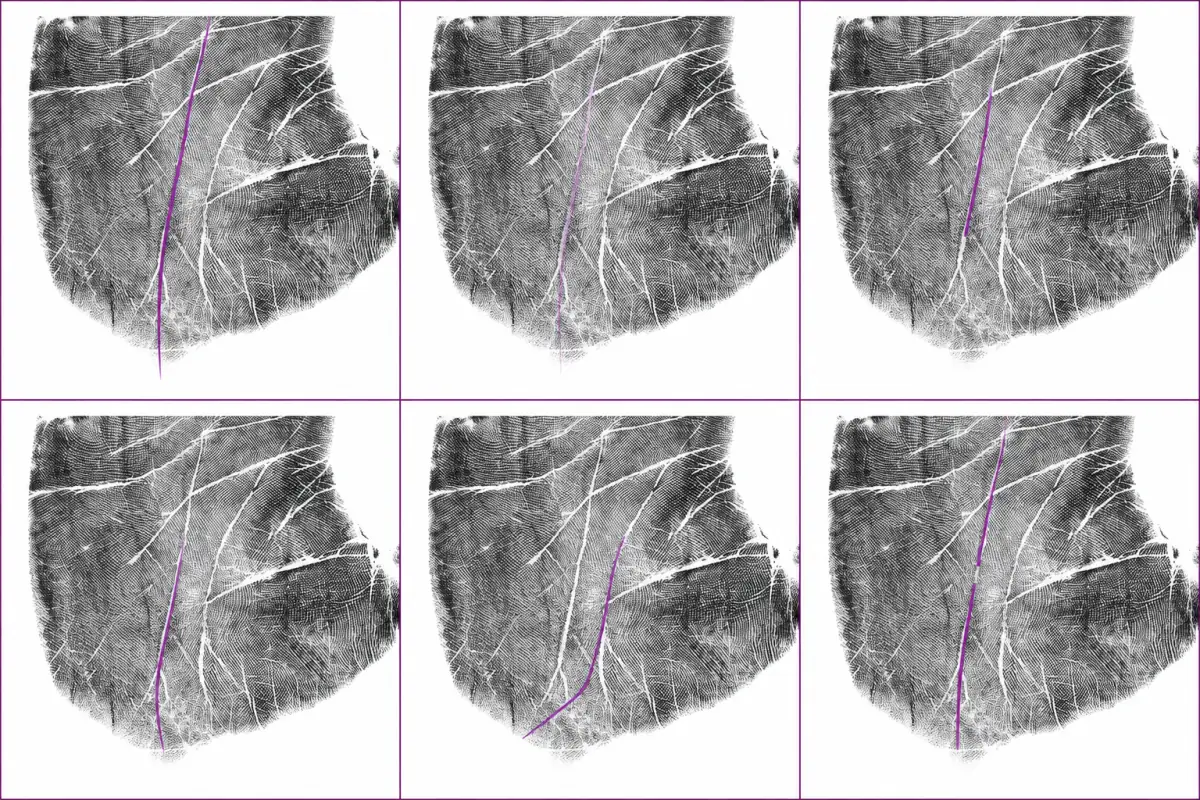
Unlike the life, head, and heart creases, a clear fate line is not present on every palm. That is normal anatomy. It is also why beginners should not keep searching until a random fine crease becomes a “destiny” line.
How to find the fate line
Look for a mostly vertical line traveling through the center of the palm toward the base of the middle finger. It may begin at the wrist, in the middle of the palm, beside the life line, or from the outer lower edge. It can stop at the head or heart line, restart above a break, or appear only in one section.
What does no fate line mean?
In modern palmistry, an absent fate line is often interpreted as a flexible, self-directed path, varied interests, or a life not organized around one continuous vocation. It does not mean a person has no purpose, career, discipline, or future. Some readers simply give other features more weight.
Deep fate line
A strong, continuous line is traditionally linked with clear direction, sustained responsibility, or a path shaped by durable commitments. It does not guarantee career status or income.
Faint fate line
A fine line may suggest evolving goals, multiple roles, or less identification with one external path. Visibility can vary with lighting, skin, and how the palm is held.
What the fate-line starting point traditionally means
- From the wrist: an early sense of direction or responsibility.
- From the middle of the palm: direction becoming clearer through experience.
- From or near the life line: family, security, or personal foundations influencing the path.
- From the outer lower palm: the public, travel, community, or other people shaping opportunities.
- From the head line: a path strengthened by decisions, study, or a later intellectual choice.
These associations are not timelines. Palmistry systems that assign exact ages to points on the fate line disagree with one another and cannot date a future event reliably.
What does it mean when the fate line stops?
A line ending at the head line is traditionally read as a major decision influencing direction. One ending near the heart line may be connected with relationships or values affecting priorities. These are broad reflection prompts, not predictions of job loss, marriage, or retirement.
Traditional meanings of breaks, branches, and doubles
- Break with a restart: a change of role, identity, location, or direction.
- Overlapping sections: transition between paths with some continuity.
- Upward branch: growing responsibility, ambition, or a new opportunity.
- Side branch: a parallel interest, project, or alternative route.
- Fork: two priorities or paths developing from one foundation.
- Double fate line: dual careers, several major commitments, or a public and private vocation in some traditions.
Is the fate line really about career?
Career is a convenient modern label, but not everyone organizes life around paid work. Direction may mean caregiving, study, creative practice, community, spiritual life, or responsibilities that are not a job. Ask what “purpose” means to the person instead of assuming professional ambition.
How to compare the fate line with other lines
Notice where the fate line meets or passes the head and heart lines. Palmists traditionally read these intersections as moments when decisions or values become important to direction. Do not convert the point into a precise age or guaranteed event. Different timing systems use different scales, and a generic diagram cannot account for every hand proportion.
Then compare the fate line with the life line. A start near the life line may inspire questions about family expectations or security; a separate start may invite discussion of outside opportunities or independent direction. Finally, look at the active and less-active hands. A clearer line on one palm can be described as a possible shift in focus, but it cannot prove a career change or tell someone to leave a job.
For a useful summary, name one current tension and one open question. You might say, “This line is traditionally linked with a path that develops in stages; where do you feel your direction becoming clearer now?” That wording brings attention back to lived choices instead of surrendering them to destiny.
A fate line is not fate. At most, palmistry uses it as a symbolic way to discuss direction, structure, and change.
Connect direction with decisions
Compare the fate line with the head line, then review the full beginner palm-reading method.
The bottom line
The fate line is an optional vertical feature, not a guarantee of destiny. Palmists use its starting point, depth, breaks, and branches to reflect on direction and responsibility. A missing or changing line is normal and should never be treated as failure.
A Full Palm Reading
Put your fate line in the context of your direction and choices
A personal reading compares where the fate line begins, changes, and ends with the head, Sun, and life lines across both palms to build a fuller picture of direction.
Your Full Palm Reading maps all the important features—hand shape, skin texture, thumb, fingers, mounts, major and minor lines, markings, and the differences between both palms—and brings them together in a holistic reading focused on your questions.