
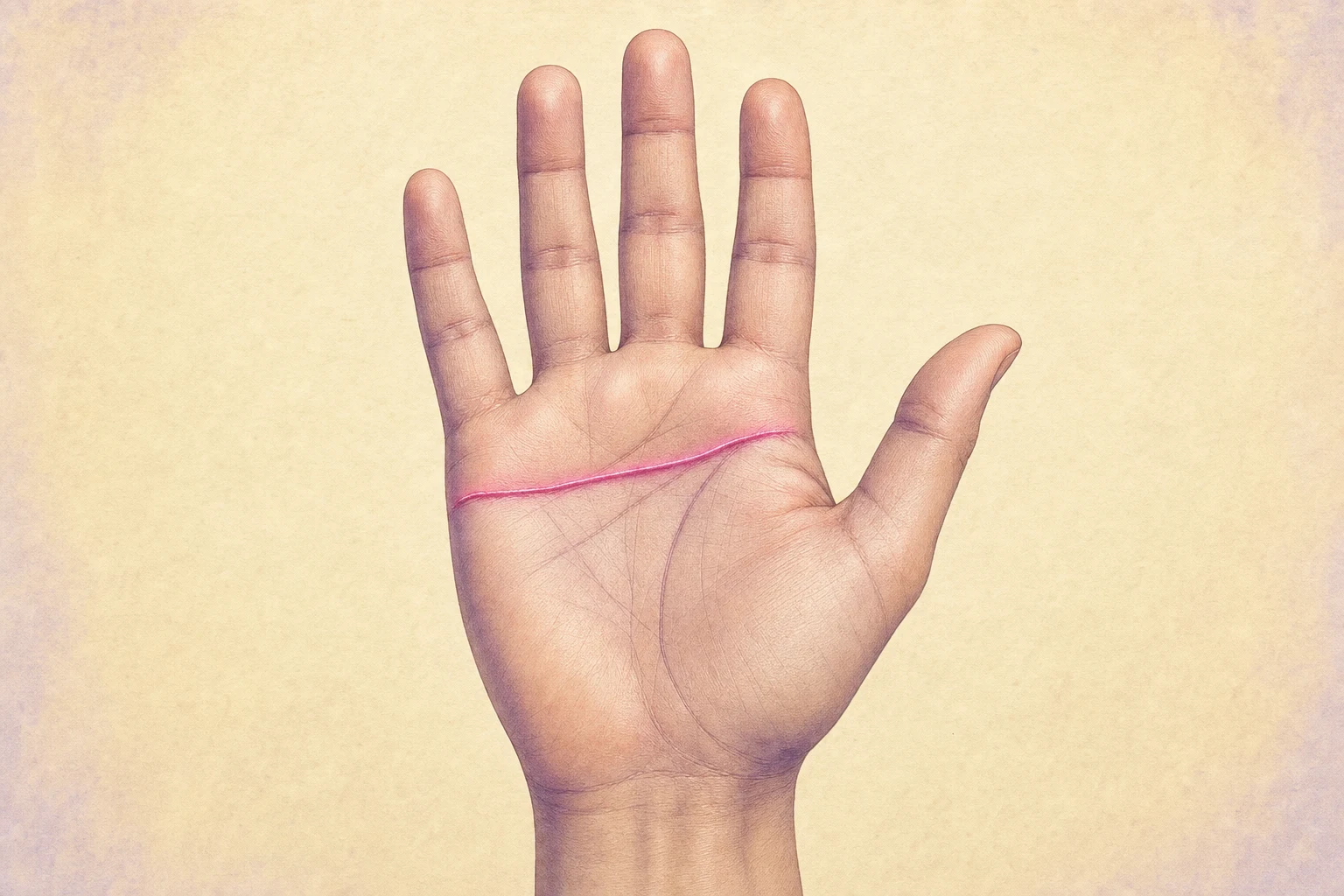
The heart line is the upper major crease running beneath the fingers, generally from the little-finger side toward the index or middle finger. Palmists traditionally connect it with how a person expresses affection, processes emotion, and approaches closeness. It cannot establish whether someone is loyal, compatible, or destined to marry.
The line that draws your attention often arrives with a real question beneath it—about love, purpose, work, or the next turning point. Let the pattern invite a deeper conversation with yourself.
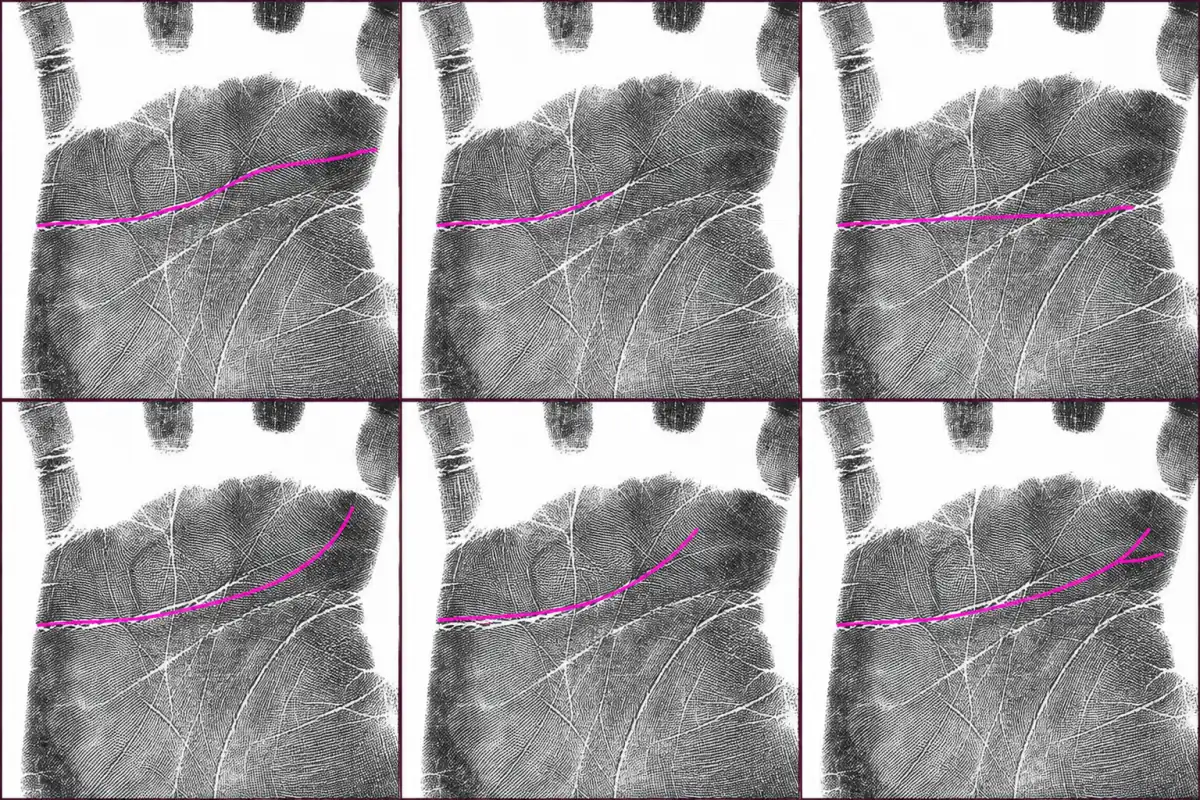
In anatomy, it corresponds broadly to the distal transverse palmar crease. Its location and form vary naturally. Palmistry gives those variations symbolic language, which is best used for conversation rather than judgment.
How to find the heart line
Hold the palm open without pulling the fingers back. Look just below the finger bases for the highest prominent line crossing the hand. Trace it from the outer edge below the little finger toward its ending below the index or middle finger. Fine relationship or “marriage” lines sit on the side of the palm and are not the heart line.
Long, short, curved, and straight heart lines
Long heart line
A line that travels far across the upper palm is traditionally associated with emotional investment, commitment, or a strong need to make sense of relationships. Length does not indicate how long a relationship will last.
Short heart line
A shorter line is often read as private emotional processing, independence, or directness. It should not be translated into “cold” or “unable to love.” A line can be short and deep, faint and long, or shaped by the proportions of the hand.
Curved heart line
An upward curve is commonly linked with visible affection, responsiveness, and expressive communication. A pronounced curve may be described as emotionally demonstrative, but it does not measure empathy.
Straight heart line
A straighter path is traditionally associated with steadier or more private emotional expression. Some readers describe it as showing that care is expressed through actions rather than dramatic display.
What does the heart-line ending mean?
- Under the index finger: idealism, high standards, or a values-led approach to relationships.
- Between index and middle fingers: a balance between ideals and practical expectations.
- Under the middle finger: independence, self-protection, or focus on personal needs.
- Forked ending: an ability to hold two perspectives, such as feeling and practicality.
Endings can be split, feathered, or hard to place. Choose the most visible main branch, note uncertainty, and avoid forcing the line into a perfect diagram.
What do breaks, chains, and branches mean?
- Deep line: feelings expressed with consistency or intensity.
- Fine line: sensitivity, subtle expression, or a reflective emotional style.
- Chained texture: emotional complexity, fluctuating needs, or many small concerns.
- Break: a shift in emotional priorities or a period of re-evaluation—not a guaranteed breakup.
- Upward branches: hope, openness, or connections that feel supportive.
- Downward branches: disappointment, emotional effort, or energy directed toward obligations.
What if the heart and head lines form one crease?
Some hands have one transverse crease rather than two distinct heart and head creases. This is an anatomical variation called a single transverse palmar crease. It should not be used alone to diagnose a condition or define a person’s emotional life. If someone has a health concern, a qualified clinician—not a palmist—should assess it.
How to make a heart-line reading useful
Replace labels with questions. Instead of saying, “You are emotionally unavailable,” ask, “Do you tend to show care more through actions than words?” Instead of predicting separation from a break, ask whether their way of relating changed during an important transition. This leaves the person free to agree, disagree, or add context.
How the heart and head lines work together
Palmists often compare the two horizontal lines rather than reading emotion in isolation. A strongly curved heart line above a straight head line may be described as expressive feelings balanced by a practical decision process. Two fine lines may suggest a more subtle or changeable style. These are conversational themes, not contradictions that need to be “fixed.”
Keep relationship questions centered on the person whose palm is present. A hand cannot reveal a partner’s private thoughts, confirm infidelity, or prove compatibility with someone who is absent. A responsible reading might explore how the person communicates needs, responds to uncertainty, or sets boundaries; it should not turn a crease into evidence about another individual.
A heart line can inspire a question about relationships; it cannot answer for another person or guarantee what happens next.
Balance heart and head
Compare emotional themes with the head line, then follow the complete beginner palm-reading sequence.
Source note
For standardized anatomical terminology, see the NCBI overview of hand and foot morphology. Palmistry interpretations are cultural and symbolic, not diagnostic.
The bottom line
The heart line is traditionally read through its path, depth, ending, and branches. Use those details to explore styles of emotional expression, not to declare someone’s character or romantic future. Relationships are shaped by communication and choices, not one crease.
A Full Palm Reading
Understand how your heart line fits your relationship pattern
A personal reading combines the heart line with the Venus mount, relationship lines, little finger, thumb, and both hands to explore how you approach closeness and communication.
Your Full Palm Reading maps all the important features—hand shape, skin texture, thumb, fingers, mounts, major and minor lines, markings, and the differences between both palms—and brings them together in a holistic reading focused on your questions.