
Here is an experiment that takes one evening and a willing friend. It will tell you more about palmistry than most articles do, including this one. The short answer to the question is no. Palm reading has not been shown to predict the future, personality or lifespan, and the best-known claim has been tested and failed. The lines themselves are real. Below is the test first, then the evidence.
You have looked at your palm and wondered whether those lines mean anything. You do not have to take anyone's word for it.
The swap test
The idea is simple. If the lines on your hands carry information about you, a reading made from your palms should fit you better than a reading made from a stranger's palms. You test that without knowing which reading is which.
You need two people: a helper who does not know the point of the test, and a volunteer whose palms you have not seen.
- Photograph the palms. The helper photographs both of your palms and both of the volunteer's, in the same light and at the same distance.
- Write two readings. The helper uses how to read palms for beginners to write five plain statements for each person: one each for the heart line, head line, life line, thumb and fingers. Keep them equal in length and tone. Label them X and Y and shuffle the order. The helper keeps the key.
- Rate every statement. You read both sets without seeing the photos. Give each statement a score from 1 (does not fit me) to 5 (fits me very well).
- Add up. Total each set. Only then does the helper reveal which was yours.
That is the whole design. It is the same logic scientists use: blind the person judging, and compare against a control.
Reading the result
| What you see | What it suggests |
|---|---|
| Your reading scores clearly higher than the stranger's | Interesting. Repeat it with two more volunteers before you believe it |
| The scores are within a point or so of each other | The lines did not add fit. Both readings probably sounded plausible |
| The stranger's reading scores higher | A good reminder of how much a reading's wording matters |
Two limits. First, this is an informal test with five statements, so a single run proves little either way. Second, if your helper knows you well, they may write statements that fit you for ordinary reasons. Pick a helper who does not.
Most people find both sets sound reasonably true. That is the Barnum effect, the habit of accepting broad statements as personal, and it is the main reason palmistry feels convincing. You can read about it in our guide to how to audit an email psychic reading.
What palm lines are
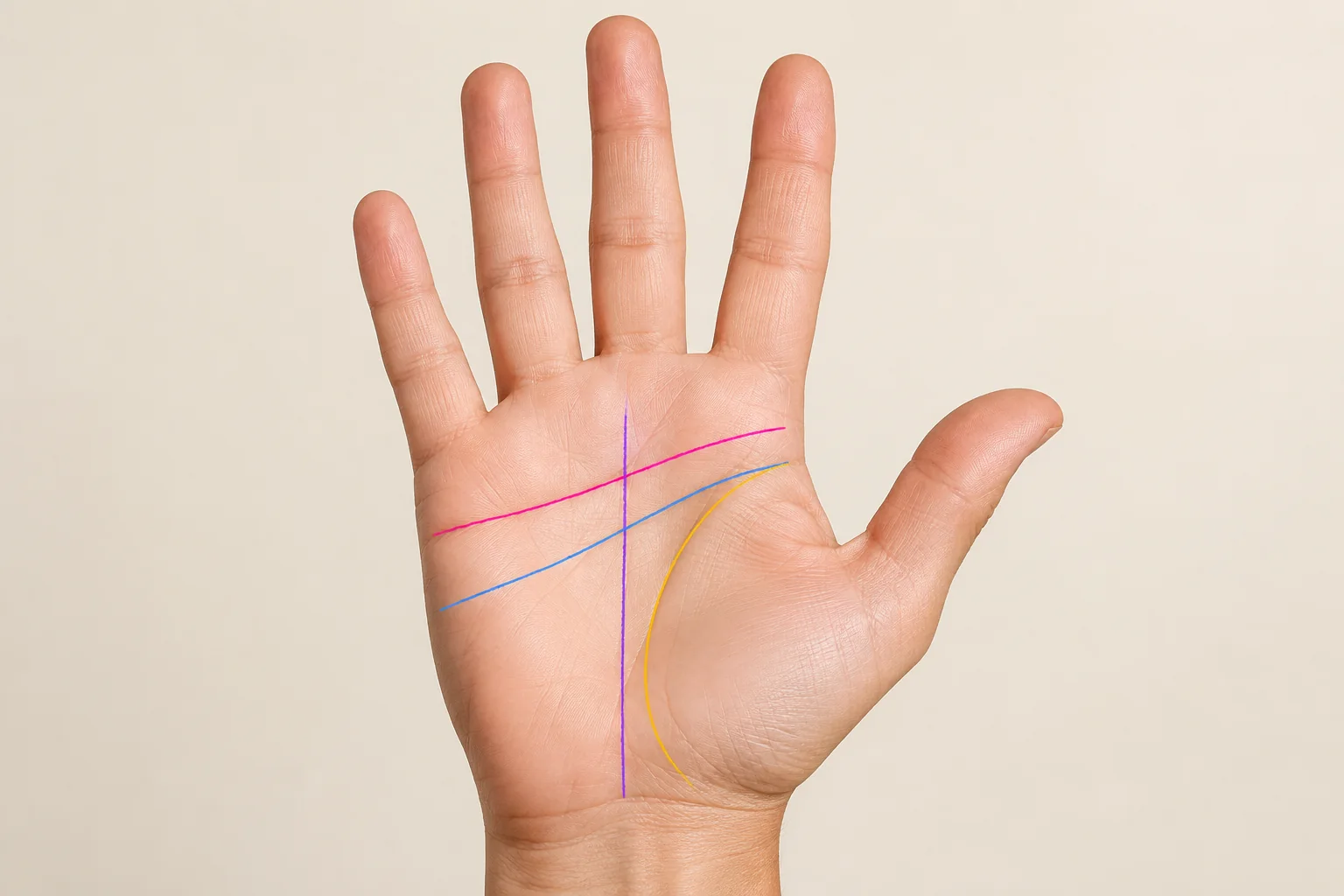
The main palm lines are flexion creases. They are the folds where skin bends when your hand opens and closes, like the creases at your knuckles. They begin to form before birth, in the first half of pregnancy, along the early planes where the hand folds.
The "life line" is the crease that wraps around the base of the thumb, and it follows how the thumb moves. It is a fold, not a clock. Skin changes with age, work and use, so lines can look deeper or lighter over time. For what palmists say about that, see do palm lines change over time?.
What studies have checked
The best-known claim in palmistry is that a longer life line means a longer life. Researchers have tested it, with mixed early results. A 1974 study by Wilson and Mather found no significant correlation. A 1990 study by Newrick and colleagues, measuring 100 cadavers, reported a correlation. A 2019 study published in Anthropological Review used the same method on 60 cadavers donated to the University of Adelaide. It found no significant correlation between life line length and age at death, and no difference between men and women or between hands. Its authors wrote that the work puts the question to rest.
That does not test everything palmistry says, and palmistry says a lot. But the claim people most want to be true has been checked more than once, and the most recent check did not support it. Treat a promise about "how long you will live" from a palm reader as a reason to be careful.
Common claims, and how to hold them
| Claim | What we know | A fair way to hold it |
|---|---|---|
| A long life line means a long life | Tested. The 2019 study found no link | Do not rely on it |
| A broken line means a crisis | We did not find controlled research linking breaks to events | A prompt to ask what changed for you |
| Marriage lines show how many partners you will have | Palmists disagree on how to count them. We found no supporting research | Treat as symbolic |
| The left hand shows what you were born with, the right shows what you made | One tradition of several. Others reverse it, and some read only the dominant hand | See which hand to read |
| Palms reveal personality | Symbolic vocabulary can help you describe yourself. It has not been shown to measure it | Use as a journaling prompt |
The pattern is the same in every row. A claim is specific, there is a story behind it, and no test it has passed. That is a reason to enjoy palmistry lightly, not to organise your life around it.
What is left
Drop the fortune-telling and you keep a few useful things. A reading gives you an excuse to slow down and look closely at your hands. It offers a symbolic vocabulary, such as head line for thinking style or heart line for emotional style, which people can use for self-reflection. It starts conversations with friends about how you each see yourselves. And it connects you to a long cultural tradition. Our guide to what a palm reading can tell you frames it the same way.
Use what you hear as a prompt, and keep decisions about money, health and legal matters with qualified professionals.
Want both hands read together?
Divine Glows offers a Full Palm Reading that compares both palms and answers your questions. It is a structured prompt for reflection, not a prediction.
- Both palms compared, not one hand alone.
- Focused on the questions you bring.
- Details on the palm reading page.
Sources
- Wilson, Mather (1974), cited in Lucas et al. (2019), as a study of life line length and life expectancy.
- Newrick, P. G. and colleagues (1990), cited in Lucas et al. (2019), 100 cadavers.
- "Predicting longevity from the line of life: is it accurate?" Anthropological Review, 2019, 82(2), 155-162. doi:10.2478/anre-2019-0011.
- Forer, B. R. (1949). "The fallacy of personal validation." Journal of Abnormal and Social Psychology, 44(1), 118-123.
Common questions about palm reading
Is palm reading scientific?
No. Palmistry has not been validated as a way to predict events, personality or lifespan. The most commonly tested claim, that life line length predicts longevity, was not supported in a 2019 study of 60 cadavers.
Do palm lines show how long you will live?
There is no good evidence that they do. Early studies disagreed, and the 2019 study found no significant correlation between life line length and age at death.
When do palm lines form?
Palm creases begin to form before birth, in the first half of pregnancy.
Which hand should you read?
Palmists disagree. Some read the dominant hand, others the non-dominant hand, and some compare both. Our guide to which hand to read in palmistry explains the main views.
Can palm reading be fun even if it is not proven?
Yes. Many people enjoy it as a reflective exercise or a conversation starter. It helps to treat it as entertainment and a prompt for thinking, not as advice.
Can I get a palm reading online?
Yes, some services read palm photos. The same cautions apply. Look for clear terms, no fear-based upsells and honest language about what a reading can and cannot do.
A Full Palm Reading
Curious what a full reading covers?
Our palm reading page explains what a structured reading looks at and how it is offered. Read it alongside the evidence above and decide for yourself.
Your Full Palm Reading maps all the important features—hand shape, skin texture, thumb, fingers, mounts, major and minor lines, markings, and the differences between both palms—and brings them together in a holistic reading focused on your questions.