
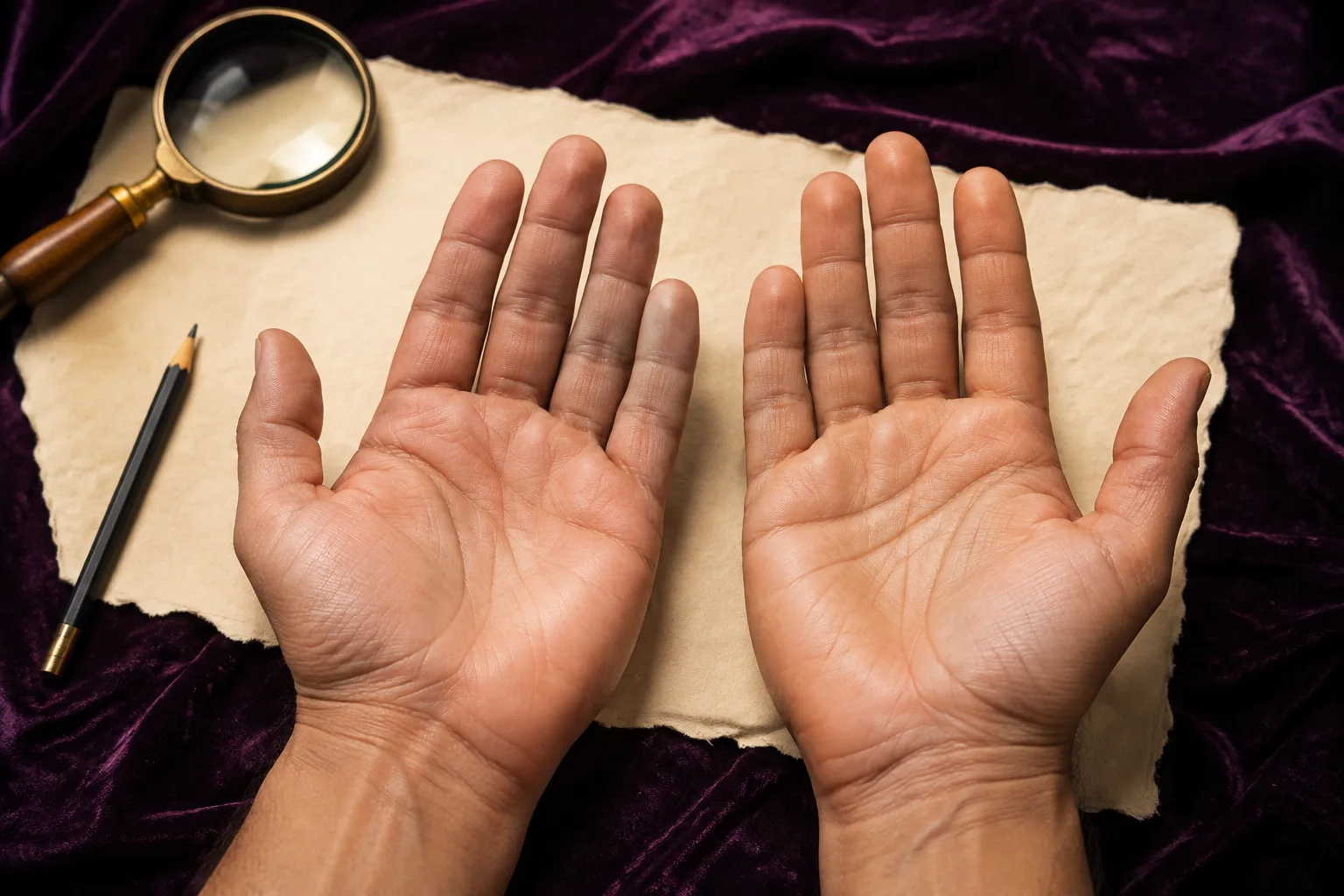
A palm reading can explore how you express emotion, approach decisions, use energy, communicate, handle responsibility, relate to work, and respond to change. It can also organize questions about love, career, money, family, and future direction. A complete reading combines hand shape, skin, thumb, fingers, prints, major lines, minor lines, and both palms to build one coherent interpretation.
A general reading becomes most useful when it shows which features repeat, which contradict each other, and where your dominant hand has developed beyond the background pattern.
What questions can palm reading answer?
| Reader question | Main palm features | What the reading explores |
|---|---|---|
| What am I like emotionally? | Heart line, Venus mount, skin texture | Expression, sensitivity, closeness, boundaries |
| How do I think and decide? | Head line, thumb, fingerprints | Practicality, imagination, concentration, independence |
| What work suits me? | Fate line, head line, fingers, Sun and Mercury lines | Structure, variety, people, ideas, craft, communication |
| What are my relationship patterns? | Heart line, Venus mount, little finger, relationship lines | Ideals, intimacy, communication, recurring dynamics |
| Where is life changing? | Differences between hands, breaks, branches, replacement lines | Development, redirection, pressure, new emphasis |
| What is my strongest theme? | Deepest line, pronounced finger, unusual print or mount | The quality that most shapes the whole reading |
Palmistry gives the most useful answer when the question is specific. “What can you tell me?” creates a broad portrait. “How do I balance stability with a career change?” lets the reader connect several features to one decision.
What every part of the hand adds
Hand shape and skin: pace and sensitivity
Hand shape provides the widest frame. Palm proportion and finger length are often grouped into earth, air, fire, or water types. Skin texture adds a traditional scale from fine and responsive to coarse and direct. These observations set the pace of the reading before any line is named.
Thumb: direction and control
The thumb is read for will, judgment, adaptability, and how strongly a person directs their own pattern. Length, the balance between its two phalanges, opening angle, and flexibility all matter. A strong feature elsewhere in the hand is expressed differently through a firm thumb than through a highly flexible one.
Fingers: the areas that seek expression
- Index/Jupiter: standards, confidence, influence, teaching, leadership.
- Middle/Saturn: structure, seriousness, boundaries, research, responsibility.
- Ring/Apollo: creativity, presentation, beauty, play, visibility, risk.
- Little/Mercury: language, negotiation, exchange, intimate communication.
Only pronounced length, setting, curve, or spacing should lead the interpretation. Average fingers support the picture without dominating it.
Major lines: the central life themes
The life line is read for vitality, roots, family, and transitions; the head line for attention and decisions; the heart line for emotional expression; and the optional fate line for direction and responsibility. Length, clarity, path, and change matter before small crosses or islands.
Minor lines and markings: supporting detail
Sun, Mercury, Mars, relationship, and Girdle of Venus lines add fulfilment, exchange, drive, partnership, and imagination. Crosses, forks, islands, squares, and triangles describe local changes only when they are clear and connected to an identifiable line or region.
Why a reader compares both hands
A common modern convention treats the non-dominant hand as the background pattern and the dominant hand as the developed or currently expressed pattern. The value comes from the comparison:
- A line stronger on the dominant hand suggests that its theme has gained clarity or emphasis.
- A weaker or more interrupted line may show that the area currently receives less energy.
- Different fingerprints or finger postures can describe a contrast between private and public style.
- A new fate or Sun line may organize a newer work direction or source of fulfilment.
Neither palm is the “bad” hand. The reading asks what stayed stable, what developed, and what appears contradictory.
Can a palm reading tell the future?
Palmists use line position to discuss broad timing and interpret branches, breaks, and new lines as possible developments. These are traditional forecasts, not fixed events. The hand is better at framing a direction—earlier versus later, stable versus changing, inward versus public—than naming an exact date or guaranteed outcome.
What happens in a complete palm reading?
- Set the question. Name love, career, family, money, direction, or a general portrait.
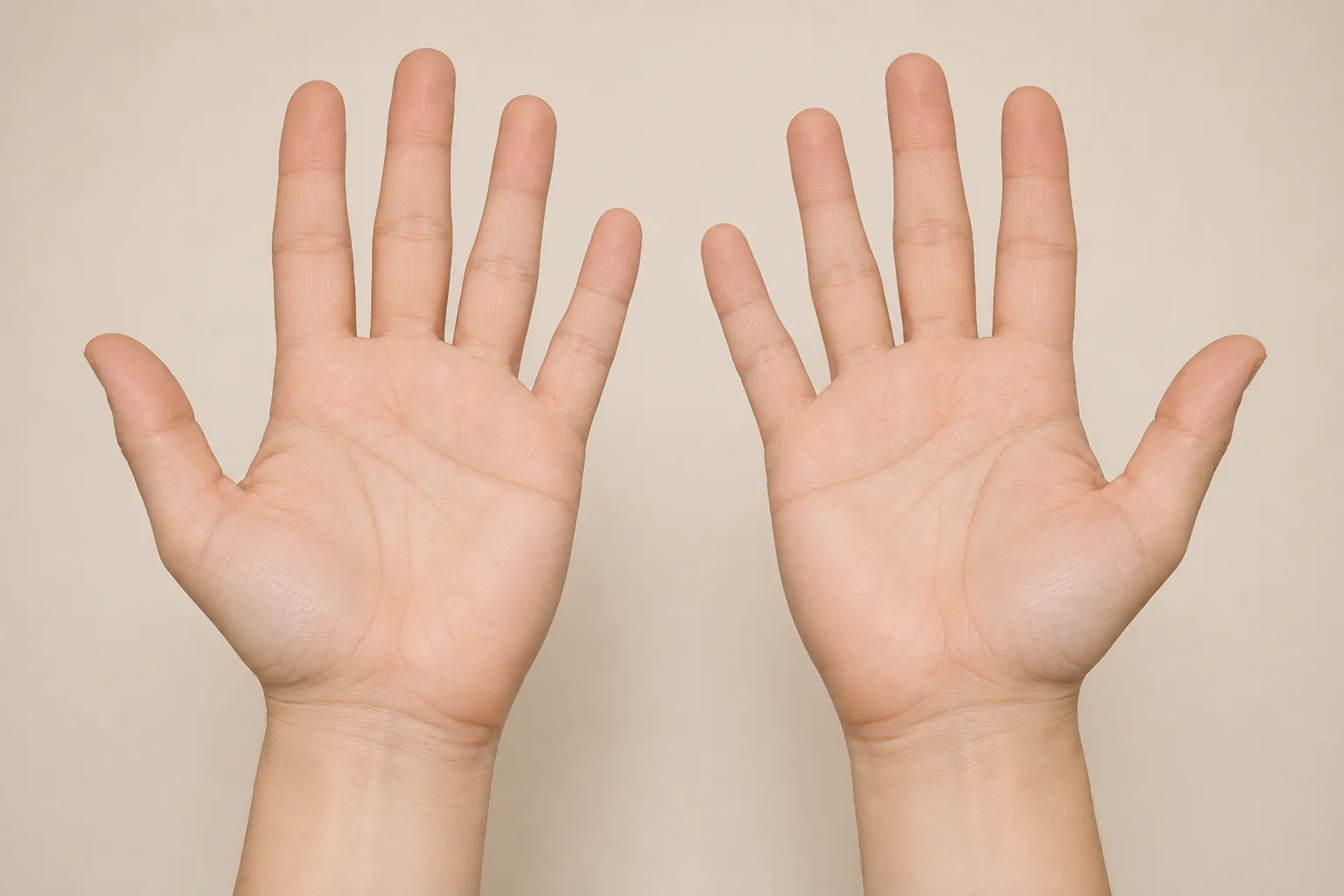
- Observe both hands. Record dominant hand, shape, texture, flexibility, and strongest visible feature.
- Read thumb and fingers. Measure proportions and note only clear differences.
- Trace the major lines. Describe each in plain visual language.
- Add minor features. Include only lines or signs clear enough to trace.
- Find repeating themes. Two or three matching clues form the core answer.
- Explain contradictions. A firm thumb with many branching lines, for example, combines control with many interests.
- Return to the question. Translate the pattern into choices, observations, and a next step.
Good questions to ask in a palm reading
- What repeats across my heart line, Venus mount, and little finger about relationships?
- Where does my fate line change, and what other feature supports that change?
- Which type of work environment matches the strongest features in my hand?
- What has developed between my non-dominant and dominant hands?
- Which quality is strongest, and which feature helps balance it?
- What should I photograph more clearly before drawing a conclusion?
What palm reading cannot establish from a line
A crease cannot confirm a medical condition, pregnancy, exact marriage date, lifespan, lottery win, another person’s secret, or a guaranteed career result. Naming that boundary briefly makes the rest of the reading more precise: it keeps attention on the themes the hand can be used to explore.
Start a complete reading
Follow the beginner sequence, use the ten-step checklist, then choose a focused love or career reading.
The complete answer
A palm reading can give you a structured portrait of emotional style, thinking, energy, communication, work preferences, relationships, and changing direction. Its depth comes from synthesis: the whole hand, both palms, the strongest repeated features, and the real question you bring to the reading.
A Full Palm Reading
Ask your question through a complete map of both palms
Your reading combines hand shape, skin texture, thumb, fingers, mounts, major lines, minor lines, markings, and both palms around the question you choose.
Your Full Palm Reading maps all the important features—hand shape, skin texture, thumb, fingers, mounts, major and minor lines, markings, and the differences between both palms—and brings them together in a holistic reading focused on your questions.