
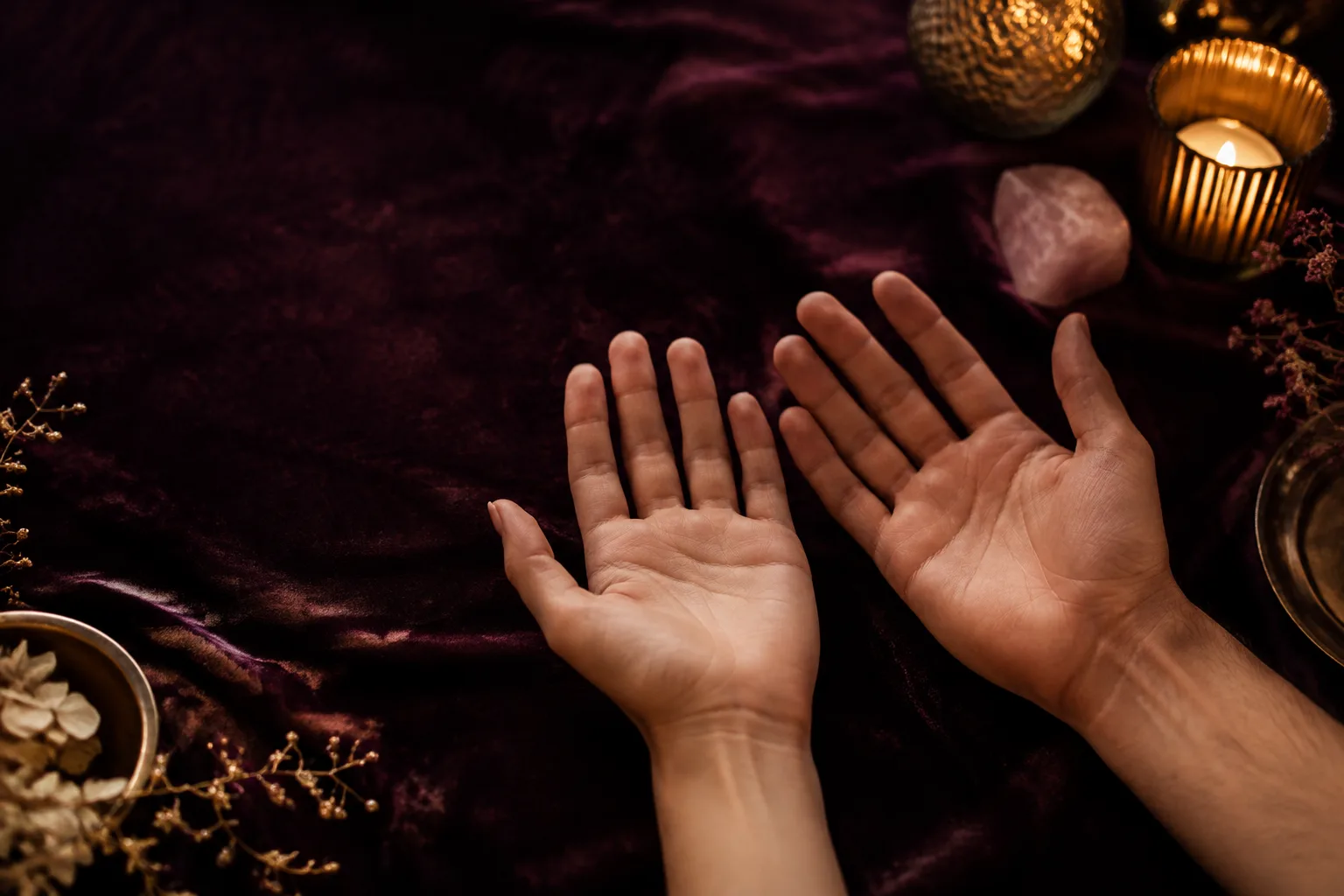
In palmistry, a love reading combines the heart line, the Venus mount at the thumb ball, the life line, relationship lines below the little finger, and the shape of the fingers and thumb. The heart line shows the central emotional pattern; the other features add desire, closeness, communication, ideals, and the way a person enters relationships. No single crease gives the whole answer.
You may be comparing a heart line, a relationship line, and a real connection that does not fit a one-line answer. A whole-hand reading can show how affection, communication, ideals, and present relationship patterns work together.
The five-part love-reading map
| Feature | Traditional question it addresses | What to observe |
|---|---|---|
| Heart line | How are feelings expressed? | Depth, length, curve, ending, branches, breaks |
| Venus mount | How warm, affectionate, or physically expressive is the style? | Fullness, firmness, fine lines, relation to the life line |
| Relationship lines | How strongly is partnership emphasized? | Only clear lines on the outer edge below the little finger |
| Little finger | How readily are needs and boundaries communicated? | Relative length, setting, straightness, flexibility |
| Index and ring fingers | How do standards, confidence, expression, and attention interact? | Relative length and any pronounced imbalance |
Begin with the features that are visibly strong. An average feature is background information; a deep heart line, very full Venus mount, unusually long relationship line, or pronounced finger difference deserves more weight.
How to read the heart line for relationships
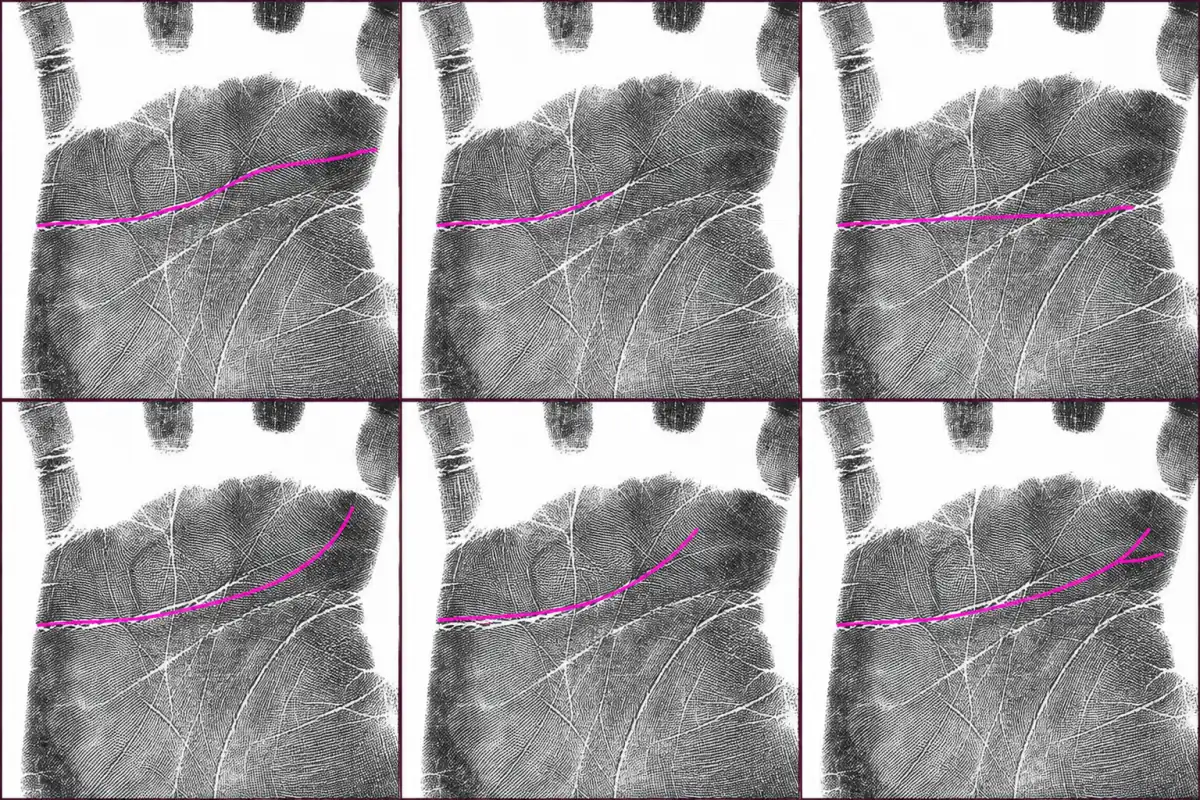
The heart line is the upper major crease running from the outer edge of the palm beneath the fingers. Read its overall quality before examining small marks.
- Deep and clear: feelings tend to be experienced and expressed consistently.
- Long: relationships and emotional bonds occupy a large part of the person’s inner life.
- Short: emotion may be concentrated, private, or expressed through action rather than extended discussion.
- Curving upward between the index and middle fingers: a balance between romantic ideals and practical expectations.
- Ending toward the index finger: selective, idealistic, or high standards in love.
- Ending toward the middle finger: a more pragmatic or self-protective approach to closeness.
- Straight: direct emotional signals and a preference for clarity.
- Upward branches: feelings moving toward expression, connection, or hope.
- Downward branches: periods when emotion is pulled into worry, disappointment, or overthinking.
- A forked ending: the ability to hold two emotional perspectives at once.
A break or island is read as a chapter within the line, not the verdict on a relationship. First check whether a second line overlaps the gap and whether the same interruption appears on both hands.
Venus mount, life line, and communication
The padded area inside the life line is the Mount of Venus. A broad, firm mount traditionally adds warmth, attachment, sensuality, and social energy. A flatter mount suggests a more contained or selective style. Many fine lines may show that relationships, family, and other people make frequent demands on the person’s attention.
The life line shows how firmly the Venus area is contained. A wide curve leaves a broad Venus mount and is read as an expansive style; a line close to the thumb creates a narrower area and a more reserved style. This is about the manner of connection, not the amount of love someone can give.
Next check the little finger. A longer, well-set little finger is traditionally linked with ease in naming needs, negotiating differences, and using language in intimate situations. A shorter or low-set little finger may point to communication that develops through trust and practice. Do not measure from the fingertip alone: first check whether its base is set lower than the other fingers.
How to read relationship lines
Relationship lines, also called affection or marriage lines, sit on the outer edge below the little finger and above the heart line. Turn the hand sideways in soft light. Give weight only to lines that are longer and clearer than the surrounding edge creases.
- A long, clear line traditionally emphasizes a lasting partnership ideal.
- An upward branch can be read as growing independence, aspiration, or a bond that changes form.
- A downward branch toward the heart line is traditionally associated with emotional strain or disappointment.
- Several faint lines are common and should not be counted as partners or marriages.
How palmists compare two people for compatibility
Compatibility is read by comparing patterns, not by trying to make two hands match. Look at these pairs:
- Skin texture: similar textures may prefer a similar pace and level of stimulation; different textures may need clearer negotiation about environment and sensitivity.
- Heart lines: compare direct versus highly expressive styles, and idealistic versus pragmatic endings.
- Index fingers: compare standards, leadership, and how each person handles influence.
- Little fingers: compare how readily each person names needs and repairs misunderstandings.
- Thumb flexibility: compare firmness with adaptability. Two very firm styles can lock horns; two highly flexible styles may avoid defining the plan.
A difference is not an incompatibility score. It identifies the conversation a couple may need: pace, affection, autonomy, decision-making, or communication.
Three example love combinations
Clear curved heart line + full Venus mount + long little finger
This combination is traditionally read as warm emotional expression supported by affection and verbal communication. The useful question is whether the person also makes room for a partner’s pace.
Straight heart line + firm thumb + short little finger
This points to loyalty shown through action, clear standards, and a need to work deliberately at verbal disclosure. The pattern can feel steady to one partner and hard to read to another.
Forked heart line + flexible thumb + several fine relationship lines
This suggests someone who sees several sides of an emotional situation and adapts readily. The growth question is where flexibility becomes indecision or blurred boundaries.
Love palm reading checklist
- Photograph both palms and the outer edge below each little finger.
- Describe each heart line in one sentence.
- Add the Venus mount and life-line curve.
- Measure the little and index fingers relative to their neighbours.
- Note only clear relationship lines.
- Find two themes that repeat and one apparent contradiction.
- Turn the result into a question about real relationship experience.
Follow the relationship path
Deepen the reading with the heart-line guide, locate the relationship lines, and compare the Venus mount.
The complete answer
A palm reading for love is strongest when the same theme appears in several places. Read emotional expression through the heart line, affection through the Venus area, communication through the little finger, relationship emphasis through clear edge lines, and compatibility through comparison. That creates a specific reading without reducing a relationship to one mark.
A Full Palm Reading
Bring the whole love pattern to your relationship question
Your reading combines the heart line, Venus area, relationship lines, little finger, thumb, and both palms to explore how affection, communication, expectations, and commitment fit together.
Your Full Palm Reading maps all the important features—hand shape, skin texture, thumb, fingers, mounts, major and minor lines, markings, and the differences between both palms—and brings them together in a holistic reading focused on your questions.