
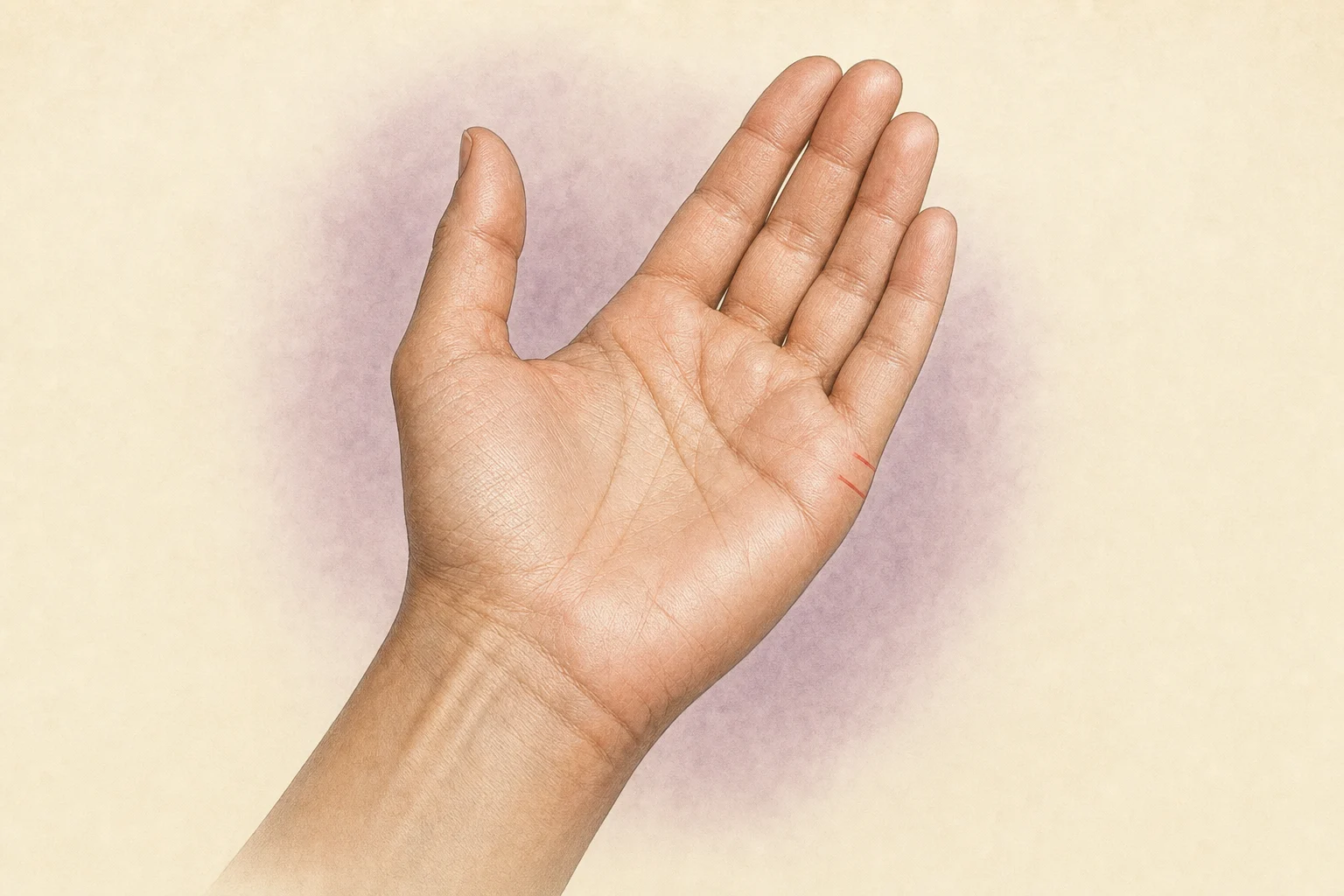
The marriage lines are short horizontal creases on the outer edge of the palm below the little finger and above the heart line. Many modern readers call them relationship, union, attachment, or affection lines because they cannot confirm legal marriage. They also cannot reliably tell how many times someone will marry, the age of a wedding, a partner’s identity, fidelity, children, or divorce.
The line that draws your attention often arrives with a real question beneath it—about love, purpose, work, or the next turning point. Let the pattern invite a deeper conversation with yourself.
The more useful approach is to treat a clear line as a traditional prompt about commitment, closeness, or expectations in significant relationships. Even then, the person’s real experiences matter more than the crease.
Where is the marriage line on the palm?
- Turn the palm slightly so the little-finger edge faces you.
- Find the heart line entering that edge lower down.
- Look in the small zone between the heart line and the base of the little finger.
- Notice any short horizontal creases running inward from the edge.
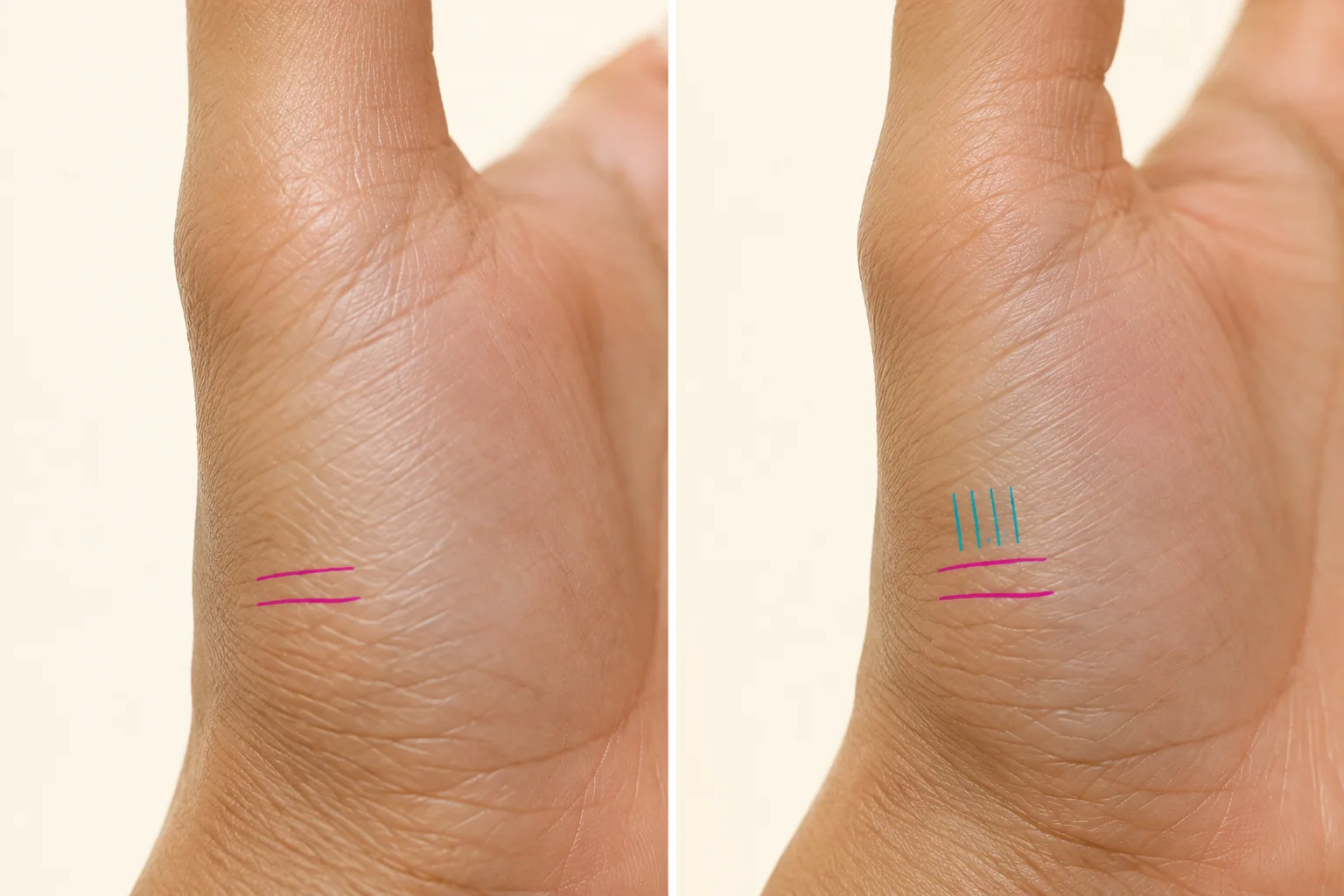
These lines are easiest to see from the side. A straight-on palm photo may hide them completely. Cup the hand gently if needed, but do not fold it tightly, because that creates temporary creases.
What do one, two, or many marriage lines mean?
They do not count marriages. Most hands contain several fine creases in this area, and visibility changes with lighting, skin texture, movement, and age. Modern palmistry also pushes back on the old practice of using these lines to count marriages or children.
Some readers give attention only to the clearest line and treat faint companions as background emotional experiences. Others interpret all visible lines. Because the methods disagree, state your convention before reading:
- One clear line: traditionally associated with one especially important bond or a focused idea of partnership.
- Two clear lines: may symbolize two formative bonds, two chapters, or competing relationship ideals—not necessarily two marriages.
- Many faint lines: may be read as sensitivity to connection, but they may simply be ordinary fine creases.
- No clear line: is normal and does not mean someone will be alone or cannot commit.
Traditional meanings of common relationship-line variations
Deep and clear line
Traditionally framed as a bond or relationship ideal that carries emotional weight. Depth does not guarantee that a relationship is healthy or permanent.
Faint or short line
Sometimes associated with privacy, a light attachment, or a relationship that is not central to identity. A faint line is also easy to invent through poor lighting, so verify it from more than one angle.
Upward-sloping line
Often read optimistically as growth, independence within partnership, or an ideal that remains strong. It cannot promise a happy marriage.
Downward-sloping line
Traditionally linked with emotional distance, changing priorities, or a bond that asks for care. Older books may call a line that drops toward the heart line a “divorce line.” That label is unnecessarily frightening and cannot predict separation.
Fork at the end
A fork may prompt discussion of diverging needs, distance, or a relationship entering two possible directions. It is not evidence that a breakup will occur.
Break, chain, or island
These shapes are traditionally associated with interruptions, ambiguity, or a complicated period. First check whether you are seeing overlapping fine creases rather than one broken line. Never use a mark to accuse a partner of infidelity or concealment.
Can the marriage line predict marriage age?
No reliable method can. Traditional timing systems divide the small area between the heart line and little finger into age zones, but the scales differ among readers and depend on vague landmarks. A millimeter of photographic distortion can change the supposed year dramatically.
If timing language is used at all, keep it broad and retrospective: “This line sits lower in the zone, which some traditions associate with an earlier adult bond.” Do not provide a wedding deadline or tell someone they have missed their chance.
Which hand is used for the marriage line?
Compare both. A common modern convention uses the dominant hand for present patterns and choices and the other for background tendencies. Other schools use different rules. Gender does not make one hand inherently correct, so the method is the same for women, men, and nonbinary people. Our guide to which hand to read explains the conventions.
Read relationship lines with the heart line—and real life
The heart line is the broader palmistry feature for emotional expression and closeness. Compare its direction and quality before discussing a tiny relationship line. Then ask open questions about values, communication, boundaries, and what commitment means to the person.
Do not use palmistry to decide whether someone should marry, stay, leave, trust a partner, or tolerate abuse. If a person is unsafe, practical support from trusted people and appropriate professional services matters more than any line.
A relationship line can start a conversation about commitment. It cannot count spouses, certify compatibility, or sentence a relationship.
Research and source note
The alternative term “affection lines,” their edge-of-palm location, and the criticism of marriage-counting come from modern palmistry teaching. Interpretations above summarize broader palmistry conventions and are offered for reflection rather than as fixed forecasts.
The bottom line
The so-called marriage lines sit below the little finger on the outer palm. Call them relationship or affection lines, focus on clear features, and avoid counting weddings or assigning exact ages. Their meanings are traditional reflections, not facts about anyone’s romantic future.
A Full Palm Reading
Read your relationship line as part of the whole love pattern
A personal reading places the fine lines below the little finger beside your heart line, Venus mount, communication indicators, and both palms before addressing your relationship question.
Your Full Palm Reading maps all the important features—hand shape, skin texture, thumb, fingers, mounts, major and minor lines, markings, and the differences between both palms—and brings them together in a holistic reading focused on your questions.