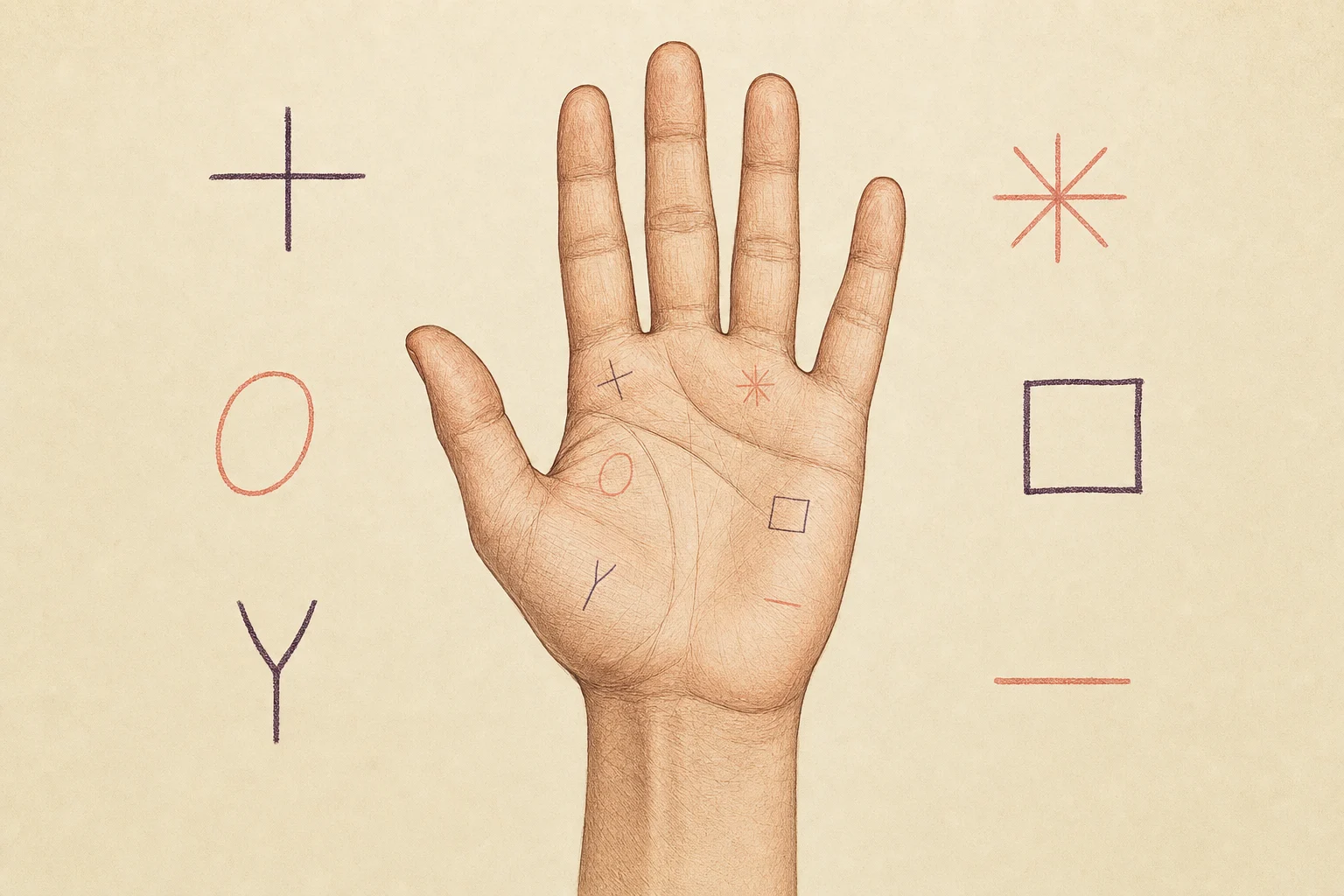
Common palmistry marks include crosses, stars, islands, squares, triangles, forks, branches, and bars. Their traditional meaning depends on where they appear and which line they affect. A cross on the life line is not read the same way as a cross under the index finger—and many apparent symbols are simply overlapping natural creases.
The line that draws your attention often arrives with a real question beneath it—about love, purpose, work, or the next turning point. Let the pattern invite a deeper conversation with yourself.
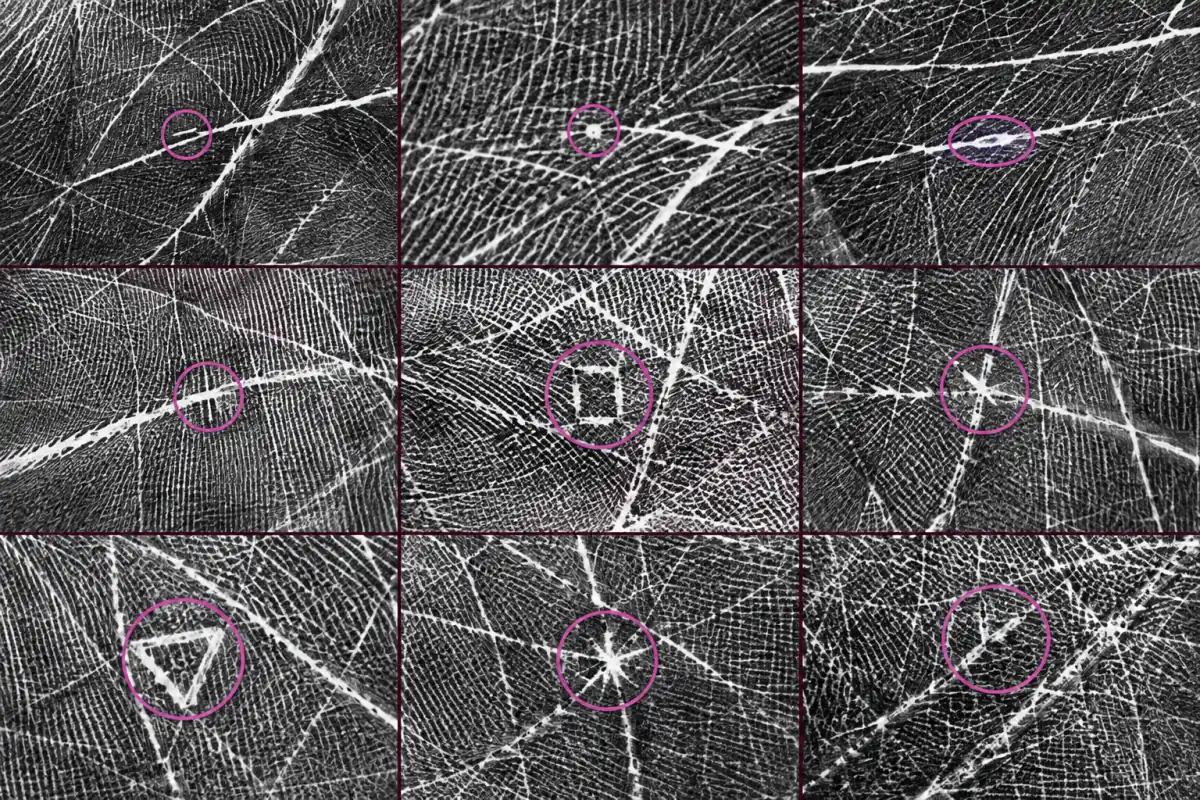
Minor marks should be read last, after the whole hand and major lines. An observation-first system is skeptical of dramatic “rare signs,” so random shapes do not outweigh clearer features. That restraint is useful: searching hard enough for a star or letter makes almost any palm produce one.
How to tell whether a palm mark is really present
- Relax the hand under bright, indirect light.
- View the feature from at least two angles.
- Separate major creases, fine secondary lines, friction ridges, scars, and temporary skin folds.
- Trace the shape without filling in a missing side in your imagination.
- Record its exact location and the line it touches.
- If the mark is faint, incomplete, or visible only in one photograph, leave it unread.
A true palmistry “square,” for example, should have four reasonably visible sides. Two crossing lines are a cross, not automatically a star. An island is a line that divides and rejoins, not every oval created by unrelated creases.
Traditional meanings of common palmistry symbols
Cross
A cross is formed by two short lines intersecting. Traditionally it marks tension, a choice, a meeting point, or an interruption in the theme of its location. Some schools give special names to crosses in particular zones, but an isolated X cannot prove psychic ability or a major event.
Star
A star usually requires three or more short lines meeting at one central point. It is often read as concentration, sudden emphasis, or an intensified expression of the line or area. “Lucky star” and “danger star” interpretations vary widely and should not be used to forecast windfalls, accidents, fame, or death.
Island
An island appears when a line splits around a small oval space and rejoins. Palmists traditionally associate it with diffusion, complication, delay, or energy spread across competing concerns. On a head or life line it must never be turned into a medical diagnosis.
Square
A clear four-sided enclosure is often called a protection mark, suggesting containment, boundaries, recovery, or support around a difficult section. The interpretation is symbolic; it does not make a risky situation safe.
Triangle
Three lines forming a closed shape may be read as focus, strategy, learning, or a talent applied within the surrounding area. Random intersections frequently create partial triangles, so require three visible sides.
Fork
A fork is one line dividing into two clear ends. It often symbolizes two directions, a widening perspective, or divided priorities. Its meaning changes with the line: a fork on the head line may prompt a different question than one at the end of the life line.
Branch
A branch is a smaller line leaving a main line. Upward branches are commonly framed as initiative or movement toward an aim; downward branches as dispersal, withdrawal, or obligations. “Up is good, down is bad” is too simplistic.
Bar
A short line cutting across another line is traditionally read as resistance, a boundary, or an interruption. First confirm that it is not simply part of the normal mesh of fine creases.
Chain or tassel
A chained line contains repeated small loops; a tassel separates into several fine ends. Palmistry often describes these as complexity, scattered attention, or a period with many demands. They are descriptive shapes, not proof of stress or disease.
Why the mark’s location matters more than its name
Use a three-part sentence: shape + location + line theme. For example, “A fork at the end of the head line is traditionally used to discuss two ways of processing or expressing an idea.” That is more precise than “You have a fork, so two futures are coming.”
Check the mark against these contexts:
- Life line: grounding, energy, support, and transitions—not lifespan.
- Head line: attention and decision style—not intelligence or mental health.
- Heart line: emotional expression and closeness—not fidelity or marriage outcome.
- Fate line: direction and responsibilities—not unavoidable destiny.
- Area below a finger: the symbolic theme assigned to that finger in the palmistry school being used.
Seven mistakes when reading rare palm signs
- Searching for letters, initials, numbers, animals, or religious symbols in random creases.
- Calling two crossing lines a multi-point star.
- Ignoring scars, calluses, dry skin, lighting, or hand tension.
- Reading a faint mark that appears only in a compressed photo.
- Assigning the same meaning regardless of location.
- Using a single mark to predict health, death, pregnancy, marriage, money, or danger.
- Letting a sensational symbol override the major lines and the person’s lived experience.
Can palm marks change?
Fine creases can look different with hydration, movement, work, aging, injury, and image quality. Major flexion creases are more stable, while small intersections may become more or less visible. A visual difference does not prove that destiny changed. Photograph both hands in the same position and light before comparing.
A reliable order for reading the palm
- Observe the whole hand and compare both sides.
- Locate the life, head, and heart lines.
- Add the fate line if it is clearly present.
- Describe each major line’s path, depth, and continuity.
- Only then consider clear minor lines and markings.
- Finish with one or two conditional themes rather than a list of predictions.
Start with the major lines
If a small mark sits on a major crease, identify that crease first with our guides to the life line, head line, and heart line.
Research and source note
The identification sequence, major-line variations, and caution around random markings draw on modern palmistry practice. Historical palmistry terminology can also be explored through the Library of Congress Chiromantia collection. Meanings here are descriptions of tradition, offered for reflection.
The bottom line
Confirm a mark’s shape, name its location, and connect it to the line it affects. Crosses, stars, islands, squares, and forks should add nuance only after the major lines are clear. Tiny shapes cannot diagnose a condition or predict a fixed event.
A Full Palm Reading
Find out whether a palm mark changes the wider pattern
Your reading identifies the mark, checks which line or mount it touches, compares the other hand, and looks for the same theme in the rest of the palm.
Your Full Palm Reading maps all the important features—hand shape, skin texture, thumb, fingers, mounts, major and minor lines, markings, and the differences between both palms—and brings them together in a holistic reading focused on your questions.