
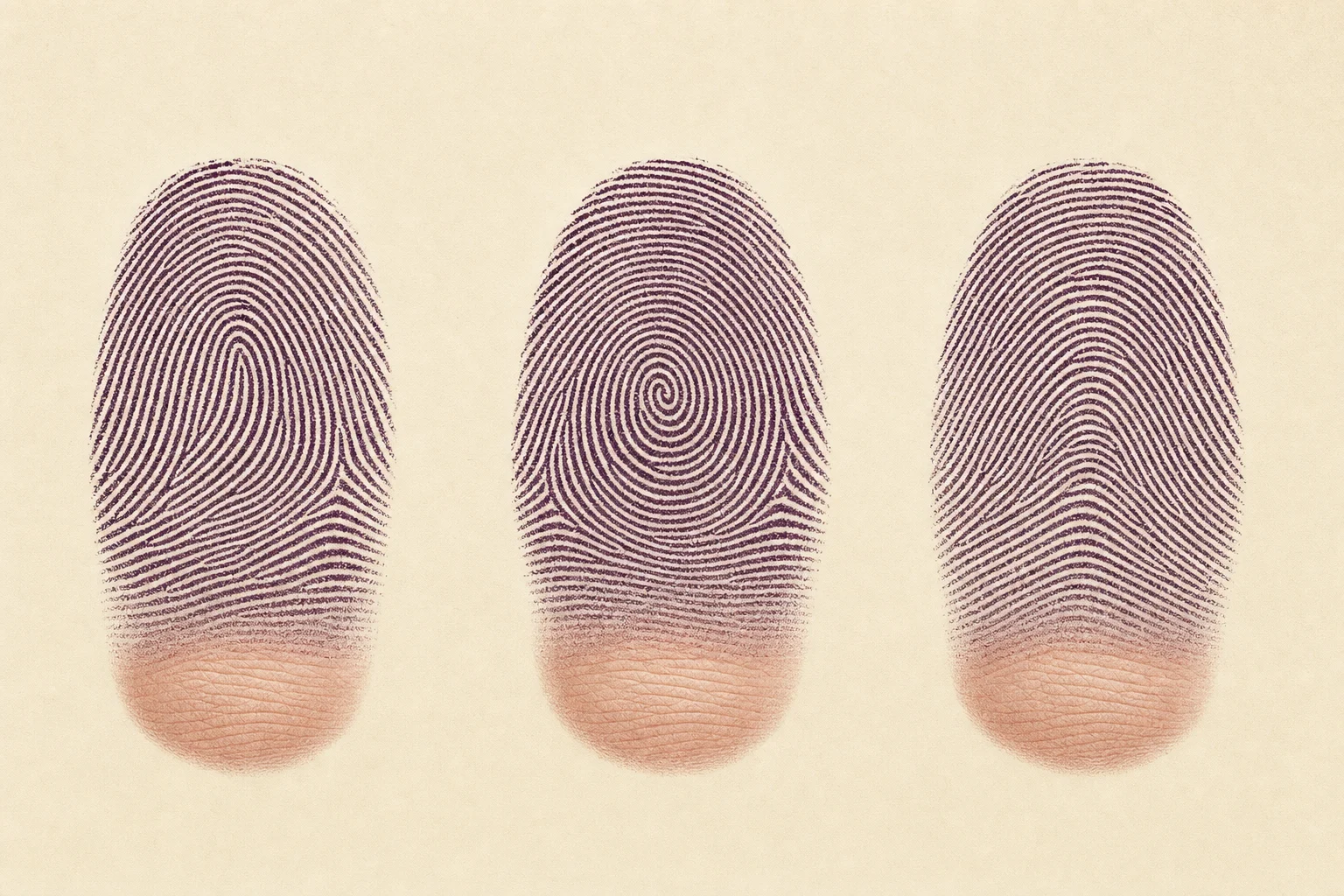
Fingerprints in palmistry are usually read as loops, whorls, arches, tented arches, and composite or double-loop patterns. Palmistry attaches symbolic personality themes to those patterns. Science supports the existence, prenatal development, persistence, and forensic classification of friction ridges; it does not establish that a whorl means independence or an arch means a particular temperament.
The line that draws your attention often arrives with a real question beneath it—about love, purpose, work, or the next turning point. Let the pattern invite a deeper conversation with yourself.
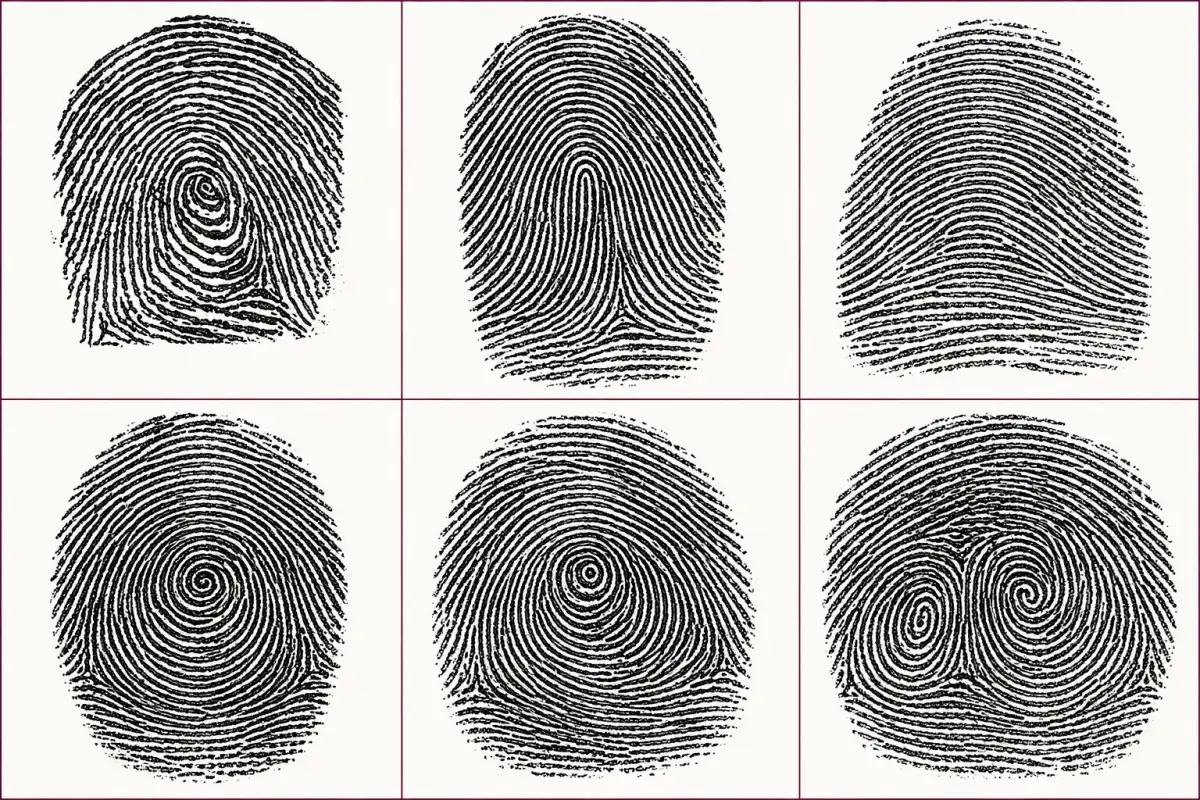
This distinction matters because the word dermatoglyphics sounds scientific. It simply refers to the study of ridge patterns on fingers, palms, toes, and soles. A scientific name for the physical feature does not validate every psychological meaning later attached to it.
What fingerprint science actually supports
Friction ridges develop before birth through a mixture of biological growth, genetics, and prenatal conditions. Once formed, their overall configurations are persistent unless deep skin damage or a medical condition alters them. Fingerprints are valuable for identification because ridge details are highly individual.
The US National Institute of Standards and Technology groups fingerprint impressions broadly into arches, loops, and whorls, with subtypes inside those categories. Researchers also study how ridges form and how some patterns correlate statistically with development or medical conditions. A statistical association in a studied group is not a diagnosis and does not support fortune-telling or individual personality profiling.
The main fingerprint pattern families
Loop
In a loop, ridges enter from one side, curve around a core, and leave on the same side. Loops may be called ulnar or radial according to their direction on the hand. Direction should be determined from the actual finger, not from a mirrored selfie.
Whorl
A whorl has circular, spiral, or strongly recurving ridge flow and generally two deltas in formal classification. Plain whorls, central-pocket loops, double loops, and accidental whorls are distinct forensic subtypes. Palmistry books sometimes use “composite” for a double-loop-like formation, so terminology may not match NIST classification exactly.
Plain arch
In a plain arch, ridges generally flow from one side to the other with a gentle rise in the center. It lacks the recurve of a loop and the circular structure of a whorl.
Tented arch
A tented arch rises more sharply or forms an angle in the center. It can be confused with a loop in a low-quality image, which is why conservative classification matters.
Friction-ridge patterns also occur across the palm, but a palmprint is not simply an enlarged fingerprint. NIST's quick pattern categories are intended for fingertip impressions, while palm examination uses different landmarks and ridge-flow areas. A casual palmistry reader should avoid forcing every palm ridge into a loop, whorl, or arch label.
What palmistry traditionally says about the patterns
The following are traditional associations, not measured traits:
- Loop: receptiveness, adaptability, and moving with a social current.
- Whorl: focus, privacy, individuality, or specialization.
- Plain arch: practicality, caution, directness, or preference for the concrete.
- Tented arch: intensity, enthusiasm, sensitivity, or a quick response.
- Double loop or composite: seeing two sides, ambivalence, or combining viewpoints.
One fingerprint method first names the pattern, then combines it with the finger’s symbolic theme—for example, communication for the little finger or self-direction for the index finger. As a reading technique, this creates more specific prompts. A whorl on an index finger is not evidence of secrecy, and a loop on a little finger does not measure communication skill.
Fingerprints are not palm lines
Fingerprint ridges are fine, closely spaced friction ridges. The heart, head, and life lines are larger flexion creases that help the palm fold. Minor palmistry marks are intersections or shapes formed by creases and fine lines. Mixing these systems leads people to “find” symbols that are only normal ridge flow.
How to inspect a fingerprint pattern
- Wash and dry the hands gently; heavy lotion can hide ridge detail.
- Use bright, indirect light and a magnifier, or a close photograph if privacy permits.
- Identify the overall flow before looking for tiny ridge details.
- Classify only a clear pattern. If the image is blurred or partial, leave it unknown.
- Record the finger and hand because loop direction depends on orientation.
There is no need to ink another person’s fingers for a casual palmistry exercise. If you do make prints with informed consent, avoid leaving biometric records lying around and destroy unwanted copies securely.
Treat fingerprints as sensitive biometric information
A high-resolution palm photograph can contain fingerprints, scars, jewelry, and other identifying details. Before uploading one to an online service, check why it is collected, where it is stored, who can access it, and how deletion works. Crop out unrelated details, remove image metadata if appropriate, and never post another person’s print without permission.
Research and source note
- NIST: fingerprint pattern classification
- PubMed: a biological model of fingerprint formation
- PMC: the history and uncertainty of clinical dermatoglyphics
The bottom line
Loops, whorls, and arches are genuine friction-ridge patterns with scientific uses in development research and identification. Their palmistry meanings are symbolic. Classify only clear prints, protect biometric privacy, and never use a fingerprint pattern to diagnose health or define someone’s personality.
A Full Palm Reading
Place your fingerprint pattern inside a complete hand reading
Your reading notes loops, whorls, and arches without isolating them, then compares their repeated themes with your fingers, mounts, and major lines.
Your Full Palm Reading maps all the important features—hand shape, skin texture, thumb, fingers, mounts, major and minor lines, markings, and the differences between both palms—and brings them together in a holistic reading focused on your questions.