
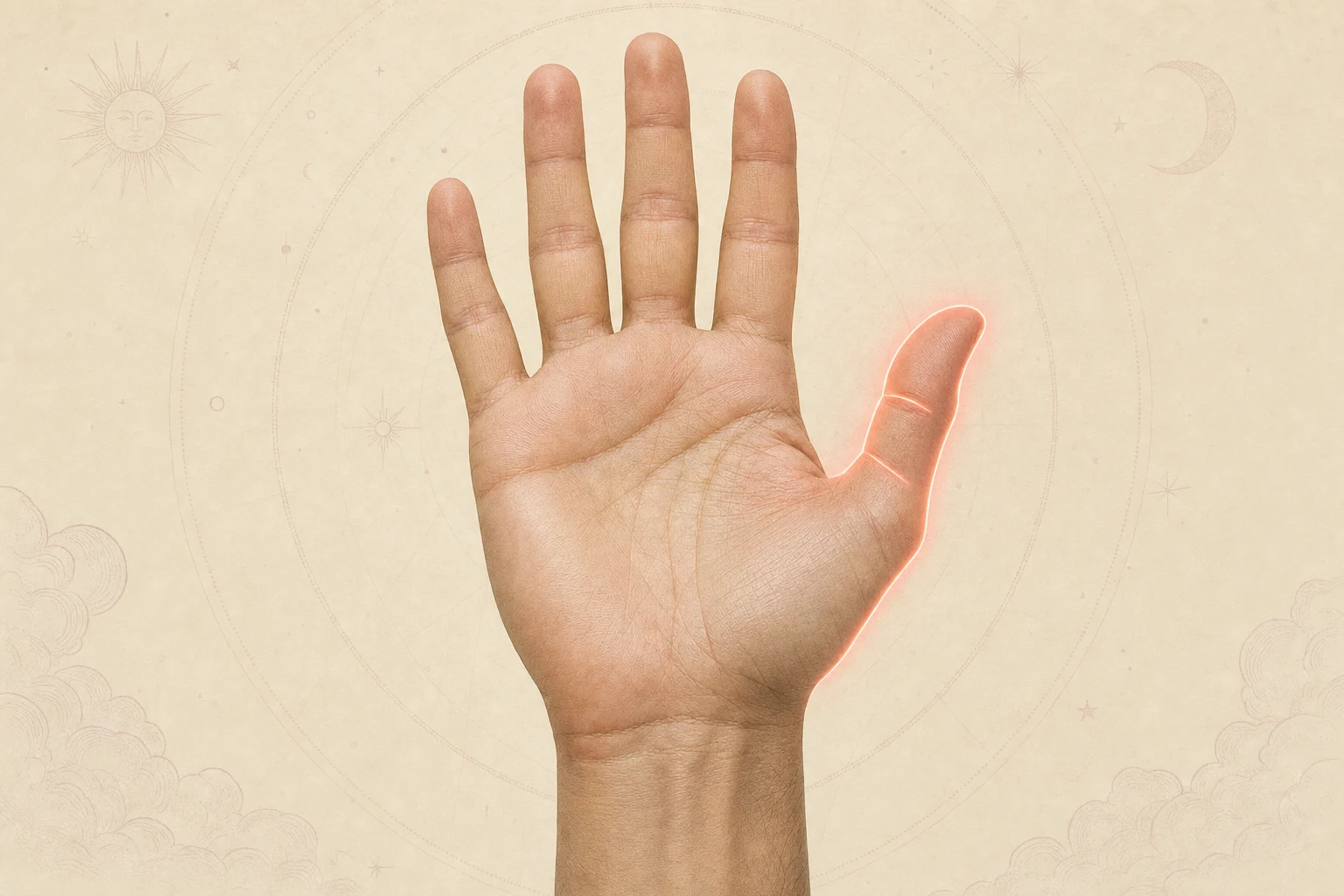
In Western palmistry, the thumb is traditionally associated with will, judgment, and the way a person directs effort. Readers may compare its length, proportions, natural angle, and flexibility. These are symbolic conventions, not a validated personality test: a long, short, straight, or flexible thumb cannot prove discipline, intelligence, honesty, or future success.
The line that draws your attention often arrives with a real question beneath it—about love, purpose, work, or the next turning point. Let the pattern invite a deeper conversation with yourself.
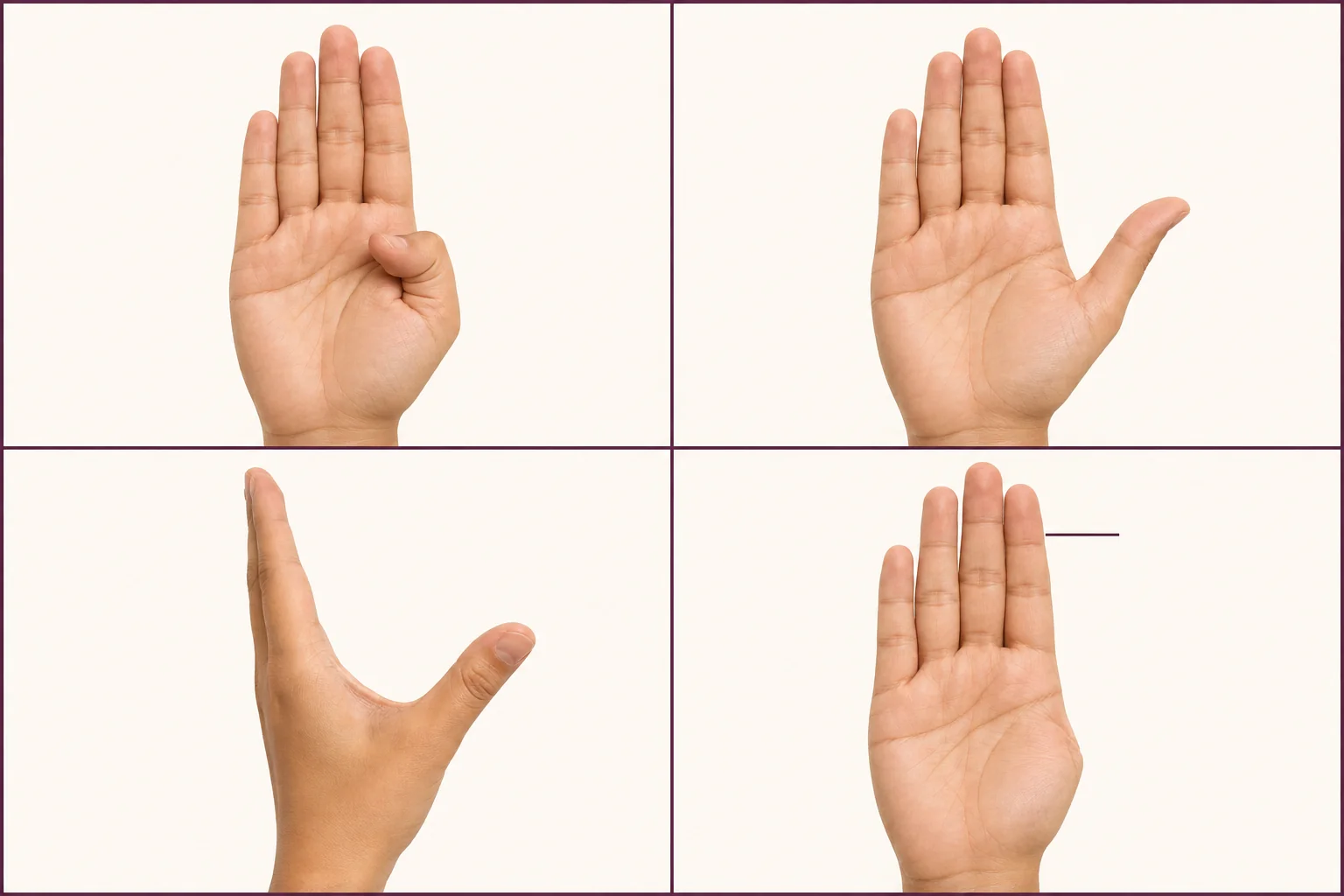
The thumb deserves attention for a non-mystical reason too. Its opposition to the fingers is central to many grips and precise hand movements. Anatomy, genetics, joint structure, age, injury, and mobility all affect how a thumb looks and moves. A responsible reading keeps those physical facts separate from traditional interpretation.
How to observe the thumb safely
- Let both hands rest naturally instead of stretching the fingers.
- View the palm straight on, then from the side.
- Compare the thumb with the same person’s index finger and palm—not with a generic ideal hand.
- Notice length, the two visible thumb sections, the natural opening angle, and how close it rests to the palm.
- Compare the active and less-active hands before assigning any symbolic theme.
Do not pull another person’s thumb backward to “test” it. Hypermobility, arthritis, past injury, pain, and connective-tissue differences can all affect range of motion. If flexibility matters to the observation, ask the person to move the thumb only within a comfortable range.
What long and short thumbs traditionally mean
One practical traditional method lays the thumb alongside the palm and compares its tip with the lower section of the index finger. This is more repeatable than guessing, although thumb placement and hand proportions still make the result approximate.
Long thumb
A thumb reaching relatively high along the lower index-finger section is traditionally read as deliberate effort, persistence, or a preference for directing one’s own course. That language is best turned into an open question: “Do you tend to stay with a plan once you choose it?” It should not become “You always have strong willpower.”
Short thumb
A proportionally shorter thumb is often associated with spontaneity, responsiveness, or acting from the whole situation rather than a fixed plan. Older manuals sometimes turn this into a judgment about weak character. Avoid that leap. A short thumb is a normal anatomical variation, and adaptability is not a defect.
Balanced proportions
Most thumbs do not look dramatically long or short. When a feature is close to average, do not force an interpretation merely to fill a reading. Observation-first palmistry gives more weight to clear differences and leaves ordinary variation alone.
What do the two thumb sections represent?
The thumb has two phalanges. Some palmistry schools associate the upper section near the nail with will or initiative and the lower section with reasoning or planning. A reader may compare their apparent lengths and balance:
- Upper section appears longer: traditionally framed as acting decisively or leading with determination.
- Lower section appears longer: traditionally framed as considering options before acting.
- Similar proportions: traditionally described as a balance between decision and deliberation.
Perspective easily distorts these proportions in photographs. Use a straight-on image, keep the thumb relaxed, and treat a small difference as inconclusive.
Flexible, stiff, open, and close-set thumbs
Flexible thumb
A thumb that naturally opens widely or bends easily is commonly associated with adaptability, generosity, or a willingness to change course. That does not make the person unreliable, suggestible, or financially careless—claims found in some older readings but unsupported by evidence.
Less-flexible thumb
A thumb that stays relatively straight or close to the hand is traditionally linked with steadiness, privacy, restraint, or conserving resources. It must not be used to label someone controlling or stubborn. Joint mobility is physical, and reduced motion can have many ordinary causes.
Natural opening angle
Some readers observe the angle between the thumb and index finger while the hand is relaxed. A broad opening may prompt discussion of independence or openness; a narrower resting angle may prompt discussion of caution or boundaries. Hand position changes this angle immediately, so it is a light contextual clue, not a verdict.
Does thumb shape reveal personality?
Palmistry books describe rounded, square, tapering, broad, and waisted thumbs. These labels vary by school, and extreme character claims attached to them are especially unreliable. Describe only what is visible—“the tip is broad,” “the lower section narrows,” or “the thumb rests close to the palm”—before offering any traditional association.
Never infer violence, morality, intelligence, sexuality, addiction, or mental health from thumb shape. Those claims are neither fair nor scientifically established.
How to read the thumb with the rest of the hand
The thumb is most useful as one part of a sequence. Compare it with the head line for a traditional discussion of decisions and with the life line for themes of grounding and energy. If the clues appear contradictory, keep the contradiction instead of forcing a neat label. A person can be deliberate in one setting and flexible in another.
Good practice describes a visible feature, names the tradition, and asks a question. It does not diagnose a person from their hand.
Research and source note
This guide uses a traditional observation sequence and thumb-measurement method. The symbolic interpretations in this article are offered for reflection and entertainment.
The bottom line
Palmists traditionally read the thumb for will, planning, and adaptability, using length, proportions, angle, and flexibility. Observe it gently, compare both hands, and phrase meanings conditionally. Physical thumb features cannot establish character or predict what someone will do.
A Full Palm Reading
Connect your thumb pattern with the decisions you are facing
Your reading considers thumb angle, flexibility, proportions, and the Venus area alongside the head and fate lines, instead of turning one thumb feature into a fixed label.
Your Full Palm Reading maps all the important features—hand shape, skin texture, thumb, fingers, mounts, major and minor lines, markings, and the differences between both palms—and brings them together in a holistic reading focused on your questions.