
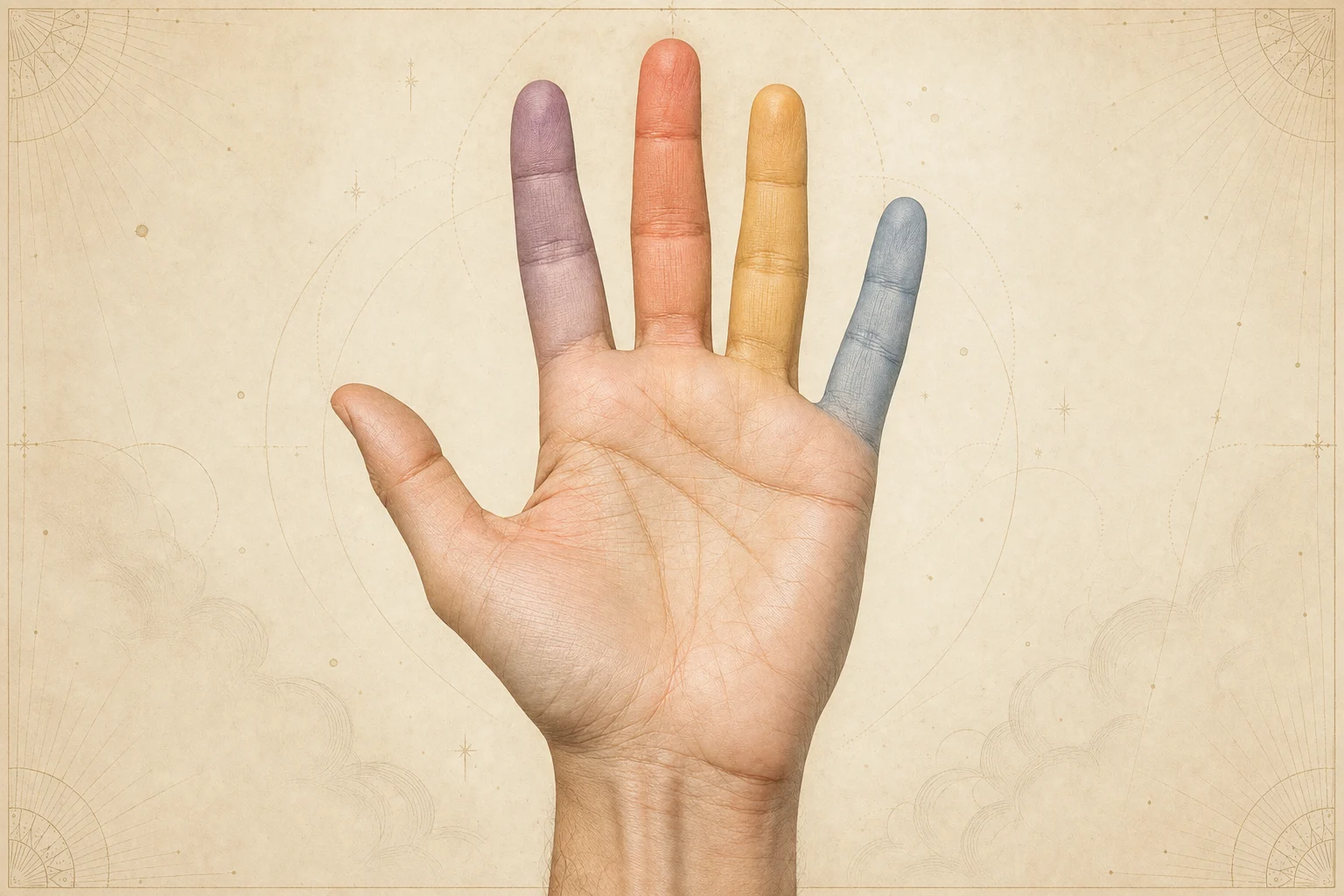
Western palmistry traditionally assigns a theme to each finger: the index finger to self-direction and ambition, the middle finger to structure and responsibility, the ring finger to expression and visibility, and the little finger to communication. Their older planetary names are Jupiter, Saturn, Apollo, and Mercury.
The line that draws your attention often arrives with a real question beneath it—about love, purpose, work, or the next turning point. Let the pattern invite a deeper conversation with yourself.
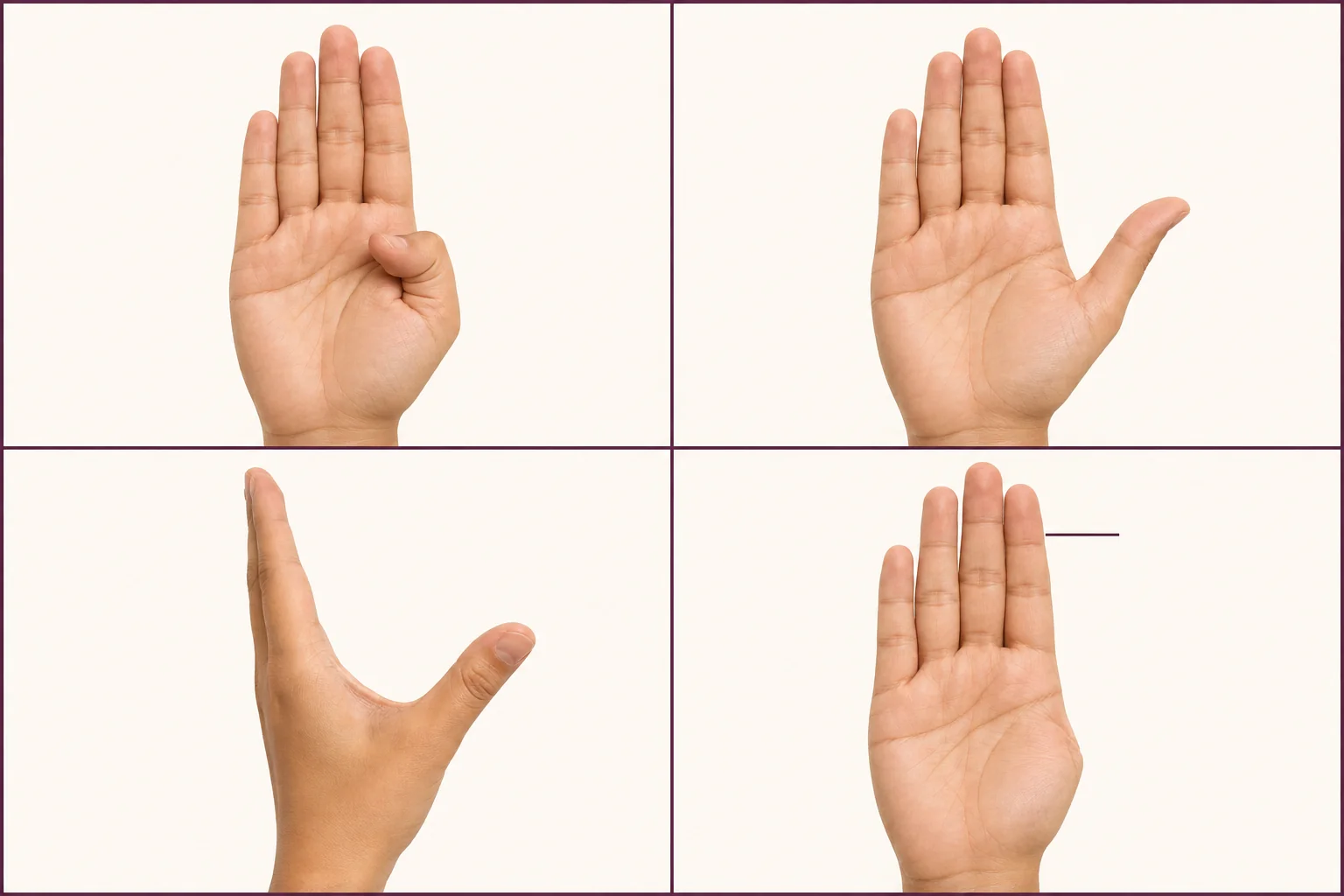
One modern palmistry system uses memorable alternatives: “mirror” for the index finger, “wall” for the middle, “peacock” for the ring, and “antenna” for the little finger. These metaphors are useful for remembering the map, but neither the metaphors nor finger lengths scientifically reveal personality.
How to compare finger length
Finger-reading is comparative. A photograph taken at an angle can make one digit look much longer than another, so begin with both hands flat or comfortably upright and the camera parallel to the palm.
- Check whether a finger begins lower in the palm than its neighbor; a low-set finger can look shorter than it is.
- Compare the index and ring fingertips while moving the middle finger out of the visual line.
- For the middle finger, notice how far it rises above the index and ring fingers.
- For the little finger, compare its tip with the top joint crease of the ring finger.
- Repeat the observation on the other hand and record only clear differences.
Do not stretch, pull, or force fingers backward. Curvature, injury, arthritis, joint laxity, and ordinary asymmetry can affect apparent length and flexibility. If a feature causes pain or concern, it belongs with a qualified clinician—not a palm reading.
Traditional meaning of each finger
Index finger: Jupiter or “mirror” finger
The index finger is commonly associated with self-image, aspiration, leadership, and the wish to influence one’s environment. A relatively prominent index finger may be framed as comfort with responsibility or personal standards. A shorter-looking index finger may invite reflection on collaboration, private ambition, or how confidently someone takes up space.
Avoid turning either observation into a diagnosis of high or low self-esteem. Confidence changes by context and experience; it is not measured by a fingertip.
Middle finger: Saturn or “wall” finger
The middle finger is traditionally linked with structure, duty, boundaries, seriousness, and a person’s relationship to rules. Because it is normally the longest finger, the question is not whether it is long in absolute terms but whether it appears unusually prominent or short relative to the hand.
A strong visual emphasis may prompt discussion of order and responsibility. A less-emphasized or curved middle finger may be interpreted as a more individual relationship with convention. Neither feature proves reliability, morality, depression, or rebelliousness.
Ring finger: Apollo or “peacock” finger
The ring finger is associated with creativity, presentation, recognition, risk, and the public face. Palmists often compare it directly with the index finger. When it extends noticeably farther, tradition may emphasize self-expression or comfort being seen; when the index dominates, the reading may emphasize direction or authority instead.
Digit-ratio research examines group-level biological associations, but it does not turn an individual ring finger into a reliable test for talent, sexuality, aggression, sporting ability, or prenatal hormone exposure. Do not use palmistry to make those claims.
Little finger: Mercury or “antenna” finger
The little finger traditionally represents language, negotiation, social exchange, and intimate communication. Its base is often lower than the ring finger’s base, which can create the illusion of unusual shortness. Check the set before comparing the tip.
A prominent little finger is sometimes framed as ease with words or commerce; a shorter-looking one as a more private or deliberate communication style. It cannot establish honesty, financial skill, sexual maturity, or the quality of someone’s parents—older claims that go far beyond observation.
What finger set, curve, spacing, and flexibility mean
- Low-set finger: begins visibly lower in the palm. Note it before judging length; traditional meanings vary.
- Finger leaning toward a neighbor: some readers blend the themes of the two fingers, but natural curvature and joint structure are common.
- Wide resting gap: may be used symbolically for independence in that area; the hand must be relaxed for the observation to mean anything.
- Close resting fingers: may be framed as caution, coordination, or privacy rather than dependence.
- Flexible fingers: traditionally associated with responsiveness; physically, flexibility reflects joints and connective tissue.
- Less-flexible fingers: traditionally associated with consistency; physically, mobility can change with age, work, pain, and health.
How to combine the four finger themes
Look for balance rather than a winning finger. A visibly strong index and ring finger could prompt a conversation about directing creative work. A prominent middle and little finger could invite questions about communicating within structured settings. If no digit stands out, say so and continue to the thumb, major lines, and overall hand.
Contradictions are more realistic than rigid types. Someone may enjoy public presentation yet prefer private decision-making. Palmistry is more respectful when it offers several possibilities and lets the person describe their actual experience.
What finger proportions cannot tell you
Finger length or shape cannot diagnose mental health, neurodevelopment, hormone levels, fertility, sexuality, morality, intelligence, addiction, or career fit. Do not infer family history or trauma from a low-set or curved finger. Population research, even when it finds an association, is not a license to profile an individual.
Research and source note
The observation order and “mirror, wall, peacock, antenna” vocabulary are one modern palmistry system. This article uses those terms as a practical map for reflection.
The bottom line
Palmistry uses the four fingers as a symbolic map of direction, structure, expression, and communication. Compare proportions carefully, account for each finger’s set, and ignore tiny differences. A finger can begin a reflective question; it cannot prove who a person is.
A Full Palm Reading
See what your finger pattern adds to the palm
A personal reading compares finger length, spacing, set, tips, and flexibility with the mounts and major lines, then relates the combined pattern to your question.
Your Full Palm Reading maps all the important features—hand shape, skin texture, thumb, fingers, mounts, major and minor lines, markings, and the differences between both palms—and brings them together in a holistic reading focused on your questions.