
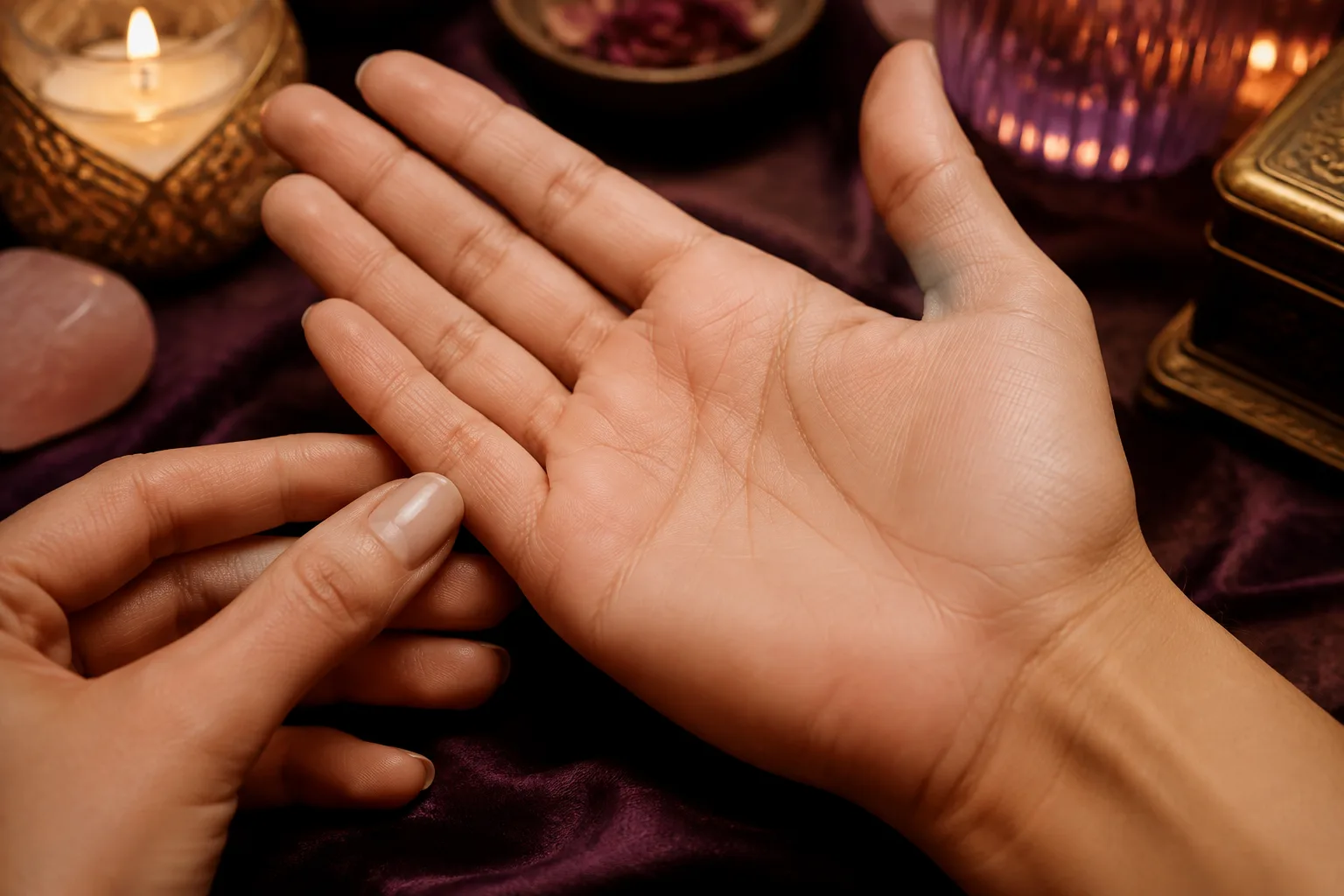
Palmists traditionally estimate marriage timing from the vertical position of a clear relationship line on the outer edge below the little finger: lower lines are read as earlier adult relationships, middle lines as mid-adulthood, and higher lines as later. This produces an approximate period, not a dependable wedding date or guaranteed age. Use it as one part of a relationship reading.
The question is often larger than a date: you want to know when commitment becomes central and what may shape the path toward it. A two-hand reading can place the relationship line inside that wider pattern.
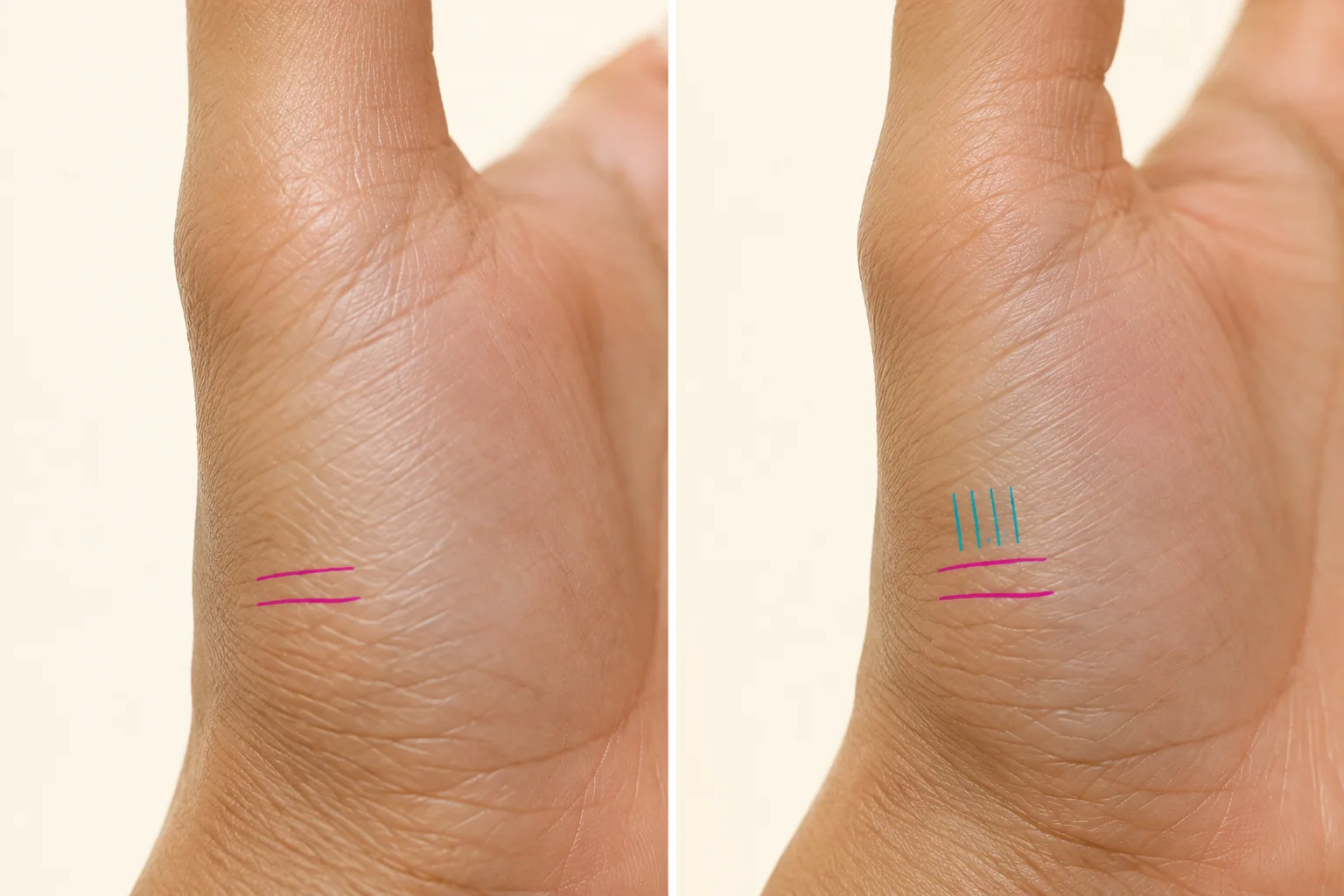
Where is the marriage line?
Turn the palm sideways and look at the short horizontal lines between the base of the little finger and the heart line. This narrow strip is the relationship-line zone. The crease entering the palm from below is the heart line; do not count it as a marriage line.
- Relax the hand. Stretching the fingers creates temporary edge folds.
- Use side lighting so the edge creases cast a slight shadow.
- Identify the heart line at the bottom of the zone.
- Identify the base of the little finger at the top.
- Choose the clearest horizontal line between those boundaries.
Most people have several faint creases. Traditional readers normally give the greatest weight to the longest and deepest line rather than counting every mark.
The traditional marriage-line timing method
Imagine the relationship zone as a scale. Its bottom begins where the heart line reaches the outer edge; its top ends at the little-finger base.
| Line position | Traditional timing | How to phrase it |
|---|---|---|
| Lower third, close to the heart line | Earlier adult relationship chapter | “Commitment may become important earlier in adult life.” |
| Middle third | Middle adult period | “The strongest partnership emphasis sits in the middle of the traditional scale.” |
| Upper third, near the little-finger base | Later commitment | “A defining bond is traditionally placed later on the relationship timeline.” |
Some charts assign exact ages to these thirds, but those ages change between schools. Hand size, line angle, and where a reader sets the boundaries can shift the estimate by years. A range such as “earlier,” “middle,” or “later adulthood” is a clearer reading than a precise birthday.
Which hand is used for marriage timing?
Compare both. A common modern method reads the dominant hand as the life being actively shaped and the non-dominant hand as background tendencies. If the clearest line sits higher on the dominant hand, a palmist may interpret commitment as developing later than initially expected. If it sits lower, partnership may have become important sooner. This is a comparison method, not a fixed rule.
What the shape of the line adds
- Long and clear: a strong or sustained partnership ideal.
- Faint: the theme carries less weight, or the relationship chapter is not clearly defined in the palmistry system.
- Rising: greater independence, aspiration, or a relationship changing direction.
- Falling toward the heart line: emotional strain, disappointment, or the need to examine recurring partner choices.
- Forked: diverging needs, distance, or two possible ways the relationship develops.
- Island: a complicated or unclear period within the bond.
- Several lines: several meaningful attachments or simply normal edge creasing; they do not equal a number of marriages.
Read position first, then form. A dramatic fork on a line too faint to trace should not outweigh a strong heart line or the person’s actual relationship history.
Four features that add marriage context
- Heart line: shows the traditional emotional style and expectations in love.
- Venus mount: adds warmth, closeness, sensuality, and the influence of family bonds.
- Little finger: adds communication, negotiation, and comfort with naming intimate needs.
- Fate line: shows whether work, family expectations, relocation, or a new direction may coincide with a relationship chapter.
If the relationship line suggests a later emphasis while the heart line is already deep and expressive, the reading may describe someone emotionally ready who still wants practical conditions to align. If the fate line changes near the head or heart line, a traditional reading may connect partnership with a wider change in work or direction.
Can palmistry show love marriage or arranged marriage?
No single line reliably distinguishes those categories. A relationship line beginning cleanly on the outer edge is sometimes read as a bond developing through the wider social world, while influence lines from the Venus area are sometimes linked with family involvement. These are traditional associations. The sensible reading names both influences rather than declaring how the marriage will be arranged.
Marriage timing FAQ
Can a marriage line show the exact year?
No. Even within palmistry, the line offers a broad relative position. Exact-year charts are inconsistent and create more precision than the hand provides.
What if there is no marriage line?
It does not mean no marriage. Faint or absent minor lines are common. Read the heart line, Venus mount, little finger, and actual relationship priorities instead.
Do two lines mean two marriages?
No. They may be read as two important bonds, two phases within one bond, or ordinary creases. Clarity and context matter more than the count.
Can the lines change?
Fine edge lines can become easier or harder to see with hand position, skin condition, lighting, and time. Photograph them consistently before comparing.
Read timing in context
Start with the detailed relationship-line guide, add the heart line, and use the two-hand comparison method.
The direct answer
A palmistry marriage line can be placed in an earlier, middle, or later adult zone, but it cannot produce a dependable date. The stronger reading is the combination: line position for timing emphasis, line shape for relationship pattern, the heart line for emotional style, and both hands for how that pattern may be developing.
A Full Palm Reading
Explore your marriage question through the whole palm
Your reading places the relationship lines within both palms, the heart line, Venus mount, fate line, and wider commitment pattern instead of returning a date from one crease.
Your Full Palm Reading maps all the important features—hand shape, skin texture, thumb, fingers, mounts, major and minor lines, markings, and the differences between both palms—and brings them together in a holistic reading focused on your questions.