
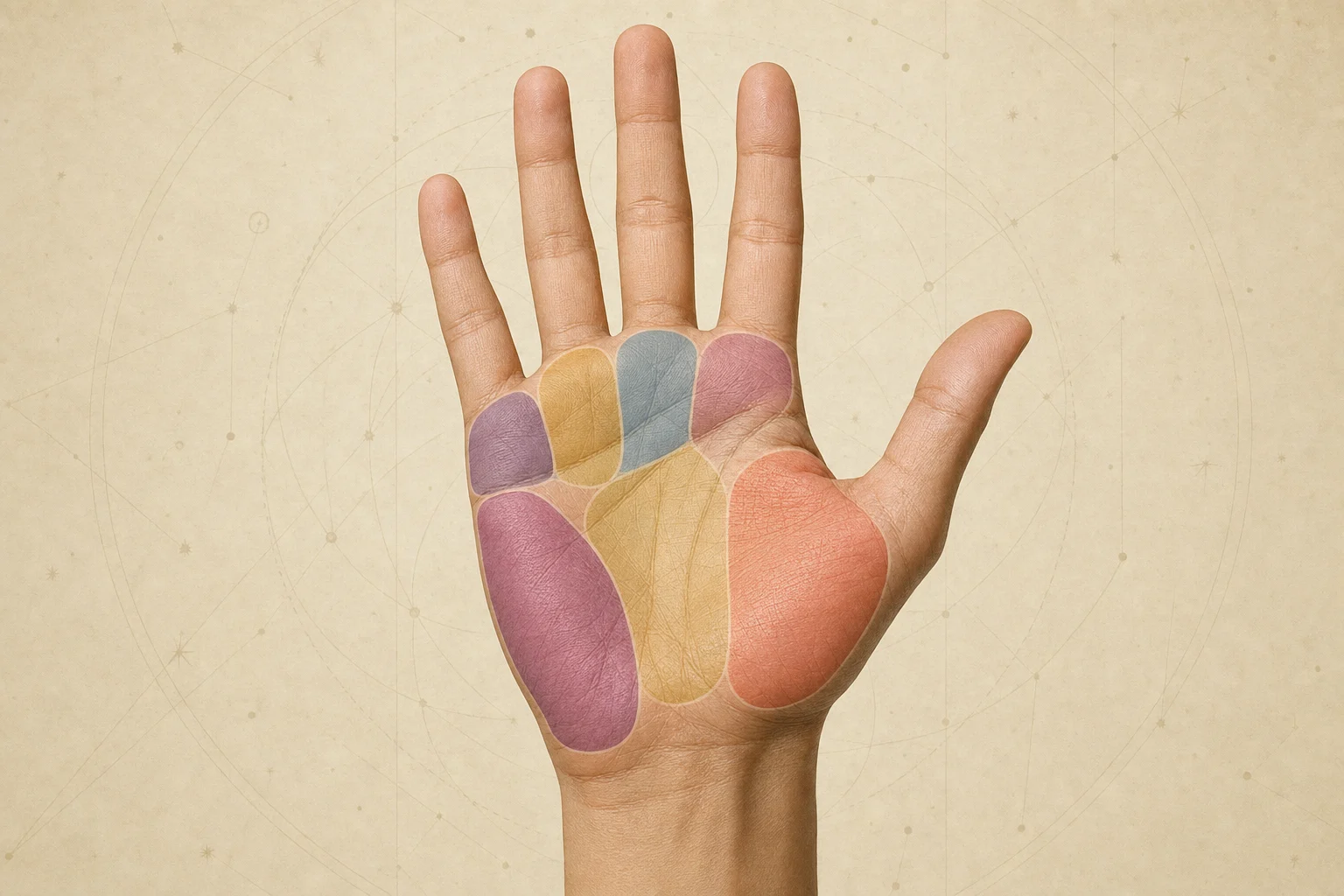
The mounts of the palm are the padded regions below the fingers and along the sides of the hand. Palmistry names them for planets: Jupiter, Saturn, Apollo or Sun, Mercury, Venus, Moon or Luna, and Mars. Readers compare relative fullness and firmness, then connect the region with its traditional theme. Mounts are not anatomical organs and cannot diagnose health or prove character.
The line that draws your attention often arrives with a real question beneath it—about love, purpose, work, or the next turning point. Let the pattern invite a deeper conversation with yourself.
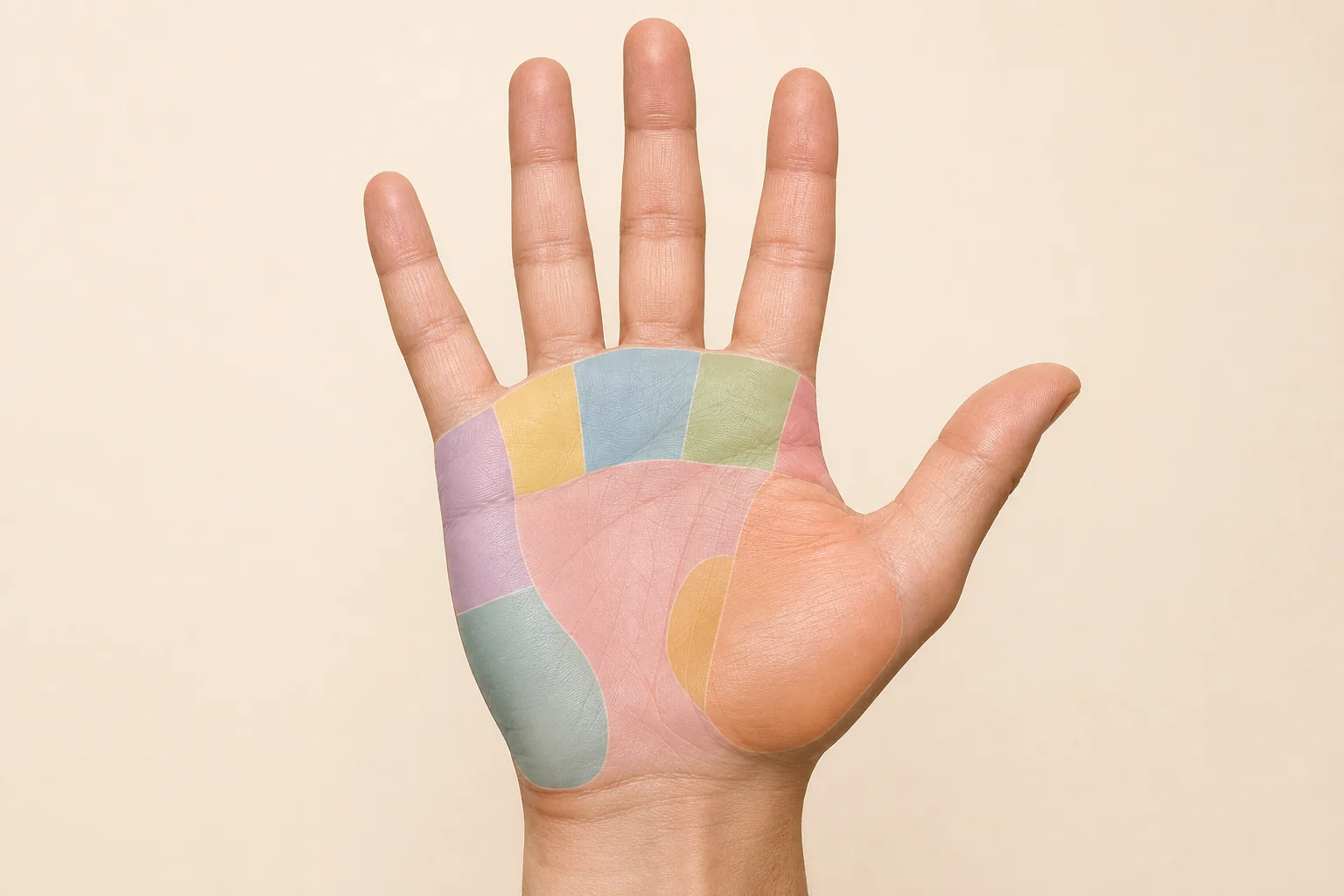
Where are the palm mounts?
- Jupiter: below the index finger.
- Saturn: below the middle finger.
- Apollo or Sun: below the ring finger.
- Mercury: below the little finger.
- Venus: the broad thumb pad inside the life line.
- Moon or Luna: the lower outer palm opposite the thumb.
- Mars: usually divided into inner/lower Mars near the life-line start, outer/upper Mars at the middle outer edge, and the plain of Mars in the centre.
Traditional meanings of each mount
Jupiter is associated with aspiration, standards, confidence, and responsibility. Saturn represents structure, patience, seriousness, and reflection. Apollo is linked with creativity, visibility, pleasure, and expression. Mercury represents communication, exchange, dexterity, and commerce.
Venus is traditionally read for warmth, affection, enjoyment, and physical engagement. Moon is connected with imagination, inward experience, travel, and receptivity. Mars carries themes of assertion, resistance, courage, and how energy is directed.
These meanings come from an astrological map applied to the hand. They are not properties established by anatomy or psychology.
How palmists compare the mounts
- Relax both hands under the same light.
- Look across the palm rather than judging one pad alone.
- Notice relative fullness, not whether a normal region exists.
- If touching another hand, ask permission and use gentle pressure.
- Check whether work, grip, swelling, injury, or camera angle changes the appearance.
A “high” mount means a region appears fuller relative to neighbouring areas; a “flat” mount means less prominent. Avoid rigid good/bad labels. In traditional practice, an emphasized mount adds weight to its theme, while a balanced mount supports it quietly. That language is symbolic and should remain conditional.
How mounts relate to fingers and lines
The location matters because lines are often named by the mount they approach. A fate line moves toward Saturn, a Sun line toward Apollo, and a Mercury line toward the little-finger pad. The life line curves around Venus. Identify the destination before naming a faint vertical line.
Why sources disagree about mounts
Classical palmistry gives mounts considerable weight. One modern method rejects them as an astrological legacy and instead divides the palm into broader functional zones. That disagreement is useful: it shows that mount interpretations are school-specific, not settled facts. If you use them, explain the system and do not let one padded area override the whole hand.
Prominence can reflect ordinary anatomy, posture, muscle use, body composition, or temporary swelling. New pain, colour change, a lump, numbness, or swelling belongs with a qualified health professional—not a palm reading.
Balanced, flat, and prominent mounts
Palmistry books often describe a mount as balanced, underdeveloped, or overdeveloped. Those terms are relative to the person’s hand, not medical grades. A balanced Jupiter mount might be read as confidence with proportion; a very prominent one as ambition needing perspective; a flatter one as less interest in status. The same three-part pattern is applied to other mounts: the symbolic quality, too little emphasis, or too much emphasis.
This framework easily becomes circular—almost any behaviour can be explained after the fact—so use it only as a conversation device. Ask an open question and allow a clear “no.” Never reinterpret disagreement as proof that the quality is hidden.
Mounts at a glance
- For relationships: traditional readers compare Venus with the heart line, not Venus alone.
- For work: Jupiter, Saturn, Apollo, and Mercury are compared with the fate and head lines.
- For imagination: Moon is considered with the direction of the head line.
- For assertion: the two Mars areas are considered with the thumb and life line.
Can you see mounts in a photograph?
A straight-on photo shows location but can flatten three-dimensional fullness. A low side light exaggerates every pad. For remote readings, request one overhead palm image and one gentle three-quarter view, both with a relaxed hand. Do not ask the client to bend the wrist painfully or press hard enough to blanch the skin.
Connect the map to the lines
Start with the finger map, then see how the life line curves around Venus and the fate line approaches Saturn.
Research and source note
The traditional map is presented alongside a modern critique of mount interpretation. Historical diagrams are available in the Library of Congress Chiromantia collection.
The bottom line
Mounts give palmists a vocabulary for location and symbolic emphasis. Locate them carefully, compare them relatively, and acknowledge that respected systems disagree about their value.
A Full Palm Reading
Map which mounts shape the strongest themes in your palm
Your reading compares the fullness, firmness, and markings of every mount with the fingers and lines that cross them, revealing emphasis across the complete hand.
Your Full Palm Reading maps all the important features—hand shape, skin texture, thumb, fingers, mounts, major and minor lines, markings, and the differences between both palms—and brings them together in a holistic reading focused on your questions.