
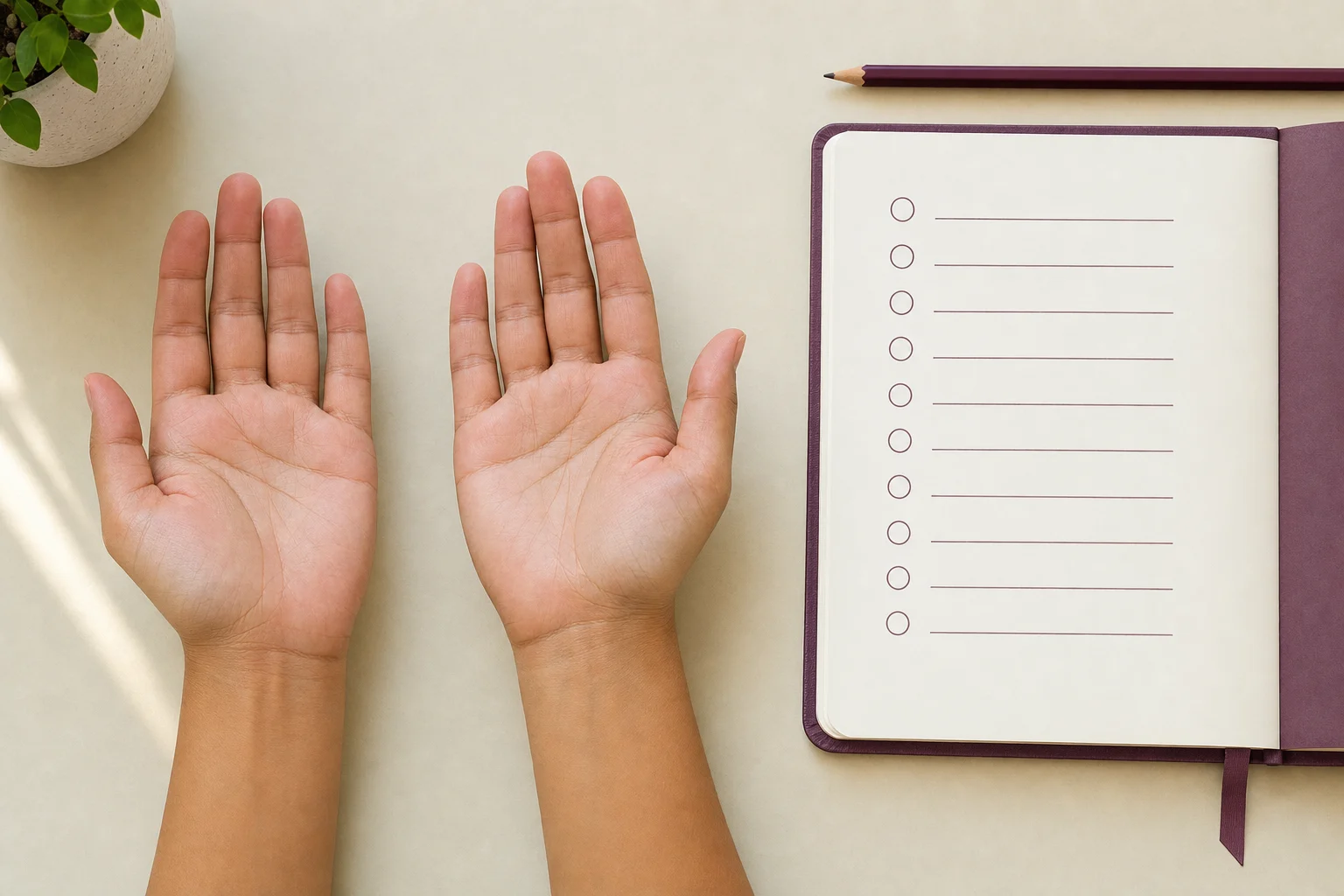
A complete palm reading should follow a consistent order: gain consent, compare both hands, observe the whole hand, then examine thumb, fingers, prints, major lines, minor lines, and clear markings. Finish by combining repeated themes and acknowledging contradictions. Palmistry is a symbolic tradition, so the synthesis should invite reflection rather than claim certainty.
The line that draws your attention often arrives with a real question beneath it—about love, purpose, work, or the next turning point. Let the pattern invite a deeper conversation with yourself.
Before the reading starts
- Ask permission and explain the entertainment or reflective nature of the session.
- Use even light, clean hands, and a relaxed position.
- Ask which hand is used for writing and skilled tasks.
- Agree on a question without promising an outcome.
- Do not photograph or store prints without explicit consent.
The ten-step palm reading checklist
- Compare both hands. Note visible similarities and differences before choosing an active-hand convention.
- Observe the whole hand. Record proportion, natural posture, and whether the palm looks square, long, or mixed.
- Note texture and firmness separately. Account for calluses, moisture, work, weather, and skin condition.
- Examine the thumb. Describe relative length, the two phalanges, resting angle, and comfortable flexibility.
- Compare the fingers. Look for clearly long, short, high-set, low-set, straight, or curved digits without turning variation into defect.
- Identify ridge patterns if visible. Name loops, whorls, and arches before adding traditional meanings.
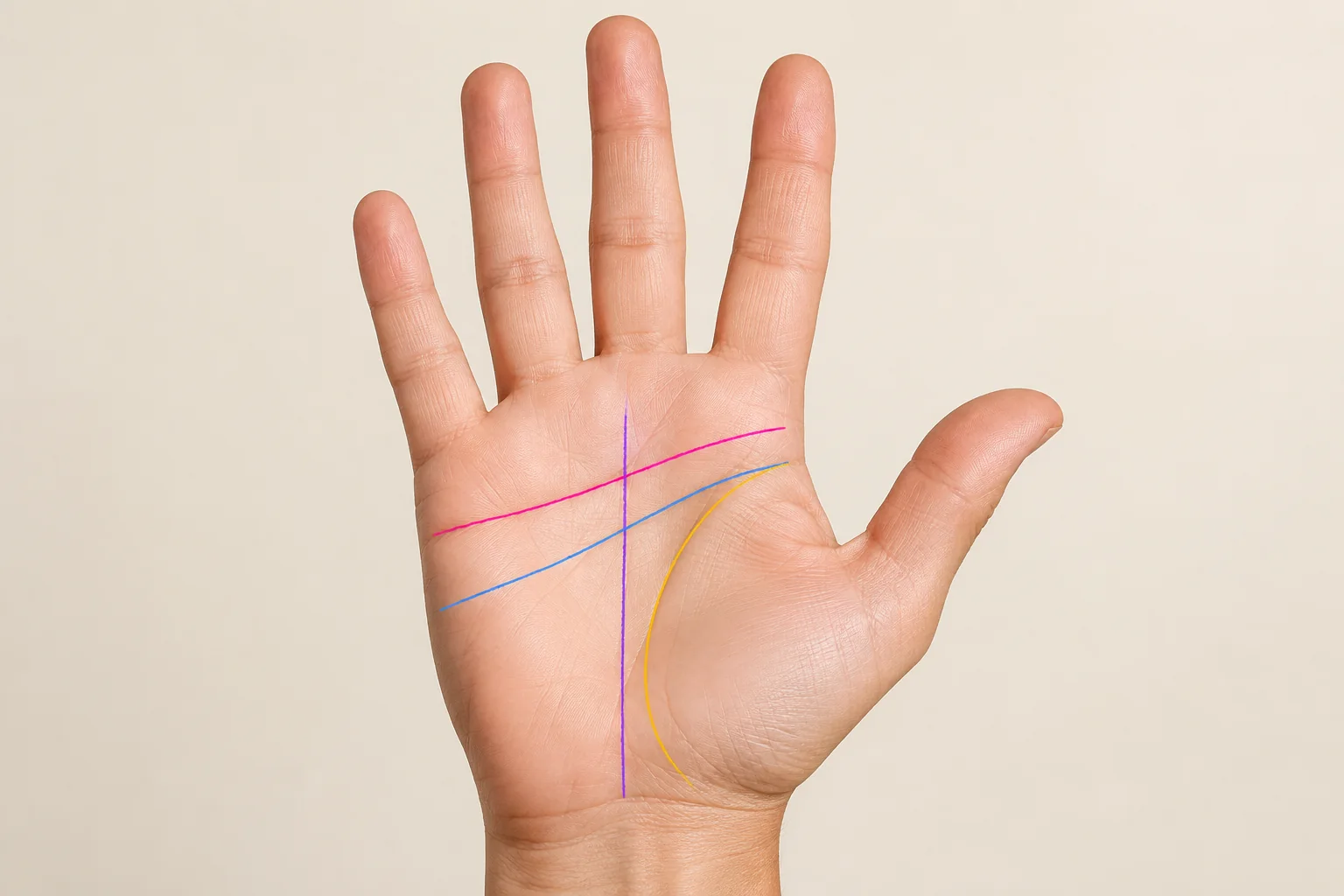
- Map the three principal lines. Find life, head, and heart; describe location, path, depth, and continuity.
- Add the fate line. If present, follow its start, direction, and changes; absence is normal.
- Add clear minor lines. Consider Sun, Mercury, Girdle of Venus, Mars, or relationship lines only when identifiable.
- Review markings last. Confirm the sides of a square or triangle and the structure of a fork, island, or star.
How to turn observations into a coherent reading
Choose two or three themes supported by more than one observation. Separate the visible evidence from the traditional interpretation in your notes. For example:
- Observation: the fate line is fine, and the head line has two clear branches.
- Traditional prompt: “Do you prefer several paths or a direction that you can revise?”
- Reality check: ask what the person’s actual experience supports or contradicts.
Contradictions are not errors. A structured fate line and flexible thumb might lead to a conversation about wanting clear goals while adapting the route. Avoid inventing a dramatic explanation just to make every feature agree.
What makes this different from the beginner guide?
The beginner guide teaches the basic four-line map. This checklist is a repeatable session workflow based on a modern synthesis approach: it includes whole-hand qualities, dermatoglyphics, minor lines, consent, note-taking, and a method for balancing several observations.
Ethical boundaries for every reading
- Do not diagnose physical or mental health.
- Do not predict death, pregnancy, fertility, marriage, divorce, abuse, crime, or financial events.
- Do not make decisions for the person.
- Do not interpret disability, injury, scarring, or difference as bad character or fate.
- Keep private information private and allow the person to stop.
A simple note-taking template
Divide a page into four columns: feature, visible observation, traditional association, and client feedback. This prevents an interpretation from being rewritten as an observation. At the end, circle themes supported by at least two features and cross out claims contradicted by the person’s experience.
How long should a complete reading take?
There is no required duration. A careful short reading can be more useful than an hour of increasingly tiny signs. Leave time to explain limits, hear feedback, and answer questions. Do not prolong a session to manufacture certainty or pressure someone into another purchase.
Quality-control questions for the reader
- Could another person see the feature I described?
- Did I explain which tradition supplies the meaning?
- Did I offer a balanced possibility rather than a fixed label?
- Am I making a medical, financial, legal, or relationship decision?
- Did I protect consent, privacy, and the person’s right to disagree?
What to do when nothing unusual appears
Do not invent a rare mark. A palm with average proportions and few minor lines is still readable through the major creases and the person’s question. “I do not see a clear line there” is a professional answer.
Use the checklist with the core guides
Review the beginner method, decide which hand convention you will use, and consult the minor-line map only after the major lines.
Research and source note
The ten-feature sequence and emphasis on synthesis are adapted from modern palmistry practice. The method keeps the session focused on visible details, your own reflections, and the broader question you want to explore.
The bottom line
A reliable palm-reading workflow is broad to specific, observation before meaning, and synthesis before conclusion. If a claim becomes frightening, medical, financial, or certain, it has moved beyond responsible palmistry.
A Full Palm Reading
Have the complete palm-reading checklist applied to your hands
Your reading follows the full sequence—from hand shape and texture to fingers, mounts, major lines, minor lines, markings, and both-hand comparison—before answering your questions.
Your Full Palm Reading maps all the important features—hand shape, skin texture, thumb, fingers, mounts, major and minor lines, markings, and the differences between both palms—and brings them together in a holistic reading focused on your questions.