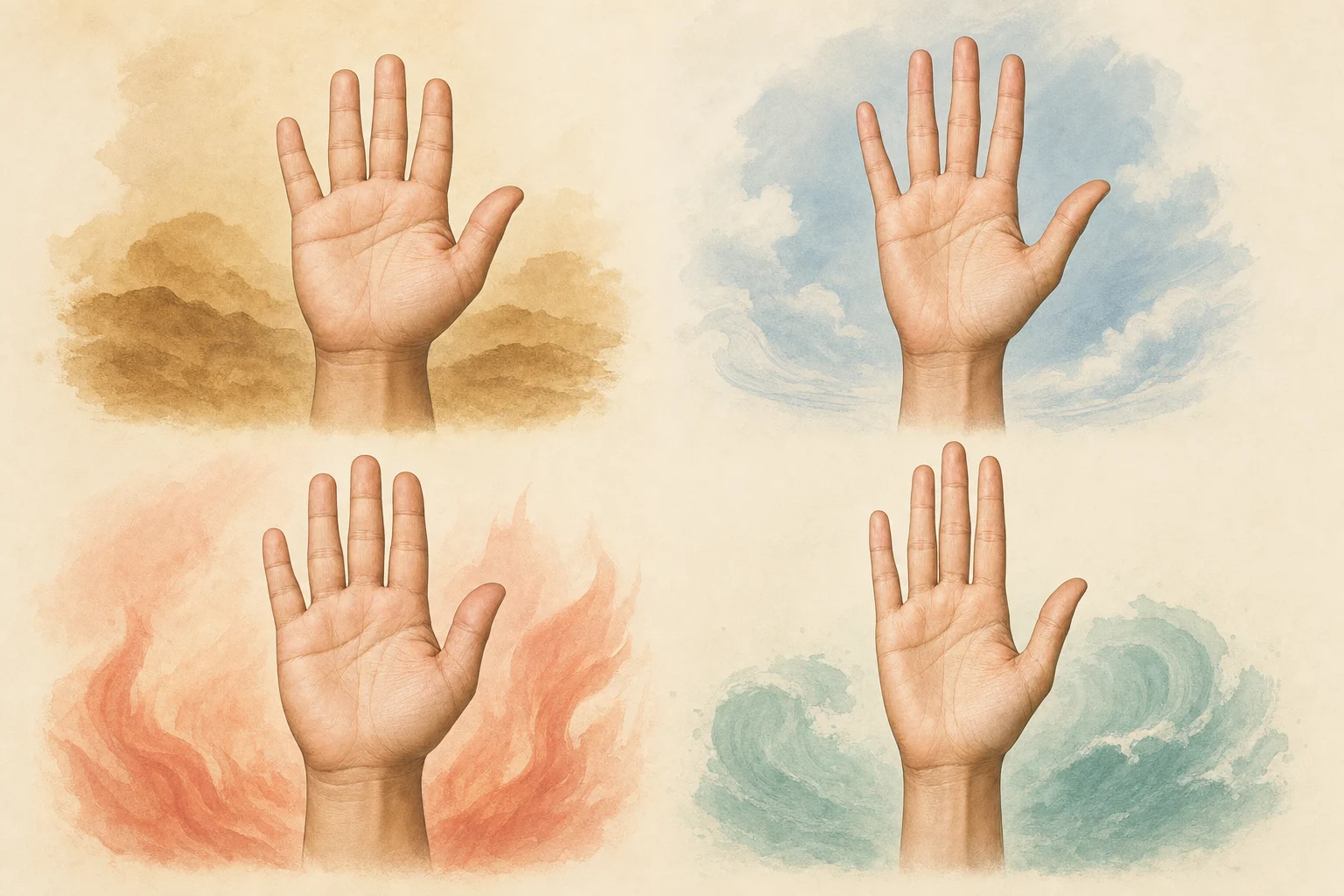
Palmistry commonly describes four elemental hand shapes: earth, air, fire, and water. The classification uses the proportion of the palm and the relative length of the fingers. A square palm with shorter fingers is called earth; square with longer fingers, air; long palm with shorter fingers, fire; and long palm with longer fingers, water. These are symbolic categories, not scientifically validated personality types.
The line that draws your attention often arrives with a real question beneath it—about love, purpose, work, or the next turning point. Let the pattern invite a deeper conversation with yourself.
How to identify your palm shape
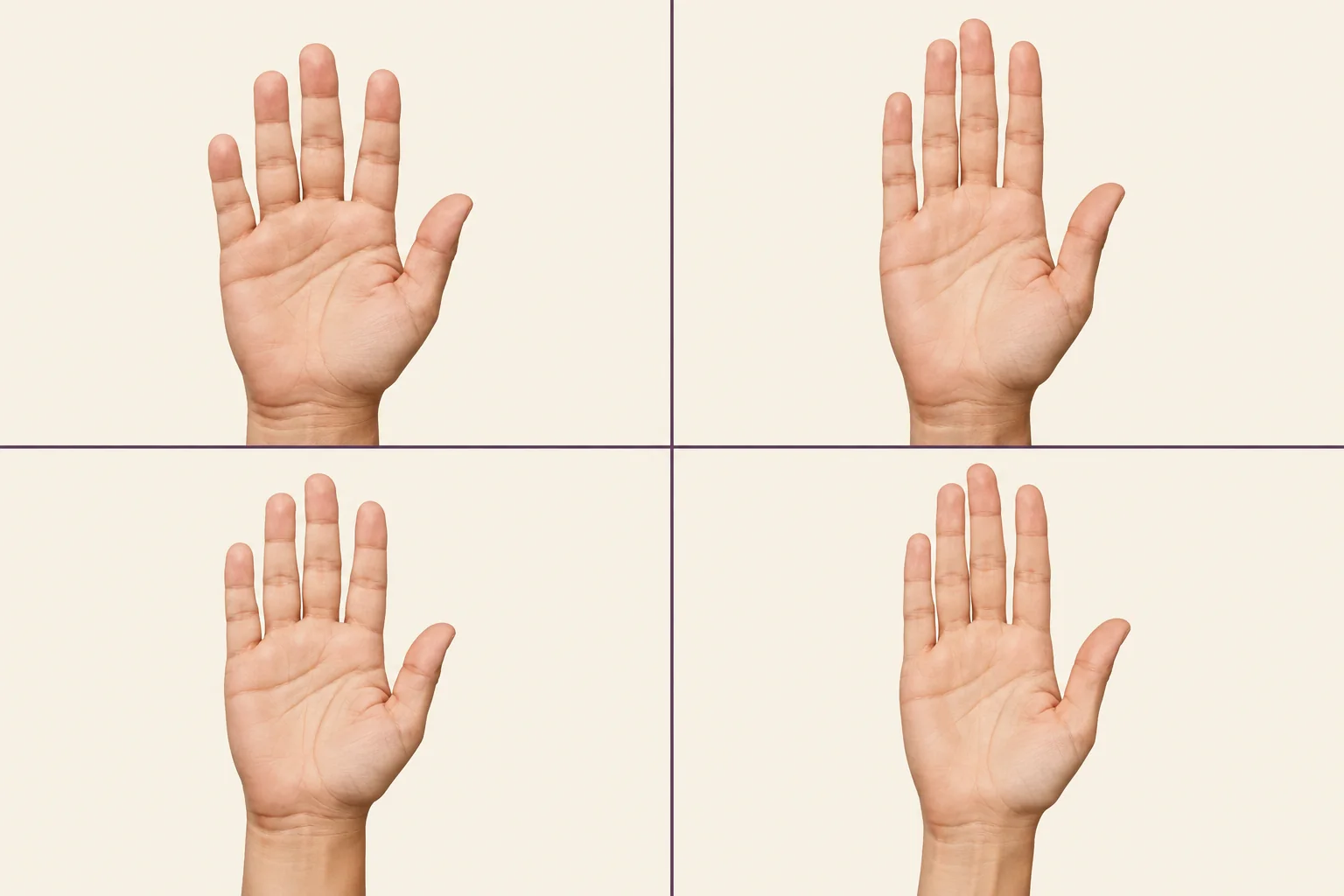
Photograph the hand straight on or place it naturally on a flat surface. Do not spread the fingers hard, because that changes the apparent proportions. Compare the palm from the wrist crease to the base of the middle finger with its width across the knuckles, then compare finger length with the palm.
- Square palm: length and width look broadly similar.
- Long palm: wrist-to-finger-base length is clearly greater than width.
- Short fingers: the fingers look compact relative to the palm.
- Long fingers: the fingers occupy a visibly larger share of the hand.
Use proportion, not absolute size. A large hand can have relatively short fingers, while a small hand can have relatively long ones.
Traditional meanings of the four hand shapes
Earth hand: square palm and shorter fingers
Earth hands are traditionally associated with practicality, steadiness, direct experience, and preference for tangible results. A responsible reading phrases this as a possible working style—not proof that someone is dependable, uncreative, or suited to manual work.
Air hand: square palm and longer fingers
Air hands are linked in modern Western palmistry with analysis, communication, curiosity, and attention to ideas. Long fingers alone cannot establish intelligence, anxiety, or a profession.
Fire hand: long palm and shorter fingers
Fire hands are traditionally framed around initiative, speed, enthusiasm, and visible expression. The category does not prove impulsiveness, leadership, or a particular level of energy.
Water hand: long palm and longer fingers
Water hands are associated with receptivity, imagination, nuance, and emotional awareness. Avoid turning this symbolism into claims about sensitivity, psychic ability, or mental health.
What if your hand does not fit one type?
Many hands sit between categories. Record the actual observations—“the palm is slightly long and the fingers are medium-long”—instead of forcing a label. Compare both hands and keep shape separate from flexibility, skin texture, line depth, and finger setting. Those are different observations.
One modern counterpoint argues that older shape systems reduce complicated people to crude types and recommends giving more weight to a sequence of visible features. That disagreement within palmistry is important. There is no universally accepted elemental formula.
What hand shape can and cannot tell you
Hand proportions reflect anatomy, genetics, development, and normal human variation. They do not reveal moral character, intelligence, health, gender identity, or destiny. Elemental meanings work best as prompts: “Do you prefer ideas or immediate action?” is fairer than “Your hand proves you are an air person.”
How to measure without fooling yourself
Camera perspective is a frequent source of error. A phone held close to the fingertips can make them look longer, while a tilted hand changes the apparent palm shape. Place the camera parallel to the palm and far enough away to minimize wide-angle distortion. Include the wrist crease and every fingertip. If you use a ruler, measure the palm and middle finger in the same image rather than comparing separate photographs.
Do not use a universal centimetre cutoff. Elemental classification is relational: the question is how the parts compare on the same hand. Mark borderline measurements as mixed. The left and right hand can also differ slightly because bodies are not perfectly symmetrical.
How shape modifies a traditional reading
Readers who use elemental types treat shape as a backdrop, not a conclusion. A deeply curved heart line on a so-called water hand might reinforce a theme of emotional expression; the same line on an earth hand might be discussed as feeling expressed through practical care. This is interpretive storytelling, so the person can accept, reject, or reframe it. Shape should never cancel what they know about themselves.
Frequently asked questions
Can hand shape change?
Basic bone proportions are relatively stable after growth, while swelling, injury, age, body composition, and camera angle can affect appearance. A different-looking photograph does not demonstrate a personality change.
Are elemental hands the same as zodiac elements?
They share earth, air, fire, and water symbolism, but a hand category is not determined by a birth sign. Palmistry schools combine the systems differently.
Read the whole hand next
Compare shape with the four fingers, the thumb, and the skin texture before moving to lines.
Research and source note
This guide compares the familiar four-element framework with a modern critique of hand-shape typing. For anatomical context, see the NCBI overview of hand muscles and structure. Traditional associations are symbolic rather than scientific measurements.
The bottom line
Use palm and finger proportions to identify an elemental category, then keep the conclusion modest. A hand may resemble earth, air, fire, water, or a mixture; none of those labels establishes personality or predicts a future.
A Full Palm Reading
Start with your hand shape, then read the details together
A personal reading uses hand shape as the foundation and tests that first impression against your fingers, thumb, mounts, skin texture, and lines.
Your Full Palm Reading maps all the important features—hand shape, skin texture, thumb, fingers, mounts, major and minor lines, markings, and the differences between both palms—and brings them together in a holistic reading focused on your questions.