
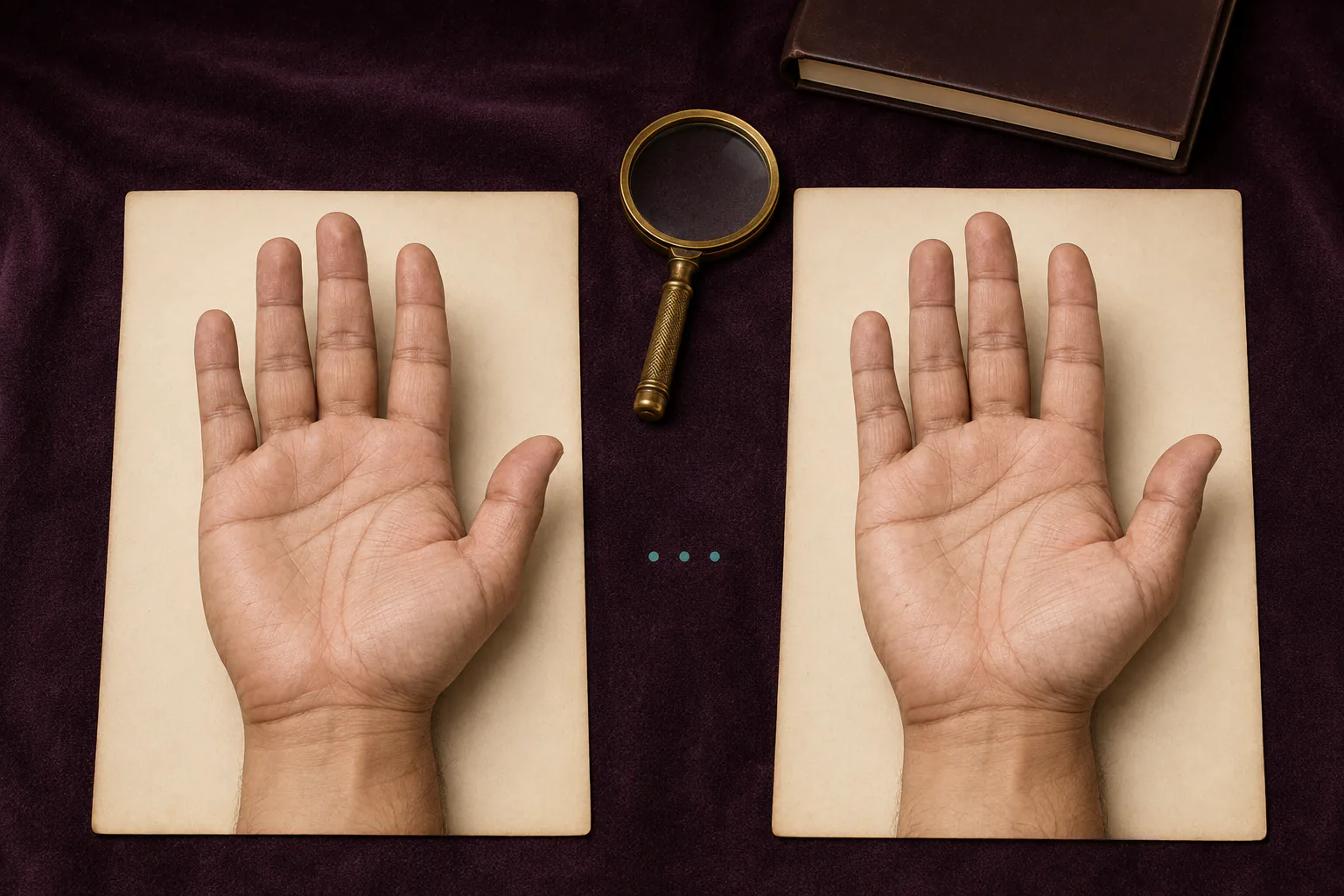
Yes, the lines on a palm can look different over time, but not every apparent difference is a newly formed palm line. The broad routes of the three major flexion creases are established before birth and usually remain recognizable. Fine secondary lines can become more or less visible, and any crease may look deeper, lighter, longer, shorter, or more broken as skin condition, hand position, lighting, work, pressure, and age change. In palmistry, a verified change is read through the line involved and the features around it rather than as a fixed prediction.
A line that looks new, deeper, faded, or broken becomes useful only after pose, light, skin condition, camera angle, and the original route have been compared. A whole-hand reading can verify the change and show how both palms connect it with work, love, family, money, travel, purpose, or direction.
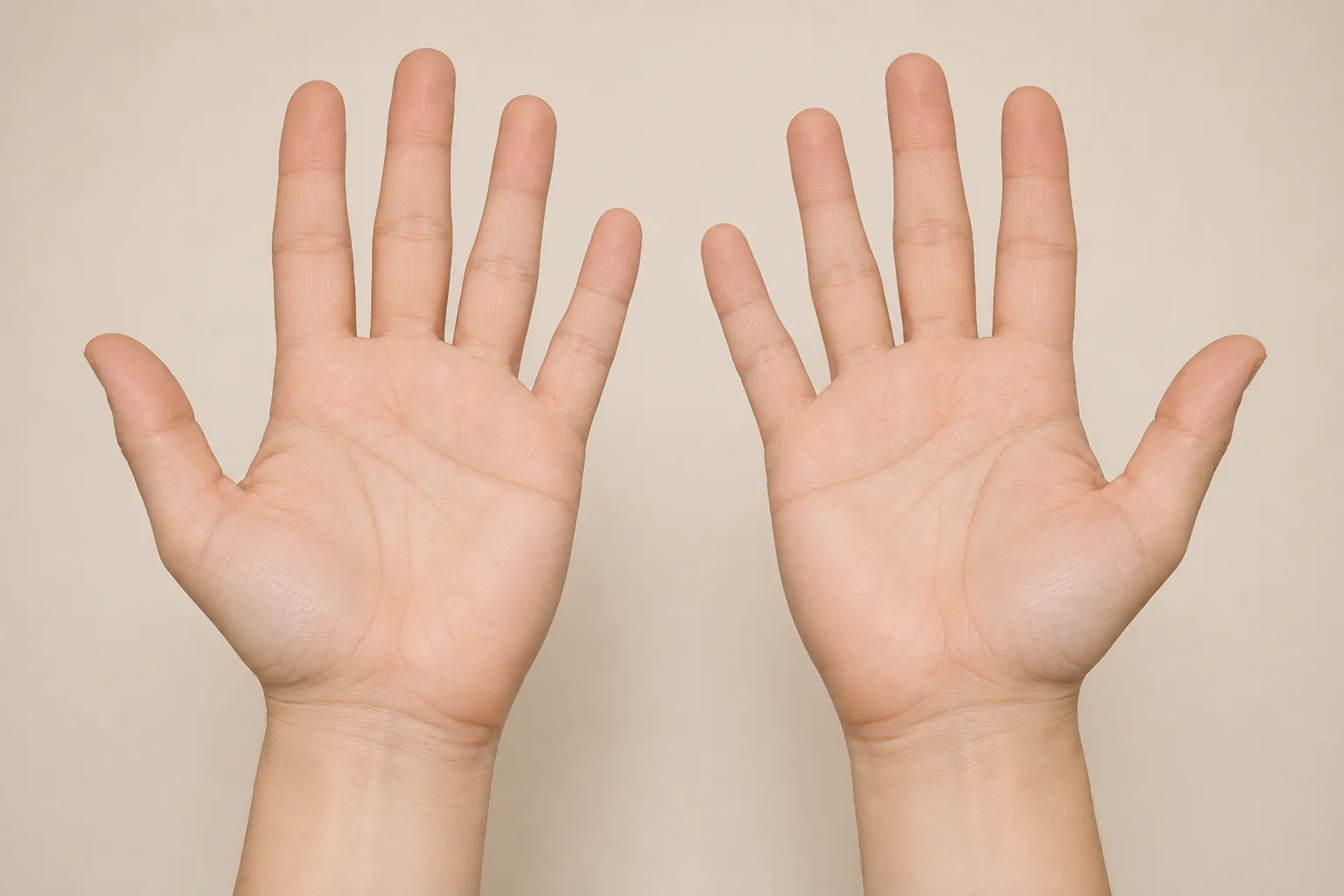
The fastest useful test is a controlled comparison: same hand, same relaxed pose, same camera, same distance, and similar light. If a branch or mark appears only when the hand is stretched, wet, dry, shadowed, or sharpened by the phone, record a photographic difference rather than a symbolic change. If it remains visible across several neutral images and can be traced directly on the palm, then compare its origin, direction, and continuation.
What actually changes in palm lines?
Anatomically, the prominent palm lines are flexion creases that help the skin fold as the hand moves. A fetal study found palmar creases consistently visible by about 13 weeks of gestation, which helps explain why the basic major-crease pattern is relatively stable rather than redrawn by every life event. The published developmental study is available through PubMed.
Researchers distinguish major and minor creases by their structure, relationships, branches, and variants. A large palm-print study also describes the major creases as physical folding structures and notes that unclear prints can change what an observer classifies. The open-access crease-classification study explains that method. These anatomical findings do not validate palmistry meanings; they clarify what the visible lines physically are.
| Palm feature | What usually stays recognizable | What may look different |
|---|---|---|
| Life, head, and heart crease routes | Their general origin, path, and relationship | Depth, contrast, fine branches, small interruptions, and nearby lines |
| Fate, Sun, Mercury, and other minor lines | A strong established segment may remain traceable | Visibility, length, new fine sections, fading, branches, and overlap |
| Small crosses, stars, islands, and bars | A deep crease or scar may persist | Weak participating strokes can appear, fade, or merge in photographs |
| Skin texture | Broad natural texture tendencies | Dryness, hydration, callus, irritation, swelling, and surface contrast |
| Mount fullness and hand posture | Basic hand proportions | Muscle tension, thumb opening, finger spread, pressure, and camera perspective |
Major creases versus fine secondary lines
The beginner palm map starts with the life, head, and heart lines because their broad routes are easier to identify consistently. The fate line is more variable and may be faint, partial, or absent. Sun, Mercury, influence, travel, relationship, and other subsidiary lines are often finer still. A visible change in one short secondary line therefore needs more careful verification than the continuing route of a major crease.
Can a completely new major line appear?
A major route rarely appears from nothing in the way a drawn line would. More often, an existing faint segment becomes visible, a minor branch deepens, two pieces appear to connect, or a changed pose reveals a crease that was already present. Compare the whole route and its anatomical position before calling it a new life, head, or heart line.
How to tell whether a palm line really changed
Use the eight-point palm-change verification method before interpreting anything. It works for a new line, a disappearing line, a deepening segment, a branch, a break, or a mark.
| Check | What to do | What it rules out |
|---|---|---|
| Correct hand | Confirm right or left and label hand dominance | Comparing opposite palms by mistake |
| Relaxed pose | Open the palm naturally without stretching the fingers back | Temporary folds created by tension |
| Camera match | Use the same lens, distance, orientation, and crop | Perspective making lines look longer or shifted |
| Light match | Repeat bright indirect light and one gentle side-lit view | Highlights hiding a line or shadows inventing one |
| Skin condition | Compare clean, dry hands at a similar temperature | Water, oil, dryness, pressure, or swelling changing contrast |
| Direct trace | Follow the complete line on the actual palm | Camera sharpening, compression, hair, lint, and image noise |
| Repeated image | Check the feature in several images over days or weeks | A temporary pressure crease or one poor photograph |
| Same location | Anchor the comparison to creases, mounts, and finger bases | Comparing two nearby but different minor lines |
Why a line can disappear for a day
A very fine line can vanish from a photograph when the light becomes flatter, the skin is more hydrated, the hand is held differently, or the camera reduces local contrast. A temporary pressure mark can also appear after gripping or resting the hand against an edge. Wait, relax the hand, and photograph it again before treating a one-day difference as meaningful.
Why phone photos create false changes
Modern phones automatically sharpen edges, combine exposures, reduce noise, brighten shadows, and compress files. These adjustments can strengthen one faint segment and erase another. Turn off beauty filters, avoid portrait mode, keep the palm parallel to the lens, and use the original color image. The palm-photo guide gives the complete capture sequence.
Which palm lines appear to change most?
Fine lines and small markings are most likely to vary in visibility. For a useful comparison, treat every line as a route with an origin, direction, intersections, and endpoint. Do not judge change from darkness alone.
| Line or feature | Changes people commonly notice | Read next |
|---|---|---|
| Life line | Fine rising branches, outward branches, overlap around a break, or changing depth | Arc, sister line, Venus, Moon, and both palms |
| Head line | New fine fork, downward branch, island-like overlap, or clearer endpoint | Slope, depth, fingerprints, fingers, and Mercury or Moon destination |
| Heart line | Fine upward branches, feathering, fork visibility, bars, or a clearer ending | Ending mount, Venus, relationship lines, and emotional combinations |
| Fate line | A section becomes clearer, begins mid-palm, shifts route, branches, or fades | Origin, timing zone, continuation, Sun line, and head-line crossing |
| Sun line | A new fine segment, branch, trident-like ending, or reduced visibility | Fate, head, ring finger, and the line's clean continuation |
| Relationship lines | One edge line becomes deeper, a fine branch appears, or several shallow folds change contrast | True edge-on view, heart line, Venus, and both hands |
| Small markings | A cross, star, island, square, or triangle seems to form or dissolve | Verify every participating stroke and the exact location |
Does the life line change?
The broad life-line route around the thumb mound usually remains recognizable. Fine upward branches, outward branches, local overlap, sister lines, and surface clarity may look different. A short or faint photograph does not mean the line physically ended, and its length is not a measure of lifespan.
Does the fate line change?
The fate line is often partial, so it is the line people most readily describe as appearing, strengthening, breaking, or shifting. Compare the origin near the wrist, life line, Moon, or middle palm; note where it crosses the head and heart lines; then check whether a new segment continues toward Saturn, Sun, or Jupiter.
Can marriage or relationship lines change?
The small horizontal lines below the little finger are easy to distort by curling the hand. Use an edge-on image with the fingers naturally extended. A deeper or newly visible line is traditionally interpreted through its clarity, branches, and relationship with the wider emotional pattern, but it does not create or end a relationship by itself. See the relationship-line identification guide.
What changing palm lines mean in traditional palmistry
Traditional palmistry treats a verified change as a shift in emphasis rather than proof of a fixed event. A line becoming clearer may be read as a subject receiving more focus or structure. A fading section may show reduced emphasis, redirection, or an incomplete channel. A new branch changes direction; an overlap can show transition with continuity; and a second line can add support or a parallel interest.
| Verified change | Traditional reading prompt | Context required |
|---|---|---|
| Line becomes deeper or clearer | The line's subject is more developed, consistent, or consciously expressed | Check whether the route is also clean and well supported |
| Line becomes finer or fades | The subject may be less central, less sustained, or changing form | Look for a replacement, branch, parallel line, or changed destination |
| New upward branch | Growth, effort, opportunity, or movement toward the receiving mount | Name the parent line and destination |
| New downward or outward branch | Energy redirected toward family, travel, imagination, rest, or an outside influence | Location and destination decide the subject |
| Break with overlap | A transition in which a new route begins before the earlier one fully ends | Compare alignment, timing zone, and continuation |
| Shifted continuation | The same broad life area takes a different direction | Read the mount or line receiving the new segment |
| Small mark forms at an intersection | A concentrated modification at that location | Verify its complete geometry before naming it |
A change does not automatically mean an event
If a fate segment deepens while someone is changing jobs, a palmist may connect the visible emphasis with work direction. That does not prove the palm predicted the job. The useful reading asks what the new route connects, whether both hands repeat it, and how the change fits the person's actual question.
Read the destination of a new branch
A branch rising from fate toward Jupiter differs from one turning toward Sun or Mercury. A life-line branch toward Moon differs from a sister line remaining inside the arc. Use the mount map and identify the endpoint instead of calling every upward branch “success.”
Why the active and less-active hands can change differently
The two-hand comparison method treats the less-active hand as the underlying pattern and the active hand as the way it is currently developed and expressed. This is a reading convention, but it creates a consistent way to compare difference and change without applying gender rules.
| Observed pattern | Traditional comparison | What to verify |
|---|---|---|
| Active-hand line becomes clearer | The quality may be gaining present expression through effort or circumstance | Which branch, mount, or line now supports it? |
| Less-active hand remains stronger | The underlying potential may exceed its current use | What redirects or interrupts the active-hand route? |
| Both hands change similarly | The theme may be broad and sustained rather than situational | Confirm the photographs are equally controlled |
| Different features change on each hand | Background and present development may emphasize different subjects | Read each location before combining them |
| Only photographs differ | No palmistry conclusion is ready | Repeat the capture with matched pose, light, and skin condition |
How to track your palm lines over time
- Record the date, dominant hand, and one specific question.
- Clean and dry both hands, then wait several minutes after gripping or pressure.
- Photograph each full palm directly above it in bright indirect light.
- Add one gentle side-lit view and any necessary edge view.
- Keep the same background, camera, lens, height, and hand position next time.
- Store original images without filters, markup, cropping, or contrast changes.
- Compare major routes first, then minor lines, branches, and markings.
- Write an observation before an interpretation: “fine branch now visible toward Jupiter” is better than “promotion line appeared.”
How often should you compare?
Monthly or quarterly photographs are more useful than daily checking. Daily lighting and skin differences can create noise, while a longer interval makes stable changes easier to separate from temporary visibility. If you are following a specific question, keep the schedule and conditions consistent.
When should you get another palm reading?
A new reading can be useful when you have a meaningfully different question, a well-documented line change, or a major shift in work, relationship, family, location, or direction that you want to explore as a complete pattern. Rechecking the same faint mark every day usually produces more photographic variation than insight.
Six worked palm-change examples
Example 1: a fate line becomes clearer above the head line
Matched images six months apart show the same fate route, but the upper segment toward Saturn is now easier to trace. The traditional reading emphasizes clearer responsibility or direction in the later section. The head line, Sun line, and actual work question show whether this concerns a job, business, study, or another long-term commitment.
Example 2: a new life-line branch points toward Moon
A fine branch now leaves the lower life line and travels toward the outer palm. It remains visible in repeated images and is not a pressure mark. The reading explores travel, relocation, independence, or a broader change of environment with Moon, travel lines, fate, and the opposite hand.
Example 3: a heart-line fork appears only when stretched
The apparent fork vanishes when the fingers relax and returns when the hand is pulled backward. Record it as a temporary fold created by pose. Interpret the stable heart-line ending instead of adding a new emotional branch.
Example 4: a Sun line seems to disappear in flat light
An earlier side-lit photograph shows a fine Sun line, while a newer front-lit photograph does not. A new side-lit image reveals the same route. The line did not reliably disappear; the capture method changed its contrast.
Example 5: a break gains an overlapping continuation
Older images show one fate segment ending near the head line. Later images reveal a second segment beginning beside it and continuing upward. Traditional palmistry reads overlap as transition with some continuity. Its direction and endpoint matter more than the word “break.”
Example 6: a small star seems to form on Jupiter
Two crossing lines were always visible, while a third fine line now appears to share their center. Verify it in direct observation and neutral photos, then apply the star-mark test. If the third stroke misses the center, the formation remains a cross.
Common mistakes when comparing changing palm lines
- Comparing the right hand with an older photograph of the left.
- Stretching one palm and relaxing the other.
- Using flash in one image and window light in the next.
- Calling greater contrast a deeper physical crease without direct observation.
- Comparing edited screenshots instead of original photographs.
- Starting with a tiny symbol before checking the major routes.
- Assigning an event before naming the branch, location, and continuation.
- Reading a single changed line without the opposite palm or surrounding features.
Questions that make a changing-line reading useful
- Which exact hand, line, segment, branch, or mark appears different?
- Were the older and newer photographs taken under comparable conditions?
- Is the difference visible on the actual relaxed palm?
- Has the route changed, or only its depth, contrast, and visibility?
- Where does the new branch begin and what mount or line receives it?
- Does the original line continue, overlap, shift, fade, or terminate?
- What appears in the matching location on the other hand?
- Which supporting features repeat or contradict the proposed meaning?
- What question matters now: work, love, family, money, travel, recognition, purpose, or direction?
Compare the complete hand, not one changing crease
Begin with matched photographs of both palms, verify the route with the complete reading sequence, identify every origin and destination, and then connect the change with the stable features around it.
The complete answer
Palm lines can look different over time, especially fine secondary lines, branches, and small markings. The broad routes of the major flexion creases form before birth and usually remain recognizable, while pose, light, skin condition, work, pressure, age, and camera processing can change how any line appears. A strong comparison uses the same hand, pose, light, distance, and original image format; verifies the difference directly; and records whether the route, depth, branch, break, mark, or continuation actually changed. Traditional palmistry then reads a verified change through its parent line, destination, timing area, supporting features, and the active-versus-less-active hand pattern. A Full Palm Reading maps all these important features across both hands and combines them into a holistic reading focused on the person's questions about work, love, family, money, travel, recognition, purpose, and direction.
A Full Palm Reading
Ask what a verified change means across your complete hand
Your reading compares matched images, identifies the exact line, branch, break, mark, origin, and destination, then adds the stable major lines, mounts, fingers, thumb, hand shape, supporting signs, and both palms to explore work, love, family, money, travel, recognition, purpose, and direction.
Your Full Palm Reading maps all the important features—hand shape, skin texture, thumb, fingers, mounts, major and minor lines, markings, and the differences between both palms—and brings them together in a holistic reading focused on your questions.