
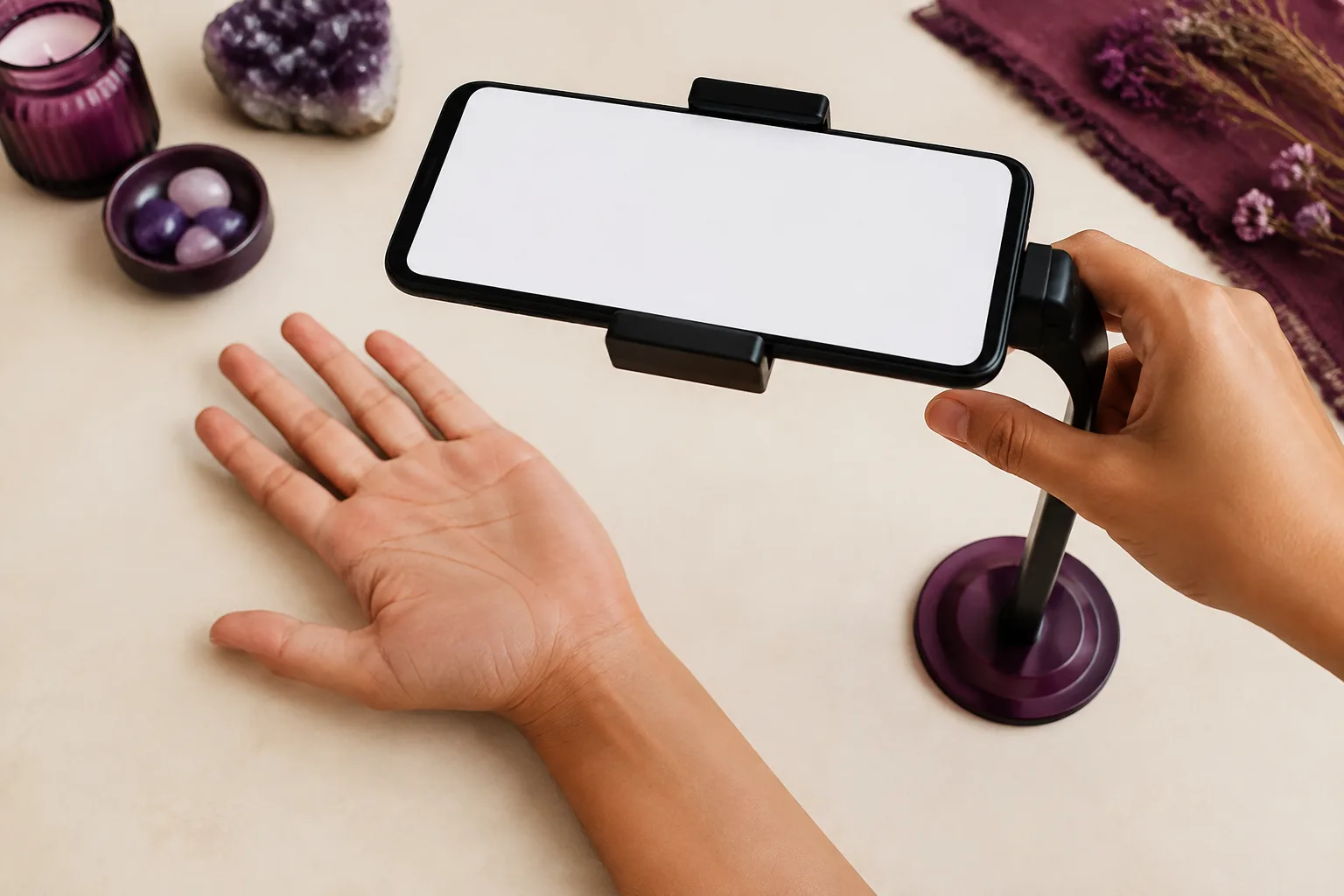
A free online palm reading from a photo usually begins by identifying visible hand features—shape, finger proportions, thumb position, major creases, minor lines, mounts, and clear markings. For the best result, take at least four images: both full palms and one angled side view of each hand. The quality of the answer depends on whether those observations are interpreted together around a clear question rather than returned as disconnected labels.
The quality of a photo reading depends on seeing the whole hand before zooming into one line. Prepare both palms and both side views, then bring the question you most want a Full Palm Reading to explore.
How an online palm reading works
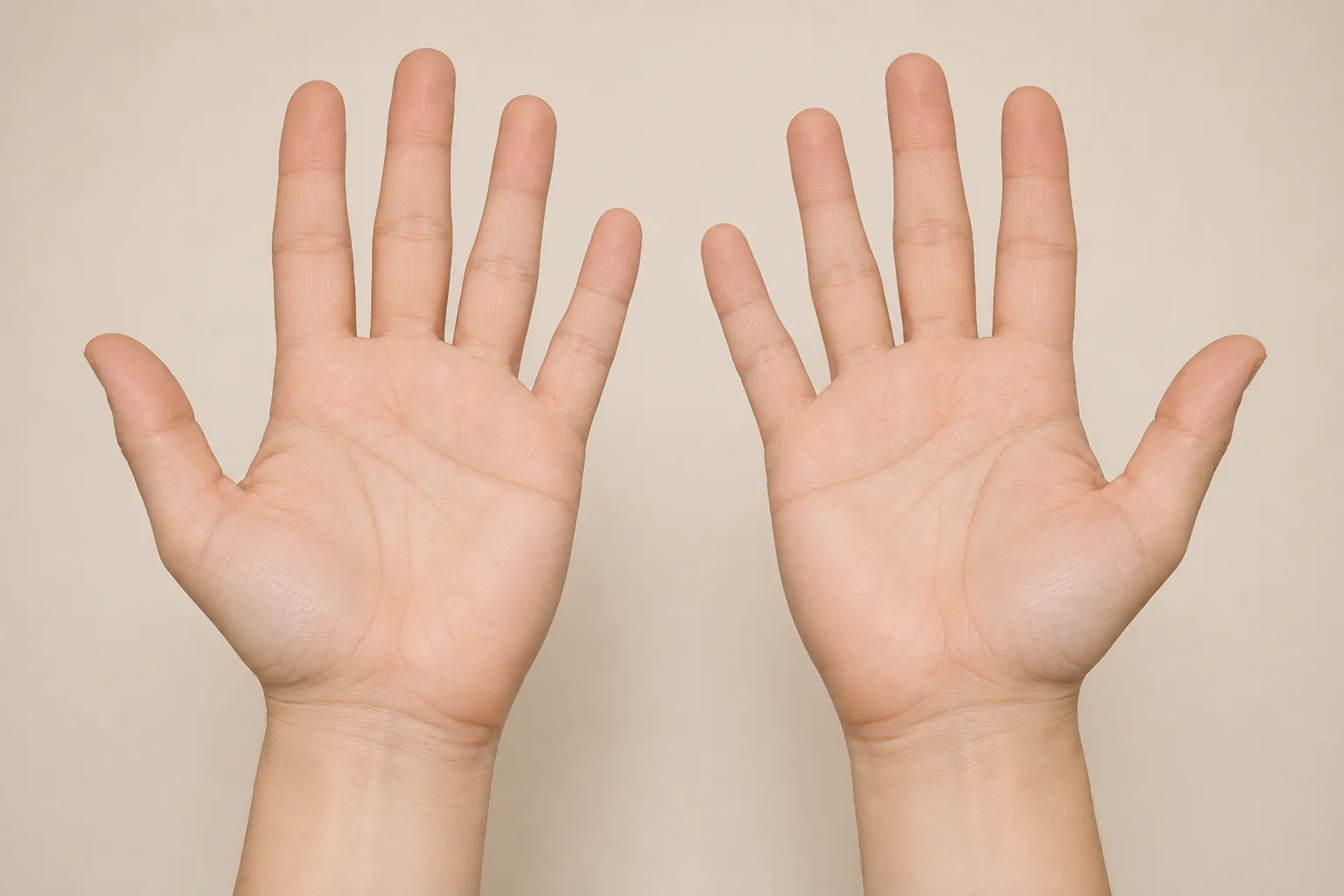
- You provide clear hand images. The reader or tool needs the full palm, fingers, wrist, and smaller line zones.
- The visible features are mapped. Major lines are traced first, followed by proportions, mounts, minor lines, and markings.
- Both hands are compared. A common method uses the dominant hand for developed patterns and the other for background tendencies.
- Your question sets the emphasis. A love reading weights the heart line and Venus area; a career reading weights the fate, head, Sun, and Mercury features.
- The repeated themes become the answer. A good reading explains which visible clues support each interpretation.
A single close crop of the palm can show the major lines, but it removes finger length, thumb angle, hand shape, and side-edge detail. That is why a complete photo set produces a better reading.
The four palm photos to take
| Photo | How to position it | What it captures |
|---|---|---|
| Dominant palm, straight on | Fingers relaxed and slightly separated; wrist visible | Major lines, mounts, hand shape, finger proportions |
| Non-dominant palm, straight on | Match the first photo’s distance and angle | Background pattern and changes between hands |
| Dominant little-finger edge | Turn the outer edge about 45 degrees to camera | Relationship and fine edge lines |
| Non-dominant little-finger edge | Repeat the same angle and light | Side-to-side comparison |
For fingerprints or very fine markings, add close-ups only after the four context images. Keep the original photo and any crop; aggressive enhancement can invent edges that are not present in the hand.
How to take a clear palm photo
- Clean the lens. A fingerprint on the camera softens fine lines more than most people realize.
- Use bright indirect daylight. Stand beside a window without placing the hand in a sharp beam.
- Choose a plain background. Cream, grey, or another neutral surface helps the camera expose skin correctly.
- Use the rear camera. It usually captures more detail than the selfie camera.
- Hold the phone parallel. Perspective distortion makes fingers and mounts look unequal.
- Relax the hand. Pressing flat or stretching the fingers creates folds and changes line depth.
- Tap the centre of the palm to focus. Move the phone closer only until focus remains sharp.
- Check every fingertip and the wrist are inside the frame.
Photo mistakes that reduce reading quality
- Flash glare that erases fine lines
- Dark shadows from overhead lighting
- Beauty filters, skin smoothing, portrait blur, or heavy sharpening
- Fingers pressed together or cropped off
- A bent wrist or strongly cupped palm
- Only one hand, with no dominant-hand information
- Jewelry, ink, henna, or an object covering the feature being read
What can be analyzed from palm photos?
- Love and relationships: heart line, Venus mount, little finger, and side-edge relationship lines.
- Career and direction: fate line, head line, finger proportions, Sun line, and Mercury features.
- Money themes: the combined pattern of direction, recognition, communication, planning, and the thumb.
- Strengths and working style: hand shape, skin texture, thumb, fingers, and the clearest repeated themes.
- Changes between hands: lines that have strengthened, weakened, branched, or become more defined.
- Rare signs: only marks that remain clear in the original full-palm image and a focused close-up.
What information should accompany the photos?
State which hand you write with and the question you want the reading to focus on. If you use different hands for writing and sports or tools, say so. A short question such as “What does my hand show about career direction over the next chapter?” produces a more useful reading than a request for every possible prediction.
What a full palm reading adds
A quick free scan may help you locate one line or recognize a broad hand shape. A Full Palm Reading goes further: it maps all the important features across both hands, checks which themes repeat or contradict one another, and brings them together in a holistic reading focused on your questions. Prepare the four-photo set so the complete palms and relationship-line edges can be read in context.
Online palm reading FAQ
Can I use a scanned palm print?
A clear print is useful for major and minor line paths, but it loses colour, three-dimensional mounts, finger posture, and some texture. Pair it with full-hand photos.
Should I send the left or right hand?
Send both and identify your dominant hand. The differences are part of the reading.
Can a photo show very fine children or marriage lines?
Yes, if you include the angled edge images. A straight-on palm image usually hides that narrow area.
Prepare a readable hand set
Learn why both hands matter, review the complete feature checklist, and see what a full reading can cover.
The complete answer
A photo-based palm reading needs sharp, evenly lit images of both complete hands plus both little-finger edges. A complete reading can then compare the visible features, find the strongest repeated themes, and answer your focused questions with supporting observations from across the whole hand.
A Full Palm Reading
Turn clear hand photos into one complete reading
Bring both full palms, useful side views, and the questions that matter to you. Your reading will map the visible features first, then interpret how they work together.
Your Full Palm Reading maps all the important features—hand shape, skin texture, thumb, fingers, mounts, major and minor lines, markings, and the differences between both palms—and brings them together in a holistic reading focused on your questions.