
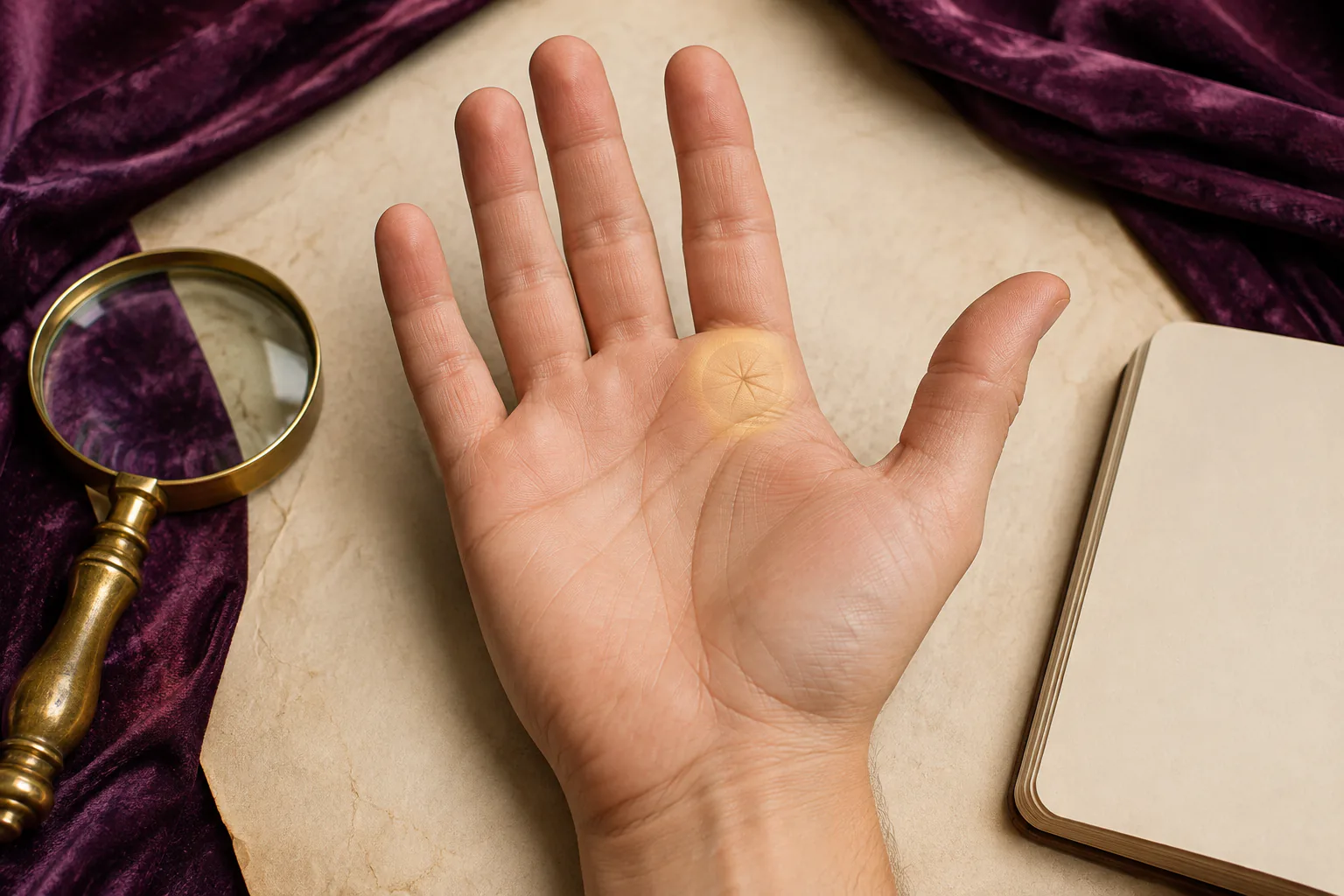
A star on the palm is a marking made by at least three independent short lines meeting at one central point, usually creating six or more rays. In traditional palmistry, it concentrates or intensifies the meaning of the exact mount, line, or palm region beneath it. A star under the index finger therefore has a Jupiter theme, while a star on the Sun line or heart line must be read through that line. It is not a universal sign of luck, fame, danger, or wealth.
A star becomes meaningful only after three or more independent lines are shown to meet at one center. A whole-hand reading can identify the exact mount or parent line and show how both palms connect that concentrated marking with love, work, money, recognition, travel, spirituality, or direction.
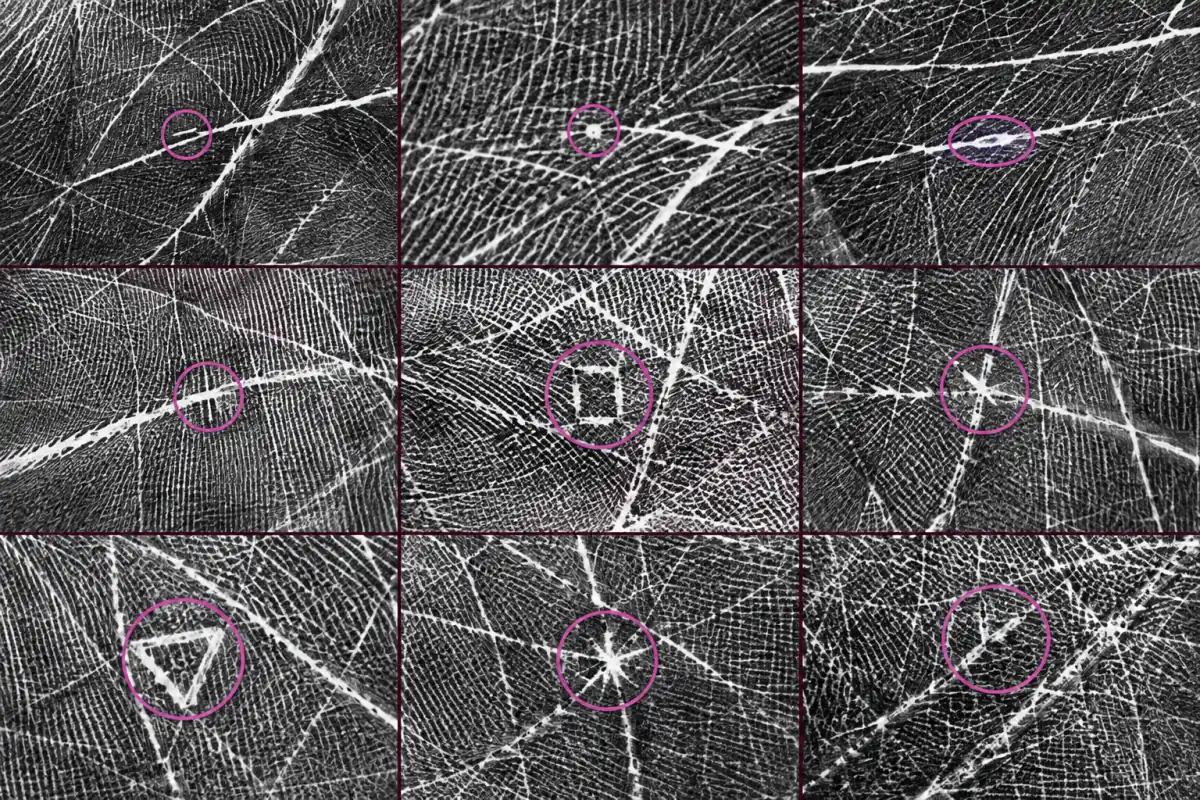
Start by proving that the formation is a star. Two crossing lines make a cross. Several separate intersections make a grille or tangle. A decorative five-point outline, triangle with extra branches, scar, or group of skin ridges does not meet the same test. Once the center and rays are clear, name its location, trace every participating line, and compare the same area on the other hand.
How to identify a real star sign on the palm
Ignore the imagined outer silhouette and focus on the center. A genuine palmistry star radiates from one shared intersection. At least three separate strokes should pass through or terminate at that point. Each ray must remain visible when the palm is relaxed and photographed under neutral light.
The seven-point star-mark verification map
| Check | What to observe | Why it matters |
|---|---|---|
| One center | All participating strokes meet at the same small point | Separates a star from nearby unrelated crossings |
| Three or more lines | At least three independent crease paths can be traced | Creates six or more rays rather than a four-rayed cross |
| Independent strokes | The third line is not merely a fork at the end of one existing line | Prevents a branch or trident from being renamed as a star |
| Readable rays | Most rays extend far enough to be seen separately | Distinguishes a structured mark from a dense dot or knot |
| Stable visibility | The center remains visible in flat and gentle side light | Rules out glare, dry skin, shadows, and camera sharpening |
| Exact location | The central intersection sits on a named mount, line, or boundary | Location supplies the subject of the reading |
| Parent lines | Each stroke's origin and continuation can be followed | Shows whether a major line creates or is interrupted by the star |
Star versus cross, grille, trident, and triangle
| Mark | Visible structure | Fastest distinction |
|---|---|---|
| Star | Three or more independent lines share one center | Six or more rays emerge from one intersection |
| Cross | Two lines intersect once | Only four arms; a third line does not join the center |
| Grille | Several horizontal and vertical lines cross at several points | Multiple centers form a mesh |
| Trident | One stem divides into three branches | The branches share a base but do not pass through one center |
| Triangle | Three sides enclose an area | Three corners surround an empty center |
| Asterisk-like scar | Raised, pale, discolored, or unusually smooth tissue | Surface and color differ from natural palm creases |
The marks-and-symbols guide helps separate the basic shapes. If the palm contains many fine lines, use the skin-texture guide before treating one busy intersection as a rare sign.
Does a star need five points?
No. Palmistry is describing intersecting crease paths, not a drawn five-point emblem. Three complete lines through one center usually create six rays. Four lines may create eight. The number of rays matters less than one clear center, independent strokes, and a precise location.
What does a star mean in palmistry?
The most useful general meaning is concentrated emphasis. Traditional systems often treat a clear star as a sudden, powerful, visible, or exceptional expression of its location. Whether that emphasis is constructive, difficult, public, private, emotional, practical, or spiritual comes from the mount or line underneath it and the quality of the wider hand.
This explains why the same mark receives contradictory labels online. A star on Jupiter is commonly linked with ambition, leadership, or distinction; one on Sun with visibility or creative recognition; one touching a damaged section of a major line may be read as a concentrated interruption. The shape amplifies a subject. It does not choose the subject by itself.
Is a star on the palm lucky?
Some placements are traditionally described as fortunate, especially clear stars on balanced Jupiter or Sun areas with supportive vertical lines. Other placements receive mixed interpretations. Read “lucky” as a symbolic shorthand for intensified opportunity or recognition in a particular area, then check whether the surrounding features show skill, direction, judgment, and follow-through.
Does a star guarantee fame or money?
No single marking guarantees either. A Sun-mount star may increase the traditional emphasis on visibility, creativity, satisfaction, or reputation. A Jupiter star may emphasize ambition or leadership. The money-reading framework still needs fate, head, Sun, and Mercury lines, thumb, mounts, and both palms; the success guide also looks for development over time rather than one isolated symbol.
Star on each palm mount: location meanings
Place the center of the star on the mount map. When it sits on a boundary, read both neighboring areas and give more weight to the mount containing the central intersection.
| Star location | Traditional emphasis | Features to combine with it |
|---|---|---|
| Jupiter, below the index finger | Ambition, confidence, leadership, teaching, status, ideals, or spiritual aspiration | Index finger, thumb, fate line, heart-line ending, and Ring of Solomon |
| Saturn, below the middle finger | Responsibility, seriousness, consequences, concentration, or a defining turning point | Middle finger, fate line, hand texture, Mars, and supporting squares |
| Sun or Apollo, below the ring finger | Visibility, creativity, recognition, reputation, pleasure, or public response | Ring finger, Sun line, fate line, head line, and Mercury |
| Mercury, below the little finger | Communication, business, analysis, persuasion, teaching, or advisory ability | Little finger, Mercury line, head line, thumb, and skin pattern |
| Venus, inside the life-line arc | Affection, family, vitality, attraction, attachment, or emotional intensity | Heart line, life line, influence lines, relationship lines, and thumb |
| Moon, lower outer palm | Imagination, intuition, travel, distant influence, public response, or inner imagery | Head-line slope, travel lines, fate origin, intuition line, and fingerprints |
| Upper Mars, outer middle palm | Endurance, resistance, conflict response, advocacy, or courage under pressure | Thumb, head line, heart line, Mars line, and hand firmness |
| Lower Mars, inside the life-line origin | Drive, initiative, directness, stamina, or readiness to confront obstacles | Life-line origin, thumb, index finger, and active-hand development |
| Plain of Mars, center of the palm | Pressure concentrated where work, thought, feeling, and competing demands meet | Exact major lines involved, line continuation, and both hands |
Star on the Mount of Jupiter
A clear star beneath the index finger is one of the placements most often called favorable. Traditional readings connect it with recognized leadership, ambition fulfilled, influence, teaching, dignity, or advancement. A proportionate index finger and balanced thumb can channel the emphasis through judgment and steady authority. An overdeveloped, heavily lined Jupiter area can turn the same concentration toward status pressure, self-importance, or competing ambitions.
Do not confuse it with a mystic cross lower in the quadrangle or a curved Ring of Solomon embracing the mount. A Jupiter star has at least three strokes meeting at one point.
Star on the Mount of Sun or Apollo
Below the ring finger, the star intensifies creative expression, visibility, reputation, personal satisfaction, and public response. When a clear Sun line reaches the star and continues cleanly, traditional readers give more weight to earned recognition. Without a supporting Sun or fate route, the mark may describe a strong need to be seen or a brief spotlight rather than sustained achievement.
Star on Saturn
Saturn stars receive the widest range of traditional interpretations. The safe reading is concentrated seriousness, responsibility, or consequence around the life path. Trace the fate line and inspect whether the star is a separate mount marking, its endpoint, or several lines colliding there. Continuation, squares, branches, and the opposite hand tell more than dramatic labels about destiny or danger.
Star on Mercury
On Mercury, the emphasis moves toward words, commerce, negotiation, technical skill, analysis, counseling, or persuasion. A straight little finger, clear head line, balanced thumb, and clean Mercury route support constructive expression. A dense grille or scattered fine lines describe diffusion rather than one concentrated star.
Star on Venus or Moon
A Venus star intensifies affection, family ties, attraction, vitality, or an emotionally significant influence. A Moon star emphasizes imagination, intuition, travel, distant connections, creative imagery, or sensitivity to atmosphere. For love questions, add the complete relationship pattern. For movement, use the travel and relocation map to separate a journey, recurring travel, and settlement.
What does a star mean on a major palm line?
When the center lands directly on a major line, trace that line before and after the intersection. Identify whether the star is created by the line itself, sits beside it, terminates it, or merely overlaps it in a photograph. The parent line supplies the life area and the continuation shows what follows the concentrated point.
| Line involved | Question traditionally emphasized | What to inspect next |
|---|---|---|
| Life line | A concentrated change in energy, home, family, environment, or life structure | Overlap, breaks, sister lines, branches, and the line beyond the mark |
| Head line | A defining decision, mental focus, idea, study period, or change in thinking direction | Slope, clarity, islands, branches, and continuation toward Mercury or Moon |
| Heart line | An emotionally powerful bond, realization, turning point, or value conflict | Ending, forks, bars, relationship lines, Venus, and the line after the star |
| Fate line | A concentrated career, responsibility, identity, or direction change | Timing zone, branches, shifted continuation, Sun support, and both palms |
| Sun line | A visible result, creative breakthrough, reputation point, or public response | Whether Sun continues cleanly and whether fate and head lines support it |
| Mercury line | A concentrated communication, business, research, or advisory theme | Little finger, head line, branches, breaks, and practical follow-through |
A star on the life, head, or heart line is sometimes given frightening fixed-event meanings. A palm photograph cannot establish an accident, illness, death, or a guaranteed event. Keep the interpretation on the visible structure: which line is involved, what changes at the intersection, how the line continues, and whether the same theme repeats elsewhere.
Star at the end of a line
An endpoint star concentrates the destination of the line. At the end of Sun it can amplify recognition or public response; at fate it can amplify responsibility or the culmination of a direction; at a heart-line endpoint it brings attention to that emotional style and the receiving mount. First confirm that several independent lines meet the endpoint, because a tassel or fork has a different structure.
How clarity, size, rays, and combinations change the reading
| Variation | Visible structure | Reading weight |
|---|---|---|
| Clear compact star | Three or more clean strokes meet at one precise center | Strongest form; location can be named confidently |
| Fine but complete star | Every ray is light yet traceable | Quieter or developing emphasis that should not outweigh stronger features |
| Uneven or partial star | Two strong lines and one faint or uncertain participant | Record it as possible or partial and lower its importance |
| Large star | Long rays spread across more than one region | Trace each parent line; the center still decides the primary location |
| Star inside a square | Four lines enclose the central star | Traditional readers add containment, recovery, or protection to the intensified point |
| Star attached to a trident | A shared center and a branching stem coexist | Separate the concentrated event from the direction of the branches |
| Two distinct stars | Two verified centers appear in separate locations | Read each location independently, then look for a repeated theme |
| Many apparent stars | Dense lines create numerous possible centers | Usually a grille or busy texture; emphasize clearer hand features |
Does the number of rays change the meaning?
Traditional sources disagree on special meanings for five, six, or eight points. Natural crease stars rarely form neat decorative geometry. Count the independent lines to verify the mark, then prioritize the center, location, clarity, parent lines, and supporting features. A six-rayed star made by three clean lines can be more convincing than an eight-rayed blur.
What if the star appeared recently?
Compare current photographs with older, similarly lit images if available. Fine subsidiary lines can become more or less visible as the hand changes, while lighting, hydration, pressure, and camera processing can change what a photograph shows. In a two-hand reading, a clearer active-hand star may be interpreted as a theme becoming more expressed through present choices or circumstances.
Star on the right hand, left hand, or both palms
Use hand dominance instead of assigning one fixed hand to women and another to men. The two-hand method uses the less-active hand for underlying tendencies and the active hand for the way those tendencies are currently developed and expressed.
| Where the star appears | Traditional comparison | Useful follow-up |
|---|---|---|
| Active hand only | The concentrated theme may have developed through choices, effort, environment, or current responsibilities | What active-hand line or mount now carries it? |
| Less-active hand only | The underlying tendency is stronger than its present visible expression | What replaced or redirected it in the active hand? |
| Both hands, same location | The theme repeats in background and current development | Compare ray clarity, center, depth, parent lines, and nearby signs |
| Different locations | The concentrated emphasis may have shifted from one subject to another | Which mount or line receives it in each palm? |
| Clear on one, partial on the other | The pattern may be strengthening, fading, or changing form | Which line became the added or missing third stroke? |
Does a star mean something different for women and men?
No separate gender rule is needed. The same center, rays, location, line quality, mounts, fingers, thumb, and hand dominance matter for every person. Compare like with like across both palms.
What can a star mean for love, career, money, and spirituality?
- Love and family: give most weight to Venus, the heart line, relationship lines, influence lines, thumb, and the star's exact center.
- Career: combine Jupiter, Saturn, Sun, Mercury, fate, head, and Sun lines to identify whether the emphasis concerns leadership, duty, visibility, communication, or a turning point.
- Money: a star can intensify opportunity or recognition, but earning, planning, trade, reputation, and continuity still come from several features.
- Travel: a Moon star gains relevance when travel lines, an outward life-line branch, or a fate line rising from Moon repeats movement or distant influence.
- Spiritual interests: Jupiter, Moon, Saturn, fingerprints, head-line slope, intuition line, a verified mystic cross, or Ring of Solomon can repeat the symbolic theme.
Six worked star-mark examples
Example 1: clear star on balanced Jupiter
Three short lines create six rays from one center beneath the index finger. Jupiter is firm, the index finger is proportionate, and the thumb balances will with reasoning. The combined reading emphasizes leadership, teaching, ethical ambition, or recognized responsibility more strongly than fame in general.
Example 2: Sun-line star with clear continuation
A fine Sun line rises to a compact star below the ring finger and continues for a short distance above it. Fate and head remain clear. The pattern concentrates creative visibility or reputation at one stage while the continuation suggests that the result can be integrated rather than remaining a brief spotlight.
Example 3: cross mistaken for a star on Saturn
Two lines cross beneath the middle finger, but a nearby third crease misses the center. This is a cross, not a star. Read Saturn, the fate line, and the four-armed crossing without adding the stronger star symbolism.
Example 4: Moon star with travel support
A compact star sits on the lower outer palm. Two travel lines are clear, the fate line begins from Moon, and the head line slopes toward that area. The combined reading connects imagination or distant influence with travel, public contact, creative work, or an opportunity arriving through other people.
Example 5: heart-line star inside a protective square
The heart line passes through a verified star, and four separate lines create a square around the intersection. Instead of assigning a fixed event, the reading notes an intense emotional turning point together with a traditional theme of containment or recovery, then checks the line before and after it.
Example 6: star on Jupiter in the less-active hand only
The underlying palm carries a clean Jupiter star, while the active palm has a vertical line but no shared center. Leadership or aspiration may remain a deep potential, while current life expresses it in a more gradual or practical form. The index finger, thumb, and fate line show how it is being used now.
Photo checklist for a star-mark reading
- Photograph both full palms from fingertips through wrists.
- Keep the hand relaxed, open, and flat without stretching the skin.
- Use bright indirect light and add one gentle side-lit image.
- Take a sharp close-up containing the star and the complete surrounding mount.
- Include the full length of any major line that helps create the star.
- Keep the photograph in colour so scars, pigment, and shadows remain distinguishable.
- Do not trace the rays, smooth the skin, or boost contrast around the center.
- Use the same angle and camera distance for the matching area on both hands.
- State hand dominance and the question you want the reading to explore.
Questions that make a star reading useful
- Do at least three independent lines meet at one exact center?
- Could the formation be a cross, grille, fork, trident, triangle, scar, or chance overlap?
- Which mount, major line, minor line, or boundary contains the center?
- Where does each participating stroke begin and continue?
- Is the star compact, large, deep, fine, partial, uneven, enclosed, or repeated?
- Does a square, branch, break, island, bar, or trident modify it?
- What do the related finger, thumb, mount, and major lines add?
- Is it present on the active hand, less-active hand, or both?
- What matters most now: love, family, work, money, recognition, travel, spirituality, or direction?
Read the star through its center and complete hand
Verify the shared intersection with the marking guide, locate it with the mount map, trace every parent line, and compare the matching area on the other palm before interpreting it.
The complete answer
A star on the palm is formed when at least three independent lines meet at one center, producing six or more rays. Traditional palmistry reads it as concentrated emphasis whose subject comes from the exact mount or line: Jupiter can emphasize leadership and ambition, Sun visibility and creative recognition, Mercury communication and commerce, Venus affection and family, Moon imagination and travel, Mars courage and pressure, while a major-line star concentrates that line's theme. A strong reading separates the star from crosses, grilles, tridents, triangles, scars, and chance overlaps, then compares its center, rays, clarity, size, parent lines, surrounding signs, mounts, fingers, thumb, and both palms. A Full Palm Reading maps all these important features across both hands and combines them into a holistic reading focused on the person's questions about love, family, work, money, recognition, travel, spirituality, and direction.
A Full Palm Reading
Ask what your star marking means inside the complete hand
Your reading verifies the shared center, independent rays, exact location, and parent lines, then adds the surrounding mount, major and minor lines, nearby signs, fingers, thumb, hand shape, and both palms to explore love, family, work, money, recognition, travel, spirituality, and direction.
Your Full Palm Reading maps all the important features—hand shape, skin texture, thumb, fingers, mounts, major and minor lines, markings, and the differences between both palms—and brings them together in a holistic reading focused on your questions.