
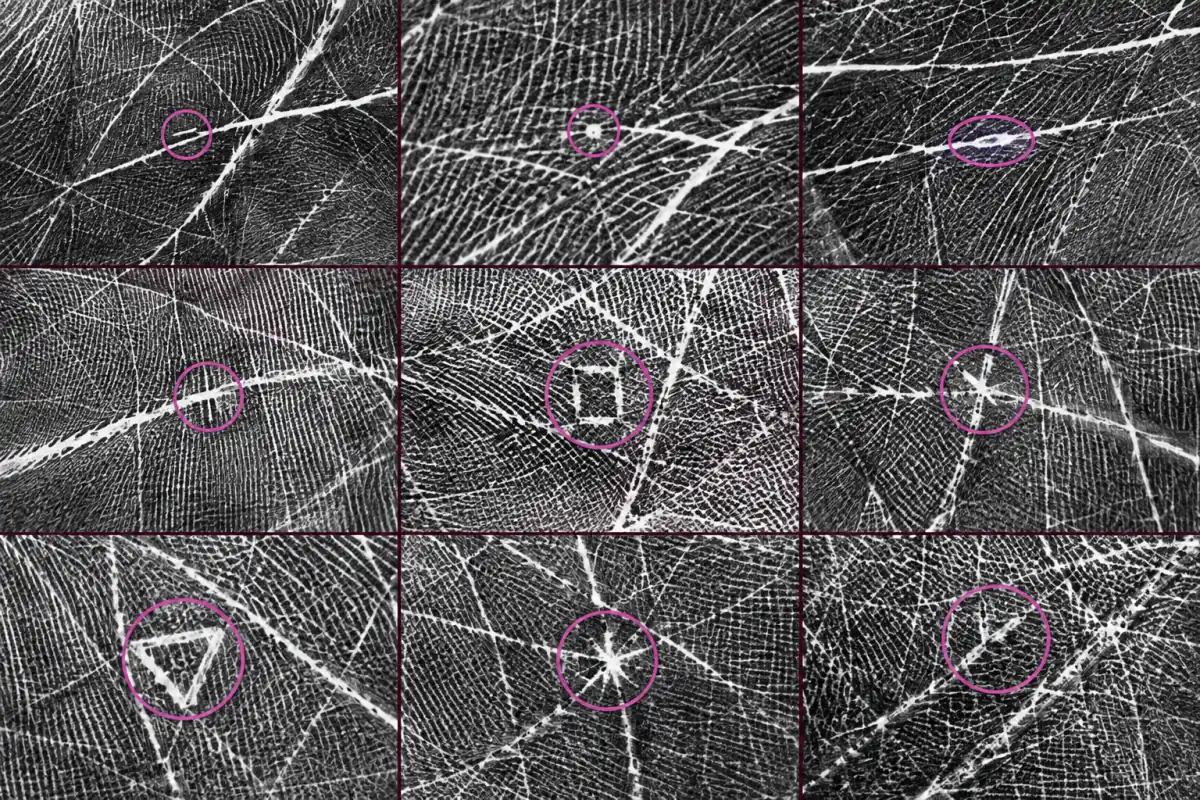
Rare palm markings include clearly formed stars, triangles, circles, squares, crosses, forks, rings, and unusual groups of fine lines. To count as a distinct sign, the shape should be complete, visible with the hand relaxed, and located on an identifiable line or mount. Its location gives the meaning; the shape alone is not enough.
A symbol becomes meaningful only after its location and surrounding lines are clear. A full reading can verify the mark and show whether the same theme appears elsewhere in the hand.
Five tests for a genuine palm marking
- Relax the hand. A sign that appears only when the skin is stretched is probably a movement fold.
- Trace every side. A triangle needs three connected sides; a star needs several lines meeting at one centre.
- Find its location. Name the line or mount beneath the sign.
- Compare scale. A clear shape should stand out from the surrounding fine texture.
- Check the original image. Sharpening, contrast, and compression can connect gaps that are not present.
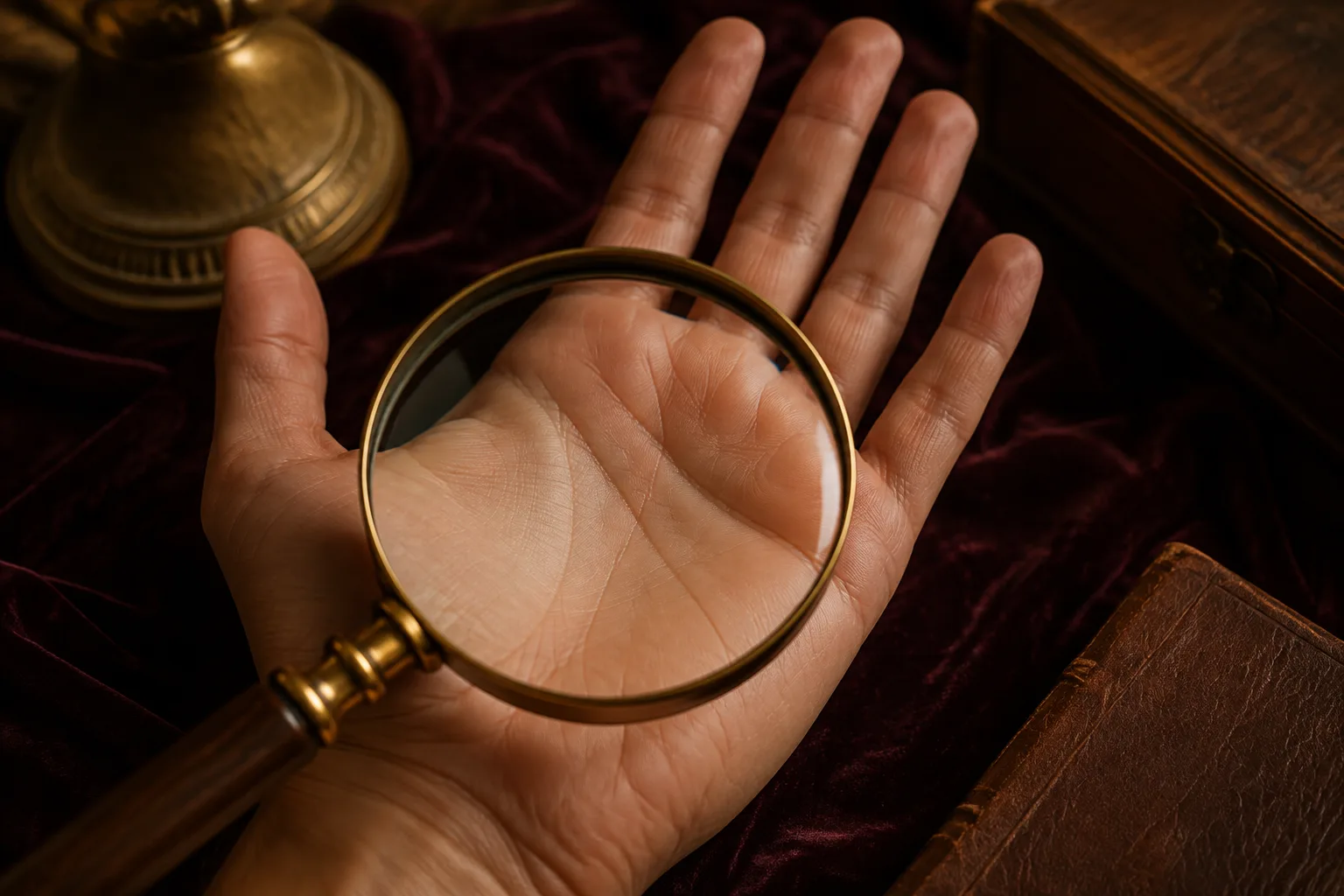
Use a magnifying glass or a sharp photograph, but return to the unaided palm. If the shape cannot be found twice, record it as an uncertain intersection rather than a rare sign.
Traditional meanings of rare shapes
| Mark | How to identify it | Traditional theme |
|---|---|---|
| Star | Three or more short lines meet at one central point | A sudden concentration or dramatic expression of the location |
| Triangle | Three lines form a genuinely closed three-sided shape | Skill, organization, or a focused use of the area |
| Square | Four sides form a closed box | Containment, stabilization, or support around a difficulty |
| Cross | Two clear lines intersect | A decision, conflict, meeting point, or concentrated event |
| Circle | A complete rounded enclosure | Attention concentrated in one area; interpreted differently by school |
| Trident | One line ends in three clear upward branches | Expansion into several channels |
| Fork | One line divides cleanly into two branches | Diverging directions, dual ability, or a choice |
| Grille | Several vertical and horizontal fine lines form a mesh | Energy scattered or repeatedly activated in the location |
Why circles and stars are easy to overread
Palm skin contains dense ridge detail and many crossing creases. A “circle” is often an island on a line or several arcs that do not close. A “star” may be three unrelated creases crossing near each other. Rotate the hand under side light; a real crease path remains traceable while surface glare changes.
Named rare markings in palmistry
Ring of Solomon
This is a fine curved line partly encircling the base of the index finger on the Jupiter mount. It is traditionally linked with insight into people, teaching, counselling, psychology, or interest in symbolic systems. Do not confuse it with the ordinary crease at the finger base.
Teacher’s square
A small square below the index finger and above the head line is sometimes called the teacher’s square. Palmists associate it with organizing information, explaining, instructing, or managing people. All four sides should be clear enough to trace.
Samaritan lines
These are a small group of fine vertical lines below the little finger, often crossing the heart line. They are traditionally associated with service, care, healing work, and a wish to help others. They should appear as a coherent group rather than general fine creasing across the upper palm.
Girdle of Venus
This curved or segmented arc sits above the heart line beneath the middle and ring fingers. A strong example is read for heightened sensitivity, imagination, or intense response to experience. It is a minor line, even when its shape looks dramatic.
Mars or sister life line
A clear line running inside and parallel to part of the life line is associated with reserve, support, persistence, or the ability to rally under pressure. Numerous short lines in the Venus area are not the same formation.
Palm loops and whorls
Dermatoglyphic loops sometimes occur between the fingers or on the lower outer palm. Named forms include loops traditionally linked with leisure, industry, sensitivity, inspiration, nature, rhythm, or courage. These are ridge patterns, not ordinary creases, so they require a high-resolution print or macro photo.
How location changes the interpretation
- On the heart line: the mark modifies an emotional or relationship theme.
- On the head line: it modifies concentration, decisions, learning, or a change in viewpoint.
- On the life line: it modifies security, vitality, family, place, or a major transition.
- On the fate line: it modifies work, direction, responsibility, or an outside influence.
- On the Jupiter mount: standards, confidence, leadership, teaching, or ambition.
- On the Apollo mount: expression, craft, beauty, visibility, or recognition.
- On the Mercury mount: communication, business, teaching, advising, or service.
- On the Moon mount: imagination, travel, audience, intuition, or the inner world.
A triangle on the fate line and a triangle below the ring finger may share the theme of concentrated skill, but one belongs to direction and responsibility while the other belongs to expression or recognition.
What about moles, scars, and coloured spots?
Moles and scars are physical skin features, not line formations. Some palmistry traditions assign them symbolic meanings by mount, but a new, changing, bleeding, itching, or unusual skin mark should be evaluated as a skin mark first. Do not cover it with a mystical interpretation.
How to photograph a rare marking
- Take one full-palm image to preserve location.
- Take a close-up with the phone parallel to the skin.
- Add a second close-up with light coming from the side.
- Keep the image in colour and turn off filters.
- Include a nearby finger crease or ruler edge for scale without covering the mark.
Which signs deserve the most weight?
Use this hierarchy: major hand proportions first, major lines second, clearly formed minor lines third, and small isolated symbols last. A pronounced finger, thumb, or major line affects the whole reading. A tiny cross adds a local detail. Rare does not automatically mean important.
Identify before interpreting
Use the foundational marks and symbols guide, locate the sign with the mount map, and capture it with the palm photo checklist.
The complete answer
A rare marking is a clear, repeatable shape with a precise location. Verify its geometry, identify the line or mount it modifies, compare both hands, and keep its weight proportional to its size and clarity. That method turns a mysterious-looking crease into a detailed, coherent part of the whole reading.
A Full Palm Reading
Find out whether your unusual mark matters to the whole reading
Your reading inspects the mark, identifies its line or mount, compares both hands, and checks whether its theme repeats elsewhere before interpreting it.
Your Full Palm Reading maps all the important features—hand shape, skin texture, thumb, fingers, mounts, major and minor lines, markings, and the differences between both palms—and brings them together in a holistic reading focused on your questions.