
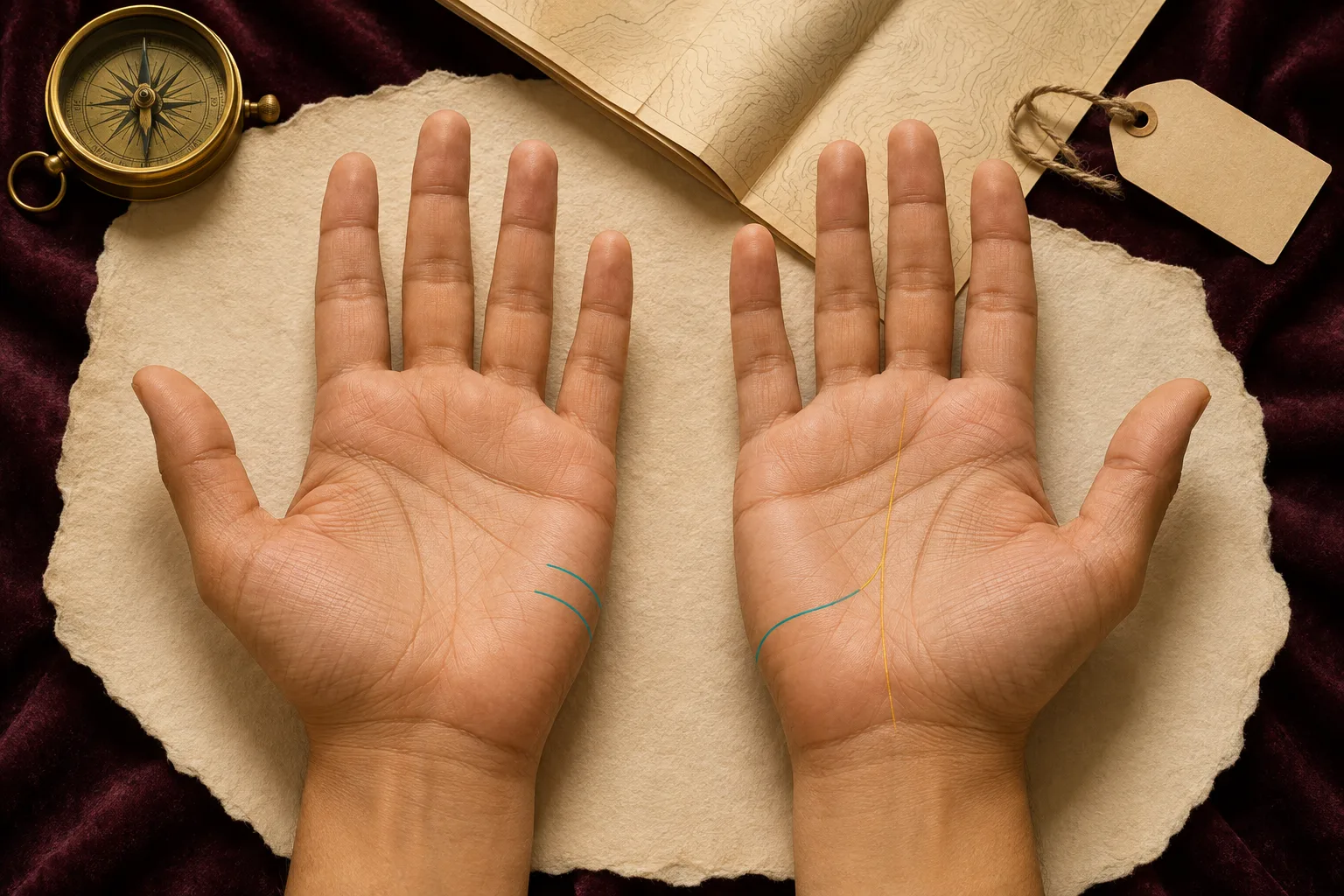
Travel lines in palmistry are the fine horizontal or diagonal creases entering from the lower outer edge of the palm across the Mount of Moon. Short lines are traditionally linked with journeys or periods away. A longer line that reaches and changes the fate line, a clear branch from the life line toward the Moon area, or a fate line rising from Moon carries more weight for relocation or a life shaped by distant places. No single line confirms permanent foreign settlement.
You may be asking about far more than a trip: whether study, work, family, or a relationship could move the centre of your life elsewhere. A whole-hand reading can show whether Moon, life-line, and fate-line features repeat around that exact relocation question.
The useful question is what travel changes. Does the line remain a small event on the edge of the hand, move the person's centre of life away from the familiar environment, redirect the career, or add recognition and stability after the move? That hierarchy separates a holiday from study abroad, repeated work travel, long-term relocation, and a divided life between two places.
Where are travel lines on the palm?
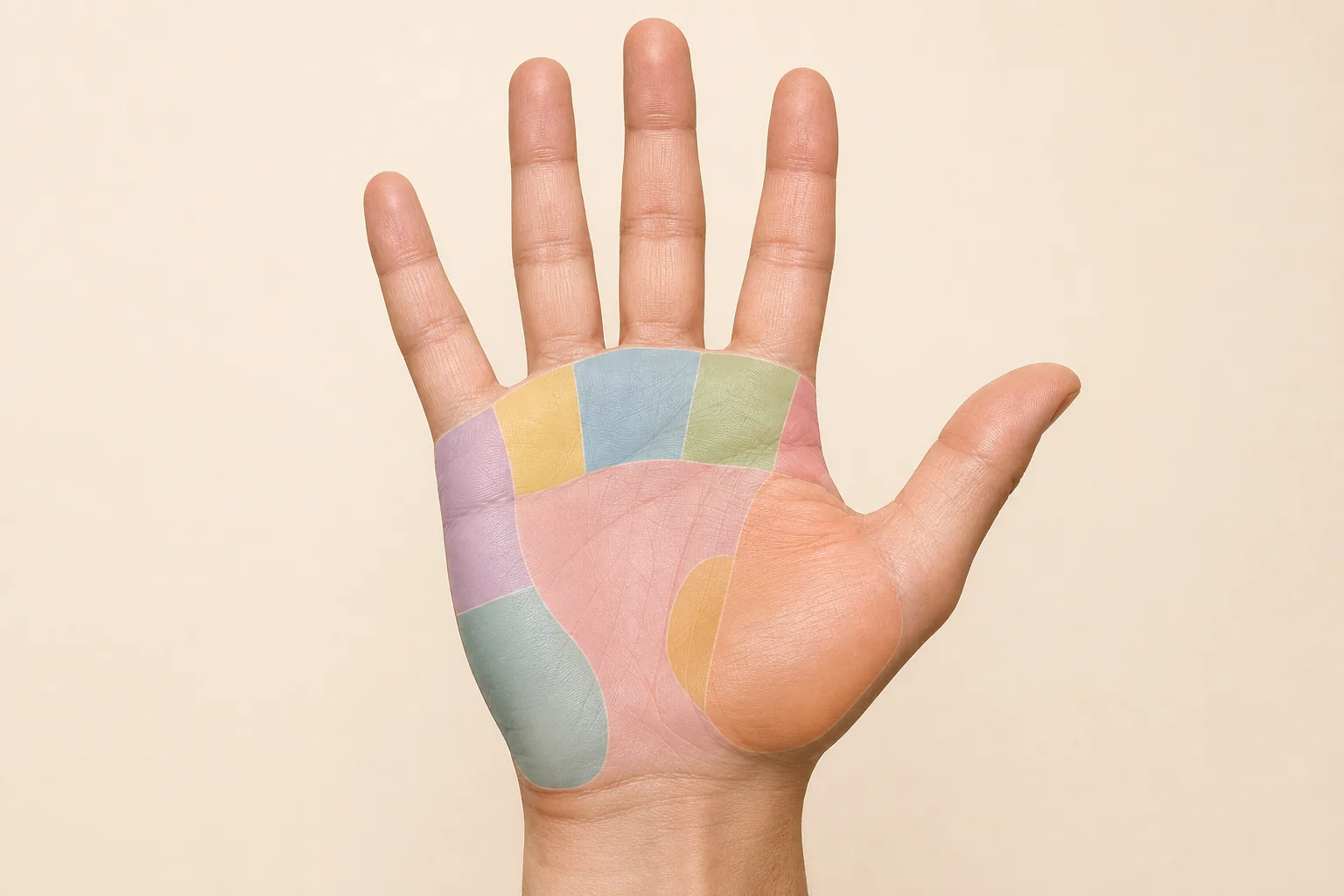
Turn the open hand so you can see the outer edge below the little finger. The lower padded area between that edge and the life line is the Mount of Moon, also called Luna. It sits opposite the thumb mound. Travel lines begin at the outer edge and move inward across this Moon area.
- Find the little finger and follow its outer edge down toward the wrist.
- Locate the padded lower outer palm, directly opposite the thumb.
- Ignore the heart line higher on the edge and the wrist bracelets below.
- Look for fine creases entering from the edge rather than lines beginning in the centre.
- Trace the clearest line inward and record what it reaches, crosses, or joins.
The Moon mount is easy to confuse with the Venus mount inside the life line beside the thumb. Venus belongs to attachment, warmth, family, and vitality in the traditional system; Moon belongs to imagination, distance, movement, audience, and unfamiliar environments. Use the palm-mount map before naming a travel line.
Travel, relocation, and foreign settlement are different patterns
| Question | Features palmists examine | Traditional emphasis |
|---|---|---|
| Short or occasional travel | One or more fine Moon lines that stay near the edge | Journeys, temporary stays, changing scenery, or formative experiences |
| Repeated long-distance travel | Several clear lines extending across the Moon mount | Movement as a recurring part of life or work |
| Relocation | Life-line branch toward Moon or a strong travel influence reaching fate | A move that changes home base, routine, or direction |
| Work abroad | Moon influence joins or redirects the fate line, with career support above | Travel or foreign connections reshape professional direction |
| Study abroad | Moon influence near an earlier fate-line zone plus a clear head line | Learning and distance combine during an earlier career stage |
| Long-term or divided settlement | Strong outward life-line branch, fate-line change, and repetition on both hands | Life becomes established away from the original base or split between places |
Depth and destination matter more than counting. Many fine edge creases can reflect ordinary skin folding. A single line that is clear, traceable, and connected with the life or fate line receives more weight than six scratches that disappear when the hand relaxes.
What the shape of a travel line adds
- Short and fine: a smaller journey, a temporary change of environment, or a travel theme with limited impact.
- Long and clear: a more formative journey or sustained connection with a distant place.
- Rising inward: movement that develops toward opportunity, work, study, or a new aim.
- Fading before the centre: a journey or plan that remains temporary, less defined, or less central to direction.
- Forked: two destinations, repeated movement, or a choice about where to establish a base.
- Broken or crossed: complications, changes of plan, or competing demands; not proof of danger, refusal, or loss.
What does a life-line branch toward the Moon mean?
The life line curves around the thumb mound. A branch leaving its main arc and moving outward across the lower palm toward Moon is one of the stronger traditional relocation signs because it shows the person's centre of activity moving away from the familiar Venus area toward distance and a new environment.
First distinguish a branch from a complete fork. A small side branch adds an episode or opportunity while the main life line continues. A lower fork with two substantial arms gives more weight to a divided life, two homes, recurring movement, or a lasting choice between roots and distance. If the outer arm becomes clearer than the inner arm, the distant environment receives greater emphasis. If the inner arm remains stronger, travel may recur while the original base remains central.
A wide life-line arc is not itself a foreign-settlement sign. It simply creates a broad Venus area. The relevant feature is a distinct branch leaving the arc toward the opposite side. Compare forms with the life-line guide.
Lines crossing from Venus to Moon
Fine lines moving from inside the life line, crossing it, and continuing toward Moon are sometimes described as family, relationship, or personal circumstances prompting a move. Their origin adds the influence; the fate line and outer branch show whether it changes direction. Do not turn one crossing into a claim about who causes the move.
How the fate line changes a travel reading
The fate line is the optional vertical line travelling toward the middle finger. It describes sustained direction and responsibility in palmistry, so a Moon line that reaches it suggests movement becomes part of the person's working path rather than remaining a separate trip.
- Travel line touches the fate line: a journey or distant connection intersects with career direction.
- Travel line joins and strengthens the fate line: the new environment, foreign contact, or move supports a clearer professional path.
- Travel line crosses a steady fate line: travel creates a turning point or competing demand, but the existing direction may continue.
- Fate line shifts after the meeting: relocation may coincide with a new job, employer, field, or working model.
- Fate line begins from Moon: work and direction are traditionally linked with the public, clients, other people, travel, or unfamiliar environments.
- Second fate line rises from Moon: a distant place, international work, audience, or partnership may become a parallel professional channel.
A fate line from Moon does not automatically mean living in another country. It can also fit client work, public-facing roles, hospitality, transport, media, imagination, or a career shaped by other people's response. The exact interpretation comes from the destination, head line, mounts, and real career context. Trace the route with the fate-line guide.
Sun and Mercury support for life abroad
A Sun line developing after a travel or fate-line change can add satisfaction, visibility, craft, or recognition in the new environment. Mercury emphasis can add language, trade, communication, technology, advising, or service. These lines describe what may develop through relocation; they do not prove settlement by themselves.
How palmists distinguish work, study, and relationship relocation
| Combination | Traditional interpretation to explore |
|---|---|
| Moon line + fate-line shift + stronger upper fate line | Career relocation or a professional path becoming clearer away from the old base |
| Moon line + clear head line + earlier career zone | Education, training, research, or learning in a distant environment |
| Influence from Venus + life-line branch to Moon | Family or relationship circumstances connected with a move |
| Moon-origin fate line + Mercury emphasis | Work with international clients, language, commerce, communication, or mobility |
| Moon influence + later Sun line | Recognition or fulfilment developing after travel or relocation |
One person can show several themes at once: study creates the first journey, a job extends the stay, and a relationship later helps form a long-term home. A whole-hand reading should explain the sequence rather than forcing the outcome into one category.
How is foreign-travel or relocation timing read?
Timing is clearest when a travel influence meets a major timed line. On the fate line, the head-line crossing is commonly treated as an approximate mid-thirties landmark and the heart-line crossing as an approximate mid-fifties landmark. A travel line meeting below, between, or above those crossings gives an earlier, middle, or later career stage.
Life-line timing systems divide the arc from its beginning near the index finger toward the wrist, but the scales differ substantially. For an outward branch, name its location first—upper, middle, or lower life line—and use a broad life stage. Fine Moon lines alone are especially difficult to date because the outer area has no consistent start and end landmarks.
- Confirm that the line genuinely begins at the outer Moon edge.
- Trace whether it stays local, reaches the life line, or meets the fate line.
- Place the meeting relative to a visible head or heart line.
- Check what happens to the fate or life line after the meeting.
- Compare the same level on both palms and against known past moves.
This can organize a broad chapter; it cannot predict visa approval, residency status, a flight date, or a particular country. A move depends on eligibility, money, opportunities, relationships, and choices outside the hand.
Which hand shows foreign settlement?
Read both. Under the common dominant-hand method, the less-active hand provides the background pattern and the active hand shows developed direction. A new Moon-to-fate connection on the active hand may be read as a travel or relocation theme strengthened through current choices. A similar strong pattern on both hands receives more weight. A mark visible on only one photograph may simply need better light.
Compare hand dominance rather than using a male-hand or female-hand rule. Follow the same process in which hand to read in palmistry.
Worked examples
Example 1: study abroad that remains temporary
A clear Moon line reaches inward near the lower career zone, the head line is long and even, and the fate line continues on its original route without shifting. A palmist might connect the journey with education or skill development while treating the established career direction as continuous. The pattern supports a formative stay more readily than permanent settlement.
Example 2: relocation changes the career path
A long Moon influence meets the fate line below the head line. The fate line shifts slightly at that point and grows clearer above it, while a Mercury line becomes visible. This combination can be read as relocation or foreign connections changing the working path, with communication, trade, technology, or service gaining emphasis.
Example 3: a divided life between two places
The lower life line forms two substantial branches: one continues around Venus and one travels toward Moon. Several clear Moon lines repeat on the active palm, while the fate line stays steady. The synthesis may emphasize recurring movement or two home bases without assuming the person permanently leaves one place for the other.
Example 4: many faint lines but no relocation combination
The Moon area contains numerous shallow creases, yet none can be traced inward and neither the life nor fate line changes. These marks deserve little weight. The hand may still belong to someone who travels or settles abroad; palmistry simply does not provide a strong visible combination to interpret.
Photo checklist for travel and settlement lines
- Photograph both full palms from the fingertips through the wrist.
- Add a slightly angled view of each lower outer edge below the little finger.
- Use bright indirect light and a second shot with gentle side light.
- Keep the hand relaxed so temporary folds do not resemble travel lines.
- Capture the entire route from Moon to the life or fate line in one frame.
- Keep the images in colour without smoothing, tracing, or sharpening filters.
Questions that make the reading more useful
- Does the visible line describe travel, a changed home base, or a changed career?
- Is the move connected more strongly with study, work, family, a relationship, or independence?
- What happens to the fate line after the Moon influence reaches it?
- Does the life line keep two strong branches, suggesting two places remain important?
- Is the same relocation pattern present on both palms?
- Which real opportunity or constraint matters most to the foreign-settlement question now?
Build the complete relocation picture
Locate the Moon mount, compare life-line branches, trace changes with the fate-line guide, and place any professional shift with the career-change timing method.
The complete answer
Travel lines begin at the lower outer Moon edge and describe journeys according to their clarity, length, and connections. A branch from the life line toward Moon adds relocation, while a Moon influence joining or changing the fate line links the move with career and direction. Repetition across both hands and a stronger line after the change add weight to long-term settlement. The most useful reading combines those features to answer whether the question concerns travel, study, work abroad, relocation, or a lasting home in another place.
A Full Palm Reading
Ask what travel or relocation changes in your complete hand pattern
Your reading connects the travel lines and Moon mount with life-line branches, the fate line, Sun and Mercury support, timing zones, and both palms to explore whether your question points toward travel, work abroad, relocation, or a divided home base.
Your Full Palm Reading maps all the important features—hand shape, skin texture, thumb, fingers, mounts, major and minor lines, markings, and the differences between both palms—and brings them together in a holistic reading focused on your questions.