
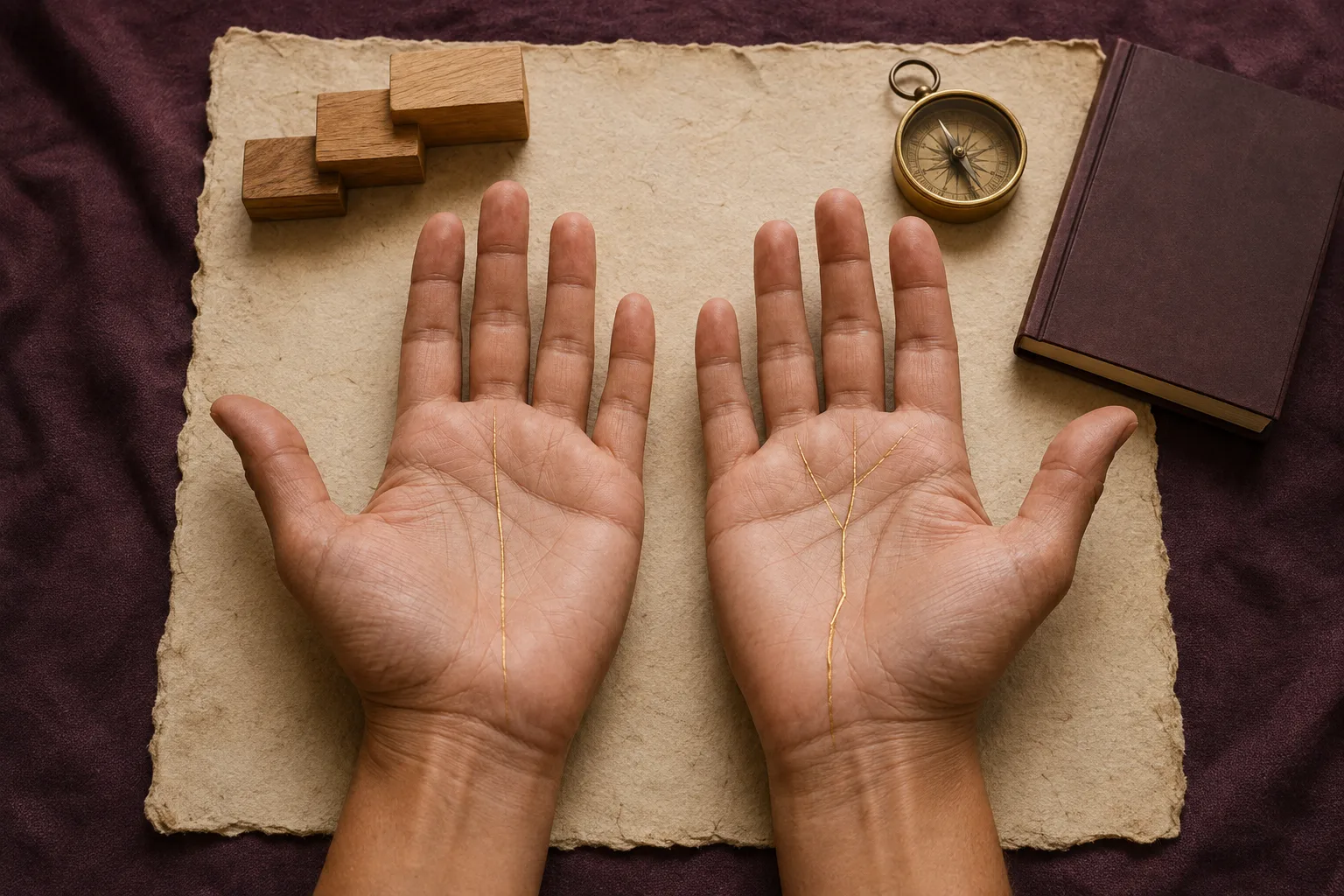
In palmistry, a career change is usually associated with a fate line that breaks and restarts on a new path, bends, forks, or gains a new influence line. Promotion is more often associated with a fate line that continues while becoming clearer, sends an upward branch toward Jupiter or the Sun, or gains a supportive Sun line. The approximate timing comes from where that change sits between the wrist, head line, heart line, and finger base.
A visible change on the fate line can leave you wondering whether it points to promotion, a new employer, or a different path entirely. A whole-hand reading can compare the continuation, branches, supporting signs, and both palms around the work decision you are facing.
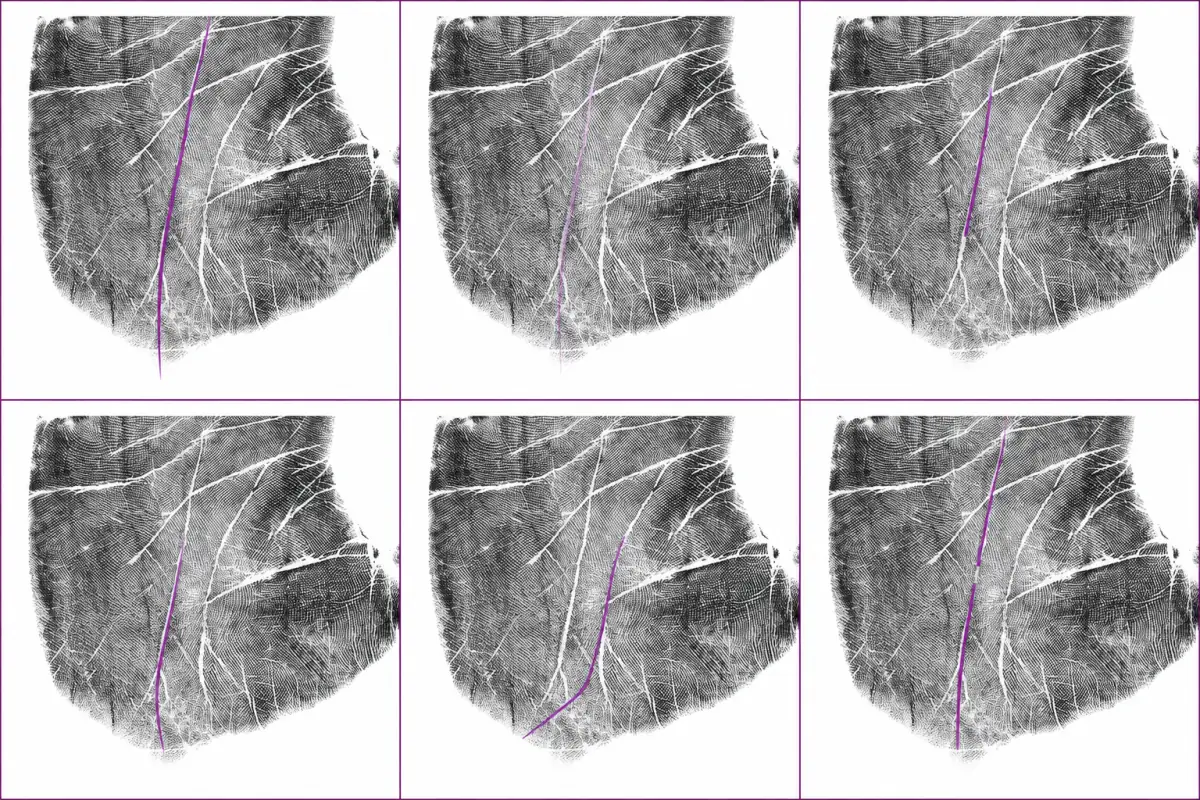
The first distinction matters. A break does not automatically mean job loss, and an upward branch does not automatically mean promotion. The surrounding line must show whether the main direction continues, shifts, gains responsibility, or receives recognition. Compare the same zone on both hands before attaching a career story to it.
First identify what actually changes on the fate line
The fate line, also called the career or Saturn line, normally travels upward through the central palm toward the middle finger. It may begin at the wrist, beside the life line, from the lower outer palm, or higher in the hand. Trace the strongest continuous route upward rather than connecting every fine vertical crease.
| Formation | What it looks like | Traditional career reading |
|---|---|---|
| Strengthening | The same route becomes deeper or cleaner | Direction, stability, or responsibility becomes clearer |
| Clean break | The line stops, leaving a visible gap | A pause, ending, interruption, or reassessment |
| Shifted continuation | A second line starts beside the first and continues upward | A changed role, employer, field, or working arrangement |
| Upward branch | A smaller line rises from the main route | Added aim, opportunity, responsibility, or recognition |
| Fork | The main line divides into two comparable routes | Two career directions, simultaneous roles, or a choice |
| Island | The line separates and rejoins around a narrow space | A complicated, diffuse, or pressured professional period |
| Cross-bar | A separate line cuts across the fate line | Friction, interruption, or a competing demand at that stage |
Use a second light angle when checking a suspected break. Dry skin, glare, a shallow crossing line, or the head line itself can hide a fine continuation. The fate-line guide shows the main routes and variations before they are applied to timing.
Break, overlap, or crossing?
- Find where the visible fate line ends.
- Look immediately above, left, and right for a continuation.
- Check whether a stronger horizontal line merely crosses and obscures it.
- Notice whether the upper segment returns to Saturn or moves toward another mount.
- Describe the geometry first: “gap,” “overlap,” “shift,” or “fork.” Interpret it second.
Palmistry signs traditionally associated with a career change
A career change means the direction or structure of work alters materially. That may be a new field, employer, location, level of independence, or second career. The palmistry pattern should therefore show redirection, not merely a good or difficult period on an otherwise continuous line.
1. A shifted fate-line continuation
This is the clearest traditional change pattern. The lower segment ends and another vertical segment begins slightly to one side, often with an overlap. A clean upper line suggests the new direction gains structure. A faint upper line suggests it is still forming or receives less emphasis. If the upper route returns toward Saturn, the change may preserve professional continuity while altering the role or organization.
2. A bend toward another mount
The destination adds a theme to the change. A route or strong branch moving toward Jupiter below the index finger adds leadership, management, teaching, standards, or authority. Movement toward the Sun area below the ring finger adds expression, visibility, craft, or recognition. A line pulled toward Mercury below the little finger adds communication, service, advising, trade, or enterprise. Use the mount map to name the destination accurately.
3. A fork or second fate line
A fork can show two possible directions or a period when one path divides into two. Two distinct vertical lines may suggest parallel roles, a profession plus a serious side project, or two sustained areas of responsibility. Check whether one route becomes dominant higher in the palm; that can describe a gradual transition rather than an abrupt exit.
4. A fate line that begins higher in the palm
When the clearest career line starts near or above the head line, palmists often describe direction emerging after education, experience, or a deliberate adult decision. This can suit a later specialization or second career. The starting level alone cannot show why the shift happened.
5. A new influence joining the fate line
A diagonal line joining the fate line can be read as another person, a partnership, public contact, family pressure, relocation, or an outside opportunity influencing work. Its origin and the condition of the fate line after the meeting matter. If the line becomes clearer, the influence is traditionally framed as strengthening direction; if it fragments, the period may be more complicated.
Palmistry signs traditionally associated with promotion
Promotion usually adds scope, authority, visibility, or reward while the main career path remains recognizable. Look for continuity first and upward development second. This separates promotion from a full redirection.
- Fate line becomes deeper without changing course: career stability or responsibility increases.
- Clear upward branch toward Jupiter: leadership, rank, supervision, teaching, or decision-making authority gains emphasis.
- Upward branch toward the Sun area: visible work, achievement, reputation, or recognition becomes more important.
- Sun line begins from or near the fate line: the existing career starts producing more satisfaction or public acknowledgment.
- Strong fate line plus balanced Jupiter mount and firm thumb: ambition is supported by responsibility, judgment, and follow-through.
- Fine rising lines from the life line: personal effort, initiative, or a new aim supports the larger career pattern.
A Sun line is a supporting line below the ring finger, not a universal promotion mark. Some respected careers show no obvious Sun line. Its presence is most useful when it agrees with a continuing fate line and the nature of the work. See the Sun-line guide before identifying it.
| Pattern | More consistent with promotion | More consistent with career change |
|---|---|---|
| Main fate line | Continues and strengthens | Shifts, forks, bends, or restarts |
| Upward development | Small branch adds authority or recognition | New route becomes equal to or stronger than the old route |
| Sun line | Appears alongside a stable direction | Appears as the previous path fades and a visible new path forms |
| Both hands | Active hand adds strength to an existing background route | Active hand departs materially from the background route |
| Practical question | “Will my scope, title, or recognition grow?” | “Will I change role, field, employer, or working model?” |
How career-change and promotion timing is estimated
Traditional timing divides the fate line into broad career stages. The wrist is treated as the beginning of the scale. The crossing with the head line is commonly placed around the mid-thirties, and the crossing with the heart line around the mid-fifties. The upper section toward Saturn covers later years. Readers interpolate between those landmarks.
| Fate-line zone | Broad traditional stage | Best wording |
|---|---|---|
| Lower palm, before the head line | Education through early career | “The change sits in the earlier part of the career scale.” |
| At the head-line crossing | Roughly the mid-thirties landmark | “Direction changes around the decision-and-judgment zone.” |
| Between head and heart lines | Middle career | “The branch develops during the middle professional period.” |
| At the heart-line crossing | Roughly the mid-fifties landmark | “Work direction meets a later values-and-priorities point.” |
| Above the heart line | Later career | “The new emphasis appears in the upper, later-stage zone.” |
This scale is approximate. Hands differ in proportion, the fate line may lean, and readers disagree about the precise anchor ages. Treat a visible change as a period, not a date. A generic photograph cannot reliably turn one millimetre into one year.
A five-step timing method
- Choose one confirmed formation. Use the start of the branch, break, shift, or stronger segment—not the point you hope will mean promotion.
- Place it relative to the head and heart lines. Name the spatial zone before assigning an age range.
- Trace what happens afterward. A clean continuation tells a different story from a fading or heavily crossed segment.
- Check supporting lines. Look for a Sun line, Jupiter branch, life-line effort line, or a second fate line beginning near the same level.
- Compare both hands and known history. Use an earlier confirmed career event to see whether the chosen scale fits this person's hand.
Calibration is more useful than pretending every palm follows one chart. If a clearly documented past change appears at a particular level, it gives the reader a local reference for nearby formations. Even then, the result remains an interpretive range rather than a promised promotion month.
What the differences between both hands add
Under the common dominant-hand method, the less-active hand is read as the background pattern and the dominant hand as developed direction. Compare the fate-line route, clarity, branches, and supporting Sun line at matching levels.
- Same change on both palms: the transition receives more weight in the symbolic reading.
- Branch appears only on the dominant palm: ambition, responsibility, or a new direction may have developed through choices and experience.
- Strong background line, shifted active line: the current working path may differ from the earlier or expected direction.
- Fragmented background line, clearer active line: career structure or commitment may have strengthened over time.
- Active line fades after a change: the new direction may be unsettled, incomplete, or simply too fine to photograph well.
Line differences do not prove that a future event has already been fixed. Lighting, hand use, skin texture, and image angle can change what is visible. Follow the two-hand comparison method and photograph both palms under the same conditions.
Worked examples: change, promotion, and mixed signals
Example 1: promotion within the same field
The active hand shows a fate line continuing toward Saturn, becoming deeper between the head and heart lines. A fine branch rises toward Jupiter and a Sun line begins at a similar level. The background hand shows the same main route without the branch. A traditional synthesis would emphasize growing responsibility and visibility within an established career. Because the main route remains intact, promotion, team leadership, or expanded scope fits better than a total field change.
Example 2: a deliberate mid-career redirection
The fate line ends near the head-line crossing and a second line begins slightly toward the outer palm before returning to Saturn. The upper segment is clearer than the lower one. A sloping head line and stronger Mercury area add communication and adaptability. This pattern is more consistent with a decision-led change of role, industry, or working method around the middle of the traditional career scale.
Example 3: job plus a second professional path
A steady fate line continues toward Saturn while another finer vertical line develops beside it. Both remain visible above the head line, and the thumb is firm but flexible. A reader might describe a stable main career with consulting, study, creative work, or a side business growing alongside it. The second line should not be treated as an instruction to resign; it shows that two sustained channels may need room.
Example 4: a break with no clear continuation
The active fate line stops below the head line and no convincing upper route appears under either light angle. This supports a period of uncertain direction more readily than a specific change or promotion. The next step is to examine the head line, thumb, mounts, skills, and present options rather than inventing an invisible continuation.
Photo checklist for career timing
- Capture both full palms from directly above.
- Include the wrist creases, fingertips, and all four finger bases.
- Take one image in bright indirect light and one with gentle side light.
- Relax the palm; stretching can split or flatten fine segments.
- Add a close-up from the wrist to the base of the middle finger.
- Keep images in colour and turn off smoothing, sharpening, and filters.
Questions that make the reading more useful
- Does the main career route continue, or does a new route replace it?
- Does the branch point toward leadership, recognition, communication, or another theme?
- Is the change repeated on both hands or developed mainly on the active hand?
- Does the formation describe a new field, a new employer, greater scope, or a second role?
- Which past career event can help calibrate the timing scale?
- What practical evidence would make a promotion or change worth pursuing now?
Read the turning point inside the whole career pattern
Start with the career feature map, trace the complete fate line, add success and recognition signs, and use the full reading sequence before interpreting one change.
The complete answer
Palmistry separates career change from promotion by asking whether the fate line redirects or continues. Breaks, shifted continuations, bends, forks, and second lines emphasize redirection. A continuing line that strengthens or sends upward branches toward Jupiter or the Sun emphasizes added responsibility and recognition. Timing comes from broad fate-line zones, refined by supporting features, both hands, and known career history. The most useful reading maps the complete pattern around the specific work decision you are facing.
A Full Palm Reading
Ask what your career turning point is building toward
Your reading follows the fate line before and after the change, adds branches toward Jupiter or the Sun, compares your head line, thumb, mounts, and both palms, and places the complete pattern around your promotion or career-change question.
Your Full Palm Reading maps all the important features—hand shape, skin texture, thumb, fingers, mounts, major and minor lines, markings, and the differences between both palms—and brings them together in a holistic reading focused on your questions.