

For a job-or-business palmistry reading, examine the fate line, head line, thumb, Mercury and Jupiter areas, Sun line, and both hands together. A steady fate line and a measured head-and-thumb pattern are traditionally associated with structured employment. An independent head-line start, a firm open thumb, a pronounced Mercury area, and career lines connected with the public are often associated with business. Most hands contain a mixture, which can point toward employment with autonomy, consulting, a side business, or entrepreneurship built after experience.
You may not be choosing between security and ambition so much as deciding where autonomy, structure, client contact, and responsibility should meet. A whole-hand reading can show which of those themes repeats most strongly around your career question.
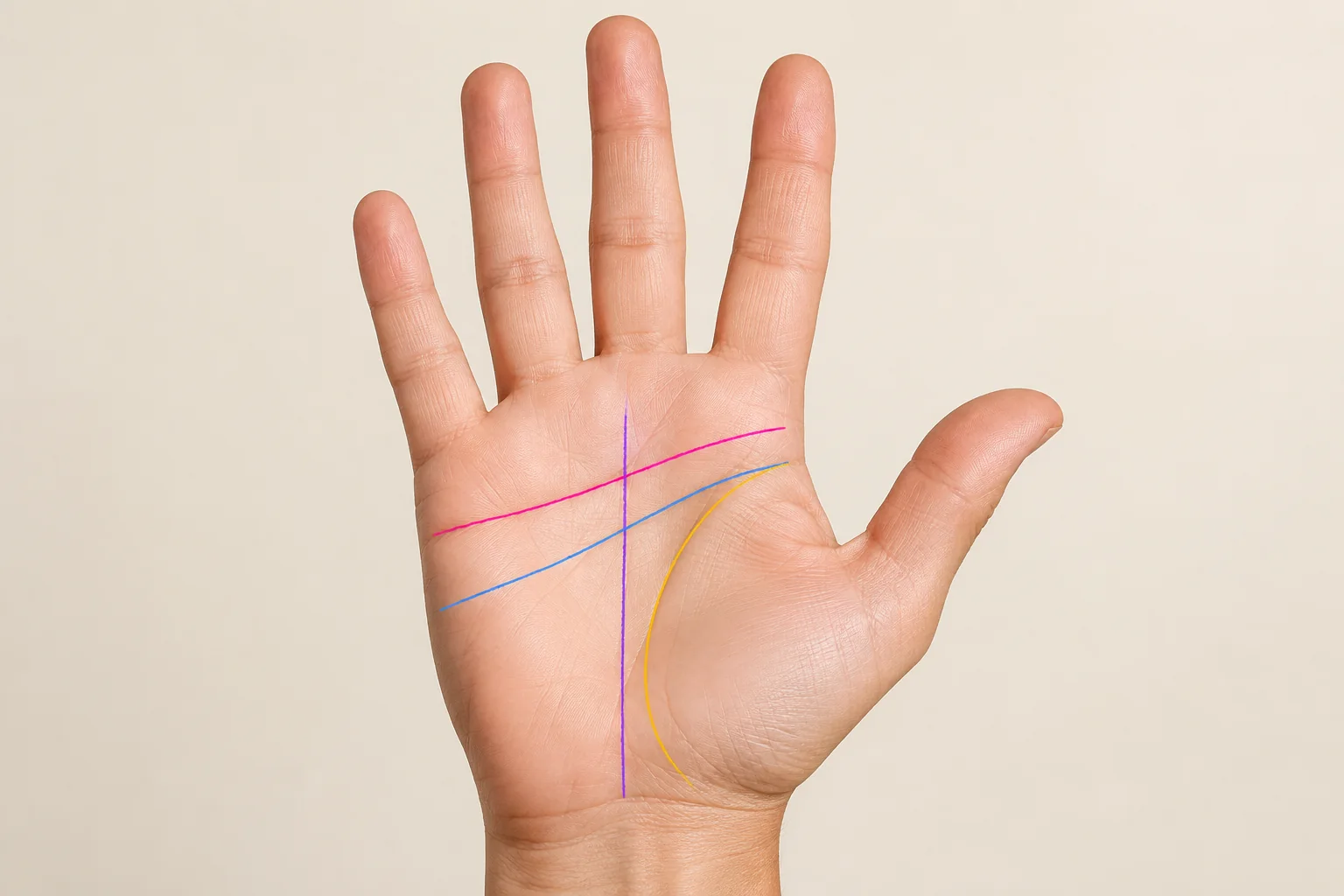
There is no single crease called the business line that can settle the question. The useful task is to identify which work conditions repeat across the hand: security or freedom, specialization or variety, private concentration or client contact, and steady progression or self-directed change.
The six-feature job-versus-business palmistry map
| Feature | What to observe | Traditional career question |
|---|---|---|
| Fate line | Origin, depth, continuity, branches, and ending | How structured is the working path, and what seems to shape it? |
| Head line | Joined or separated start, direction, length, and forks | How independently, practically, or imaginatively are decisions approached? |
| Thumb | Opening angle, flexibility, length, and balance of its sections | How are will, judgment, negotiation, and risk traditionally framed? |
| Mercury and Jupiter areas | Relative fullness, firmness, finger proportions, and clear vertical lines | Is the emphasis on commerce and communication, or authority and organization? |
| Sun line | Presence, clarity, origin, breaks, and branches | Where do expression, reputation, craft, or recognition enter the work pattern? |
| Both hands | Features that repeat, strengthen, fade, or change | Which tendencies look foundational, and which appear more developed now? |
Read in that order. Starting with a tiny mark below the little finger can make the answer feel precise while missing the structure shown by the fate and head lines. The complete career palm-reading guide explains the wider vocational sequence.
1. Start with the fate line
The fate line, also called the Saturn or career line, usually rises vertically through the centre of the palm toward the middle finger. Some hands show a deep line from the wrist, some show a line beginning halfway up the palm, and others have several fragments or no obvious fate line.
- Clear line rising from the wrist: traditionally read as comfort with a defined path, long commitments, or steady professional development.
- Line rising close to the life line: associated with progress built through personal effort, family context, or responsibilities that shape the early path.
- Line rising from the lower outer palm: linked with clients, audiences, partners, travel, or work that depends on public response.
- Line beginning at the head line: often read as a direction that becomes clearer after learning, judgment, or a deliberate decision.
- Two vertical career lines: may suggest parallel roles, a profession plus a side business, or two sustained areas of responsibility.
- Branches or shifted breaks: traditionally indicate a change in role, organization, industry, or working method rather than a simple success-or-failure verdict.
A strong fate line does not automatically mean “job,” and a faint line does not automatically mean “business.” Its origin and relationship with the other features matter more than depth alone. See the fate-line guide for the main variations.
2. Compare the head line with the life line
The head-line start is one of the most frequently used job-versus-business clues. When the head and life lines share a longer starting section, palmists traditionally discuss caution, consultation, preparation, or preference for known conditions. When a visible gap separates them, the reading shifts toward independence, initiative, and willingness to decide without waiting for approval.
The gap should be read by degree. A small separation is different from an unusually wide one, and neither cancels the rest of the hand. Direction adds another layer: a straighter line is associated with practical organization and calculation, while a line sloping toward the Moon area is associated with imagination, audience awareness, and work shaped by ideas or stories. A fork can combine the two approaches. The head-line guide shows how to identify each form.
3. Use the thumb to judge how the pattern operates
The thumb helps distinguish having an independent idea from sustaining it. A firm thumb held at a natural open angle is traditionally connected with decision, self-direction, and the ability to negotiate boundaries. A flexible thumb is associated with adaptability and responsiveness. A thumb held closer to the palm may suggest a more measured use of resources or a preference for certainty before committing.
Look at length and flexibility separately. A long firm thumb with a cautious head-line start can describe someone who makes strong decisions after preparation. A widely opening flexible thumb with a sloping head line can point toward experimentation, people-facing work, or several changing projects. Neither is exclusively a job or business sign. Use the thumb guide to compare the proportions accurately.
4. Compare Mercury, Jupiter, and their fingers
The area below the little finger is the Mercury mount. In palmistry it is linked with communication, exchange, trade, persuasion, calculation, advising, and practical skill. A pronounced Mercury area combined with a relatively long, straight little finger and clear vertical markings is often included in a business-oriented pattern.
The Jupiter mount lies below the index finger and is associated with standards, ambition, leadership, responsibility, and position. A strong Jupiter pattern can appear in managers, administrators, teachers, institutional leaders, or business owners. Mercury may emphasize the exchange; Jupiter may emphasize direction and authority. A person running a business often needs both.
Compare these areas with the Saturn mount below the middle finger, which is linked with patience, depth, discipline, and long responsibility, and the Apollo area below the ring finger, which adds presentation, design, visibility, or pride in craft. The palm-mount map helps locate all four.
5. Add the Sun and Mercury lines only when they are clear
A Sun line beneath the ring finger is traditionally connected with satisfaction, expression, reputation, or recognition. It may strengthen a business pattern when the work depends on a personal brand, a visible craft, or public appreciation. It can also support recognition inside an established profession.
A Mercury line rising toward the little finger may add themes of communication, service, trade, organization, or multiple practical interests. Many hands do not show either line clearly. Their absence should not overturn the major pattern; treat them as supporting evidence. Compare the Sun line and Mercury line before naming them.
Combinations traditionally associated with a structured job
- A clear fate line with a steady course toward Saturn.
- A head line that begins with the life line and separates gradually.
- A firm, measured thumb rather than a very wide opening angle.
- Strong Saturn or Jupiter emphasis for responsibility, standards, and organization.
- Similar career structure on both hands.
This combination can suit work with defined progression, specialist depth, established systems, or responsibility inside an organization. It does not mean the person must accept routine or cannot lead. The question becomes: how much autonomy and variety are needed inside the structure?
Combinations traditionally associated with business
- A distinct gap between the head and life lines, especially when supported by a firm thumb.
- A developed Mercury area and a proportionate little finger.
- A fate line connected with the Moon area, traditionally linking work with clients, audiences, or the public.
- A clear Sun line supporting visibility, craft, or reputation.
- Branches from the fate line or two career lines suggesting multiple channels of work.
- Jupiter emphasis adding ambition, leadership, and willingness to direct others.
Business can mean far more than starting a large company. The same pattern may fit freelancing, consulting, commissioned work, independent practice, sales, a family enterprise, or a side project that becomes a second income stream.
How to read mixed job-and-business signs
Mixed signs are common and usually more useful than a forced binary answer. Use a simple weighting method:
- Write one observation for each of the six feature groups.
- Mark each observation as favouring structure, autonomy, people contact, specialization, visibility, or variety.
- Circle themes that appear at least three times.
- Compare the same features on the other hand.
- Turn the repeated themes into possible work arrangements rather than one job title.
| Repeated pattern | Possible work arrangement to explore |
|---|---|
| Structure + leadership + communication | Management, administration, team leadership, or a regulated professional practice |
| Autonomy + Mercury + public influence | Consulting, sales, freelancing, agency work, or a client-led business |
| Steady fate line + second vertical line | A main profession with a sustained side business or second specialization |
| Imagination + Sun line + independent thumb | Creative enterprise, media, design, teaching, or a visible personal craft |
| Saturn emphasis + independent head line | Research, technical consulting, specialized self-employment, or project ownership |
Worked example: a stable job with a growing side business
Suppose the dominant hand shows a clear fate line from the wrist, a small gap between the head and life lines, a firm thumb, a developed Mercury area, and a second fine vertical line becoming clearer in the upper palm. A palmist might read the steady fate line as the main professional structure and the second line plus Mercury emphasis as a parallel commercial path. The practical synthesis is not “quit your job.” It is that autonomy, client contact, or a side venture may need room inside an otherwise stable working life.
Worked example: independence inside employment
Imagine a hand with a separated head-line start and strong Jupiter mount, but a steady fate line and little Mercury emphasis. The repeated themes are initiative, leadership, and structure rather than trade. That combination may fit owning a function, leading a team, or making independent decisions inside an organization more closely than running a sales-driven business.
Which hand should you use for a career decision?
Photograph and compare both. Under the common dominant-hand method, the more active hand represents developed patterns and the other provides the background tendency. A business-oriented feature visible only on the active hand may be read as a quality that has strengthened through experience. A similar pattern on both hands may be treated as more established. Follow the same comparison method described in which hand to read in palmistry.
Questions that make the reading more useful
- Do I need more autonomy, or a better role inside a stable structure?
- Does the hand repeat communication, leadership, technical depth, visibility, or variety?
- Would a side business satisfy the independent pattern without discarding useful stability?
- Which feature changes most between my two hands?
- Is the real decision about employment type, industry, role, timing, or confidence?
Use palmistry as a symbolic way to organize those questions, then compare the interpretation with your skills, resources, obligations, market evidence, and actual opportunities. The hand can structure the conversation; it cannot calculate business profit or guarantee career success.
Build the full career picture
Start with the career feature map, check changes on the fate line, add the traditional money and wealth combinations, and finish with the complete reading sequence.
The complete answer
Palmistry distinguishes job and business tendencies by combining the fate line's structure, the head line's decision style, the thumb's operation, Mercury and Jupiter emphasis, supporting Sun or Mercury lines, and the differences between both hands. Strong employment and business signs can coexist. The most useful reading identifies the work arrangement that connects stability, autonomy, people, responsibility, and expression around the career question you are actually asking.
A Full Palm Reading
Ask whether your strongest career pattern needs a job, a business, or both
Your reading compares the fate and head lines with your thumb, Mercury and Jupiter areas, Sun line, fingers, and both palms to show how structure, independence, communication, and visibility work together.
Your Full Palm Reading maps all the important features—hand shape, skin texture, thumb, fingers, mounts, major and minor lines, markings, and the differences between both palms—and brings them together in a holistic reading focused on your questions.