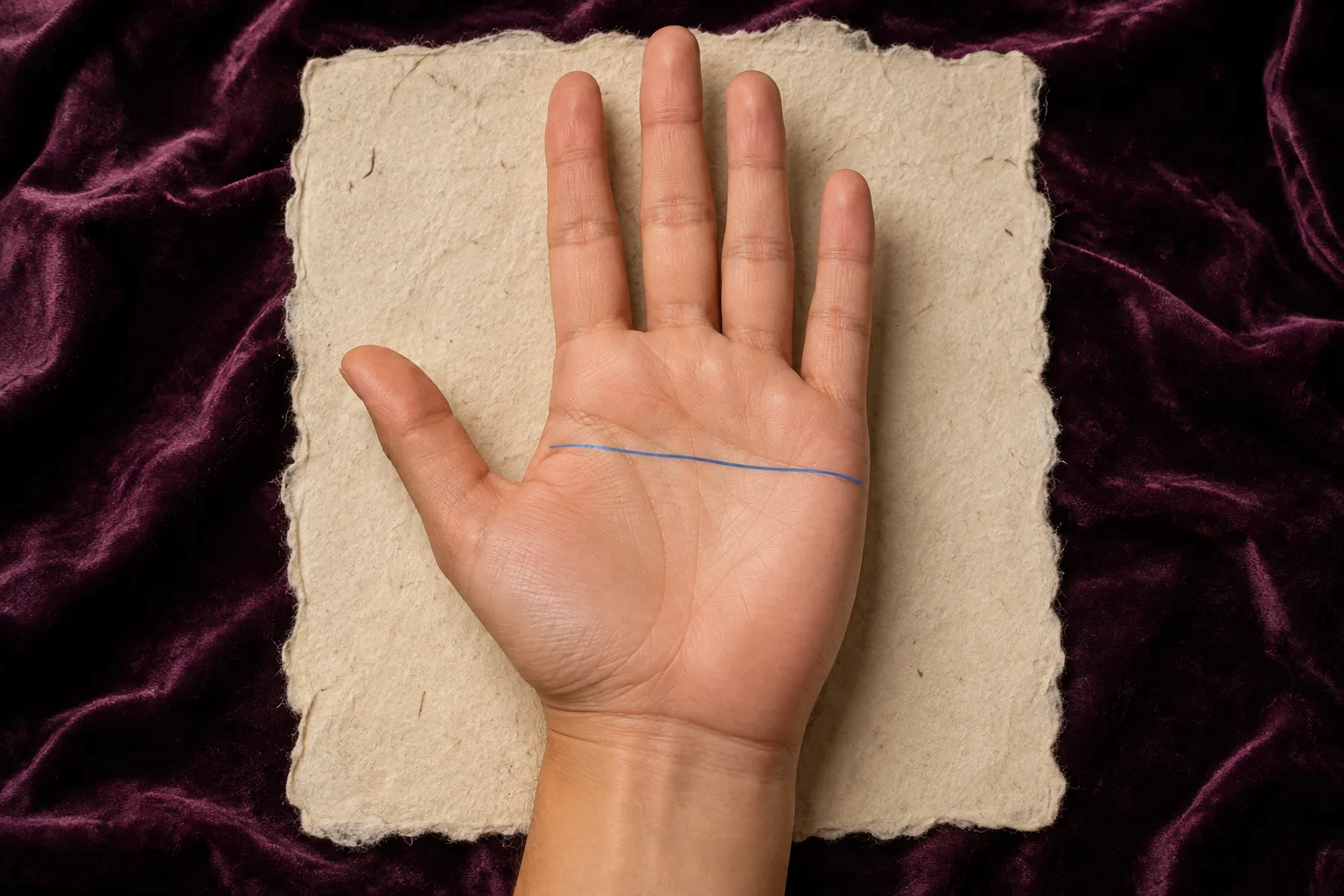
In traditional palmistry, a straight Head line is one coherent middle-palm parent that runs in a broadly level direction from the thumb-index side toward the outer Upper Mars area. It is associated with practical, sequential, evidence-oriented thinking and a preference for usable conclusions. It does not prove someone is unimaginative, unemotional, rigid, highly intelligent, or certain to make good decisions.
A straight Head line becomes personal only after the true thumb-side parent, sustained level route toward Upper Mars, endpoint, length, depth, clarity, slope, fork, branch, crossing and break tests, Life-line start, thumb, fingers, Mercury, Mars, Fate, Heart, hand shape, real decisions, and both palms are compared. A whole-hand reading can show how practicality, planning, imagination, communication, and direction work together.
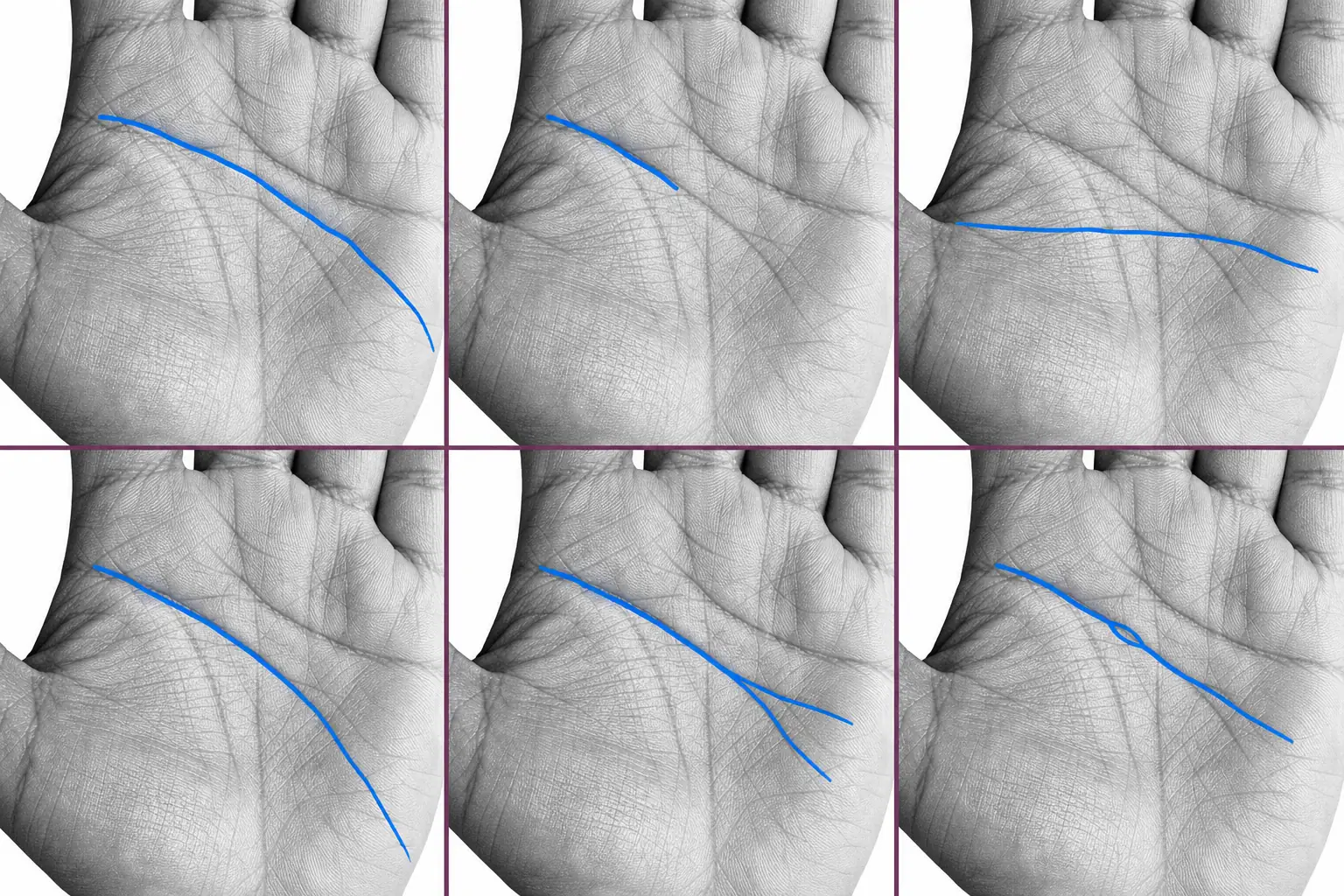
Direction is only one variable. First confirm the true parent and compare its course with the palm's natural horizontal axis. Then add length, depth, clarity, endpoint, the Head line's start with the Life line, thumb, fingers, Mercury and Mars areas, Fate and Heart lines, hand shape, real behavior, and both palms.
Locate the Head-line route
The Head line usually begins near the Life line between the thumb and index finger and crosses the middle palm below the Heart line. It may begin joined to Life, touch it briefly, or start separately. Trace the strongest coherent groove from this inner origin to its own endpoint.
A straight route remains broadly level as it crosses toward the percussion edge, often aiming at Upper Mars in the middle outer palm. It can have a gentle natural bow and still be classed as straight. The defining feature is its sustained direction, not perfect ruler geometry.
Straight means direction, not personality by itself
A level route traditionally emphasizes practical and sequential processing. Length describes mental range, depth describes how established the pattern appears, and the rest of the hand shows how thought becomes communication, choice, and action.
Use a ten-part straight-Head-line method
- Relax the palm. Do not stretch the fingers backward or twist the wrist.
- Find the inner origin. Locate the Head line beside or with the Life line.
- Trace one parent. Follow the strongest continuous middle-palm groove.
- Mark the endpoint. Stop where that parent actually ends.
- Imagine a horizontal axis. Compare the route with the palm's width, not the tabletop.
- Check the destination. A straight course aims toward central or Upper Mars rather than lower Moon.
- Exclude additions. Record a fork, branch, crossing, break, or restart separately.
- Measure length and quality. Note span, depth, clarity, chaining, and markings without mixing them with direction.
- Add support features. Compare the thumb, fingers, Mercury, Mars, Fate, Heart, and hand shape.
- Repeat on both palms. Test the symbolic reading against actual decisions, communication, work, and experience.
| What you see | Direction test | Classification |
|---|---|---|
| One parent stays broadly level across the middle palm | It aims toward central or Upper Mars | Straight Head line |
| The route descends throughout the outer half | Its endpoint enters the lower Moon area | Sloping Head line |
| A straight parent divides into a downward arm | The level route exists before one junction | Forked Head line |
| One thin branch falls from a level parent | The stronger parent continues separately | Straight Head line with Moon branch |
| A foreign crease crosses the parent | It has a different origin and destination | Crossing or crossbar |
| Open skin separates two pieces | The outer segment has its own start | Broken Head line |
What a straight Head line traditionally means
A level route is traditionally associated with organizing thought through sequence, observable facts, comparison, and practical consequences. The person may prefer clear definitions, workable plans, direct evidence, or a problem that can be broken into steps.
When the line is clear and supporting features agree, this can show realism, consistency, and an ability to translate an idea into a method. When the pattern becomes overused, the person may discount possibilities that cannot yet be measured or may keep applying an old procedure after circumstances change. Use those as reflective questions rather than fixed judgments.
A straight route does not remove imagination. Creative work can depend on structure, technique, observation, and revision. The Moon mount, Mercury, fingertips, hand shape, and branches may add intuition, narrative thinking, or experimentation around a practical mental base.
Long and short straight lines express differently
Direction and length must be recorded separately. A straight line may reach most of the way across the palm or end near the center. The long Head-line guide owns broad span, while the short Head-line guide owns a genuine early endpoint.
| Straight-line form | Traditional synthesis | Useful question |
|---|---|---|
| Long and straight | Broad analysis expressed through order, evidence, or planning | When does more context improve the result? |
| Short and straight | Concentrated, direct, or action-focused processing | What minimum evidence prevents a rushed choice? |
| Straight with terminal fork | A practical parent opens into a second final viewpoint | How do two perspectives meet before deciding? |
| Straight with Moon branch | A structured base develops one imaginative channel | Where does intuition add to a tested method? |
The sloping Head-line guide covers a parent whose sustained course enters the Moon area. A downward branch from a straight parent is not the same geometry.
Depth, clarity, and markings change the expression
A deep, even route traditionally strengthens the practical pattern and suggests consistency. A fine but coherent line may express the same sequence more subtly or flexibly. A chained section adds repeated small shifts. An island encloses one local area. A break introduces interruption and a separate restart.
| Quality | Traditional modifier | Verify |
|---|---|---|
| Deep and clear | An established, steady practical approach | A real groove under neutral and side light |
| Fine and continuous | Adaptable or less externally obvious structure | One route remains visible without a gap |
| Chained section | Frequent adjustments within the level path | Linked loops rather than crossing creases |
| Break and aligned restart | A change in approach with practical continuity | Genuinely empty skin between segments |
Supporting features for a complete interpretation
The thumb adds will, logic, flexibility, and follow-through. A firm but flexible thumb can help a practical plan adapt; rigidity may reinforce fixed procedure. Longer fingers add detail and verification, while shorter fingers can emphasize quick synthesis. Mercury adds communication, calculation, trade, and application. Upper Mars adds persistence and response under pressure.
The Head line's relationship with the Life line shows starting style. A joined beginning may add caution or preparation, while a separated start may add independent action. The joined-versus-separated guide keeps this geometry distinct from direction.
The Fate line shows how decisions interact with work and direction. The Heart line adds values and emotional priorities. A practical Head line does not silence feeling; a useful reading asks whether the two systems support each other or create a recurring tension.
Translate the sign into a real decision
Ask which evidence you trust, whether your process leaves room for new information, what makes a plan usable, and where intuition has earned a place beside analysis. Those answers show how the symbol operates in life.
What if only one palm has a straight Head line?
Compare square, evenly lit photographs and identify the active hand by actual use. Palmists often treat the less-used hand as background disposition and the active hand as developed expression. This is a reading convention rather than a scientific rule.
A straighter route on the active hand may suggest that experience has encouraged structure, evidence, or practical judgment. A more sloping active-hand route may suggest greater use of imagination or association. Confirm the difference against pose, camera rotation, a branch, and the true endpoint before interpreting it.
Worked examples
Example 1: long, straight, clear line with a flexible firm thumb
The line supports broad practical analysis, while the thumb adds adaptable follow-through. The useful test is whether careful planning still produces a timely decision.
Example 2: short, straight line with strong Upper Mars
The short span concentrates thought, the level route emphasizes practical action, and Mars adds persistence. The balancing question is whether speed leaves room for a necessary second look.
Example 3: straight parent with one branch toward Moon
The main thinking route remains structured while the branch adds an imaginative outlet. Do not reclassify the entire parent as sloping; interpret the two features together.
Example 4: straight but fine line with long fingers
The path is orderly but subtly expressed, while long fingers add detail. This can describe quiet method and careful verification without requiring a forceful outward style.
Example 5: straighter active-hand route
Matched photographs confirm the change. A reader may explore whether work, responsibility, or repeated decisions developed a more systematic approach.
Photo checklist
- Capture both palms from the same height and angle.
- Keep the wrist and full outer edge visible.
- Use bright indirect light plus one gentle side-light image.
- Relax the hand without twisting it toward the camera.
- Trace the same parent from origin to endpoint.
- Compare its route with the palm's own horizontal width.
- Record direction, length, depth, start, and markings separately.
- Avoid glare, filters, smoothing, and source-photo annotations.
Frequently asked questions
Does a straight Head line mean a practical person?
Traditional palmistry associates the route with practical and sequential processing. Confirm that theme through the rest of the hand and the person's actual decisions rather than treating one line as proof.
Does it mean someone lacks imagination?
No. Imagination may appear through Moon, Mercury, fingertips, branches, hand shape, interests, and behavior. Structure can also support creative work.
How straight must the line be?
It should remain broadly level toward central or Upper Mars. A gentle natural bow is normal. A sustained descent into lower Moon is the stronger sign of a sloping route.
Can a straight Head line be short?
Yes. Direction and length are separate observations. Record the level course and early endpoint, then combine their traditional meanings.
What if one branch slopes downward?
Keep the main parent classified by its sustained route and record the branch separately. One Moonward branch does not make the whole line sloping.
Which hand should I read?
Read both. Compare the same parent, direction, length, start, quality, and supporting features, then use handedness and real history as context.
The complete answer
A straight Head line is one coherent parent beginning near the thumb-index side and following a broadly level middle-palm route toward central or Upper Mars. Traditional palmistry associates that direction with practical, sequential, and evidence-oriented thinking, but it does not prove rigid thinking or lack of imagination. Distinguish the parent from a Moonward slope, fork, downward branch, crossing, break, and camera rotation. Then add length, depth, clarity, endpoint, Life-line start, thumb, fingers, Mercury, Mars, Fate, Heart, hand shape, real decisions, and both palms. A Full Palm Reading maps all the important features across both hands and combines them into a holistic reading focused on your questions about judgment, planning, learning, communication, creative structure, work direction, and how your thinking style is developing.
A Full Palm Reading
Ask how your straight Head line fits your complete thinking pattern
Your reading maps the true Head-line parent, sustained level route toward Upper Mars, endpoint, length, depth, clarity, slope, fork, branch, crossing and break tests, Life-line start, thumb, fingers, Mercury, Mars, Fate, Heart, hand shape, real decisions, and both palms, then adds every other important line, mount, finger, marking, shape, and texture into one holistic reading focused on your questions.
Your Full Palm Reading maps all the important features—hand shape, skin texture, thumb, fingers, mounts, major and minor lines, markings, and the differences between both palms—and brings them together in a holistic reading focused on your questions.