
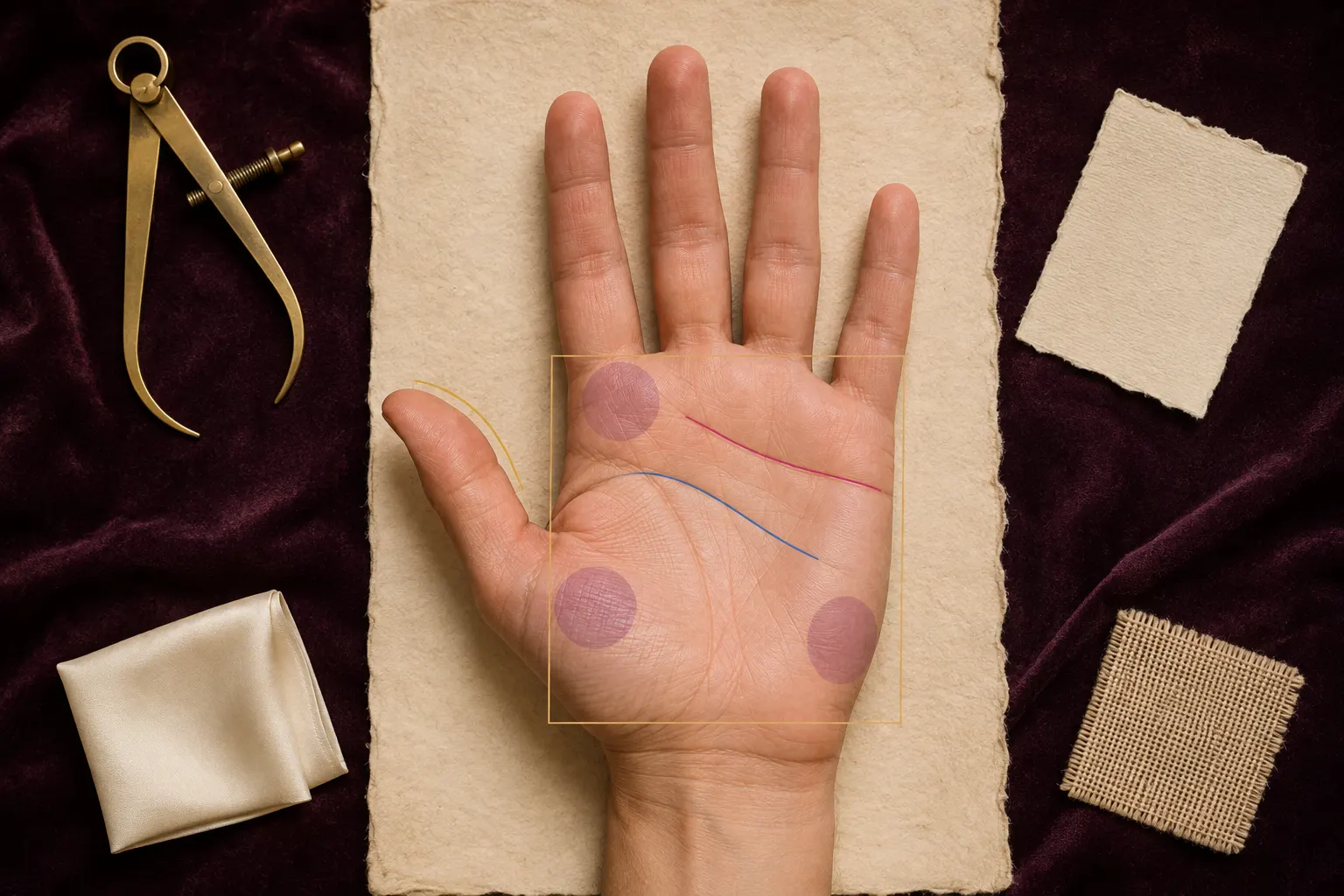
In palmistry, personality traits are read from the whole hand rather than one line. Begin with palm and finger proportions, then add skin texture, thumb length and flexibility, finger proportions, mounts, the head and heart lines, fingerprints, and differences between both hands. A trait becomes important when it repeats in at least two or three independent features.
A trait becomes useful when it repeats across hand shape, texture, thumb, fingers, mounts, lines, fingerprints, and both palms. A whole-hand reading can show which qualities lead, which modify one another, and how the same personality pattern operates in relationships, work, decisions, creativity, communication, boundaries, and purpose.
For example, a long sloping head line can suggest an imaginative thinking style. That theme becomes stronger when the hand is long with long fingers, the Moon mount is developed, and whorl or loop patterns repeat independent or receptive qualities. A firm thumb can keep this sensitivity directed toward a goal; a flexible thumb can make its expression more adaptive. The combination describes how a quality operates, not just whether it exists.
| Layer | What to observe | Personality question |
|---|---|---|
| Hand shape | Palm length, width, and finger length | What broad pace and processing style appears? |
| Skin texture | Fine, paper-like, grainy, or coarse ridges | How much stimulation and environmental intensity suits the person? |
| Thumb | Length, opening angle, flexibility, and phalanges | How are will, judgment, control, and adaptability applied? |
| Fingers | Relative length, setting, shape, spacing, and flexibility | Which motives—aspiration, structure, expression, or communication—stand out? |
| Mounts | Relative fullness, firmness, markings, and balance | Where is energy concentrated? |
| Head line | Length, depth, slope, start, branches, and ending | How does the person think, decide, focus, and communicate ideas? |
| Heart line | Curve, depth, branches, and ending area | How are feeling, attachment, standards, and affection expressed? |
| Both hands | Features that repeat, strengthen, soften, or differ | What is underlying, and what is more actively developed now? |
The eight-layer personality-reading sequence
Use the same order for every hand. It moves from the broadest, most stable visual pattern to the finer details, so one unusual crease does not dominate the interpretation.
- Classify the hand shape. Compare palm length with width, then compare finger length with the palm.
- Assess skin texture. Look closely at ridge scale and feel the center of the palm when reading in person.
- Read the thumb. Measure length, note opening angle, and observe flexibility without forcing the joint.
- Compare the fingers. Find the finger that is clearly longer, shorter, lower-set, more flexible, or more widely spaced than the rest.
- Map the mounts. Judge relative fullness and firmness rather than assuming every mound is “strong.”
- Read the head and heart lines. Separate thinking style from emotional expression before combining them.
- Add fingerprints and distinctive markings. Use them as stable modifiers, not replacements for the whole-hand pattern.
- Compare both palms. Build the final profile from repetition, contradiction, and active-versus-less-active development.
Observe before you interpret
Write down proportions, texture, flexibility, line direction, and mount fullness in neutral terms. “Long fingers, firm thumb, fine skin, straight head line” is a better starting record than “intelligent and stubborn.” Observation keeps the reading traceable and makes it easier to change an interpretation when another feature contradicts it.
Give extra weight to distinctive features
An average-length finger or moderately curved line adds little by itself. A very long index finger, unusually open thumb, strongly sloping head line, or clear contrast between the two palms deserves more attention. Distinctive does not mean good or bad; it means the quality is more central to the profile.
Use repetition to identify the core trait
One feature suggests a possibility. Two aligned features make a theme. Three or more independent features show how that theme affects thinking, emotion, goals, relationships, work, and decision-making. Start with the beginner whole-hand map if the lines and mounts are not yet familiar.
Personality traits by hand shape
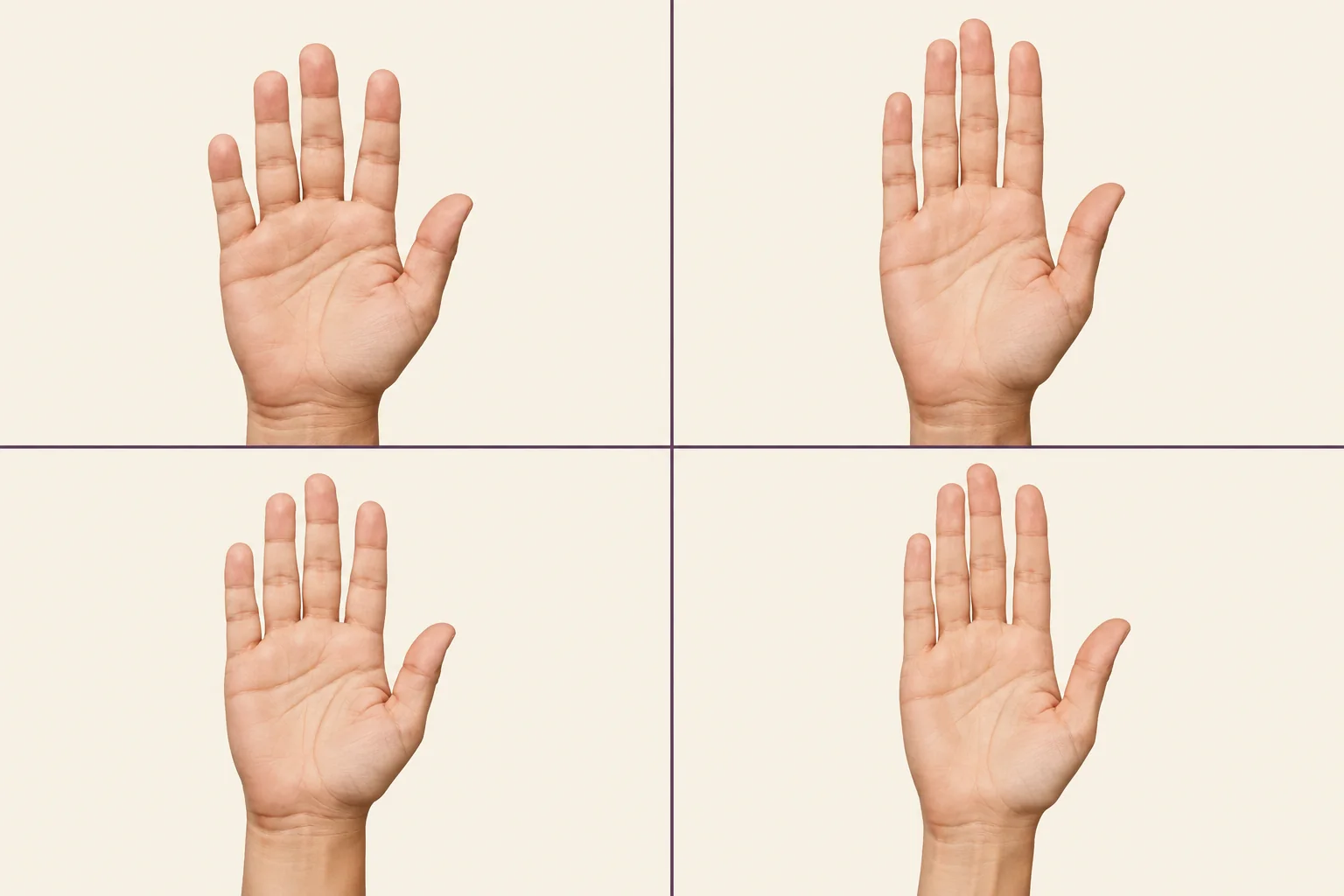
The four elemental hand shapes combine two measurements: whether the palm is relatively square or long, and whether the fingers are relatively short or long. Mixed hands are common. Use the closest baseline, then let texture, thumb, and lines modify it.
| Traditional hand type | Visual proportion | Common personality emphasis | Useful modifier |
|---|---|---|---|
| Earth | Square or broad palm with shorter fingers | Practical, steady, direct, sensory, routine-oriented | Fine skin adds sensitivity; a sloping head line adds imagination |
| Air | Square or broad palm with longer fingers | Analytical, verbal, curious, observant, mentally active | A firm thumb adds follow-through; a full Moon mount adds intuition |
| Fire | Long or rectangular palm with shorter fingers | Energetic, expressive, fast-moving, decisive, experience-led | A straight head line adds strategy; a flexible thumb adds adaptability |
| Water | Long palm with longer fingers | Sensitive, imaginative, receptive, relational, atmosphere-aware | A strong thumb adds boundaries; firm fingers add structure |
How to measure the palm
Measure from the wrist crease to the base of the middle finger, then compare that length with the palm width. Next compare the middle finger with the palm length. A photograph taken at an angle can stretch one dimension, so keep the palm flat and parallel to the camera. Do not classify a hand from finger length alone.
How mixed hand shapes read
A nearly square palm with medium-to-long fingers may combine Earth steadiness with Air curiosity. A long palm with medium fingers may blend Water sensitivity and Fire pace. State the two strongest tendencies, then use the head line for thinking style and texture for stimulus level. The mixed reading is often more accurate than forcing the hand into one category.
What palm skin texture adds
The skin-texture guide describes how palmists use ridge fineness as a clue to receptivity and preferred stimulation. Texture is easiest to assess by touch; a sharp close photograph can show the ridges but may not reveal firmness or softness.
| Texture | How it appears or feels | Traditional response style | Balance with |
|---|---|---|---|
| Silk-fine | Very smooth, delicate, closely spaced ridges | Highly receptive, subtle, peace-seeking, atmosphere-sensitive | Thumb strength and hand shape |
| Paper-fine | Fine, dry, lightly perceptible ridges | Mental, orderly, idea-oriented, detail-aware | Head-line slope and Mercury finger |
| Grainy | Clearly felt medium ridges with firmer texture | Active, quick-responsive, stimulation-seeking, competitive | Finger flexibility and Mars areas |
| Coarse | Broad, pronounced ridges and robust feel | Direct, tangible, physically engaged, hardship-tolerant | Thumb, head line, and finger length |
Texture changes how another sign is expressed
A long sloping head line on silk-fine skin may show imagination that absorbs atmosphere and nuance. The same line on grainier skin can express imagination through action, performance, design, travel, or competitive problem-solving. The line names the thinking route; texture describes how intensely the environment is felt.
Do not confuse temporary skin condition with texture
Dryness, water, callus, pressure, cold, and camera sharpening can change how ridges look. Assess the natural central palm rather than one worn patch. Use the same light for both hands and record whether texture is felt in person or inferred from a photo.
What the thumb says in palmistry
The thumb modifies nearly every personality trait because palmists associate it with will, judgment, self-direction, and the ability to regulate other tendencies. Read length and flexibility separately.
| Thumb feature | Traditional trait | Possible strength | Possible tension |
|---|---|---|---|
| Long thumb | Will and judgment receive strong emphasis | Persistence, self-direction, planning | Over-control when very stiff |
| Short thumb | Feeling, impulse, or surrounding influence may lead | Spontaneity, responsiveness, openness | Inconsistent follow-through without support |
| Firm or stiff thumb | Will is applied steadily | Discipline, boundaries, endurance | Rigidity or difficulty changing course |
| Flexible thumb | Will adapts to people and circumstances | Negotiation, generosity, social ease | Distraction or over-accommodation |
| Wide opening angle | Energy moves outward freely | Independence, openness, initiative | Overextension |
| Close-held thumb | Energy is contained and assessed first | Caution, conservation, privacy | Reluctance to take a chance |
How to measure thumb length
Rest the thumb naturally beside the palm and compare its tip with the lower phalanx of the index finger. A broadly average thumb reaches partway up that section. Photograph both hands in the same relaxed position; a thumb stretched outward can look longer and a tightly tucked thumb shorter.
The thumb resolves contradictions
Very flexible fingers can suggest openness, variety, and quick adaptation. With a long firm thumb, those qualities can still be directed toward a sustained goal. With a short flexible thumb, the same fingers may express as spontaneity, rapid interest shifts, or stronger response to other people. The thumb shows how much control is applied to the rest of the pattern.
Personality traits by finger
The finger guide compares length relative to neighboring fingers and the palm. One obviously distinctive finger deserves more weight than four average ones.
| Finger | Traditional subject | When relatively long or prominent | When relatively short or low-set |
|---|---|---|---|
| Index / Jupiter | Self-belief, aspiration, leadership, ideals | Ambition, standards, authority, desire to guide | Self-questioning, modesty, less need to dominate |
| Middle / Saturn | Responsibility, structure, boundaries, seriousness | Duty, caution, concentration, conventional awareness | Spontaneity, lighter attitude to rules, less patience for routine |
| Ring / Sun | Expression, display, risk, aesthetics, visibility | Creative presentation, performance, competition, public confidence | Private expression, lower need for attention or risk |
| Little / Mercury | Communication, negotiation, wit, social exchange | Verbal agility, commerce, teaching, networking | Reserved communication or confidence that develops gradually |
Finger spacing and flexibility
Wide natural spacing suggests that the related motives seek more independence; close spacing suggests coordination, caution, or preference for shared structure. Flexible fingers add openness and response to change. Firmer fingers add consistency and resistance to outside pressure. Judge the relaxed resting position rather than asking the person to spread the fingers.
Index versus ring finger
When the index is clearly stronger, aspiration, leadership, standards, or self-definition may outweigh the need for display. When the ring finger is clearly longer or more prominent, creative presentation, risk, visibility, or competition may take the lead. A strong thumb decides whether either tendency becomes disciplined action; Jupiter and Sun mounts show where the energy is concentrated.
How mounts concentrate personality themes
The mounts are the padded areas beneath the fingers and around the palm. Compare their fullness and firmness with the rest of the same hand. A developed mount emphasizes its theme; a flat mount reduces emphasis; an overfull or heavily lined mount can show excess, pressure, or scattered expression.
| Mount | Personality theme | Balanced expression | Useful cross-check |
|---|---|---|---|
| Jupiter | Ambition, ideals, confidence, guidance | Purposeful leadership and healthy standards | Index finger and thumb |
| Saturn | Responsibility, patience, realism, solitude | Depth, discipline, and measured judgment | Middle finger and fate line |
| Sun / Apollo | Expression, joy, visibility, aesthetics | Creative confidence and appreciation | Ring finger and Sun line |
| Mercury | Communication, exchange, analysis, craft | Clear expression and practical intelligence | Little finger and Mercury line |
| Venus | Warmth, attachment, vitality, home, pleasure | Affection, engagement, and relational energy | Life line and heart line |
| Moon | Imagination, intuition, travel, inner life | Empathy, symbolic thought, and creative vision | Head-line slope and fingerprints |
| Mars areas | Courage, assertion, endurance, pressure response | Composure, boundaries, and constructive action | Thumb, life line, and skin texture |
A mount must agree with its finger or line
A full Jupiter mount with a long index finger repeats leadership and aspiration. If the thumb is firm, the quality is more likely to be applied consistently. If the index is short and the head line cautious at its start, the full mount may describe strong ideals that are more privately held. The apparent contradiction tells you how confidence is experienced versus expressed.
Mount fullness is relative
Lighting and hand pressure can exaggerate the padded areas. Compare neighboring mounts and both hands with the palm relaxed. A large Venus mount on an overall fleshy hand may be proportional, while a single raised Jupiter or Moon mount on a flatter palm is more distinctive.
Head line, heart line, and personality
The head line shows the route of thought in palmistry: focus, decision style, mental pace, and the balance between practical and imaginative processing. The heart line describes emotional expression, attachment, ideals, and the way feeling is communicated. Read them separately before asking how thought and feeling work together.
| Line form | Traditional personality reading | What modifies it |
|---|---|---|
| Long straight head line | Sustained, practical, outward-focused thinking | Texture, Mercury finger, and thumb flexibility |
| Long sloping head line | Imaginative, reflective, intuitive, associative thinking | Moon mount, hand shape, and line clarity |
| Short clear head line | Fast conclusions, direct focus, preference for action | Finger length and thumb judgment |
| Head line joined to life at start | Cautious beginnings, background influence, deliberation | Length of the join and later separation |
| Separated head-line start | Independent thought and readiness to act from one's own judgment | Gap size, thumb, and Mars development |
| Curved rising heart line | Visible warmth, emotional expression, relational responsiveness | Ending mount, Venus, and branches |
| Straighter heart line | Contained feeling, steadier expression, practical affection | Depth, ending, and little finger |
| Forked heart-line ending | Ability to hold more than one emotional viewpoint | Branch destinations and line quality |
Read the head line with the thumb
A straight head line with a firm thumb reinforces planning, control, and persistence. A sloping head line with a firm thumb can turn imagination into disciplined creative work. A straight head line with a flexible thumb may be practical but responsive to people and changing conditions. See the complete head-line guide for starts, forks, islands, branches, and endings.
Read the heart line with Venus and Mercury
A curved heart line, full Venus mount, and clear Mercury finger can combine warmth with open expression. A straighter heart line, flatter Venus, and shorter or lower-set little finger can show affection expressed through reliability or action rather than frequent words. The heart-line guide explains how endpoints and branches change the emotional style.
What life, fate, and Sun lines add
The life line adds stability, rhythm, roots, and how readily energy moves beyond the familiar. The fate line adds direction and responsibility. The Sun line adds visibility, satisfaction, and creative expression. They are supporting personality routes here; use the career map when work is the primary question and the love map when relationships are primary.
Fingerprints as stable personality modifiers
The fingerprint guide separates loops, arches, whorls, and composite patterns by ridge flow. Palmistry uses them as stable modifiers because their basic pattern does not redraw with changing mood. A normal palm photograph rarely shows enough ridge detail, so use macro close-ups or clear prints.
| Pattern | Traditional emphasis | How to combine it |
|---|---|---|
| Loop | Adaptability, responsiveness, social learning | Read through the finger's subject and thumb strength |
| Whorl | Individuality, self-contained focus, need for space | Check whether finger spacing and head line repeat independence |
| Arch | Directness, reliability, practical response | Compare with Earth shape, coarse texture, or straight head line |
| Tented arch | Intensity, quick ignition, heightened response | Balance with skin texture, Mars, and thumb flexibility |
| Composite | Multiple viewpoints, complexity, deliberation | Compare with forks, long fingers, and decision patterns |
The finger carrying the print changes its subject. A whorl on Jupiter modifies self-belief and leadership differently from a whorl on Mercury, where it modifies communication and exchange. Count repeated patterns, then give special weight to a rare pattern on a distinctive finger.
Six worked personality combinations
1. Sensitive but strongly self-directed
Water-shaped hand, silk-fine skin, developed Moon, and a sloping head line repeat sensitivity and imagination. A long firm thumb adds boundaries, persistence, and the ability to direct those impressions. The person may feel atmosphere deeply without being easily diverted from a chosen goal.
2. Practical communicator
Earth or Air-influenced square palm, paper-fine skin, long Mercury finger, straight head line, and firm thumb combine order, communication, and application. A developed Mercury mount can add teaching, negotiation, commerce, writing, or technical craft. The heart line shows whether communication is emotionally open or more task-focused.
3. Expressive risk-taker with restraint
Fire-shaped hand, prominent ring finger, full Sun mount, and grainy texture emphasize pace, visibility, performance, and challenge. A clear straight head line and moderately firm thumb add calculation. The combination can express as bold action that is planned rather than purely impulsive.
4. Independent thinker who starts cautiously
Whorls on several fingertips, wide finger spacing, and a strong Jupiter area suggest independence and self-definition. A head line joined to the life line for a noticeable distance adds cautious beginnings or strong background influence. The person may need time before acting on views that are internally original.
5. Warm relationship style with private feelings
A full Venus mount and broad life-line arc suggest warmth and engagement, while a straighter heart line and short or lower-set Mercury finger show more contained verbal expression. Affection may be demonstrated through presence, practical help, loyalty, or shared routine rather than constant emotional language.
6. Flexible explorer who needs structure
Long fingers, flexible joints, open thumb angle, loop fingerprints, and a life-line branch toward Moon repeat variety, movement, and openness. A short or highly flexible thumb may make sustained direction harder. A clear fate line, firm middle finger, or structured environment can supply the consistency that lets curiosity become progress.
How to resolve contradictory personality signs
- Name both qualities without forcing one to cancel the other.
- Decide which feature is broad and which is a modifier.
- Use the thumb to judge control, persistence, and flexibility.
- Use skin texture to judge sensitivity and stimulus level.
- Use the head line to see how the tension is processed.
- Use the heart line to see how it enters relationships.
- Compare the same features on the other hand.
- Ask where the person recognizes each side: privately, socially, at work, or in close relationships.
Underlying and active personality across both hands
The active and less-active hand method uses the less-active palm for the underlying pattern and the active palm for qualities that are more consciously developed and expressed now. Read the same feature independently on each hand before comparing it.
| Difference between hands | Traditional personality reading | Question to ask |
|---|---|---|
| Active thumb is held more openly | Independence or outward engagement is more practiced | Where has the person learned to act more freely? |
| Active head line is clearer | Thinking, focus, or decision style is more organized in current life | Which work or responsibility developed it? |
| Less-active heart line is more expressive | Private feeling may be warmer or more idealistic than outward behavior | What makes emotional expression more contained now? |
| Active fate or Sun line is stronger | Direction, responsibility, or visible expression has developed | Which choices strengthened the route? |
| Fingerprints differ by corresponding finger | Private and active expression may use different strategies | Does the person act differently at work and in close relationships? |
| Most major features repeat | Underlying and active personality are relatively aligned | Which one or two features supply the main nuance? |
Common personality-reading mistakes
- Reading one line as the entire personality.
- Using palm color or temporary dryness as a fixed trait.
- Calling every long ring finger artistic talent instead of a need for expression or visibility.
- Judging thumb flexibility from a forced pose.
- Assuming a full mount is strong without comparing the rest of the hand.
- Giving average features the same weight as distinctive ones.
- Listing traits without showing which observations support them.
- Treating contradictions as errors instead of useful tension.
- Using gender rules to choose which hand matters.
- Skipping the other palm and the person's real-life context.
Photo checklist for a personality palm reading
- Photograph both full palms from fingertips through wrists.
- Keep the palms flat, relaxed, and parallel to the camera.
- Include the full thumb and natural space between every finger.
- Take a second image with the hands resting naturally rather than stretched.
- Use bright indirect light plus one gentle side-lit view for mounts and texture.
- Add close-ups of the central skin ridges, thumb joints, fingertips, and unusual markings.
- Keep images in color without filters, smoothing, tracing, or perspective correction.
- Use the same camera distance and angle for both hands.
- State hand dominance and the settings in which you want the personality pattern explored.
The palm-photo guide shows how to capture the full palm, edge, thumb, and close details without losing proportions.
Questions that make a personality reading useful
- Which two or three traits repeat most strongly across independent features?
- What is the hand-shape baseline, and which texture or line modifies it?
- How does the thumb strengthen, restrain, or redirect the rest of the pattern?
- Which finger and mount are genuinely distinctive?
- Does the head line show practical, imaginative, fast, cautious, or divided thinking?
- How does the heart line show feeling, attachment, standards, and expression?
- What do fingerprints add that ordinary line quality does not?
- Where do apparent contradictions appear?
- What is stronger on the active hand than the less-active hand?
- Do you want the profile focused on relationships, work, decisions, creativity, communication, boundaries, or purpose?
Turn separate traits into one usable profile
Record the hand shape, texture, thumb, distinctive fingers, mounts, head and heart lines, fingerprints, supporting routes, and both-hand differences. Then group repeated qualities and explain the contradictions instead of producing a disconnected list.
The complete answer
Palm reading personality traits begins with a whole-hand baseline. Palm and finger proportions suggest a broad Earth, Air, Fire, Water, or mixed style; skin texture modifies sensitivity and preferred stimulation; the thumb shows how will, judgment, control, and adaptability are applied; and distinctive fingers concentrate aspiration, structure, expression, or communication. Mounts show where energy gathers, the head line describes thinking and decision style, the heart line describes emotional expression and attachment, and fingerprints add stable modifiers. The strongest trait repeats across multiple independent features, while contradictions show how a person can feel one quality privately and express another in work or relationships. A Full Palm Reading maps all these important features across both hands and combines them into a holistic reading focused on the person's questions about personality, relationships, work, decisions, creativity, communication, boundaries, and purpose.
A Full Palm Reading
Ask what your traits mean when the complete hand is read together
Your reading combines palm and finger proportions, skin texture, thumb strength and flexibility, distinctive fingers, mounts, head and heart lines, fingerprints, supporting routes, contradictions, and both palms into one profile focused on your questions about relationships, work, decisions, creativity, communication, boundaries, and purpose.
Your Full Palm Reading maps all the important features—hand shape, skin texture, thumb, fingers, mounts, major and minor lines, markings, and the differences between both palms—and brings them together in a holistic reading focused on your questions.