
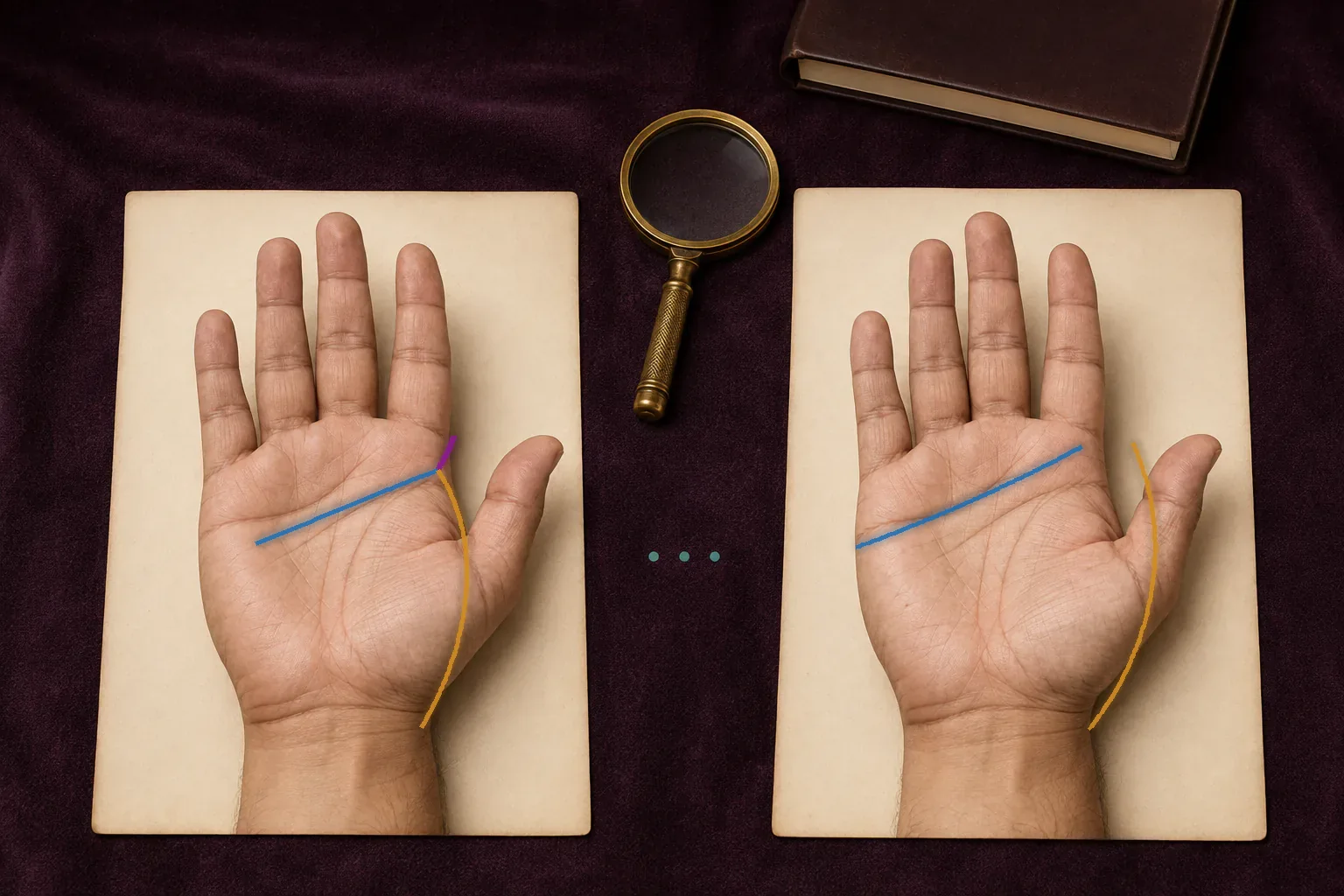
When the head and life lines begin joined, traditional palmistry associates the shared origin with caution, deliberation, and decisions shaped by security or other people before independent thought takes its own route. When they begin with a visible gap, the tradition emphasizes independence, initiative, and a willingness to decide or act without waiting for approval. Neither pattern measures intelligence, courage, success, or maturity by itself.
The head and life line origins become meaningful only after their exact opening points, shared route, join length or gap width, line quality, complete head-line direction, thumb, supporting features, changes, and both hands are compared. A whole-hand reading can show how caution, independence, initiative, security, and decision style work together.
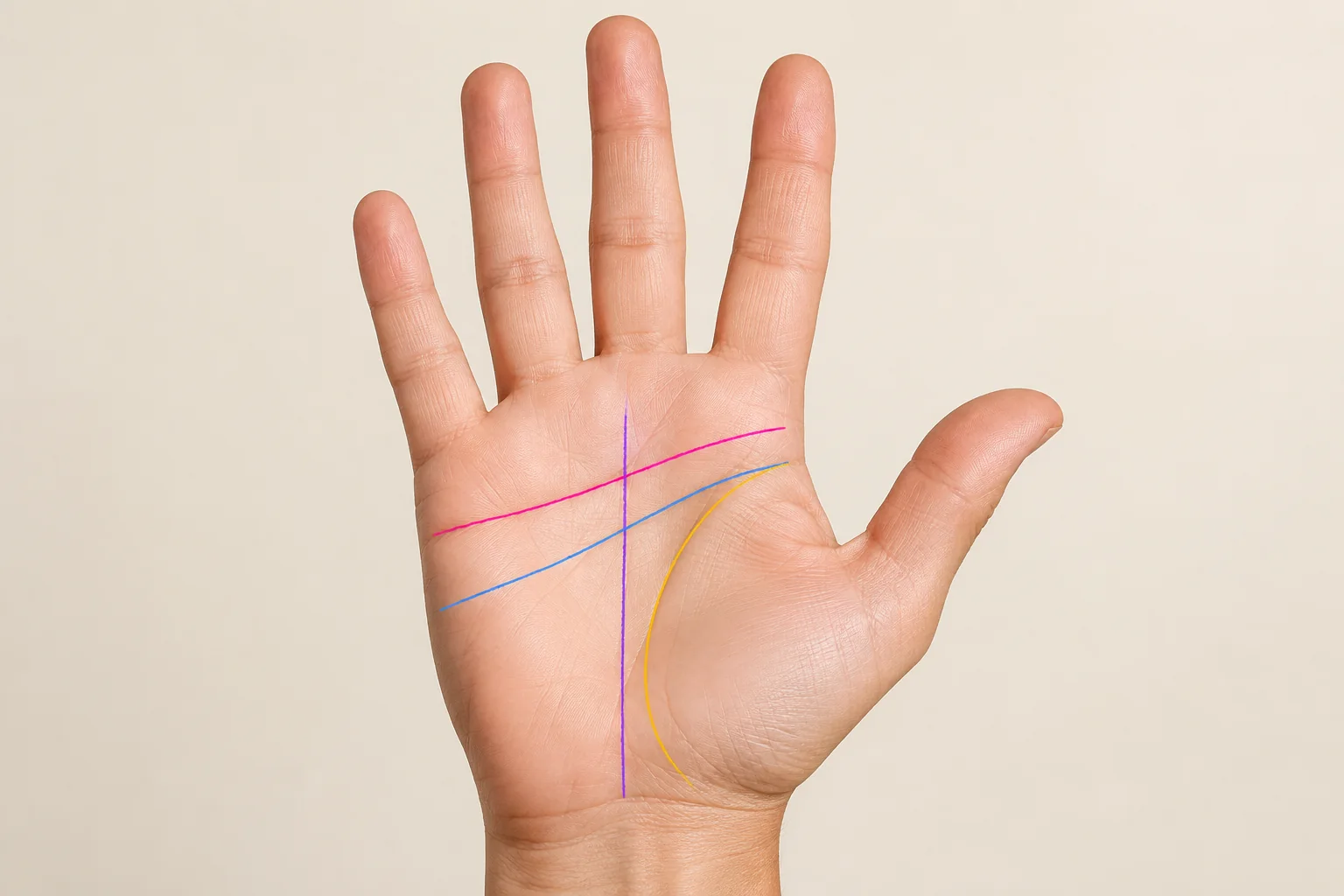
Use a seven-part head-and-life origin method: locate both parent lines, identify their exact opening points, decide whether they truly share a route, measure the join or gap relative to the hand, trace where the head line goes next, compare supporting features, and compare both palms. The start shows one part of decision style; the complete head line, thumb, fingers, mounts, and active hand refine it.
Read the shared route, not just a touching point
Two lines can meet at one point, overlap for a short section, stay joined for a longer section, or begin separately. Follow both edges from the thumb-index web until two routes are unmistakable. The length of the shared section or width of the gap changes the traditional emphasis.
Where the head and life lines begin
Both lines usually begin near the thumb-index web. The life line curves down around the Mount of Venus beside the thumb. The head line travels across the middle of the palm toward Mars or Moon. The life-line guide maps the arc, while the head-line guide covers length, slope, depth, branches, and endpoints.
Start from the outside edge and move inward. If one crease forms a stem before dividing into a downward arc and a transverse route, the lines are joined. If two creases have distinct openings with skin between them, they are separated. If a fine connector crosses the gap, keep the two origins separate and record the connector as an influence line.
| Opening pattern | How to identify it | Common confusion |
|---|---|---|
| Shared point | Two routes begin at one junction and divide immediately | Lines merely crossing nearby |
| Brief join | One short stem produces head and life routes | A branch from the life line |
| Long join | Both routes overlap visibly before separating | One faint head-line beginning |
| Narrow gap | Two independent starts sit close together | Glare hiding a shared stem |
| Wide gap | Clear skin separates the opening routes | Cropped photo hiding the web |
| Joined by a fine bar | Parent lines start separately; another line connects them | A true shared origin |
Five start types at a glance
Use relative categories rather than a fixed millimeter rule. Hand size, line depth, and camera scale vary. Compare the join or gap with the width of the nearby life-line arc and with the same origins on the other hand.
| Start type | Traditional emphasis | What to check next |
|---|---|---|
| Shared point, immediate split | Balance between initial caution and quick independence | Head-line direction and thumb |
| Brief joined section | Considered decisions with developing autonomy | Exact separation point |
| Long joined section | Security, family, or consensus carries greater early weight | Whether head line strengthens after separating |
| Narrow separation | Independent judgment with awareness of limits | Gap consistency under new light |
| Wide separation | Strong initiative, direct action, and personal risk tolerance | Thumb, Mars, and line quality |
These are traditional tendencies rather than verdicts. A wide gap on a firm, balanced hand reads differently from the same gap beside a weak fragmented head line. A long join followed by a deep clear head line can show caution at the start and decisive thought after commitment.
What joined head and life lines traditionally mean
A joined origin traditionally shows that thought begins inside a need for safety, preparation, belonging, or reference to circumstances. The person may prefer to understand consequences, consult trusted people, or build a secure base before acting. The reading becomes stronger as the shared section lengthens.
This does not mean permanent dependence. The separation point matters because the head line then takes an independent route. If it becomes clear and strong immediately after leaving the life line, the traditional synthesis is considered judgment followed by confident execution. If it remains faint or chained, caution combines with a more changeable thinking process.
| Joined feature | Traditional reading | Modifier |
|---|---|---|
| Short clear join | Practical caution without prolonged hesitation | Head-line depth after split |
| Long clear join | Strong security needs or careful preparation | Thumb flexibility and Jupiter |
| Joined and chained | Decisions develop through repeated reconsideration | Where the line clears |
| Joined, then rising head line | Caution develops toward practical ambition | Jupiter and Mercury direction |
| Joined, then sloping head line | Security supports imagination or responsive thought | Moon development |
| Join crossed by fine lines | Other people or circumstances affect the opening process | Origins of crossing lines |
What separated head and life lines traditionally mean
A visible gap traditionally emphasizes independent judgment, initiative, quick commitment, and willingness to choose a personal route. The person may rely less on consensus at the opening of a decision. A narrow gap suggests measured independence; a wide gap increases the emphasis on freedom, speed, and tolerance for uncertainty.
Separation does not guarantee good decisions or leadership. The head line shows how thought proceeds after the independent start. A long clear head line can direct initiative through sustained analysis. A short or fragmented one may show faster decisions with less continuity. The whole-hand personality guide explains why one origin cannot define a person.
| Separated feature | Traditional reading | Modifier |
|---|---|---|
| Narrow clean gap | Independent but measured judgment | Head-line length and clarity |
| Wide clean gap | Strong initiative and freedom of action | Thumb control and Mars balance |
| Gap + deep straight head line | Independent decisions follow a practical route | Mercury and Saturn |
| Gap + sloping head line | Independent choices follow imagination or intuition | Moon and fingerprints |
| Gap + downward branches | Initiative divides across concerns or alternatives | Branch endpoints |
| Gap crossed by a connector | Independent starts remain linked by one influence | Connector origin and depth |
How long joins and wide gaps change the meaning
Measure the join from the common opening to the point where the lines have separate edges. A longer shared route traditionally extends the influence of caution, family, security, or consultation. Measure a gap between the nearest points of the two openings; greater separation traditionally strengthens personal initiative and willingness to act before every condition is settled.
A dramatic category should require clear evidence. Hand tension can widen the thumb-index web and stretch fine lines. Strong flash can hide a shallow bridge. Retake the palm relaxed before calling an origin widely separated or long joined.
| Relative size | Traditional emphasis | Reading limit |
|---|---|---|
| One-point contact | Initial reference to security, then immediate independence | Not a sustained join |
| Brief shared stem | Caution and autonomy remain balanced | Check actual split |
| Long overlap | Preparation or consensus has prolonged influence | Do not assign an exact age from length alone |
| Fine narrow gap | Independent start stays close to practical limits | Confirm skin between lines |
| Wide open gap | Freedom and initiative dominate the opening style | Read Mars and thumb before judging risk |
Joined on one hand and separate on the other
Traditional readers often treat the less-active hand as underlying capacity and the active hand as present expression. Joined origins on both hands carry a consistent caution-and-security theme. Separated origins on both strengthen the independence theme. A change between hands shows development rather than contradiction.
| Hand comparison | Traditional synthesis | Verify |
|---|---|---|
| Joined on both | Considered, security-aware opening style repeats | Join length and head-line route |
| Separate on both | Independent initiative repeats across the pattern | Gap width and thumb |
| Joined less-active, separate active | Experience develops greater autonomy | Active head-line strength |
| Separate less-active, joined active | Independent capacity now uses more consultation or structure | Current responsibilities and crossings |
| Difference appears only in photos | Evidence is not yet reliable | Retake matched relaxed palms |
The which-hand guide explains dominance without relying on gender rules.
Can the opening relationship change?
The major origin is usually a stable structural feature, but fine connectors, visibility, surrounding branches, and the apparent separation point can look different over time. Use dated matched photographs before deciding a verified change has occurred. The palm-line change guide explains how to control light, tension, camera distance, and angle.
If a fine bridge appears between previously separate lines, read the bridge as a new influence rather than rewriting the original openings. If a faint joined stem becomes clearer, the structure may have been present but under-photographed. A change on the active hand carries more weight when the matching head line, thumb, or fate line changes with it.
Head-and-life origin combinations
| Combination | Traditional synthesis | Read with |
|---|---|---|
| Long join + flexible thumb | Careful opening adapts after information arrives | Thumb opening and head line |
| Long join + strong Jupiter | Preparation supports deliberate leadership | Index finger and Jupiter mount |
| Narrow gap + clear fate line | Independent decisions operate within steady structure | Fate origin and crossings |
| Wide gap + firm thumb | Initiative combines with sustained will | Mars and head-line length |
| Gap + fine sloping head line | Independent choices use responsive imagination | Moon mount and fingerprints |
| Joined origin + sister life line | Caution develops beside added reserve or support | Sister-line length and timing |
The thumb guide adds will, reason, flexibility, and opening angle, while the hand-shape guide supplies the broader pace and style.
Worked joined and separated examples
Brief join followed by a deep straight head line
The person traditionally begins with practical caution, then thinks and decides through a clear sustained route. A firm flexible thumb would add persistence without rigidity.
Long join followed by a clear downward slope
Security or consultation strongly shapes the opening, after which thought develops toward imagination, context, or intuition. The Moon mount and active hand show how that quality is expressed now.
Wide gap with a short fragmented head line
Initiative is strong, but the mental route changes across several sections. Read each restart, branch, and endpoint before describing the decision pattern as a whole.
Joined on the less-active hand, separated on the active hand
The underlying pattern begins cautiously while present expression shows developed independence. Compare gap width, head-line depth, thumb opening, and fate-line changes before connecting the difference to a real question.
Photo checklist for the head and life line origins
- Photograph both full palms together before taking close-ups.
- Keep the thumb naturally open without stretching the web.
- Use soft side light to reveal a faint shared stem.
- Include the complete thumb-index web and upper life-line arc.
- Take one straight-on view and one slight-angle view.
- Show where the head line becomes fully independent.
- Do not draw over or press the opening creases.
- State hand dominance and the decision or personality question you want explored.
Read the opening pattern inside the complete hand
A Full Palm Reading maps both origins, join length or gap width, head-line route, life-line arc, depth, branches, crossings, changes, and both palms. It then adds the thumb, fingers, mounts, fate line, hand shape, texture, and fingerprints into one holistic reading focused on your questions.
The complete answer
Joined head and life lines traditionally emphasize caution, deliberation, security, and decisions that begin with reference to circumstances or trusted people. Separate origins emphasize independence, initiative, and willingness to act without waiting for consensus. A brief join, long join, narrow gap, and wide gap carry different degrees of emphasis, but none measures intelligence, courage, or success alone. A Full Palm Reading maps the origin relationship and all important features across both hands and combines them into a holistic reading focused on your questions about decisions, personality, work, relationships, family, change, timing, purpose, and direction.
A Full Palm Reading
Ask how your decision pattern develops across both hands
Your reading maps the head and life line origins, join length or gap width, head-line route, life-line arc, depth, branches, crossings, and changes, then adds the thumb, fingers, mounts, fate line, hand shape, texture, fingerprints, and both palms into one holistic reading focused on your questions.
Your Full Palm Reading maps all the important features—hand shape, skin texture, thumb, fingers, mounts, major and minor lines, markings, and the differences between both palms—and brings them together in a holistic reading focused on your questions.