
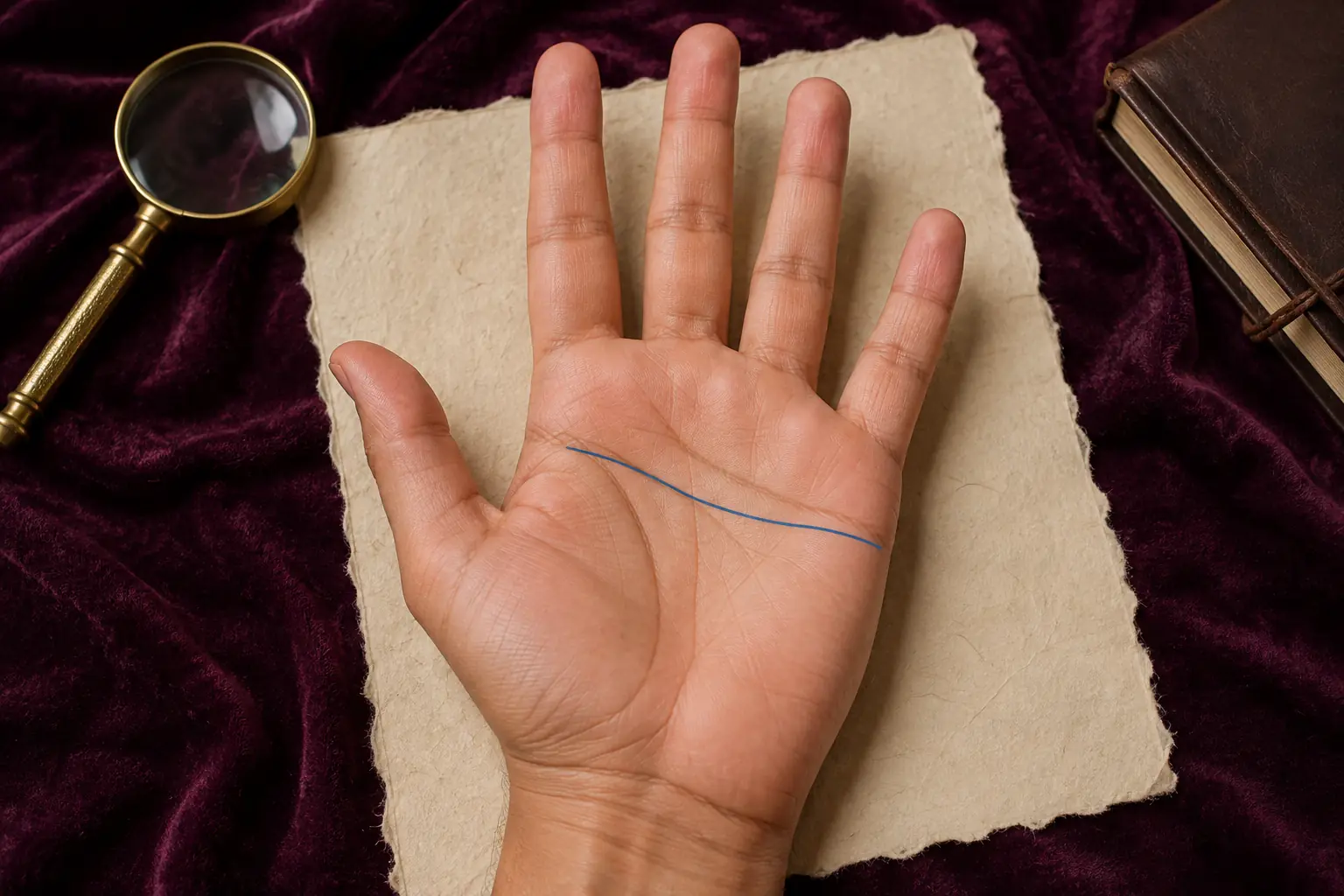
In traditional palmistry, a long Head line is one coherent middle-palm parent that begins near the thumb-index side and travels across most of the palm toward the outer edge. Its reach is associated with breadth of thought, sustained mental engagement, and a tendency to consider a subject from several angles. It does not prove higher intelligence, education, wisdom, memory, or future success.
Head-line length becomes personal only after one true thumb-side parent, its endpoint, proportional span, straight or Moonward direction, depth, clarity, fork, branch, crossing, overlap and restart tests, Life-line start, thumb, fingers, Mercury, Moon, Fate, Heart, hand shape, real decision style, and both palms are compared. A whole-hand reading can show how range, focus, learning, imagination, communication, and direction work together.
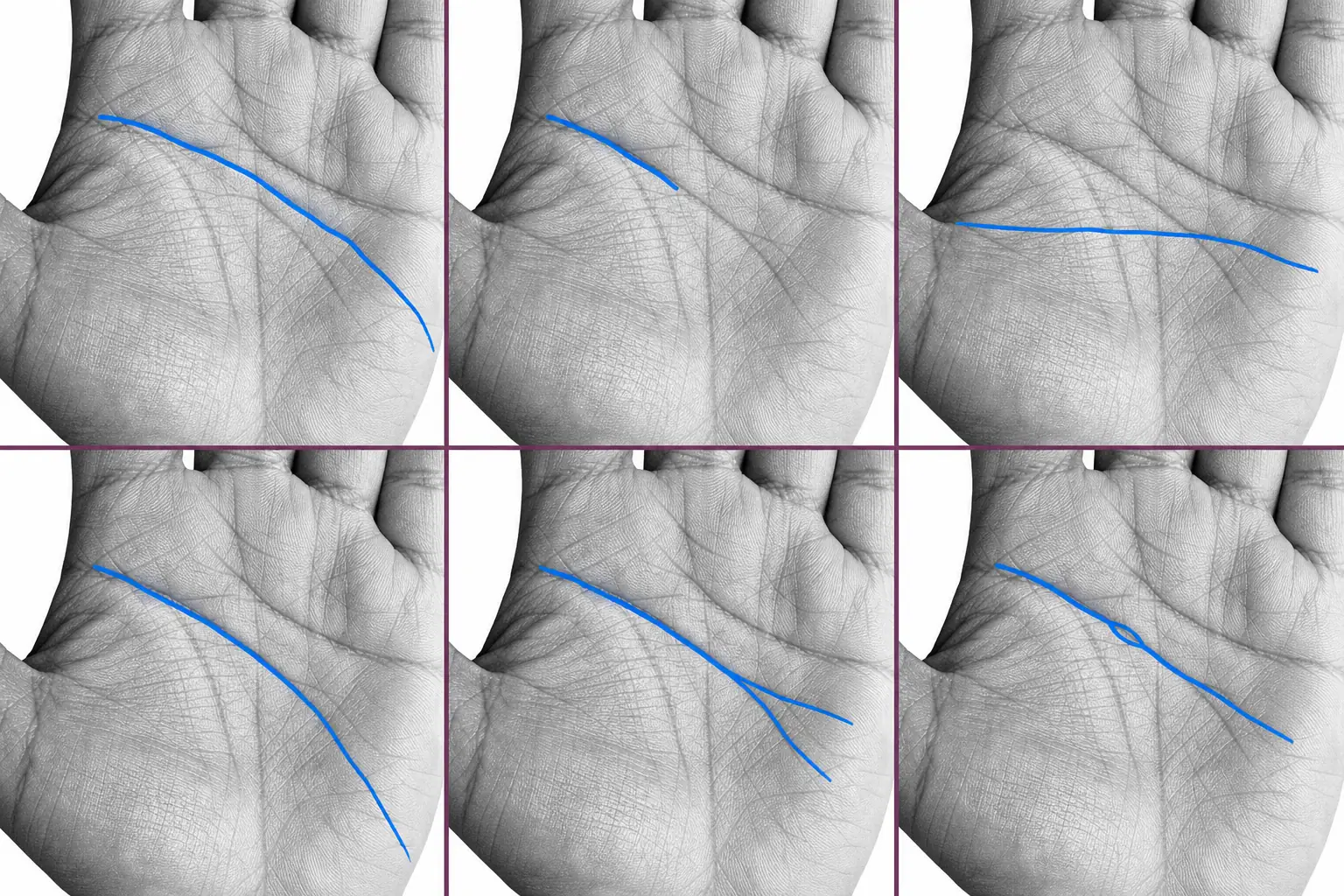
Measure only the parent route. Exclude terminal forks, side branches, crossings, overlaps, and a separate continuation after a true gap. Then add the line's straight or Moonward direction, depth, clarity, endpoint, starting relationship with the Life line, thumb, fingers, Mercury and Moon areas, hand shape, real decision style, and both palms.
Locate the Head-line parent
The Head line usually begins near the Life line between the thumb and index finger and crosses the middle palm below the Heart line. It may begin joined with the Life line, touch it briefly, or start separately. That starting geometry describes a different variable from length.
Trace the most coherent groove from the inner start to its own final endpoint. Judge its span against the width of the same palm. A long route reaches well into the outer half, often toward Upper Mars or the Moon side. A camera angle can stretch or compress the apparent distance, so photograph the palm square-on.
Long does not mean smarter
Length traditionally describes how much mental ground the line covers: range, duration of attention, and willingness to examine detail. Intelligence is not a crease measurement, and a shorter line does not imply lower ability.
Use a ten-part long-Head-line method
- Relax the hand. Avoid stretching the palm flat under tension.
- Find the inner start. Locate the Head line beside or with the Life line.
- Trace one parent. Follow the strongest coherent middle-palm groove.
- Find its endpoint. Stop where the parent actually terminates.
- Compare with palm width. Decide whether it enters the outer third.
- Exclude additions. Do not add a fork, branch, crossing, or overlap.
- Test apparent gaps. Separate faintness from a true break and restart.
- Record direction and quality. Note level or sloping path, depth, clarity, and markings.
- Add supporting features. Compare thumb, fingers, Moon, Mercury, Fate, and hand shape.
- Repeat on both palms. Test the symbolic reading against real thinking and decisions.
| What you see | Length test | Classification |
|---|---|---|
| One parent spans most of the middle palm | The groove remains coherent into the outer third | Long Head line |
| A shorter parent divides into two long arms | Measure only to the shared junction | Forked Head line |
| One thin side branch reaches Moon | Stop at the parent endpoint | Head line with Moon branch |
| Open skin separates aligned pieces | No continuous full span exists | Broken Head line |
| A separate crease crosses the route | Do not follow the foreign line | Crossing or crossbar |
| The parent fades but remains aligned | Use side light to confirm one groove | Long but faint Head line |
What a long Head line traditionally means
A long route is associated with wide mental range and the ability to stay with a question. The person may enjoy context, comparison, planning, research, or thinking through consequences before acting. That can support careful judgment when clarity and follow-through agree.
The same range can become overextension when many possibilities compete or decisions remain open too long. This is a reflective tension, not a fixed flaw. Depth, direction, thumb, fingers, Fate line, and actual habits show whether broad thought becomes useful analysis, imaginative exploration, or repeated indecision.
The complete Head-line guide covers every major variable. This page owns the narrower task of verifying length and interpreting mental range without turning it into a ranking of ability.
Straight and sloping long lines are different
Length asks how far the route travels. Direction asks where it travels. A long line can remain broadly level toward Upper Mars or slope toward the Moon mount. Record both instead of treating every long line as imaginative or every straight line as long.
| Long-line path | Traditional synthesis | Useful question |
|---|---|---|
| Broadly straight | Wide mental range expressed through sequence, practicality, or structure | When does analysis help you act? |
| Gently sloping | Breadth combined with imagination and association | How do you test an intuitive idea? |
| Strongly toward Moon | Sustained imaginative, visual, narrative, or inward thought | What anchors imagination in evidence? |
| Terminal fork | One broad parent develops two thinking directions | How do practical and imaginative views cooperate? |
The sloping Head-line guide owns Moonward direction. The forked Head-line guide explains the one-parent, shared-junction, two-arm test.
Depth, clarity, and markings change the expression
A clear, even long line supports sustained and organized engagement. A fine but coherent route may show subtle or flexible thought. Chaining introduces repeated small fluctuations. An island encloses one local section. A break introduces an interruption and separate restart; see the broken Head-line guide.
| Quality | Modifier | Verify |
|---|---|---|
| Deep and clear | Strongly established, sustained mental approach | A real groove rather than shadow |
| Fine and continuous | Subtle, adaptable, or less externally obvious thought | One route survives side light |
| Chained | Many small shifts within a broad range | Linked loops rather than crossings |
| Broken | A change or redirection in the route | Open skin between separate segments |
Supporting features for a complete interpretation
The thumb adds will, logic, flexibility, and follow-through. Long fingers can reinforce attention to detail; shorter fingers may bring a broader line back toward practical summary. Mercury adds communication and application. Moon adds imagination. Hand shape and skin texture show the medium through which the mental pattern is expressed.
The Fate line shows whether thought connects with a sustained direction. A clear Fate route crossing the Head line can mark a strong relationship between judgment and work choices in traditional reading. The Heart line shows how feeling and values interact with reasoning. Seek repeated themes and useful contradictions.
Turn the sign into a practical question
Ask whether you gather enough context to decide, whether detail improves the result, and which deadline or criterion helps thought become action. Those answers are more useful than the label “overthinker.”
What if only one palm has a long Head line?
Compare matched photos and identify the active hand by actual use. Palmists often treat the less-used hand as background tendency and the active hand as developed expression. This is a reading convention rather than a scientific rule.
A longer active-hand route may suggest wider mental range developed through learning or experience. A shorter active-hand route may reflect greater concentration. Check for faint continuation, different curve, hand pose, and branch confusion before interpreting the difference.
Worked examples
Example 1: long, straight, clear line with a firm thumb
The combination supports broad analysis, structure, and follow-through. The practical test is whether decisions arrive after sufficient review rather than endless review.
Example 2: long line sloping gently to Moon
Length adds sustained range and the slope adds imagination. Mercury, thumb, and Fate show whether ideas become communication, plans, or applied work.
Example 3: apparent long route created by a fork
One parent ends at a shared junction and two arms continue. Measure the parent only, then interpret the fork separately instead of combining both endpoints into length.
Example 4: long but faint line
The span is broad, while visibility is subtle. Traditional synthesis may explore wide interests with variable focus. Side-light confirmation and real habits decide whether that fits.
Example 5: longer active-hand line
After matched images confirm the difference, a reader may explore whether education, work, or repeated choices expanded the person's mental range. It does not prove increased intelligence.
Photo checklist
- Capture both palms from the same height and angle.
- Use bright indirect light plus one gentle side-light image.
- Include the thumb-index start and full outer edge.
- Relax the palm without pulling the fingers backward.
- Trace one parent to its own endpoint.
- Exclude forks, branches, crossings, and restarts.
- Record length, direction, and quality separately.
- Avoid filters, glare, smoothing, and source-photo annotations.
Frequently asked questions
Does a long Head line mean high intelligence?
No. Traditional palmistry connects it with breadth and duration of mental engagement. Intelligence cannot be measured from a palm crease.
What counts as long?
One coherent parent travels from the thumb-index side well into the outer half or third of that same palm. Use proportion rather than centimetres.
Does a fork count toward length?
No. Measure the parent to the shared junction, then record the two terminal arms separately.
Is a long sloping Head line the same thing?
It is long by span and sloping by direction. Combine the two observations rather than replacing one with the other.
Can length change?
Visibility varies with light, dryness, and pose. Keep matched dated photos before deciding that the endpoint has extended or faded.
Which hand should I read?
Read both. Compare the same parent, path, endpoint, quality, and supporting features, then use handedness and history as context.
The complete answer
A long Head line is one coherent parent beginning near the thumb-index side and spanning most of the middle palm toward the outer edge. Traditional palmistry associates that reach with broad, sustained mental engagement, not superior intelligence. Measure only the parent and exclude forks, branches, crossings, overlaps, and separate restarts. Then add direction, depth, clarity, endpoint, starting relationship with the Life line, thumb, fingers, Mercury, Moon, Fate, Heart, hand shape, real decision style, and both palms. A Full Palm Reading maps all the important features across both hands and combines them into a holistic reading focused on your questions about thinking style, learning, decisions, imagination, communication, career direction, and how your mental approach is developing.
A Full Palm Reading
Ask how your long Head line fits your complete thinking pattern
Your reading maps one true Head-line parent, its endpoint, proportional span, straight or Moonward direction, depth, clarity, fork, branch, crossing, overlap and restart tests, Life-line start, thumb, fingers, Mercury, Moon, Fate, Heart, hand shape, real decision style, and both palms, then adds every other important line, mount, finger, marking, shape, and texture into one holistic reading focused on your questions.
Your Full Palm Reading maps all the important features—hand shape, skin texture, thumb, fingers, mounts, major and minor lines, markings, and the differences between both palms—and brings them together in a holistic reading focused on your questions.