
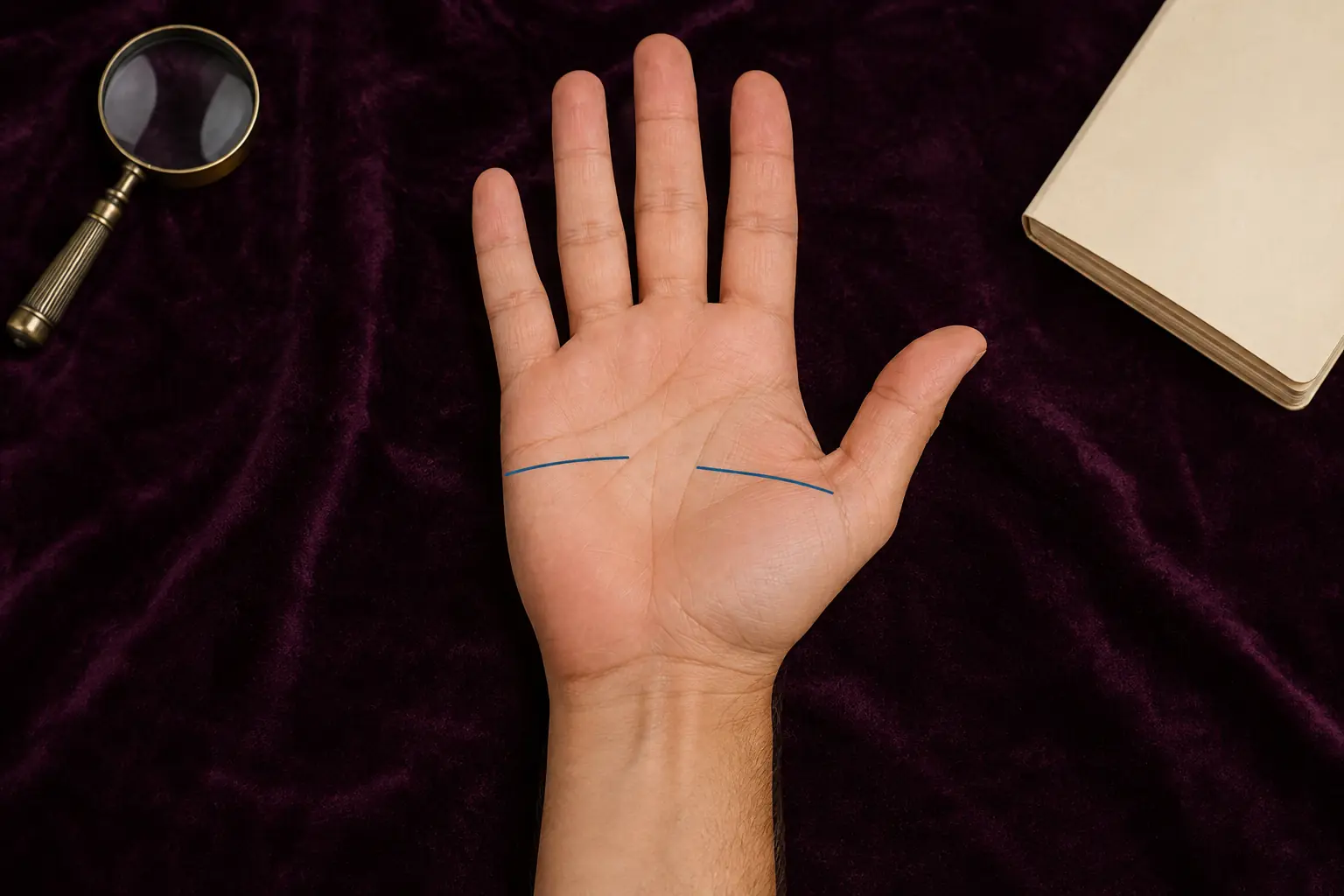
In traditional palmistry, a broken Head line is a section of genuinely empty skin between two parts of the major line that begins near the thumb-index web and crosses the middle of the palm. The interruption is usually read as a change in thinking style, judgment, education, concentration, plans, beliefs, or the way a person approaches decisions. A visible continuation shows how the later approach develops. A broken Head line cannot diagnose injury, neurological illness, memory problems, or mental-health conditions.
A Head-line break becomes meaningful only after the thumb-side parent, true empty gap, outer restart, alignment or displacement, strength before and after, overlap, faintness, island and fork tests, direction toward Mars or Moon, broad timing, Life, Fate, Heart, Mercury, Jupiter, thumb, hand shape, and both palms are compared. A whole-hand reading can show how judgment, learning, imagination, communication, and direction work together.
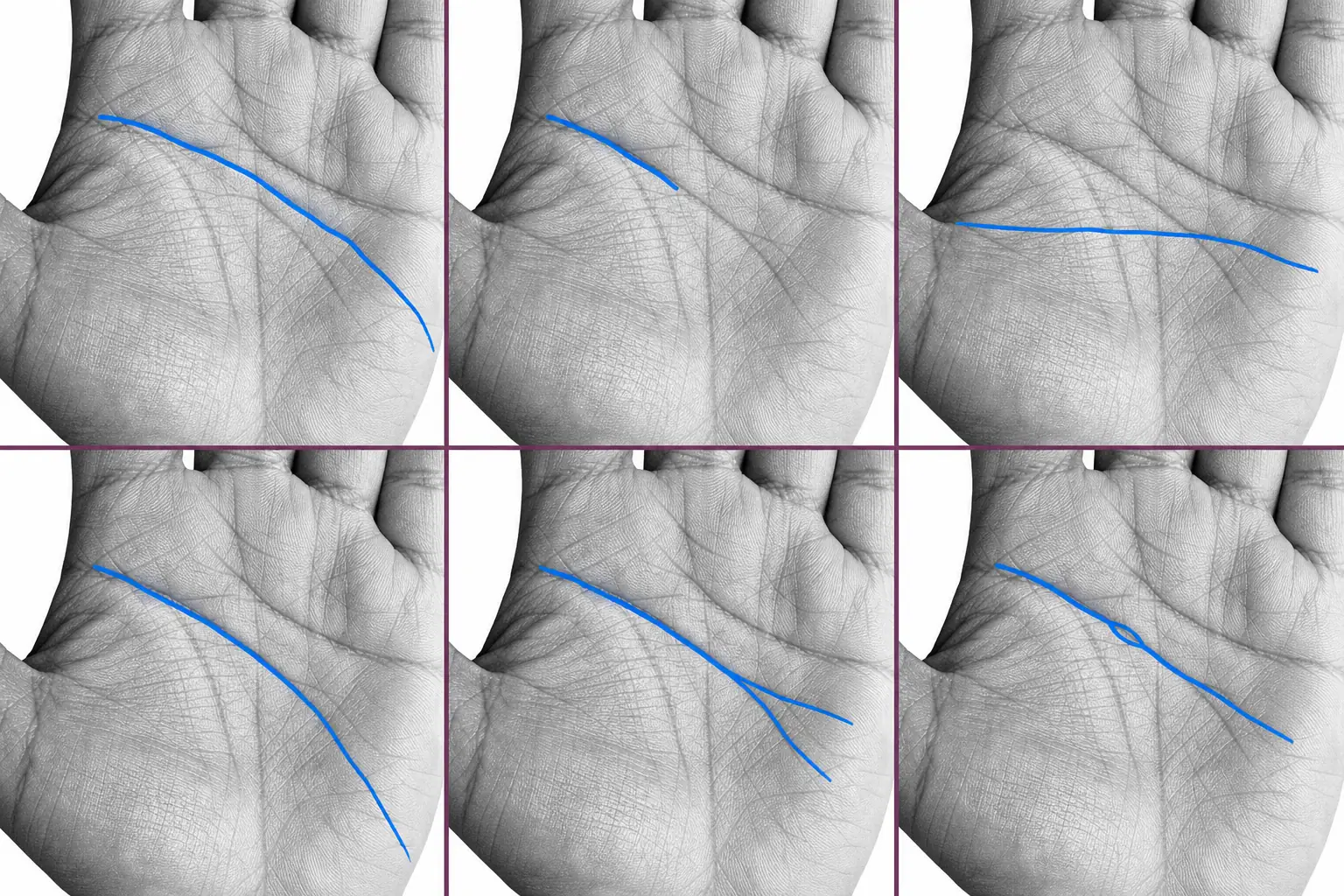
Use a ten-part broken-Head-line method: locate the thumb-side origin, trace the inner parent, confirm empty skin, trace the outer continuation backward, exclude faintness and islands, test for overlap or a fork, compare depth before and after the gap, follow the restart toward Upper Mars or Moon, add Life, Fate, Mercury, thumb, and hand-shape context, then compare both palms and real history. The useful reading comes from the changed route, not from treating the gap as an isolated warning.
Read a change in approach, not a medical event
The Head line belongs to a symbolic palmistry system for reasoning, attention, imagination, communication, and decision style. A gap may frame a turning point in how someone learns or plans. Health concerns need qualified assessment based on symptoms and evidence, not a palm crease.
Where the Head line is and how a break looks
The Head line usually begins near the Life-line origin between the thumb and index finger. It crosses the middle palm toward Upper Mars on the outer side or slopes downward toward the Mount of Moon. It normally sits below the Heart line. Some Head lines begin joined to the Life line, while others begin separately.
Trace the line from the thumb side outward. A true break appears when the main route stops, a patch of skin contains no connecting groove, and a second plausible Head-line segment continues toward the outer palm. Reverse the trace from the outer endpoint. Both pieces should belong to the same middle-palm level and orientation. Two separate creases that happen to point toward one another do not automatically form a broken Head line.
| What you see | Decisive visual test | Best classification |
|---|---|---|
| Two related middle-palm segments with empty skin between | No groove survives across the gap | Clean break and restart |
| Segments run beside each other briefly | The new route begins before the earlier route ends | Overlapping transition |
| A shallow groove continues through the pale area | The parent remains traceable in side light | Faint or weakened Head line |
| Line divides around a closed oval and rejoins | Two sides enclose one complete space | Island, not a break |
| One parent ends in two connected prongs | Both arms share one visible junction | Forked Head line |
| A short crease cuts the parent | The main line continues beneath or beyond it | Crossbar or interference line |
| Upper horizontal line begins at the outer edge | It sits higher and belongs to the emotional route | Heart line, not a Head continuation |
How to verify that the Head-line gap is real
Take one full-palm photograph in bright indirect light and another with gentle side light. Keep the thumb-index origin and the full outer edge visible. A tight central crop can hide where each line begins and ends. Flash glare can erase a shallow bridge, while strong shadows can turn fine texture into a continuation.
- Locate the Life-line origin and identify the Head line beside or joined to it.
- Trace the inner Head segment toward the center.
- Mark where the groove visibly stops.
- Inspect the empty area for faint continuation, an island edge, or overlap.
- Trace the outer candidate backward from Upper Mars or Moon.
- Confirm both pieces occupy one plausible Head-line route.
- Record whether the restart stays straight, rises, or slopes downward.
- Compare depth, clarity, and length before and after the gap.
- Separate crossing Fate, Mercury, and influence lines.
- Repeat the same process on the other palm.
The general broken-lines guide explains gaps, overlaps, shifted continuations, islands, squares, and support lines across different parents. This article owns the Head-line question: what changes in judgment, learning, planning, imagination, communication, or follow-through after the interruption.
What a broken Head line traditionally means
Traditional readers connect the Head line with the way a person processes experience and turns ideas into decisions. A break can be explored as a period when an old mental framework no longer works: changing education, retraining, abandoning a plan, revising beliefs, adapting to a new culture, switching careers, recovering confidence after failure, or learning to balance practical and imaginative approaches differently.
The break does not reveal whether the transition was chosen or forced. A student changing fields, a founder revising a business model, a parent reorganizing priorities, and a person moving to another country may all describe a distinct change in thinking without sharing the same event. The line after the gap and the person's history supply the difference.
| Break pattern | Balanced traditional direction | Useful question |
|---|---|---|
| Narrow aligned gap | A defined interruption followed by a familiar thinking style | What paused without changing the overall approach? |
| Wide gap | A more substantial reorientation in plans or beliefs | What separated the earlier and later frameworks? |
| Overlapping segments | Gradual handover between approaches | Did the new plan develop before the old one ended? |
| Restart becomes clearer | Later judgment, focus, or direction becomes more organized | What skill or decision created greater clarity? |
| Restart becomes faint or chained | The new approach develops tentatively or through experimentation | What remains undecided or divided? |
| Support line bridges the area | Advice, training, routine, or another resource helps continuity | What practical support carried the transition? |
Straight, rising, and Moon-directed restarts
The direction of the outer segment shows how the later mental style is expressed. A straight restart toward Upper Mars traditionally emphasizes practicality, direct reasoning, implementation, and attention to tangible results. A downward route toward Moon adds imagination, context, empathy, imagery, intuition, storytelling, or work with possibilities. A slightly rising route toward Mercury or the upper mounts can add communication, strategy, commercial thinking, or ambition depending on its true endpoint.
| Outer continuation | Traditional emphasis | Check before concluding |
|---|---|---|
| Aligned with the inner segment | A familiar approach resumes after interruption | Depth and gap width |
| Straighter toward Upper Mars | Practical judgment and execution gain weight | Thumb firmness, Mars balance, and work context |
| Slopes toward Moon | Imagination and contextual thinking gain weight | Degree of slope, grounding signs, and full endpoint |
| Rises toward Mercury | Communication, analysis, or commerce may gain weight | Whether it remains the Head line or becomes a branch |
| Overlaps before changing direction | One approach develops alongside the previous one | Which segment becomes deeper? |
| Forks after the restart | Two later modes may be used together | Trace the shared junction and both destinations |
A Moon-directed restart is not automatically impractical. The sloping Head-line guide shows how depth, length, hand shape, thumb, Fate and Mercury features distinguish productive imagination from scattered follow-through. A clear straight route is not automatically more intelligent; it simply emphasizes a different way of organizing information.
What the Life, Fate, Mercury, and thumb add
The Head and Life line origins show how caution and independence begin. If the inner segment shares a long origin with Life, the earlier style may be more deliberate or security-aware. A separated origin can add independent judgment. After the break, compare whether that relationship changes and use the joined-versus-separated guide for the exact geometry.
The Fate line shows whether work direction changes at a similar stage. A Fate break or shifted route near the Head-line gap can connect new thinking with training, career redirection, or a major decision. A steady Fate line may mean responsibilities continue while the person's method or priorities change. Mercury adds communication and practical exchange; Jupiter adds ambition and standards; Moon adds imagination and unfamiliar environments.
The thumb combines will and reason in traditional palmistry. A balanced, firm thumb may support follow-through after a mental redirection; flexibility can support adaptation. Hand shape and skin texture show the overall tempo. Read these features as combinations, because one Head-line gap cannot measure intelligence, concentration, creativity, or decision quality by itself.
How to estimate timing on a broken Head line
Timing along the Head line is approximate and varies by system. Treat the thumb-side origin as earlier and move outward across the palm into later zones. The central vertical axis and any Fate-line crossing provide landmarks. A wide gap needs two ranges: one for where the earlier route stops and another for where the new approach becomes clear.
- Mark the end of the inner segment.
- Mark the beginning of the outer continuation.
- Place both relative to the central palm and Fate-line crossing.
- Use separate ranges when the gap covers meaningful space.
- Compare Fate, Life, travel, or influence changes nearby.
- Calibrate against a known education, career, move, or major decision.
- Repeat the estimate on the other palm and keep the answer broad.
The palmistry timing guide explains proportional sections and calibration. A Head-line gap cannot reliably date a diagnosis, accident, breakdown, examination result, or specific decision.
What a broken Head line means in both palms
Compare both palms under matching light and state hand dominance. A common modern convention treats the less-active hand as background pattern and the active hand as current development. Use it as a comparison method rather than a fixed rule.
| Two-hand pattern | Traditional comparison | Useful focus |
|---|---|---|
| Similar break at a similar level in both palms | The change in approach repeats strongly | Compare restart directions and known turning points |
| Break only in the dominant hand | Current experience may have reshaped thinking or plans | Present decisions, learning, work, and environment |
| Break only in the non-dominant hand | An underlying interruption may be handled more continuously now | What practice or choice strengthened the active route? |
| Restart clearer in the dominant hand | Later focus or judgment may be consolidating | Training, routine, communication, and follow-through |
| One restart is straight and the other slopes | Background and current expression favor different mental tools | Which approach fits the person's present work and decisions? |
The two-hand guide explains how to use differences without labeling one hand as better. Development across hands can be the strongest clue in this formation.
Five worked examples
1. Aligned restart after an education change
The Head line has a narrow central gap and resumes at the same level with greater depth. Fate strengthens shortly afterward. This can fit a pause or change in study followed by clearer plans and more structured work. The palm does not identify the course or outcome.
2. Restart slopes toward Moon
A straight inner segment ends near the center, while the outer continuation begins slightly lower and travels into Moon. The later approach may use more imagination, empathy, visual thinking, storytelling, or cross-cultural context. A clear Fate line and firm thumb show whether those ideas gain structure.
3. Overlap during retraining
A second segment begins beside the first before the old route disappears. Both remain visible for a short distance, then the newer route becomes dominant. This supports a gradual handover: learning a new method while still using the old one, or preparing for a new field before leaving the earlier plan.
4. Island mistaken for a break
The parent divides around an oval and rejoins. Because the sides enclose a complete space, the formation is an island. Traditional readers may frame it as a complicated or divided period, while a clean break describes empty continuity and a separate restart.
5. Crossing Fate line mistaken for continuation
The Head line ends near the center and a vertical stroke crosses the gap area. Tracing shows that the vertical belongs to Fate and does not continue toward the outer palm. The Head line has no verified restart, so the formation is an ending or incomplete route rather than a broken parent.
Photo checklist for a Head-line break
- Photograph both full palms from fingertips through wrists.
- Keep the thumb-index web and entire outer palm visible.
- Use bright indirect light without flash glare.
- Add a gentle side-lit image to reveal faint bridges and overlaps.
- Take a close-up centered on the suspected gap.
- Trace the Life, Head, Heart, and Fate lines separately.
- Capture the outer endpoint so Mars or Moon direction stays visible.
- Do not sharpen, smooth, trace, or raise contrast on the original.
- Keep one unmarked photo and annotate only a duplicate.
- State hand dominance and the learning, decision, career, or planning question.
Frequently asked questions
Does a broken Head line mean brain injury or mental illness?
No. Palm lines cannot diagnose medical, neurological, or mental-health conditions. In palmistry, the gap is interpreted symbolically as a change in thinking, plans, learning, or decision style.
Is a broken Head line bad?
No. It marks discontinuity in the traditional map. A strong restart, overlap, support feature, clearer active hand, or well-supported new direction can emphasize adaptation and a more suitable later approach.
What if the line is stronger after the break?
A clearer continuation is traditionally read as stronger focus, judgment, or organization after change. Compare its direction, endpoint, supporting Fate line, thumb, and the real skill or decision that became clearer.
What if the restart slopes down?
A route toward Moon adds imagination, context, empathy, or visual thinking. Check its depth, length, grounding features, Fate support, and real work before deciding whether the change is productive or scattered.
Is an overlap the same as a break?
An overlap includes two segments running beside each other, so some continuity remains. A clean break contains empty skin. Traditional readers often interpret overlap as a gradual transition or handover.
Can the gap show an exact age?
No. Its position gives a broad zone. Use the central palm, Fate crossing, known events, and both hands to estimate a range rather than claiming a precise date.
What if only one hand has the break?
Compare background pattern with current development. The active hand may show a change formed through experience, or it may show more continuity than the less-active hand. The difference is part of the reading.
Can the Head line change over time?
Fine crease visibility can vary with light, dryness, hand position, pressure, and longer-term use. Keep matched photographs before deciding that a new gap or continuation has appeared.
The complete answer
A broken Head line is genuinely empty skin between two related sections of the major middle-palm line that begins near the thumb-index web. Traditional palmistry reads it as a transition in thinking style, judgment, learning, plans, beliefs, communication, or decision-making—not as a medical diagnosis. Verify the inner parent and outer continuation, distinguish the gap from faintness, an island, crossbar, fork, overlap, or unrelated crease, then compare the restart's strength and direction toward Upper Mars, Moon, or Mercury. Add the Life, Fate, Heart, Mercury, Jupiter, Moon, thumb, hand shape, broad timing, real history, and both palms. A Full Palm Reading maps all the important features across both hands and combines them into a holistic reading focused on your questions about choices, learning, work, creativity, communication, timing, and the direction that develops after the change.
A Full Palm Reading
Ask what changes across your Head-line gap
Your reading maps the thumb-side parent, true empty gap, outer restart, alignment or displacement, strength before and after, overlap, faintness, island and fork tests, direction toward Mars or Moon, broad timing, Life, Fate, Heart, Mercury, Jupiter, thumb, hand shape, and both palms, then adds every other important line, mount, finger, marking, shape, and texture into one holistic reading focused on your questions.
Your Full Palm Reading maps all the important features—hand shape, skin texture, thumb, fingers, mounts, major and minor lines, markings, and the differences between both palms—and brings them together in a holistic reading focused on your questions.