
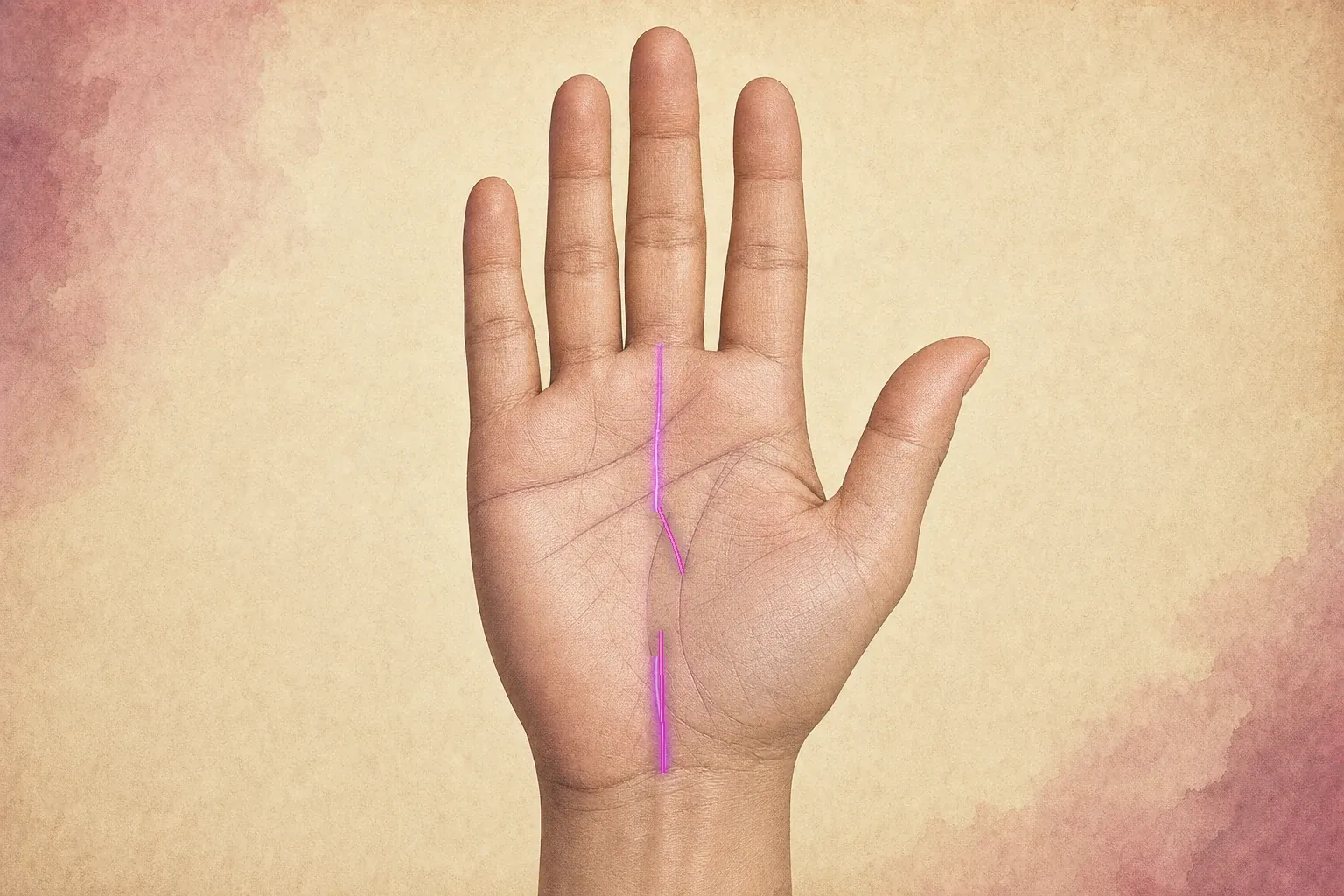
A broken palm line has a visible gap where one identifiable parent line stops and either resumes, overlaps, shifts, or is replaced. Traditional palmistry reads a break as interruption, redirection, or reorganization in that line's subject. A fate-line break concerns work, responsibility, or direction; a head-line break concerns thinking and decisions; a heart-line break concerns emotional expression; and a life-line break concerns lifestyle, support, or continuity. It does not predict death, illness, job loss, or separation by itself.
A break becomes meaningful only after its parent line, gap, overlap, restart, alignment, new destination, support signs, timing, and both hands are compared. A whole-hand reading can show whether the interrupted section reflects a pause, transition, replacement, or redirection around work, decisions, relationships, family, or purpose.
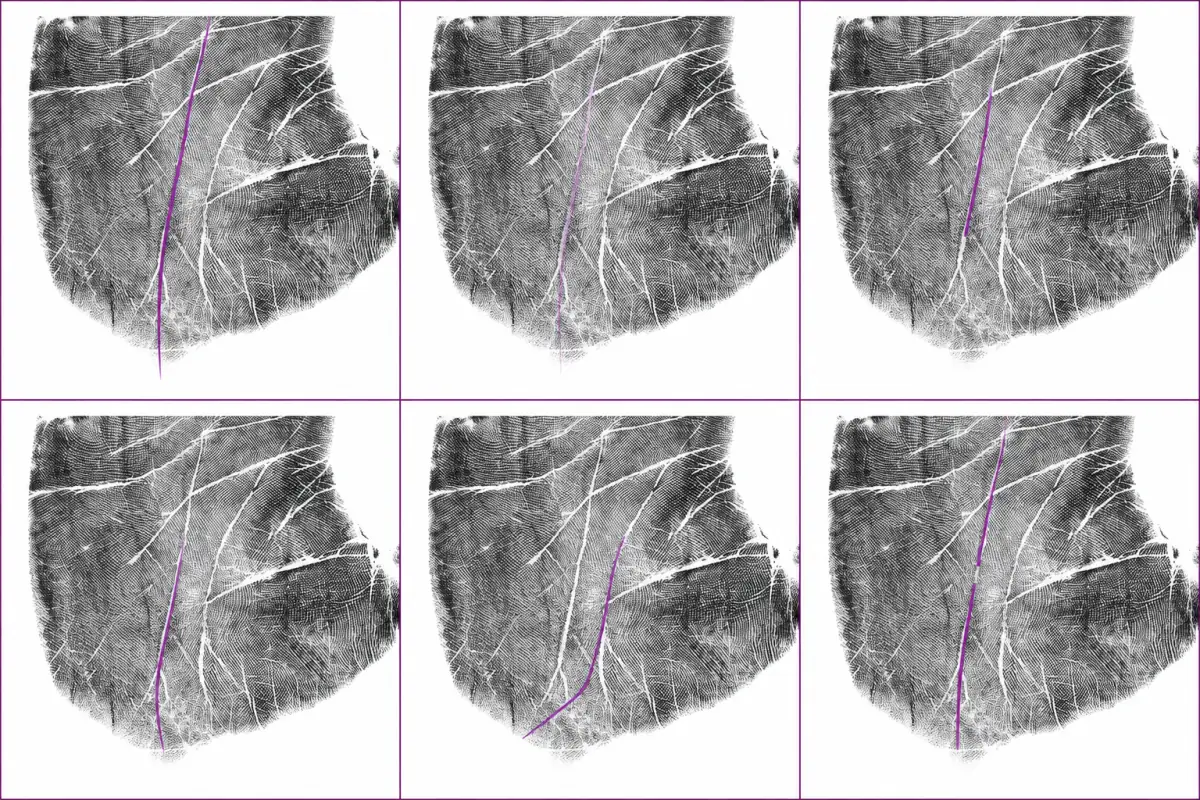
Use an eight-part broken-line reading method: identify the parent line, verify open skin between segments, classify the break, locate it along the route, compare alignment, inspect support or repair signs, follow the upper continuation, and compare both hands. The segment after the gap often tells you more than the interruption itself.
A break can interrupt, replace, or redirect a route
A clean gap with no continuation differs from overlapping segments that preserve momentum. A shifted restart toward another mount can show a new outlet, while a parallel support line or enclosing square adds traditional continuity or stabilization.
How to verify a true break in a palm line
Trace the suspected line from its origin, through the gap, and beyond it. A real break leaves visible skin between related segments. The upper segment should align with the same route or plausibly continue its subject. Do not join two unrelated fine lines because they sit near each other.
| Check | True break | Common confusion |
|---|---|---|
| Parent line | Lower segment is clearly identifiable | Random minor crease |
| Gap | Open skin separates the segments | Weak ink-like section hidden by glare |
| Continuation | Upper segment follows or meaningfully shifts the route | Independent line with another origin |
| Edges | Stops and starts remain visible in two angles | Dry skin, scar, shadow, or compression fold |
| Context | Nearby lines show support, pressure, or redirection | A gap interpreted without the rest of the palm |
A faint section is not automatically broken. Adjust the light and relax the hand; if a shallow route crosses the supposed gap, read a weak line rather than a clean break. If one line splits into endpoints, use the forked-lines guide; if it splits and rejoins, use the island guide.
Clean gaps, overlaps, shifted continuations, and replacement lines
| Break type | How it looks | Traditional emphasis |
|---|---|---|
| Clean gap | Line stops, open space follows, aligned segment resumes | Clear interruption followed by return |
| Overlapping break | New segment begins beside the old before it ends | Transition with continuity between phases |
| Shifted continuation | Upper segment restarts to one side | Direction or method changes after interruption |
| Replacement line | New route begins from another source | Different influence takes over the subject |
| Bridge line | Fine connector crosses the gap | Support, adaptation, or partial continuity |
| Square around break | Four-sided enclosure contains the gap | Traditional protection or stabilization |
| Sister line beside break | Parallel route covers the interrupted section | Backup, resilience, or outside support |
| Multiple gaps | Several distinct interruptions | Repeated changes rather than one transition |
In an overlap, establish which segment arrives first along the line's reading direction. An upper segment that begins before the lower one ends suggests a new phase develops while the old one remains active. A wide blank gap with a faint distant restart suggests a less continuous transition.
Broken life, head, heart, fate, Sun, and relationship lines
The parent line supplies the subject; the break only describes what happens to its continuity. Avoid using one universal meaning.
| Parent line | Traditional break theme | Read next |
|---|---|---|
| Life line | Change in lifestyle, environment, support, pace, or roots | Overlap, Mars line, Venus/Moon direction, continuation |
| Head line | Change in thinking, priorities, study, decisions, or communication | New slope, thumb, Mercury, line clarity afterward |
| Heart line | Shift in emotional expression, attachment, standards, or boundaries | New ending, branches, Venus, relationship lines |
| Fate line | Work, role, identity, duty, or long-term direction reorganizes | New origin, destination, head/heart crossings, Sun line |
| Sun line | Pause or change in expression, satisfaction, reputation, or recognition | Apollo, fate line, new source, upper strength |
| Mercury line | Change in communication, business, service, or applied skill | Mercury mount, head line, vertical replacements |
| Relationship line | Discontinuity or changed pattern within a close bond | Heart line, fork, overlapping line, both hands |
Broken life line
A break in the life line does not determine lifespan. In symbolic reading it can mark a changed environment, disrupted routine, family transition, move, altered pace, or a period when support is reorganized. Overlapping ends, a parallel Mars line, a square, or a strong continuation show how continuity is maintained.
Broken head line
A head-line break is read through a change in thinking, study, communication, attention, or decision style. A straight lower segment followed by a Moon-bound upper segment can show a shift from concrete processing toward imagination or association. Describe the visible pattern without turning it into a neurological or mental-health diagnosis.
Broken heart line
A break in the heart line can symbolize a change in emotional expression, attachment, standards, or boundaries. An overlapping continuation suggests transition rather than a blank ending. The new endpoint under Jupiter, Saturn, or between them shows the standards expressed afterward. It does not guarantee heartbreak or separation.
Broken fate line
A fate-line break often receives career questions, but it can concern any sustained role or responsibility. An aligned restart toward Saturn suggests direction resumes. A shifted restart toward Apollo adds expression or recognition; toward Mercury, communication, business, teaching, or applied skill; toward Jupiter, leadership or advancement. The new route's origin shows what feeds it.
Broken Sun, Mercury, or relationship line
A Sun-line break concerns continuity in visibility, creative expression, satisfaction, or recognition. A Mercury-line break concerns communication or applied skill. A relationship-line break concerns the way a bond is expressed, and must be read with the heart line, influence lines, actual context, and both hands rather than as a fixed outcome.
How to read the line after a break
Compare depth, direction, destination, and texture before and after the gap. The upper segment can be clearer, weaker, displaced, chained, forked, or absent. Those differences show whether the line consolidates, changes method, keeps two options, or remains diffuse.
| After the gap | Traditional reading | Question to ask |
|---|---|---|
| Clearer and deeper | Greater definition after change | What new source or support appears? |
| Aligned and similar | Original route resumes | What bridged the interruption? |
| Shifted to another mount | New emphasis or destination | Which mount owns the new route? |
| Faint or chained | Continuity remains uncertain or complex | Do support signs repeat? |
| Forked | Change opens two possible outlets | Which prong is stronger? |
| No continuation | Theme ends or becomes less line-led | Does another line carry the subject? |
This page owns the geometry of the break. For a transition involving several simultaneous signs, use the major life-change guide, which combines fate, life, influence, head, heart, Sun, and Moon features.
Position and timing of a broken palm line
Place the gap on the parent line and use its proportional sections or major crossings as broad landmarks. A fate-line break at the head-line level is often connected with a decision period; at the heart-line level, with values or relationships affecting direction. A life-line break uses the curved route's broad stages. The timing guide explains how to confirm a range without claiming an exact date.
| Location | Reading focus | Confirmation |
|---|---|---|
| Near line origin | Foundation or early expression changes | Origin lines and family zone |
| Before head-line crossing | Transition builds before a decision landmark | Head-line branch or change |
| At head-line crossing | Thinking or choice intersects the route | Which line actually breaks? |
| At heart-line crossing | Values or relationships intersect the route | Heart-line condition and continuation |
| Near line end | Final destination changes or diffuses | Mount and replacement route |
Compare a broken line on both hands
Use matched full-palm and close-up photographs. Traditional readers often treat the less-active hand as the underlying pattern and the active hand as present expression. A break on both hands carries more structural weight. A repaired overlap or stronger continuation on the active hand may suggest adaptation; a newly visible shift may show the theme being handled differently. First use the matched-photo method to rule out light, pressure, and pose.
Support and repair signs around a break
| Combination | Traditional emphasis | What to verify |
|---|---|---|
| Overlapping segments | New route begins before old route fully ends | Which segment is clearer? |
| Parallel Mars line | Support beside a life-line interruption | Whether it covers the same section |
| Square around gap | Containment, protection, or stabilization | Four closed sides |
| Upward branch before break | Effort or opportunity precedes change | Destination mount |
| Sun line begins after fate break | Expression or recognition develops after redirection | Sun-line clarity and source |
| Cross or bar at gap | External pressure intersects the transition | Independent bar origin |
Worked broken-line examples
Fate line overlaps and shifts toward Apollo
The old responsibility remains active while a new route begins. The Apollo destination adds expression, visibility, fulfillment, or recognition. A clear Sun line strengthens the creative or public outlet.
Life-line gap covered by a Mars line
The life line shows a lifestyle or support transition while the parallel Mars route supplies continuity. A clear continuation and stable fate line help show how the new phase becomes organized.
Head line restarts with a different slope
The change in angle suggests a new thinking or communication style after the gap. Thumb firmness, Mercury, work patterns, and the line's clarity show whether the new method becomes sustained.
Heart-line overlap appears on one hand
Matched images come first. If the difference remains, the active and less-active hands show a contrast between underlying emotional patterns and present expression, not proof of a relationship event.
Photo checklist for a broken palm line
- Photograph both full palms in soft neutral light.
- Add a close-up showing at least two centimeters before and after the gap.
- Keep the destination mount visible for a shifted continuation.
- Relax the hand and repeat the image at one second angle.
- Capture overlapping, parallel, square, bar, and support lines clearly.
- State hand dominance and the work, relationship, move, family, or decision question.
- Trace segments visually without drawing over the original image.
Read the interruption and the replacement together
A Full Palm Reading maps the parent line, gap, overlap, restart, new destination, support signs, timing, mounts, fingers, and both hands. That complete pattern can show whether the break reflects interruption, transition, replacement, or redirection around your question.
The complete answer
A broken palm line contains a visible gap in one identifiable parent route. Traditional palmistry reads it as interruption, change, or reorganization in that line's subject, but the break type and continuation define the result: aligned segments suggest return, overlaps preserve continuity, shifted restarts change emphasis, sister lines add support, squares add traditional containment, and a stronger upper segment suggests greater definition afterward. Life-line breaks concern lifestyle and support, head-line breaks thinking and decisions, heart-line breaks emotional expression, and fate-line breaks work or direction. A Full Palm Reading maps the break and all other important features across both hands and combines them into a holistic reading focused on your questions about work, relationships, decisions, relocation, family, recognition, purpose, timing, and direction.
A Full Palm Reading
Ask what happens before and after the break across your complete hand
Your reading maps the parent line, true gap, overlap, shifted restart, alignment, new destination, support signs, and timing, then adds the mounts, fingers, hand shape, and both palms into one holistic reading focused on your questions about work, decisions, relationships, relocation, family, recognition, purpose, and direction.
Your Full Palm Reading maps all the important features—hand shape, skin texture, thumb, fingers, mounts, major and minor lines, markings, and the differences between both palms—and brings them together in a holistic reading focused on your questions.