
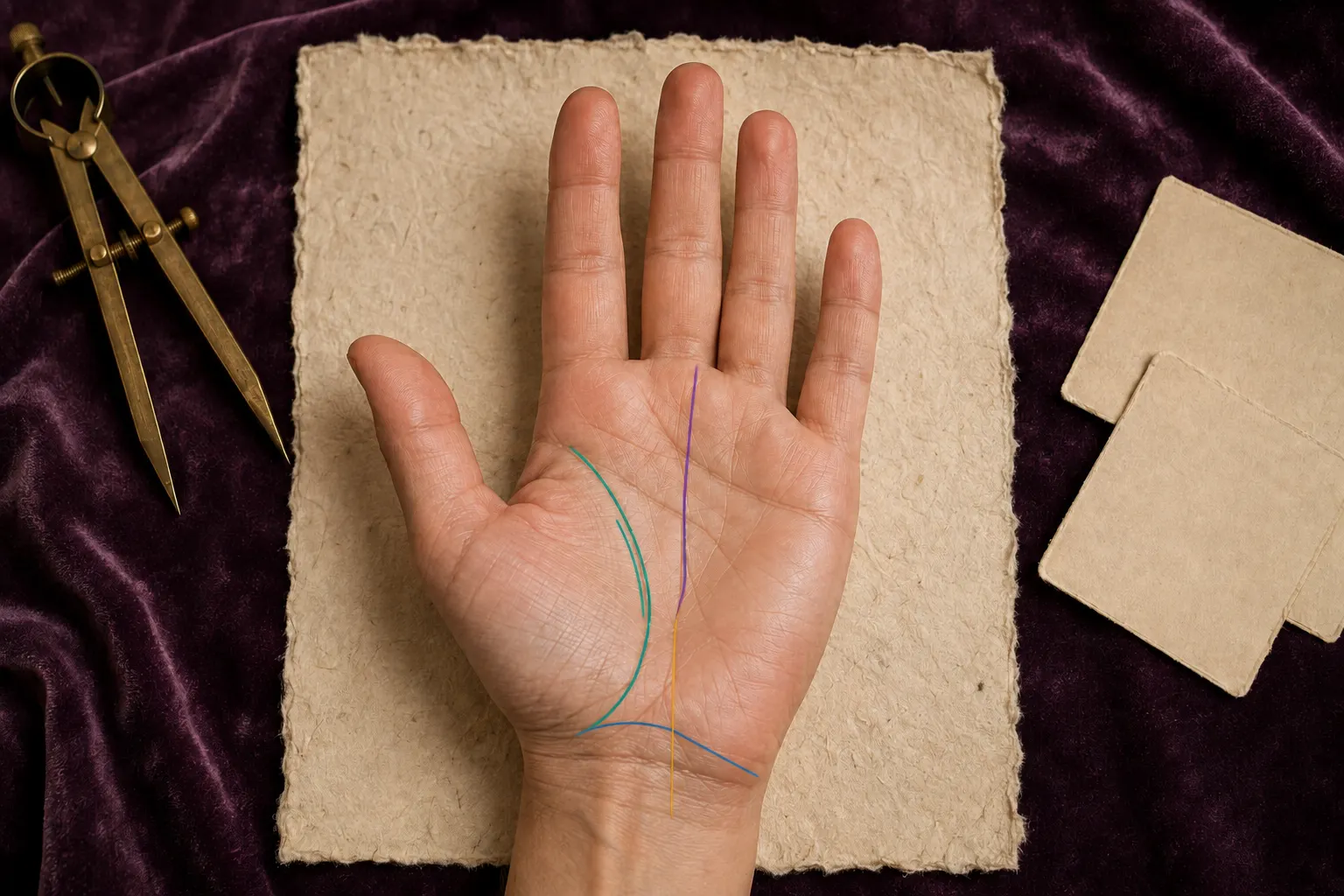
The clearest major life-change signs in palmistry are a fate line that breaks, shifts, begins, strengthens, or changes destination; a life line with an overlapping continuation or outward branch; and an influence line that joins or redirects a major line. One mark does not identify the event. Palmists look for at least three parts: a route change, a second feature that names the life area, and a similar timing zone elsewhere on the hand.
A fate-line shift or life-line branch becomes useful only after its source, destination, timing, continuation, and supporting features are clear. A whole-hand reading can show whether work, relationships, home, relocation, family, money, recognition, or purpose forms the strongest transition pattern across both palms.
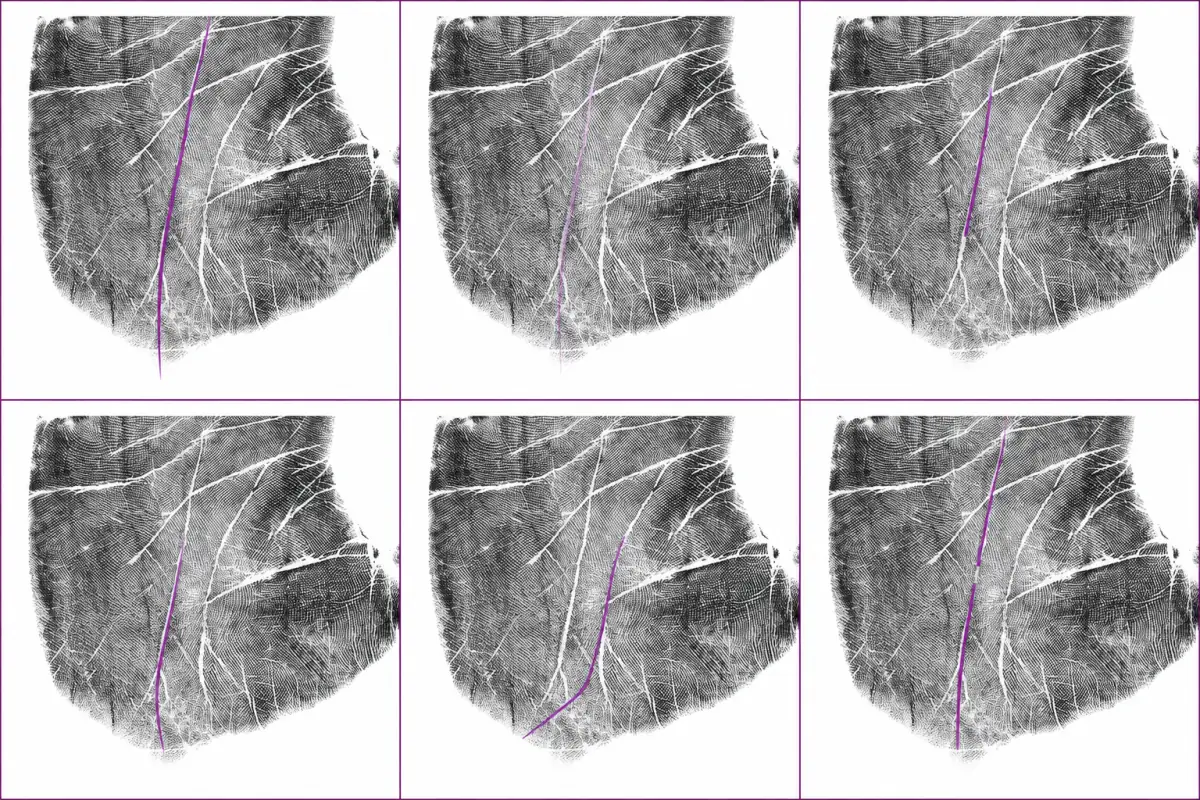
A shifted fate line can describe a new direction, but the destination decides whether the emphasis moves toward leadership, recognition, communication, or a more independent path. A life-line overlap can show that a new lifestyle begins while the previous structure is still ending. An outward branch toward the Moon area adds movement, travel, relocation, or a wider environment. When these appear together, the pattern says more than any one line can.
| Feature | Traditional change theme | What makes it specific |
|---|---|---|
| Fate-line break with shifted continuation | One direction gives way to another | Overlap, new strength, destination, and timing zone |
| Fate line begins or strengthens | Direction, responsibility, or purpose becomes clearer | Its source and where it continues |
| New line joins or replaces fate | Outside influence or a new need redirects the path | Whether it comes from Venus, Moon, life, head, or heart |
| Life-line break with overlap | Change in lifestyle, stability, home base, or rhythm | Quality of the continuing segment and support lines |
| Life-line branch or fork toward Moon | Travel, relocation, independence, or a broader environment | Fate-line response and Moon markings |
| Influence line reaches a major line | A person, family tie, place, or responsibility enters the pattern | Origin, point of contact, and effect after the join |
| Head line changes direction | A major decision, new outlook, study, or working method | Fate or Sun change at the same level |
| Heart-line branch or interruption | A changed emotional chapter, standard, or relationship pattern | Venus, relationship lines, and fate-line response |
| Both palms repeat the transition | The shift is strongly established across background and present expression | Same formation, subject, and broad period |
The nine-feature major life-change map
Start with the major lines, then move outward. The strongest reading is a sequence rather than a collection of dramatic-looking marks.
- Find the fate-line change. Record whether it starts, stops, overlaps, shifts sideways, forks, strengthens, or changes destination.
- Inspect the life-line structure. Look for an overlap, stronger continuation, outward branch, travel fork, or parallel support line.
- Trace every influence line. Identify whether it comes from the Venus side, Moon side, wrist, or another major line.
- Name the destination. Jupiter, Saturn, Sun, Mercury, Moon, or Venus changes the subject of a branch or new route.
- Check the head line. A decision-related change may appear as a branch, altered slope, fork, or fate-line shift near the crossing.
- Check the heart line and relationship zone. These show whether attachment, values, partnership, or family expectations participate.
- Add the Sun line. A new or stronger Sun segment can show that visibility, satisfaction, or creative expression grows in the next chapter.
- Place the features in a broad timing zone. Use the same period only when the landmarks genuinely align.
- Compare both hands and the actual question. Decide whether the pattern is underlying, currently developed, repeated, or contradicted.
Change of subject versus change of intensity
A line that merely deepens keeps the same route and often shows the existing theme becoming more consistent. A line that stops and restarts elsewhere changes structure. A branch adds a second direction. A joining influence introduces another source. These are different change patterns and should not be collapsed into “something big will happen.”
Why the continuation matters most
The formation after a break shows what the new chapter can sustain. A clean, steady continuation suggests the route becomes more organized. A faint or chained continuation suggests that the change remains unsettled. A segment moving toward another mount changes the emphasis. Always follow the new route to its final destination.
A major change needs a combination
Use one feature to show that a route changes, another to identify the subject, and a third to confirm timing or direction. The complete palm-reading checklist keeps that sequence consistent.
Fate-line signs of a new life direction
The fate line is the main route for questions about direction, responsibility, vocation, and the structure of adult life. It normally rises from the lower palm toward Saturn below the middle finger, but its start, clarity, route, and ending vary widely.
| Fate-line change | How it looks | Traditional reading prompt |
|---|---|---|
| Clean break | The line stops, leaves a visible gap, then may resume | What direction or responsibility ended, and what replaced it? |
| Overlapping break | A new segment begins beside the old before it ends | Did the next chapter begin while the previous one was still active? |
| Shifted continuation | The upper segment resumes to one side of the lower route | Which mount receives the new path? |
| New mid-palm start | No clear lower segment; a defined line begins higher | When did direction or responsibility become more organized? |
| Line becomes stronger | A faint lower route gains depth and clarity above a point | What decision, skill, or commitment strengthened it? |
| Forked fate line | One parent line divides into two continuing routes | Are two roles, goals, locations, or identities developing together? |
| Replacement from Moon | An outer-palm line joins or takes over the central route | Did public response, travel, a partner, or a wider environment redirect the path? |
How to read an overlapping fate-line break
Verify that two separate segments run beside each other for a short distance. If the new segment starts before the lower one ends, palmists read a managed transition: the next role, place, responsibility, or purpose begins to form before the earlier path closes. If the upper line is clearer, the new direction becomes more settled. If it moves toward Jupiter, Sun, or Mercury, use the mount map to read the destination.
A fate line that changes at the head line
The head-line crossing is commonly placed around the late thirties. A break, fork, strengthening point, or sideways shift there is traditionally connected with a decision, changed thinking, study, or a new working method. The career-change guide separates promotion, new employment, business, and parallel-role combinations; this article uses the same feature only as one part of a wider life transition.
Life-line signs of lifestyle and home-base change
The life line curves from between the thumb and index finger around the Venus mount toward the wrist. In a life-change reading, its structure describes continuity, support, rhythm, and the relationship between familiar roots and a wider environment. Its length is not used to calculate lifespan.
| Life-line feature | Traditional change theme | Features to add |
|---|---|---|
| Wide clean gap | An abrupt break in the previous lifestyle or stable rhythm | Continuation, Mars support, fate line, and both hands |
| Short overlap | Transition with continuity while old and new phases coexist | Strength and direction of the later segment |
| Stronger line after overlap | A fresh structure becomes more established after change | Upward branches and fate-line support |
| Branch toward Moon | Travel, relocation, independence, or life beyond the familiar base | Moon lines, fate source, and travel direction |
| Fork near the lower end | Two environments, a later move, or a divided home base | Which fork is stronger and whether both hands repeat it |
| Parallel inner Mars line | Support, reserve, or continuity beside a difficult section | Where support begins and ends |
| Upward branch | Initiative, opportunity, responsibility, or a constructive new phase | The mount or line receiving it |
Overlap versus a double life line
An overlap is local: one segment shifts and runs beside the earlier line for a short distance around a transition. A double life line or long Mars line continues beside a much larger portion of the arc. Trace both beginnings and endings before naming the formation. A short overlap changes one chapter; a long parallel line describes sustained support or a second channel across a broader period.
What the outward branch adds
A lower life-line branch moving away from Venus toward Moon points beyond the familiar home base. It can join travel, relocation, study abroad, work in another place, or a life divided between environments. It becomes a stronger relocation combination when Moon markings and the fate line repeat the same movement. The travel and foreign-settlement guide explains those location-specific combinations in depth.
Influence lines, Moon, and relocation combinations
Influence lines are fine routes that enter or meet a major line. Their origin tells you where the new influence comes from; their effect after contact shows whether it strengthens, redirects, divides, or briefly interrupts the parent route.
| Influence origin | Traditional source | Change combination |
|---|---|---|
| Venus mount inside the life line | Family, attachment, close relationship, or established roots | Line reaches fate while heart or relationship features change |
| Moon mount on the outer lower palm | Travel, public response, imagination, partner, audience, or another environment | Line joins or replaces fate while life line branches outward |
| Life line | Personal effort, roots, or a choice growing from the existing life structure | Fate begins from life and later separates clearly |
| Head line | Decision, study, strategy, or a new mental direction | Fate or Sun line starts at the same crossing |
| Heart line | Relationship, family value, or emotional priority | Fate starts, ends, or changes at the heart-line level |
| Wrist or central lower palm | Early-established direction or independent development | Later branch shows how the original path expands |
How a relationship can redirect the fate line
A fine line from Venus or Moon that reaches fate may traditionally show another person becoming part of the direction pattern. Do not name marriage from that contact alone. Check the heart line, the true edge-on relationship lines, Venus development, the little finger, and whether the fate line becomes stronger, weaker, or shifts after the join. The love and relationship map supplies the emotional context.
How relocation differs from ordinary travel
Short horizontal lines on Moon can show movement or travel themes, while a life-line branch toward Moon changes the life structure itself. A Moon-origin line that joins fate adds work, public, partner, or environment influence. When the fate route also shifts and remains strong afterward, the combination supports a substantial location change more than a temporary trip.
Head-line and heart-line changes
A turning point may be driven by a decision, a relationship, or both. The head line adds how the person thinks and chooses through the transition. The heart line adds emotional priorities, attachment style, ideals, and how relationships shape the change.
| Supporting feature | Life-change question | Strongest cross-check |
|---|---|---|
| Head line suddenly changes slope | Did practical priorities give way to a more imaginative path, or the reverse? | Fate or Sun line changes at the same level |
| Head-line fork becomes clear | Are two ways of thinking, working, or communicating being combined? | Forked fate line or strong Mercury/Sun support |
| Fate line shifts at head line | Did one major decision redirect work or responsibility? | Timing and upper fate-line destination |
| Heart line develops upward branch | Did standards, commitment, or emotional expression become more central? | Venus, relationship line, and fate contact |
| Fate changes at heart-line level | Did relationship, family, or values reshape the life path? | Heart-line continuation and Venus influence |
| Sun line begins near head or heart line | Did visibility, fulfillment, or creative identity emerge with the transition? | Fate-line change and ring-finger context |
A break or island on the head or heart line should be described through its visible geometry and surrounding features. It does not identify a diagnosis or guarantee an external event. Ask what changed in thought, work, communication, emotional standards, attachment, or responsibility at that part of the line.
How to build a complete life-change combination
Use the route–subject–timing–continuation method. It gives each sign one job and prevents several vague marks from being treated as independent predictions.
| Layer | What to identify | Example |
|---|---|---|
| Route | The major line that starts, breaks, overlaps, forks, or shifts | Fate line resumes to the Sun side |
| Subject | The destination, joining line, mount, or companion feature | Sun adds recognition and creative fulfillment |
| Timing | The broad zone where the change begins | Shift occurs near the head-line crossing |
| Continuation | Strength, clarity, branches, and endpoint after the transition | Upper fate route becomes cleaner and reaches Sun |
| Confirmation | A second line and the other palm | Sun line begins nearby and both palms show the shift |
| Question | The real decision or life area being explored | Career move that also changes location and public role |
Strong, moderate, and incomplete patterns
A strong combination has a clear route change, identifiable destination, coherent continuation, similar timing elsewhere, and useful support on the other hand. A moderate combination has two or three aligned features but an uncertain date or subject. An incomplete pattern is a single faint mark, unclear photo, missing continuation, or feature whose origin cannot be traced.
Contradictory signs can describe the tension
A life-line branch toward Moon may pull toward movement while a strong Venus area and inward-curving lower life line favor roots and familiarity. A forked fate line may keep a stable role while another route develops. The contradiction can describe the actual choice: relocation versus home base, security versus autonomy, or one profession versus a parallel pursuit.
How to estimate when the change occurs
Use the palmistry age-calculation method only after the formation is verified. On the fate line, the head-line crossing is commonly placed around ages 35–40 and the heart-line crossing around 55–60. Measure positions between landmarks proportionally. On the life line, follow the curved route and divide it into broad stages or approximate decade sections.
Give a range, then look for the same period on another line. A fate shift near the head line, a life-line branch at a comparable stage, and a Sun-line start near its head-line crossing form a more coherent late-thirties transition than any one mark alone. Calibrate with a known past event when possible.
What the active and less-active hands add
The two-hand comparison method treats the less-active hand as the underlying pattern and the active hand as its current development and expression. This convention is more useful than choosing a hand by gender.
| Two-hand pattern | Traditional reading | Practical next step |
|---|---|---|
| Shift appears clearly on both | The transition is deeply established and actively expressed | Compare timing and destination on each hand |
| Clearer on active hand | Present choices or circumstances strengthen the new route | Identify what support developed beside it |
| Clearer on less-active hand | The underlying possibility may not be fully expressed now | Look for a subtler active-hand branch or replacement |
| Active hand has stronger continuation | The person may have built more stability after the change | Trace the qualities that support the later segment |
| Destinations differ | The present path develops beyond the background direction | Read each mount and route separately before combining |
| Only the photographs differ | No symbolic conclusion is ready | Repeat matched images and verify the actual palm |
If a line seems newly formed, faded, or deeper, use the matched-photo comparison guide first. The current article interprets a verified formation; the changing-lines guide determines whether the physical difference is real.
Worked major life-change examples
Example 1: new career and relocation develop together
The fate line overlaps and resumes closer to Sun near the head-line crossing. A life-line branch leaves the lower-middle arc toward Moon, and a Moon-origin line reaches the new fate segment. The combination connects a career or purpose shift with relocation, wider public contact, and stronger visibility. A clear upper continuation suggests the new structure becomes established.
Example 2: a relationship changes the home base
An influence line from Venus reaches fate, the heart line gains an upward branch in a comparable zone, and the life line develops a short outward branch. This can connect partnership or family influence with a new responsibility and changed environment. The relationship-line zone and other hand are needed before describing commitment or timing.
Example 3: a second role grows beside a stable path
A clear fate line forks, with one branch continuing toward Saturn and the other turning toward Mercury. The head line also ends in a practical-imaginative fork. The pattern supports two simultaneous roles: an established responsibility plus communication, consulting, commerce, teaching, or specialist work. Because the parent line remains intact, the reading is expansion rather than total replacement.
Example 4: a lifestyle reset with continuity
The life line has a short overlap and continues more clearly afterward. A Mars support line covers the transition, while fate remains stable but strengthens slightly above the same period. The pattern emphasizes a changed daily structure, home base, or responsibility with support and renewed consistency rather than an abrupt ending.
Example 5: direction becomes clearer later
The lower fate line is absent or faint, then a clean segment begins from the head line and rises toward Saturn. The head line is strong, and a Sun line appears above the same level. Traditional timing places this around the late thirties, when decision, responsibility, and visible fulfillment become more organized. Earlier years are not empty; the defined route simply appears later.
Example 6: the palms show potential and action differently
The less-active hand has a lower life-line fork toward Moon, while the active hand carries a stronger outward branch plus a Moon-origin fate line. The underlying attraction to a wider environment appears more actively developed through present choices. Timing and the actual relocation question determine whether the combination describes travel, study, work, partnership, or a divided home base.
Common mistakes when reading major change
- Calling every fate-line break a job loss.
- Reading a life-line break as a lifespan prediction.
- Confusing a faint patch with a clean gap or overlap.
- Ignoring the route and quality after the change.
- Assigning relocation from one short Moon line.
- Naming marriage from any influence line that reaches fate.
- Using one timing scale unchanged on every line.
- Combining marks that sit in unrelated periods.
- Ignoring a stable original path when a second route appears.
- Reading one palm without the corresponding feature on the other.
Photo checklist for a life-change reading
- Photograph both full palms from fingertips through wrists.
- Keep the hands relaxed and parallel to the camera.
- Use bright indirect light plus one gentle side-lit image.
- Include the full life, head, heart, fate, and Sun-line routes.
- Add close-ups of every break, overlap, fork, joining line, and destination.
- Include the lower outer Moon area and the complete Venus mount.
- Keep photographs in color without tracing, filters, sharpening, or contrast edits.
- Use the same camera angle and distance for both hands.
- State hand dominance, current age, known change dates, and the question you want explored.
Questions that make a major-change reading useful
- Which line changes route, and what exactly happens to it?
- Is there a clean gap, short overlap, fork, join, strengthening point, or replacement?
- Where does the new segment come from and where does it end?
- Is the continuation stronger, weaker, shifted, doubled, or redirected?
- Which second feature identifies career, relationship, family, relocation, recognition, or another subject?
- Do the features occupy a comparable timing zone?
- What was happening at a known past marking that can calibrate the scale?
- Does the other hand repeat, strengthen, soften, or redirect the pattern?
- Has the formation been verified in matched photographs?
- What decision or transition do you most want the reading to explore?
Read the transition across the complete hand
Verify the changed route, trace its source and destination, place it in a broad period, then add the head, heart, Sun and relationship lines, Venus and Moon, the thumb, fingers, hand shape, supporting marks, and both palms before deciding what kind of turning point it describes.
The complete answer
Major life-change signs in palmistry are strongest when several features form one coherent transition: a fate line breaks, overlaps, shifts, begins, strengthens, forks, or changes destination; the life line shows an overlapping continuation, outward branch, lower fork, or support line; and an influence line, head-line change, heart-line feature, Sun-line start, or Moon marking identifies the subject. The new route's origin, destination, strength, timing, and continuation show whether the pattern concerns career, relocation, partnership, family, recognition, responsibility, or two paths developing together. Compare both hands and verify apparent line changes with matched photographs. A Full Palm Reading maps all these important features across both hands and combines them into a holistic reading focused on the person's questions about work, relationships, home, relocation, family, money, recognition, purpose, and the next chapter.
A Full Palm Reading
Ask what kind of turning point your complete hand describes
Your reading verifies fate-line shifts, life-line overlaps and branches, influence lines, timing zones, and new destinations, then adds the head, heart, Sun and relationship lines, Venus and Moon, fingers, thumb, supporting signs, and both palms to explore work, relationships, home, relocation, family, money, recognition, purpose, and the next chapter.
Your Full Palm Reading maps all the important features—hand shape, skin texture, thumb, fingers, mounts, major and minor lines, markings, and the differences between both palms—and brings them together in a holistic reading focused on your questions.