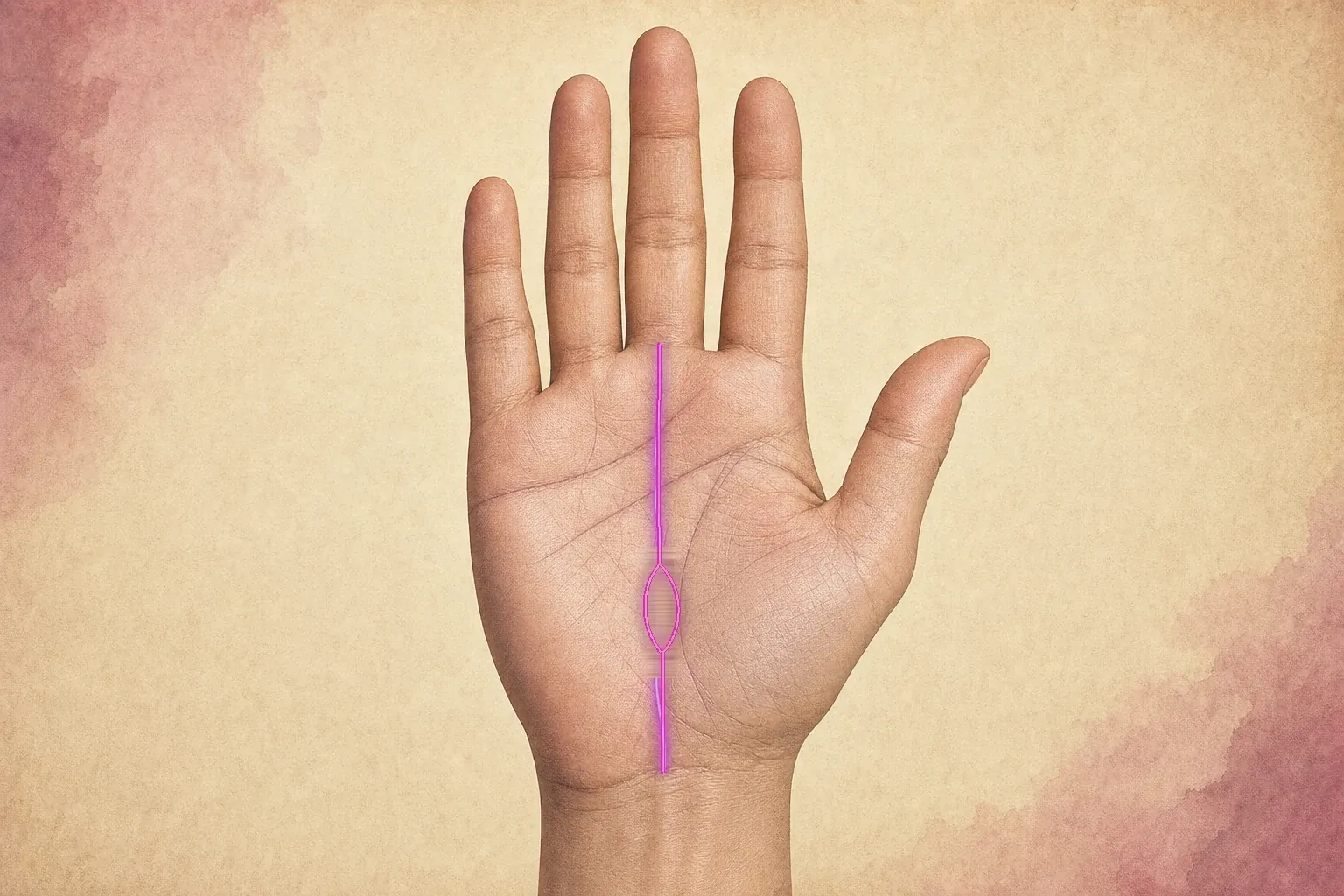
An island on a palm line is an enclosed oval, eye, leaf, or narrow loop formed when one line divides into two branches and then joins again. In traditional palmistry, it represents a period when the parent line's energy or attention becomes divided, complicated, delayed, or less clear. An island on the head line is read through thought and decisions; on the heart line, through emotional experience; on the fate line, through work and direction; and on the life line, through lifestyle, support, and sustained energy.
An island becomes meaningful only after one parent line, the split and reunion, position, length, clarity, crossings, support signs, continuation, timing, and both hands are compared. A whole-hand reading can show whether the divided section connects with work, decisions, relationships, family, recognition, purpose, or direction.
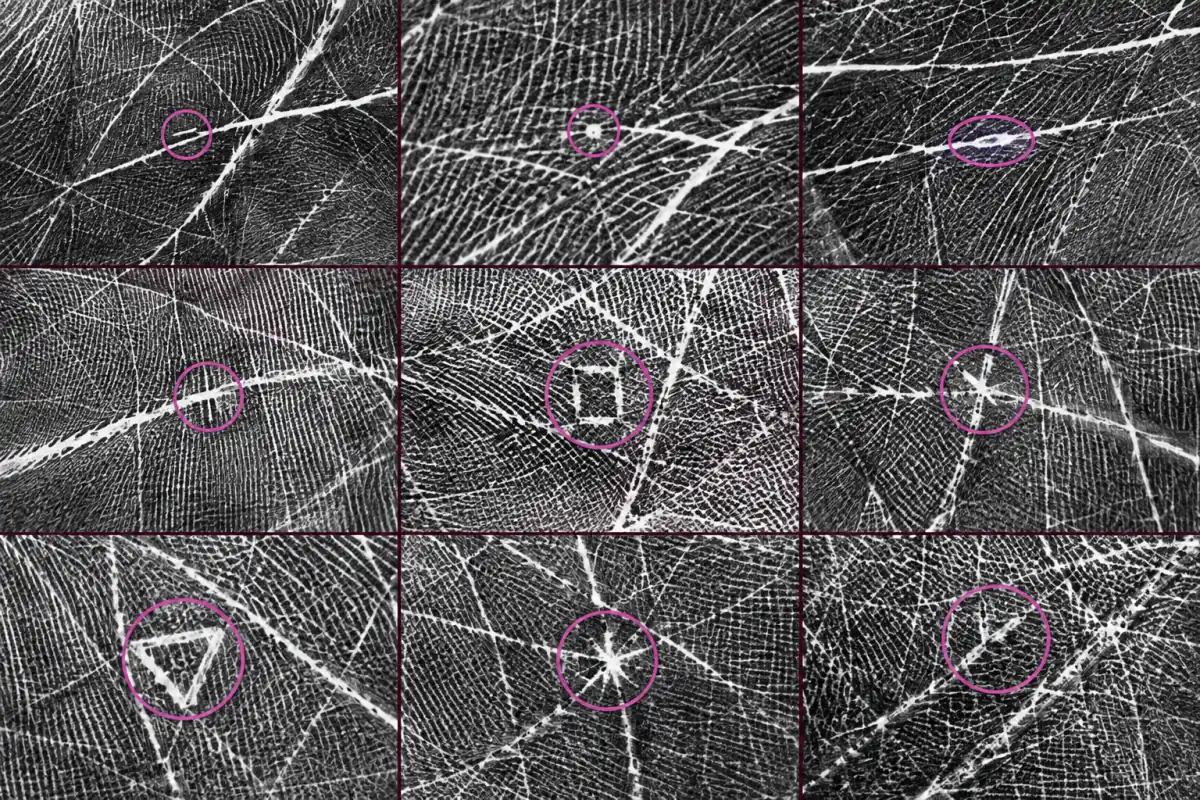
Use a seven-part island reading method: verify one parent line, trace the split and reunion, identify the line, locate the island along its route, inspect its length and clarity, follow the line after it, and compare the same area on both hands. The island is a symbolic line condition. It does not diagnose an illness, prove a future event, or determine lifespan.
An island describes a divided section, not the whole line
The line before the island shows what enters the period, the two sides show division or competing demands, and the line after the reunion shows what becomes possible next. A short island followed by a clear line reads differently from a long chain that never fully resolves.
How to verify a true island on a palm line
Begin with the parent line and keep your eye on it from its origin. A true island has four essential parts: one incoming line, a visible split, two sides enclosing one space, and a visible reunion into one outgoing line. The outline may be narrow or broad, but the interior must close. Do not mentally complete a missing edge.
| Check | A true island | If the check fails |
|---|---|---|
| Parent | Both sides grow from the same identifiable line | May be two crossing or neighboring creases |
| Split | One route visibly becomes two | May be a branch, fork, or bar |
| Interior | The two sides enclose an open space | May be a thick patch or doubled line |
| Reunion | Both sides visibly rejoin one route | May be a fork or two parallel lines |
| Stability | Shape remains under relaxed light and angle | May be glare, dry skin, shadow, or wrist flexion |
First use the palm marks and symbols guide to identify the geometry. Then use the dedicated guide for the parent line rather than assigning one universal meaning to every island.
Island versus circle, fish, fork, chain, and crossing lines
Searchers often call any eye-shaped or oval mark an island. The deciding feature is not the silhouette alone; it is the relationship to a parent line. Trace every stroke separately.
| Formation | Geometry | How it differs from an island |
|---|---|---|
| Circle | Independent rounded enclosure | Does not need one parent line to split and rejoin |
| Fish sign | Enclosed body with a distinct tail | Tail extends beyond the body instead of returning to one route |
| Fork | One line divides into two endpoints | Branches do not rejoin |
| Chain | Several linked islands or wave-like loops | Repeated condition rather than one isolated enclosure |
| Crossing lines | Independent strokes cross the parent twice | Parent often continues through the middle |
| Ridge loop | Fine fingerprint-like skin ridges | Belongs to skin pattern rather than a major crease |
| Grille | Several short lines form a mesh | Has multiple cells and directions |
A closed oval around an uninterrupted line is usually a circle or crossed-line enclosure, because the parent did not divide. See the circle-on-palm guide for that boundary. If two or more loops repeat, save the detailed reading for the separate chained-lines guide.
Island meaning on the life, head, heart, fate, and Sun lines
The parent line supplies the subject. Traditional palmistry usually treats an island as concentrated complexity, divided focus, uncertainty, reduced clarity, or a prolonged adjustment within that subject. The surrounding hand shows what causes it and how the pattern develops.
| Parent line | Traditional island theme | Context to add |
|---|---|---|
| Life line | A demanding lifestyle phase, divided energy, family pressure, or reduced steadiness | Venus, Mars support line, branches, fate line, continuation |
| Head line | Mental strain, competing ideas, uncertainty, distraction, or difficult decisions | Slope, depth, thumb, Mercury, bars, line after island |
| Heart line | Emotional confusion, divided attachment, guarded expression, or a demanding relationship phase | Ending, branches, Venus, relationship lines, both hands |
| Fate line | Uncertainty in work, duty, identity, role, or long-term direction | Origin, destination, head/heart crossings, Sun line |
| Sun line | Divided creative focus, delayed recognition, confidence pressure, or mixed satisfaction | Apollo, fate line, head line, line after island |
| Mercury line | Complication in communication, applied skill, business, or nervous pace | Mercury mount, little finger, head line, texture |
| Relationship line | A complicated or divided phase within a close bond | Heart line, branches, influence lines, actual relationship context |
Island on the life line
An island on the life line does not predict death or specify a disease. Read it as a traditional sign of divided resources or reduced steadiness during a broad life phase. A parallel Mars line, clear continuation, upward branch, or strengthening fate line can show support and reorganization. An island touching an influence line from Venus may place family or close relationships inside the story.
Island on the head line
On the head line, the two routes are traditionally associated with divided attention, uncertainty, competing interpretations, or sustained mental pressure. Position matters: an island near the start belongs to an earlier section, while one near the outer palm belongs later. A clear single line afterward suggests focus returns. Describe the pattern symbolically and avoid turning it into a mental-health diagnosis.
Island on the heart line
An island on the heart line traditionally points to emotional ambiguity, competing needs, a complicated attachment, or difficulty expressing what is felt. The ending under Jupiter, Saturn, or between them still describes emotional standards; branches and relationship lines show how the phase connects with affection, boundaries, hope, or disappointment.
Island on the fate line
On the fate line, an island suggests a period of divided work, uncertain direction, competing roles, or responsibility without a clean route. A stronger line after the island favors consolidation. A route shifting toward Apollo or Mercury afterward changes the emphasis toward recognition, creativity, communication, business, or applied skill.
Island on the Sun or Mercury line
A Sun-line island belongs to expression, visibility, reputation, satisfaction, and recognition; a Mercury-line island belongs to communication, exchange, skill, business, and nervous tempo. In both cases, check whether the line clears, breaks, changes direction, or continues faintly above the enclosure.
What the island's position and timing change
Position describes where the divided section occurs along the parent line. Use proportional zones and major crossings as broad landmarks. Do not convert millimeters into an exact date. The palmistry timing method explains how to combine several clues.
| Position | Reading question | Useful confirmation |
|---|---|---|
| At the line's start | Was the theme complicated from its foundation? | Origin lines, family zone, early branches |
| Before a major crossing | What built up before the decision or emotional landmark? | Head- or heart-line crossing |
| Centered on a crossing | Did two themes become entangled at the same phase? | Trace which line forms the island |
| After a crossing | What changed after the landmark? | Continuation, new branch, destination |
| At the line's end | Does the route diffuse, divide, or close before its destination? | Mount condition and alternate endings |
When an island appears where the fate line meets the head line, keep the parent clear: a fate-line island is read through role and direction even though the head-line level adds decisions and thinking. If the head line itself splits and rejoins, the island belongs to thought. A photograph can make two separate marks look like one.
Small, long, faint, deep, crossed, and clearing islands
Size changes duration or emphasis in traditional reading, but clarity matters more than dramatic shape. A short, clean island followed by a deep line describes a contained phase. A long island with uneven sides suggests sustained division. A faint island on a faint parent line may simply belong to an already diffuse pattern.
| Condition | Traditional emphasis | Read next |
|---|---|---|
| Small and isolated | Contained complication or brief divided focus | Line before and after |
| Long and narrow | Extended phase with two parallel pressures | Crossings and timing support |
| Broad | Wider separation between competing routes | Which side is stronger |
| Deep and clear | More strongly expressed condition | Parent-line strength |
| Faint or incomplete | Weak evidence; may be surface texture | Matched photos before interpretation |
| Crossed by a bar | External pressure intersects the divided phase | Bar origin and line continuation |
| Square around island | Traditional containment or stabilization around difficulty | Whether the square fully closes |
| Clear line afterward | Theme consolidates after complexity | New strength, branches, destination |
Compare the island on both hands
Compare the same parent line, section, lighting, and hand position. Traditional readers often treat the less-active hand as the underlying pattern and the active hand as the pattern developed through choices and experience. An island present on both hands carries more structural weight. One that clears on the active hand may suggest the theme is managed differently, while a new active-hand island may show a current complexity. First rule out photographic differences and natural line change with the matched-photo method.
Island combinations that make the reading more specific
| Combination | Traditional reading | Question it raises |
|---|---|---|
| Life-line island + Mars support | Demanding phase with parallel support or resilience | What maintains continuity? |
| Head-line island + clear upward branch | Complex thinking with a constructive outlet | Where does the branch lead? |
| Heart-line island + relationship-line fork | Emotional ambiguity alongside a partnership decision | Do the timings and hands agree? |
| Fate-line island + Sun line begins | Unclear role while expression or recognition develops | Does the new outlet continue? |
| Island enclosed by a square | Difficulty receives traditional containment or repair | Does the parent line strengthen? |
| Several linked islands | Repeated rather than isolated complexity | Is the line actually chained? |
One island rarely answers a life question alone. Combine the parent line, mounts, fingers, texture, timing landmarks, support signs, and both palms. If the pattern concerns a major transition, compare it with the major life-change combinations.
Worked island examples
Fate-line island below the head line, then a stronger route
The island places divided work or direction before the decision landmark. A deeper line afterward suggests the role consolidates. If a Sun line begins near the reunion, recognition or meaningful expression may become part of the new route.
Head-line island crossed by an influence line
The head line owns the island, so the main theme is competing thoughts or sustained uncertainty. The crossing line adds outside pressure. A clear continuation and firm thumb show how focus and decision-making return.
Life-line island with a parallel Mars line
The life line shows a demanding or divided lifestyle phase while the Mars line adds support. A stable fate line and upward life-line branch can connect that support with work, training, family help, or renewed direction.
Heart-line island on only one hand
Retake matched photographs first. If the difference remains, the traditional reading becomes a contrast between underlying emotional patterns and present expression, not a fixed relationship prediction.
Photo checklist for an island on a palm line
- Photograph the full active and less-active palm in soft neutral light.
- Add one close-up centered on the suspected island.
- Keep the hand flat and relaxed without stretching the skin.
- Take a second angle to rule out glare and shallow surface creases.
- Trace the parent line before and after the shape.
- Include enough palm to identify line crossings and destination mounts.
- State hand dominance and the work, relationship, decision, family, or direction question.
Read the island inside the complete hand
A Full Palm Reading maps the parent line, the island's exact geometry, position, size, crossings, support signs, continuation, mounts, timing, and both hands. That wider pattern can connect a divided section with the question you are actually asking.
The complete answer
A true island forms when one palm line splits around an enclosed space and visibly rejoins. Traditional palmistry reads it as a period of divided focus, complexity, uncertainty, or reduced clarity in the parent line's subject: lifestyle and support on the life line, thinking and decisions on the head line, emotional experience on the heart line, work and direction on the fate line, recognition on the Sun line, and communication or applied skill on the Mercury line. Its start and end, length, clarity, crossings, support signs, continuation, and presence on both hands matter more than the outline alone. A Full Palm Reading maps the island and all other important features across both hands and combines them into a holistic reading focused on your questions about work, relationships, decisions, family, recognition, purpose, timing, and direction.
A Full Palm Reading
Ask what the island means across your complete hand
Your reading verifies the parent line, split, enclosed space, reunion, position, length, clarity, crossings, support signs, and continuation, then adds the mounts, fingers, hand shape, timing, and both palms into one holistic reading focused on your questions about work, decisions, relationships, family, recognition, purpose, and direction.
Your Full Palm Reading maps all the important features—hand shape, skin texture, thumb, fingers, mounts, major and minor lines, markings, and the differences between both palms—and brings them together in a holistic reading focused on your questions.