
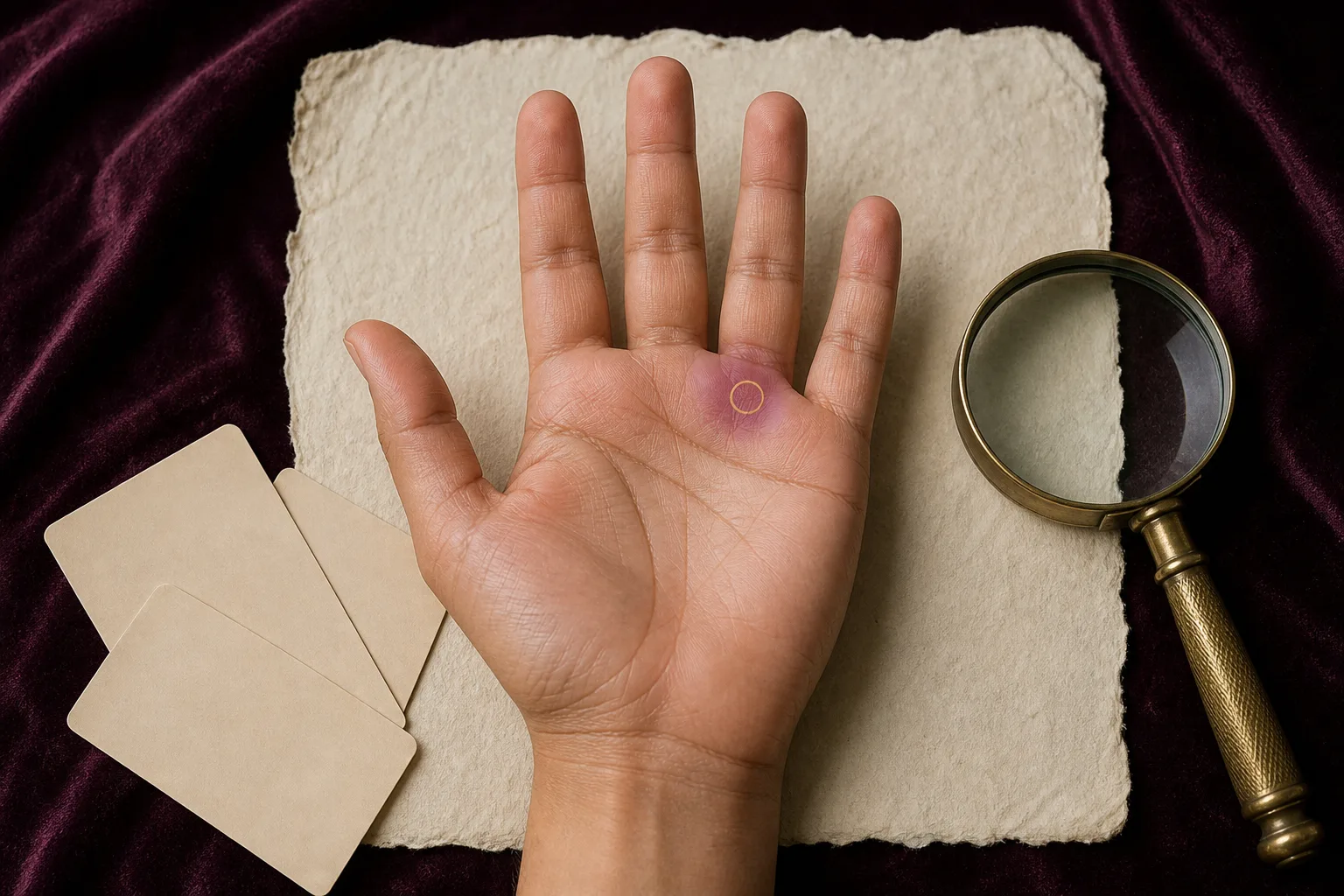
A circle on the palm is a rare closed marking made by a curved crease or several curved crease segments that join into one loop and enclose one visible space. Traditional palmistry treats it as concentration, enclosure, heightened focus, or obstruction in the area where it appears. The main exception is a clear circle on the Apollo mount or Sun line, which many systems associate with recognition, focused visibility, or creative success. On other mounts and major lines, the circle is usually read more cautiously through what it encloses and how the parent feature continues.
A circular mark becomes useful only after its crease boundary, closure, exact center, contents, parent-line behavior, timing, and the other hand are compared. A whole-hand reading can show what becomes concentrated and how that pattern affects work, recognition, relationships, communication, travel, creativity, purpose, or direction.
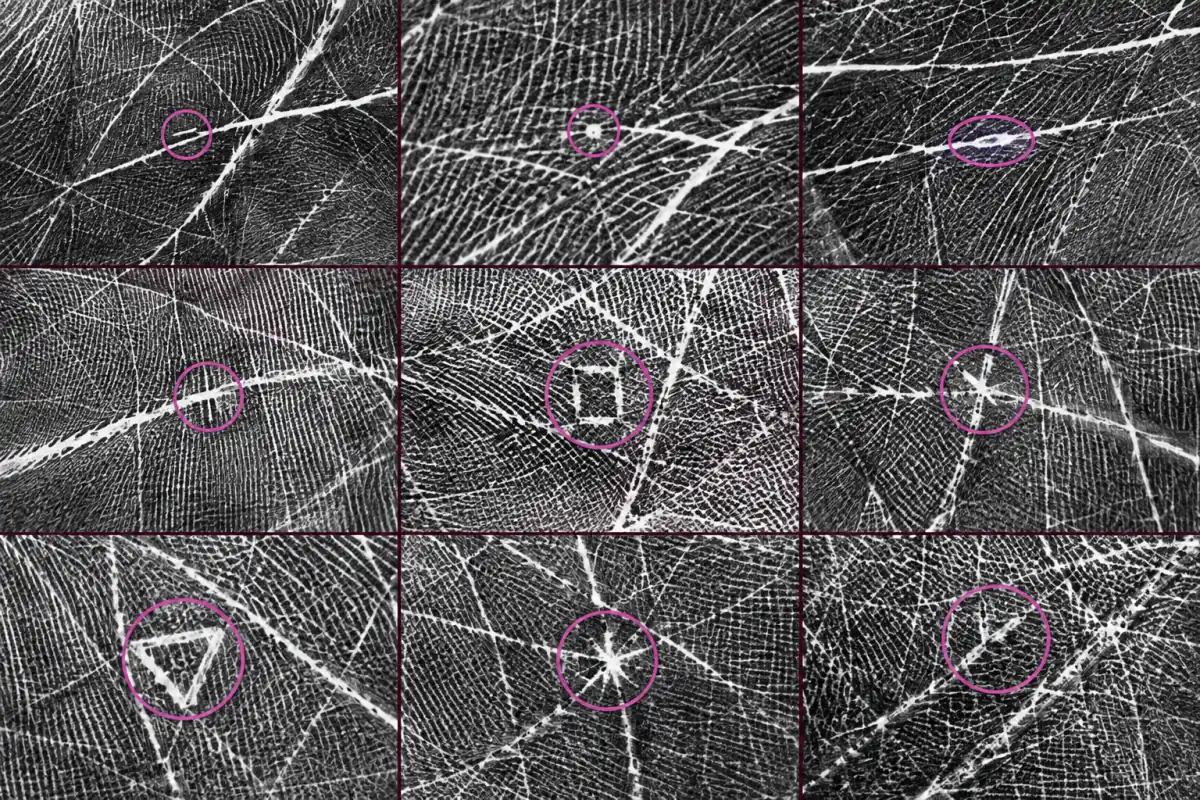
A round-looking mark in a photograph is often something else: an island formed when one line divides and rejoins, a fingerprint loop made by fine skin ridges, an open ring around a mount, a scar, a pressure mark, or a pigmented spot. First decide whether the boundary is actually a crease. Then test closure, shape, independence, location, contents, and line continuation before applying any symbolic meaning.
A crease boundary must close around one space
Start at any point on the suspected circle and trace the boundary all the way around until it returns to the start. A gap makes it an open arc. Two pointed ends attached to one parent line suggest an island. Fine fingerprint ridges curving together are skin texture rather than a palm-line symbol.
Seven-point circle verification map
| Check | What a verified circle shows | Reason to pause |
|---|---|---|
| Boundary | One curved route can be traced around the mark | Several unrelated creases only suggest a curve |
| Closure | The boundary returns to its starting point | A visible gap leaves an open arc or C shape |
| Interior | One enclosed space remains visible | Crossing lines divide it into a grille or mesh |
| Curvature | The sides remain rounded without sharp corners | Three or four corners make a triangle or square |
| Crease depth | The boundary interrupts the skin surface as a crease | Only color, reflection, or fine ridges define the shape |
| Location | The loop can be placed on a line, mount, or plain | A tight crop hides the fingers and major routes |
| Persistence | The closed outline remains under direct and side light | Pressure, dryness, angle, or shadow changes it completely |
- Relax the hand and inspect the whole palm before the close-up.
- Choose one point on the suspected boundary.
- Trace the curved crease continuously around the enclosure.
- Confirm that the final segment meets the starting point without a gap.
- Check whether the boundary has pointed ends, corners, or crossing lines.
- Identify any parent line, mark, mount, or plain inside the circle.
- Repeat the check under gentle side light and compare the other palm.
A palm circle does not need to be mathematically perfect. A small oval may belong to the same broad enclosure category when it has a smooth closed boundary and is not created by a parent line splitting and rejoining. Record what you actually see: “independent rounded loop on Apollo” is more useful than forcing a slightly oval crease into an exact geometric label.
How rare is a true circle on the palm?
It is uncommon compared with crosses, forks, islands, bars, and triangles. Natural palm creases tend to branch, intersect, or taper rather than curve into a complete isolated loop. Rarity increases the need for a strict test; it does not make the mark more powerful or more predictive.
Circle lookalikes: island, fingerprint loop, ring, spot and scar
| Possible formation | What it looks like | How it differs from a circle |
|---|---|---|
| Island | One parent line divides and rejoins around an oval space | Two pointed ends remain attached to the same route |
| Fingerprint loop | Many very fine ridges curve and return | Skin-ridge pattern rather than one crease boundary |
| Open ring or arc | A curved line partly circles a mount | The ends never meet, so the interior is not closed |
| Spot or mole | A small round area of color | Pigment has no crease boundary |
| Scar | Smooth, raised, indented, or differently textured tissue | Skin change interrupts rather than follows natural creases |
| Pressure mark | Temporary round redness or indentation | Fades after contact pressure is removed |
| Square with rounded corners | Four crease sides enclose a softened box | Four direction changes remain traceable |
| Ring of Solomon | Curved arc under the index finger | Usually an open arc embracing Jupiter, not a closed loop |
Circle versus island
An island belongs to a parent line: the line divides, travels around a narrow enclosed space, and rejoins. Its ends often taper into points. A circle can stand independently or cross another line as a separate boundary. If the suspected circle shares its upper and lower sides with one major route, use the island interpretation from the marks-and-symbols guide.
Circle versus fingerprint loop
Fingerprint and palm-ridge loops are made from many fine parallel ridges. They look clearest in even light and may form loops, whorls, or triradii. Palmistry line symbols use deeper flexion and secondary creases. Magnify the image: if the “circle” is only one part of a repeating ridge flow, it is texture rather than a closed crease mark.
Circle versus a spot or mole
A circle is a line formation; a mole or pigmented spot is part of the skin. Do not use a crease meaning for a colored mark. The planned mole guide covers traditional location symbolism separately. A photograph can show color and outline, but it cannot establish what a skin mark is.
Five circle types and what changes their meaning
| Circle type | Visible structure | Reading priority |
|---|---|---|
| Independent circle | Closed curved crease away from major routes | Mount location and enclosed area |
| Circle crossing a line | A separate loop intersects a major or minor line | Parent line, entry and exit, continuation |
| Circle around a mark | Closed boundary encloses a dot, cross, star, bar, or break | Identify the inner feature independently |
| Open or broken circle | Curved boundary has one visible gap | Read as incomplete enclosure, not a full circle |
| Double or concentric circles | Two closed loops overlap or one sits inside another | Verify each boundary and rule out ridge whorls |
The interior matters. An empty circle concentrates the mount's subject. A circle around a cross, star, break, or spot adds enclosure to a second feature, so the inner mark must be verified before combining the two meanings. If lines heavily cut the boundary, describe a disturbed or crossed circle rather than a perfect sign.
Circle meanings by mount
Find the center of the enclosure on the palm mount map. Then compare the mount's relative fullness, firmness, texture, finger, and nearby lines. Traditional interpretations vary, but most treat the circle as concentrated visibility on Apollo and as intensified or enclosed expression elsewhere.
| Circle location | Where to look | Traditional emphasis | Support to compare |
|---|---|---|---|
| Jupiter | Below index finger | Ambition, status, teaching, or leadership becomes highly concentrated | Index finger, thumb, fate branches |
| Saturn | Below middle finger | Responsibility, solitude, study, or caution becomes enclosed or intensified | Middle finger, fate line, texture |
| Apollo / Sun | Below ring finger | Focused recognition, creative visibility, or satisfaction | Sun line, ring finger, head and fate lines |
| Mercury | Below little finger | Concentrated communication, analysis, enterprise, or specialist work | Little finger, head and Mercury lines |
| Venus | Thumb mound inside life line | Attachment, family influence, affection, or personal energy becomes enclosed | Life and heart lines, thumb, influence lines |
| Moon | Lower outer palm | Imagination, travel, public atmosphere, or inward sensitivity becomes intensified | Head line, travel lines, fate origin |
| Upper Mars | Outer middle palm | Boundaries or repeated focus around resistance and negotiation | Head and heart lines, Mars support |
| Lower Mars | Inner palm above Venus | Courage, reaction, or immediate self-assertion becomes concentrated | Life line, thumb, head line |
| Plain of Mars | Central palm | A central duty, conflict, or practical concern draws sustained attention | Fate, life, head, and support lines |
“Concentrated” can be constructive or restrictive. A clear circle on balanced Apollo beside a strong Sun line may focus visibility. A crossed circle on overactive Mars amid many bars may show attention trapped in recurring conflict. The surrounding hand decides whether the enclosure gathers a quality or limits its expression.
Circle meanings on the life, head, heart, fate and Sun lines
When a circle touches a long line, first decide whether the line actually splits to form an island. If the boundary is independent, note where the parent line enters and leaves the enclosure, what sits inside it, and whether the line resumes with the same strength. A line that stops inside the circle differs from one that passes cleanly through.
| Parent line | Traditional circle emphasis | What to inspect |
|---|---|---|
| Life line | A period of concentrated pressure or narrowed attention around lifestyle, home, family, or environment | Island test, continuation, Mars support, branches |
| Head line | Thought or decision-making becomes intensely focused, enclosed, or temporarily constrained | Entry, exit, slope, forks, thumb |
| Heart line | Emotional expression or a relationship theme becomes concentrated | Curve, ending, branches, Venus, relationship lines |
| Fate line | Work, duty, or direction enters a focused or restrictive phase | Origin, circle level, route above it |
| Sun line | Recognition, creative identity, or fulfillment receives concentrated visibility | Apollo, clear continuation, bars, stars |
| Mercury line | Communication, analysis, systems, or specialist work becomes highly focused | Head line, little finger, line quality |
| Relationship line | A significant bond becomes the center of attention or feels enclosed | Edge photo, island test, fork, heart line |
Circle on the life line
A round enclosure touching the life line is easy to mistake for an island. Trace the line: if it divides into two sides and rejoins, read an island. If a separate loop crosses the line, traditional palmistry treats it as a concentrated or restrictive phase involving routine, family, home, energy, or environment. It does not predict lifespan or diagnose a health condition. Look for a clear continuation, Mars support, and branches that show how the route develops.
Circle on the head line
A separate circle crossing the head line is read through focus, planning, interpretation, and choice. A line that passes clearly through and resumes can show intense concentration around one period or subject. A line that becomes weak, chained, or islanded within the enclosure suggests divided or constrained focus. Palm markings cannot diagnose vision, neurological, or mental-health conditions.
Circle on the heart line
On the heart line, the circle concentrates an emotional or relationship chapter. An empty independent loop through an otherwise clear line differs from an island made by the heart line itself. Add the ending beneath Jupiter or Saturn, upward and downward branches, Venus, thumb, and relationship lines before interpreting what kind of bond or feeling receives attention.
Circle on the fate line
A fate-line circle can mark a focused assignment, responsibility, institution, or period where direction narrows. If the fate line grows stronger above it, the concentrated phase feeds a clearer route. If the line stops or shifts inside, the enclosure is part of a reorganization. The level may offer a broad timing clue when checked against head- and heart-line landmarks.
Circle on the Sun line
A clean circle centered on or immediately beside the Sun line is the most constructive traditional placement. It can symbolize attention, recognition, or one visible body of work coming into focus. The reading gains strength when the Sun line is clear below and above the circle, Apollo is balanced, and the fate and head lines support sustained output. A circle cut by bars or containing a star needs a more complex reading.
Why the circle on Apollo is treated differently
Apollo governs visibility, creative presentation, reputation, satisfaction, and the response one's work receives. A circle resembles a focused field or lens, so many palmistry traditions treat a rare clear circle below the ring finger as a sign of concentrated recognition. It may refer to creative work, public expression, a specialist reputation, or satisfaction through a visible contribution rather than celebrity.
| Apollo-circle context | Traditional reading | Clarifying feature |
|---|---|---|
| Independent clear circle on Apollo | Focused visibility or creative distinction | Ring finger and balanced mount |
| Circle centered on clear Sun line | Recognition gathers around a developed route | Line quality before and after |
| Circle beside Sun line | A local visibility theme without direct interruption | Distance from the parent line |
| Circle contains a verified star | Intense attention enclosed within one field | Verify both symbols independently |
| Circle crossed by several bars | Visibility complicated by interference or divided response | Sun-line continuation |
| Open arc around Apollo | Partial concentration or an unrelated curved crease | Closure test before interpretation |
The circle does not guarantee fame, awards, wealth, or a public career. Use the Sun-line guide to compare route, start, ending, branches, breaks, and the Apollo mount. Recognition becomes a credible hand-level theme only when more than one feature supports it.
How size, depth, contents and crossings modify a circle
| Circle variation | Traditional interpretation | Reading priority |
|---|---|---|
| Small, deep, clear circle | Focused concentration in a specific local area | Exact center and parent feature |
| Large circle across two areas | Broader enclosure joining more than one subject | Verify it is not several unrelated arcs |
| Faint developing circle | Possible emerging focus or incomplete enclosure | Matched photos over time |
| Open circle | Partial concentration without full closure | Gap direction and supporting lines |
| Circle with a clean interior | The local theme is concentrated without another symbol | Mount balance or line continuation |
| Circle enclosing a cross or star | An intense point is itself contained | Verify and read the inner mark first |
| Circle divided by many lines | Focus complicated by interference or a grille-like pattern | Count the crossings and cells |
| Circle crossed by one parent line | That life area enters and leaves the enclosure | Compare strength before, inside, and after |
Does a larger circle mean a stronger result?
No. A larger shape encloses more palm area and therefore often creates more ambiguity. A small clean circle with a precise Apollo or Sun-line relationship can be more informative than a broad loop assembled from several unrelated creases. Give more weight to closure, boundary depth, exact center, contents, parent-line behavior, and repeated support.
What does a broken circle mean?
A visible gap means the enclosure is incomplete. Note whether the arc still focuses attention toward a mount or line, but do not assign the full circle meaning. If the missing segment appears only under one lighting angle, the honest conclusion is that the shape cannot yet be verified.
How to time a circle without inventing a date
A circle can be placed in a broad period only when its center intersects a line with a usable proportional scale. Use the center of the enclosure, then inspect where the line enters and exits. On the fate line, compare with the head- and heart-line crossings. On the life line, use proportional position along the entire arc. A free-standing mount circle supplies no timing by itself.
| Circle position | Useful timing method | Avoid |
|---|---|---|
| On fate line | Place the center against head and heart landmarks | Using diameter as duration |
| On life line | Use proportional arc position and corroboration | Reading it as a lifespan marker |
| On head or heart line | Use broad traditional sections only | Claiming an exact age from finger alignment |
| On Sun line | Corroborate with a connected fate or life-line feature | Dating recognition from Apollo position alone |
| Independent on mount | Describe the active theme without a date | Inventing timing from mount location |
The palmistry timing guide explains landmark calibration, proportional sections, and broad windows. Timing remains approximate even when a parent line is clear.
What a circle means on the active and less-active hands
Use hand dominance rather than a gender rule. Palmists often read the less-active hand as background pattern or earlier potential and the active hand as present expression and developed choices. Because a circle can be faint or dependent on light, matched photography is essential before treating a one-hand difference as meaningful.
| Two-hand pattern | Traditional interpretation | Next check |
|---|---|---|
| Same circle in same location | The concentrated theme is both underlying and actively expressed | Compare depth, contents, and nearby lines |
| Clearer on active hand | Present choices may have intensified or focused the subject | Which supporting route also developed? |
| Clearer on less-active hand | The underlying focus may now be redirected or less enclosed | Look for an active-hand branch or continuation |
| Open on one, closed on the other | The degree of concentration differs between background and current expression | Verify the missing segment under matched light |
| Circle becomes island | An independent focus may now be integrated into a divided parent-line phase | Trace the line split and reunion |
| Only photographs differ | No symbolic change is established | Retake both hands with the same pose and light |
Six worked circle examples
1. Clear Apollo circle on a strong Sun line
A small closed loop sits directly on a clear Sun line below the ring finger. The line remains deep before and after it, Apollo is balanced, and a fate branch supports the same period. The traditional reading emphasizes one visible project, skill, or contribution receiving concentrated recognition.
2. Life-line island mistaken for a circle
The middle life line divides into two curved sides and rejoins around a narrow oval. Because both pointed ends belong to the same route, this is an island rather than an independent circle. Read the divided life-line phase, continuation, Mars support, and surrounding branches without applying the rare-circle meaning.
3. Independent Moon circle with travel support
A small closed crease circle sits on Moon away from the head and fate lines. A life-line branch reaches the outer palm and the fate line begins from Moon. The combination concentrates imagination, wider environments, public contact, or travel as an important theme, while the connected routes show how it enters daily direction.
4. Fate-line circle followed by a stronger route
A separate circular crease crosses the fate line below the head-line landmark. The fate line weakens inside the enclosure but resumes more deeply above it and shifts slightly toward Apollo. The reading suggests a focused or constrained work phase followed by clearer direction and more visible contribution.
5. Fingerprint loop mistaken for a palm circle
A magnified mark on the upper palm consists of several fine parallel ridges that bend and return. No single deeper crease creates a closed boundary. It is a ridge loop rather than a circle symbol, so the reader returns to the mount, major lines, and fingerprints as separate features.
6. Active-hand Apollo circle becomes clearer
The less-active hand shows an open C-shaped arc on Apollo. In a matched active-hand photo, a short natural crease closes the same outline, while the Sun line and ring-finger balance are stronger. After ruling out light and pressure, the traditional reading emphasizes a visibility or creative focus becoming more developed in present expression.
What a palm photo can and cannot show
| A good photo can show | A photo alone cannot establish |
|---|---|
| Whether a crease boundary appears closed | Whether a faint segment is permanent |
| Whether the shape has rounded sides or pointed island ends | How the skin feels or whether tissue is raised |
| Which line or mount contains the center | The cause or nature of a colored skin mark |
| What enters, crosses, or sits inside the loop | An exact date, outcome, or guarantee |
| Differences between matched views of both palms | A meaningful change from unmatched images |
Use one full-palm image and one close-up for each hand. Include the fingers and wrist in the full view, then keep enough surrounding area in the close-up to identify the parent line or mount. Take direct-lit and gently side-lit versions, keep them in color, and disable smoothing, portrait effects, sharpening, or drawn annotations.
Common mistakes when reading a circle
- Closing a visible gap mentally.
- Calling every oval island an independent circle.
- Mistaking a fingerprint loop or ridge whorl for a crease.
- Using a circle meaning for a mole, spot, scar, or pressure mark.
- Calling an open Ring of Solomon a closed circle.
- Assuming every circle carries the favorable Apollo interpretation.
- Ignoring what the circle encloses or crosses.
- Reading a line circle without checking entry, exit, and continuation.
- Assigning an exact date to a free-standing mount circle.
- Letting one rare mark outweigh the complete hand pattern.
Questions that make a circle reading useful
- Can one curved crease boundary be traced back to its starting point?
- Is the interior fully enclosed without a gap?
- Could the mark be an island, fingerprint loop, open ring, square, spot, or scar?
- Is the circle independent, crossing a line, or surrounding another mark?
- Which line, mount, or plain contains its exact center?
- What enters, exits, crosses, or sits inside the enclosure?
- Does the parent line continue with the same strength afterward?
- Which mount, finger, thumb, or second line repeats the same subject?
- Can the center be placed in a broad period on a timed route?
- Does the other hand repeat, close, open, fade, or redirect the pattern?
- What question about work, recognition, relationships, communication, travel, creativity, purpose, or direction should the circle answer?
Read the circle inside the complete hand
Verify the curved boundary and closure, separate crease from color and ridge texture, identify the exact center and anything enclosed, then add parent-line behavior, timing, mounts, fingers, thumb, other markings, and both palms. This shows what becomes concentrated and whether the wider hand supports, redirects, or limits that focus.
The complete answer
A circle on the palm is a closed curved crease enclosing one visible space. Traditional palmistry reads it as concentration, intensified attention, enclosure, or obstruction within the line or mount where it appears. Apollo and a clear Sun line form the main constructive exception, associated with focused recognition, creative visibility, or satisfaction. Elsewhere, Jupiter concerns ambition, Saturn responsibility, Mercury communication, Venus attachment, Moon wider environments, and Mars pressure or boundaries. On a major line, inspect whether the mark is truly a separate circle rather than an island, then compare the line before, inside, and after it. Fingerprint loops, open rings, squares, scars, pressure marks, moles, and pigmented spots require different identification. A Full Palm Reading maps the circle and all other important features across both hands and combines them into a holistic reading focused on your questions about work, recognition, relationships, communication, travel, creativity, timing, purpose, and direction.
A Full Palm Reading
Ask what your circle means across the complete hand
Your reading verifies the curved crease boundary and closure, separates it from islands, ridge loops, rings, spots, and scars, then adds the exact center, contents, parent-line behavior, timing, nearby markings, fingers, thumb, hand shape, mounts, major and minor lines, and both palms into one holistic reading focused on your questions about work, recognition, relationships, communication, travel, creativity, purpose, and direction.
Your Full Palm Reading maps all the important features—hand shape, skin texture, thumb, fingers, mounts, major and minor lines, markings, and the differences between both palms—and brings them together in a holistic reading focused on your questions.