
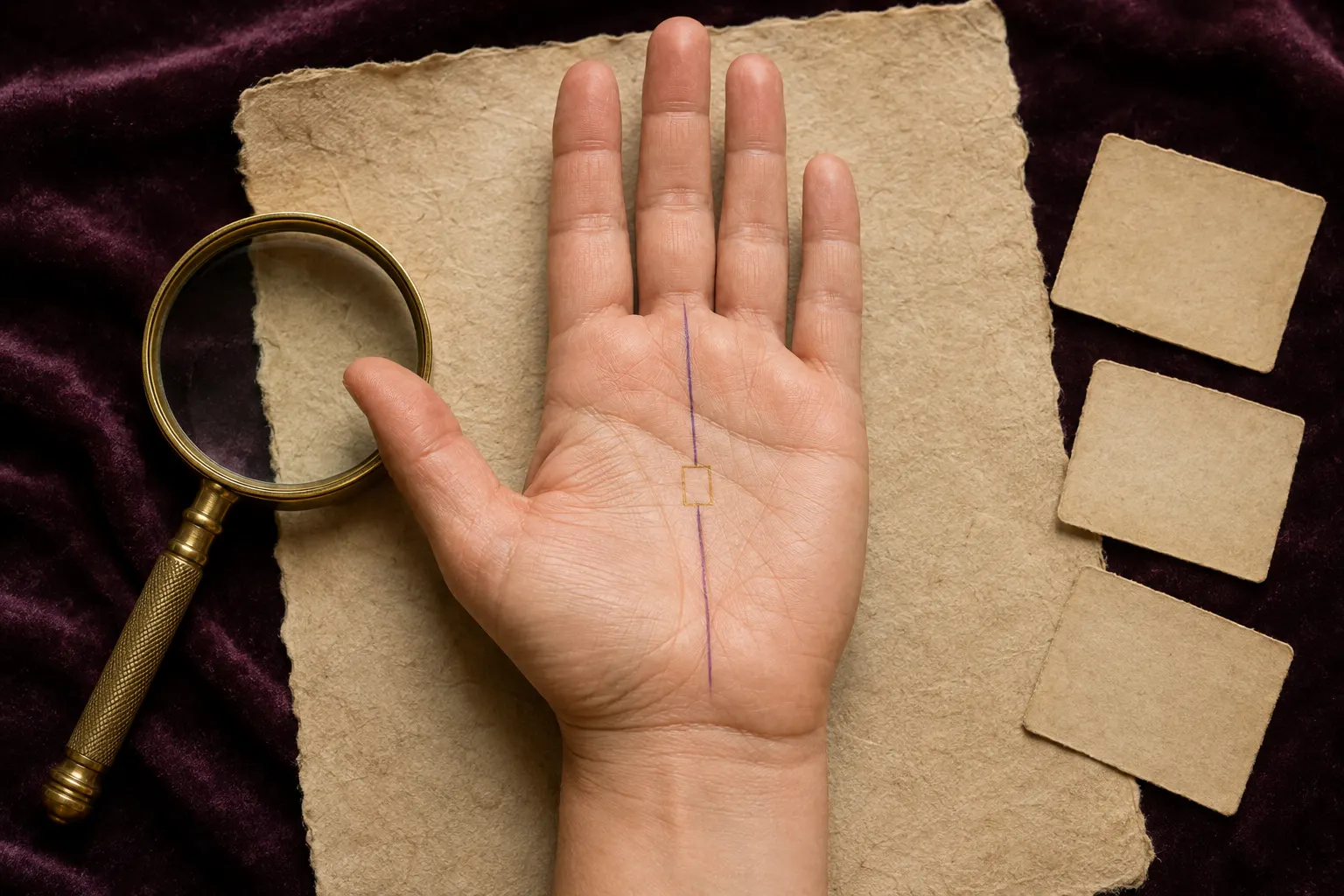
A square on the palm is a closed four-sided marking traditionally associated with containment, protection, stabilization, or recovery in the area where it appears. A square surrounding a break in the fate line is read through direction and responsibility; around a life-line interruption, through support during a lifestyle or environmental change; on Jupiter, through organized leadership or teaching; and on Moon, through boundaries around imagination, travel, or emotional atmosphere.
A four-sided mark becomes useful only after the enclosure, its inner feature, parent line, continuation, timing, and the other hand are compared. A whole-hand reading can show what is being contained, where support appears, and how that pattern affects work, relationships, family, reputation, learning, travel, or boundaries.
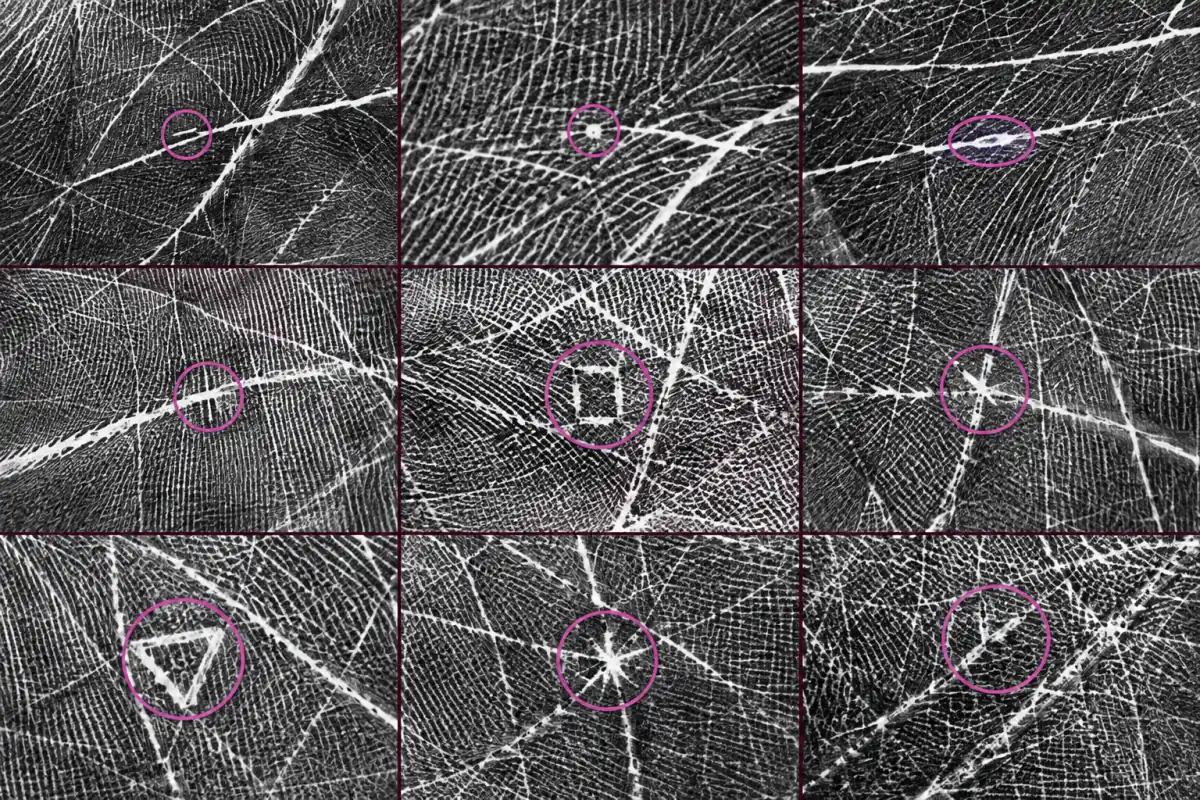
The square does not erase the difficulty it surrounds. Its useful meaning comes from the relationship between the enclosure and the underlying feature: what happens before the square, what is contained inside it, whether the line continues afterward, and which other parts of the hand show support. A free-standing square on an undisturbed mount is better read as organization or containment of that mount's quality than as rescue from an unnamed danger.
Four sides must enclose one space
Do not close a missing corner mentally. A rough U shape, rectangle with a gap, two parallel bars, grille, island, diamond, or several accidental crossings is not automatically a square. Verify the geometry before applying the traditional protection meaning.
Six tests for a genuine square on the palm
| Test | What a verified square shows | Reason to pause |
|---|---|---|
| Side count | Four identifiable boundaries | Three sides make a triangle; extra crossings create a mesh |
| Corner contact | Each side meets the next at four visible corners | One corner opens or ends short |
| Interior | One enclosed space remains readable | Several lines divide the space into smaller cells |
| Line quality | Sides remain traceable under more than one light angle | Glare, dryness, or shadow supplies a false edge |
| Context | The enclosure's mount or parent line is visible | A tight crop hides what the square contains |
| Proportion | Four sides create a compact box-like figure | A long channel between two lines is mistaken for a square |
- Relax the palm so tension does not stretch one side out of alignment.
- Photograph the full hand first, then the suspected mark close-up.
- Begin at one corner and trace each of the four sides in sequence.
- Check that the last side returns to the first corner without a gap.
- Identify the line, break, island, cross, mount, or plain inside the enclosure.
- Repeat the check with gentle side light and compare the other palm.
The marks-and-symbols guide provides the basic shape dictionary. Use it before deciding whether a busy group of creases forms a square, triangle, star, island, fork, or grille.
Square lookalikes: open boxes, rectangles, grilles, and islands
A square does not have to be mathematically perfect. Palm creases rarely meet at exact right angles, and a short rectangle can carry the same traditional enclosure theme when all four sides close. The important difference is between a closed four-sided figure and a shape that only resembles one from a particular angle.
| Possible formation | Visual structure | How it differs from a square |
|---|---|---|
| Open box | Three sides or four sides with one gap | Containment is incomplete |
| Rectangle | Four closed sides with one dimension clearly longer | Can still be read as enclosure if compact and independent |
| Diamond | Four sides meet at sharp upper and lower points | Verify whether hand angle rotated an ordinary square |
| Grille | Several parallel lines cross several other lines | Multiple cells and intersections, not one clean enclosure |
| Island | One line divides and rejoins around an oval space | Curved sides and two pointed ends |
| Two bars | Parallel short lines cross a parent line | No closed sides between them |
| Major-line overlap | Several long routes happen to create a box-like area | Each line continues far beyond the supposed square |
Does a rectangle count as a square?
Many palmistry systems use “square” for a compact closed quadrilateral even when opposite sides differ slightly in length. A narrow elongated channel deserves more caution because it may be two parallel lines joined by unrelated creases. Describe the visible shape first, then explain that its traditional meaning comes from complete enclosure rather than perfect geometry.
Square versus grille
A grille spreads repeated crossing lines over a mount and is usually read as scattered, overworked, or obstructed expression of that area. A square contains one interior with four boundary lines. If extra lines cross both the square and its interior, note that the enclosure is disturbed instead of treating every little cell as a separate protective sign.
When does a square mean protection?
The protection interpretation is strongest when a verified square encloses or bridges a visible difficulty: a gap, weak segment, island, cross, star, or heavy bar. The square then adds a traditional theme of containment, support, limits, repair, or recovery. The line's continuation shows whether the route resumes, shifts, strengthens, or remains interrupted afterward.
| Square relationship | Traditional reading | Evidence that matters |
|---|---|---|
| Square fully surrounds a clean gap | Support or containment during a disrupted phase | Line quality before and after the enclosure |
| Square encloses an island | Limits around a prolonged complication or divided focus | Whether the island closes and the line clears afterward |
| Square encloses a cross or star | Containment around an intense point or turning event | Exact inner mark and surrounding mount |
| Square touches one side of a line | Local support or organization beside that route | Whether the line enters the enclosure |
| Free-standing square on clear mount | Organization, boundaries, or structured use of the mount | Finger, thumb, and supporting lines |
| Open or heavily crossed square | Incomplete or complicated containment | The weak corner and interfering lines |
Protection does not mean immunity from events, illness, loss, or consequences. In a useful reading it describes the way a difficult pattern may be bounded, supported, or followed by continuity. The major life-change guide helps identify the actual transition before the square modifies it.
Five square types and what changes their meaning
| Square type | How it appears | Traditional emphasis | Reading priority |
|---|---|---|---|
| Independent square | Four short local lines close away from major routes | Organization or boundaries within the mount | Location first |
| Square on a line | The parent line enters, crosses, or forms one side | Containment or support within that line's subject | Trace the complete parent line |
| Square around a defect | Encloses a break, island, cross, star, or bar | Traditional protection, repair, or stabilization | Identify the inner formation |
| Open or broken square | One side or corner fails to close | Partial, developing, or interrupted containment | Read the missing boundary |
| Double or nested squares | Two complete enclosures overlap or one surrounds another | Layered support, responsibility, or boundaries | Verify each square independently |
Does a large square mean stronger protection?
No. Size mainly shows how much area is enclosed. A small clear square around a line break can be more specific than a broad four-sided space accidentally formed by major creases. Give more weight to closure, clarity, the feature inside, the parent-line route, and independent support.
What does a broken square mean?
A broken square has incomplete boundaries, so it should not receive the full protection interpretation. Note which side fails: a broken side supplied by the head line, fate line, or minor connector points to a different weakness. The surrounding hand may still show support through Mars lines, upward branches, a stronger continuation, or the other palm.
Square meanings by mount
The palm mount map supplies the subject. Judge the mount's relative fullness, firmness, markings, and finger before interpreting the square. A clear square can organize an active mount; it does not automatically turn an overfull or heavily grilled mount into a favorable one.
| Square location | Where to look | Traditional meaning | Support to compare |
|---|---|---|---|
| Jupiter | Below index finger | Structured leadership, teaching, management, or boundaries around ambition | Index finger, thumb, head and fate lines |
| Saturn | Below middle finger | Containment around responsibility, solitude, study, or a serious turning point | Middle finger, fate line, hand texture |
| Sun / Apollo | Below ring finger | Protection or organization around reputation, creativity, and public expression | Ring finger, Sun line, head and fate lines |
| Mercury | Below little finger | Boundaries around communication, commerce, teaching, or specialist work | Little finger, head and Mercury lines |
| Venus | Thumb mound inside life line | Containment of family pressure, affection, social demands, or personal energy | Life and heart lines, thumb, influence lines |
| Moon | Lower outer palm | Boundaries around imagination, travel, atmosphere, or inward sensitivity | Head line, travel lines, fate from Moon |
| Upper Mars | Outer middle palm | Protection, restraint, or negotiation under opposition | Head and heart lines, Mars support |
| Lower Mars | Inner palm above Venus | Controlled courage and boundaries around immediate pressure | Life line, thumb, head line |
| Plain of Mars | Central palm | Stabilization amid competing duties, conflict, or practical strain | Fate, life, head, and support lines |
Square meanings on the life, head, heart, fate, and Sun lines
When a square touches a line, the line matters more than the symbol. Trace its origin, route, clarity, changes, branches, destination, and continuation. Then ask what the square encloses and whether a second route shows support during the same broad period.
| Parent line | Traditional square emphasis | What to inspect |
|---|---|---|
| Life line | Support or containment during a change in energy, lifestyle, family setting, or environment | Venus, Mars line, branches, continuation |
| Head line | Boundaries, organization, or recovery around a pressured thinking phase | Depth, slope, islands, branches, thumb |
| Heart line | Containment, support, or emotional boundaries around a relationship phase | Curve, ending, branches, Venus, Mercury |
| Fate line | Stabilization around a career, duty, or direction change | Origin, break, shifted continuation, destination |
| Sun line | Protection or structure around reputation, recognition, or creative confidence | Apollo, break, bars, continuation |
| Mercury line | Boundaries around work systems, communication, or specialist practice | Head line, little finger, line clarity |
| Relationship line | Containment, repair, or boundaries within a significant bond | Edge photo, heart line, Venus, both hands |
Square on the life line
A square around a life-line gap, island, or heavy crossing is traditionally read as support during a disruptive phase. It does not predict lifespan or guarantee physical safety. Look for an intact continuation, parallel Mars support line, upward branches, and a stable fate line to understand how continuity is maintained.
Square on the fate line
A fate-line square can contain a break, overlap, or crossing associated with work, responsibility, or direction. A stronger segment above the enclosure suggests the route reorganizes and continues. A shifted upper segment may show a new responsibility rather than return to the old path. Timing comes from the fate-line level, not the square's size.
Square on the heart line
On the heart line, the square is read through emotional expression and relationship patterns. If it surrounds an island or break, it can add containment, support, or rebuilding around a difficult phase. Add the line ending, upward and downward branches, Venus, relationship lines, thumb, and both hands before describing what kind of bond or boundary is involved.
What is the teacher's square?
The teacher's square is a small independent four-sided mark on Jupiter, below the index finger and generally above the head line. Traditional hand readers associate it with organizing knowledge, explaining, instructing, guiding, managing people, or making a subject understandable. It is a location-specific square rather than a universal guarantee that someone must work as a teacher.
| Teacher-square check | Supportive pattern | Common confusion |
|---|---|---|
| Location | Fully on Jupiter below the index finger | Square centered below middle or ring finger |
| Closure | Four traceable sides and corners | Three-sided triangle or open U |
| Independence | Small local marking above the head line | Large box made by several major lines |
| Jupiter balance | Firm, proportionate mount and well-set index finger | Overfull or heavily grilled mount |
| Expression support | Clear head line, Mercury, and balanced thumb | Symbol read without communication context |
| Application | Teaching, management, coaching, mentoring, or instruction | Forcing one occupation from the mark |
The rare-markings guide introduces the teacher's square beside the Ring of Solomon and Samaritan lines. This page owns the four-side verification and explains how Jupiter, Mercury, the head line, thumb, and current life question decide its expression.
How to estimate timing for a square
An independent square on a mount has no age scale by itself. A square surrounding a line feature can be placed broadly by the parent line. Use landmarks, give a range, and confirm it through another line or a known past event. The palmistry timing guide explains the method.
| Square context | Timing method | Useful confirmation |
|---|---|---|
| Independent on a mount | No standalone age; read as a quality or present feature | Both hands and dated photographs |
| Around fate-line break | Use head- and heart-line crossings plus proportional sections | Sun, head, or life-line change nearby |
| Around life-line island or gap | Follow the curved route through broad stages | Mars support or fate change in comparable zone |
| On Sun line | Use head- and heart-level landmarks | Fate-line or Apollo support |
| On heart line | Use broad relationship stages rather than exact dates | Relationship lines, Venus, known history |
| Appears in matched photos | Date only the verified visibility change | Same angle, light, focus, and hand tension |
Square on the right hand, left hand, or both
Use dominance rather than gender. In the common two-hand method, the less-active hand shows the underlying pattern and the active hand shows how it is being expressed or developed.
| Two-hand pattern | Traditional interpretation | Next check |
|---|---|---|
| Same square on both | Underlying boundaries or support remain actively relevant | Compare the enclosed feature and continuation |
| Clearer on active hand | Present choices may have strengthened structure or containment | What supporting line also developed? |
| Clearer on less-active hand | The protective or organizing pattern may remain private or redirected | Look for an active-hand alternative |
| Closed on one, open on the other | The level of containment differs between background and current expression | Identify the missing side or line |
| Same square, different inner mark | The support remains while the contained issue changes | Read each inner formation independently |
| Only photographs differ | No symbolic difference is established | Retake matched images before interpreting |
Six worked square examples
1. Fate-line square around a career interruption
The fate line has a clean gap near the head-line level. Four short lines form a closed square around it, and a shifted but stronger fate segment continues above toward Saturn. A Sun line begins nearby. The combination suggests containment and reorganization during a career or responsibility change, followed by a more visible new route.
2. Life-line square with Mars support
A small square surrounds an island on the middle life line. A clear parallel Mars line covers the same section, while the fate line remains stable. The reading emphasizes support, boundaries, and continuity through a demanding lifestyle or family phase rather than predicting a physical event.
3. Teacher's square with strong communication
A clean independent square sits on balanced Jupiter above the head line. The index finger is proportionate, the thumb is firm and open, Mercury is clear, and the head line carries a practical-imaginative fork. The pattern supports teaching, mentoring, management, coaching, or turning complex material into clear instruction.
4. Apollo square around a star
A verified three-line star sits on Apollo inside a separate closed square. The Sun line below is clear but carries one bar near the same level. The star concentrates attention; the square adds containment around reputation or creative pressure. The line above the mark shows whether expression recovers cleanly.
5. Open box mistaken for protection
Three strong sides surround a fate-line break, but the upper edge stops short. Because the enclosure remains open, it should not receive the full square meaning. The reading turns to the weak connector, the fate-line continuation, and any Mars or Sun support rather than declaring guaranteed protection.
6. Active-hand boundaries become clearer
The less-active hand has a faint rectangle on Venus, while the active hand shows a compact closed square in the same area plus a firmer thumb and fewer crossing influence lines. The underlying family or relational demands remain, but present boundaries appear more organized and selective.
Common mistakes when reading a square
- Completing a missing side or corner mentally.
- Calling every rectangle, diamond, island, or grille a square.
- Assuming protection without identifying what the enclosure contains.
- Describing a free-standing square as rescue from an unknown danger.
- Ignoring the parent line before and after the mark.
- Reading a teacher's square outside the Jupiter area.
- Assuming larger means stronger protection.
- Giving an exact date to a square that touches no timed line.
- Comparing hands from different angles or lighting.
- Letting one small square outweigh the complete hand pattern.
Photo checklist for square identification
- Photograph both full palms from fingertips through wrists.
- Keep the hands relaxed, flat, and parallel to the camera.
- Add a sharp close-up with enough context to identify the mount.
- Take one direct-lit and one gently side-lit view.
- Include the entire parent line, not only the box.
- Capture the feature inside the square and the continuation above it.
- Keep images in color without tracing, smoothing, or contrast edits.
- State hand dominance and the question connected with the mark.
Questions that make a square reading useful
- Do four traceable sides meet at four visible corners?
- Could the shape be an open box, elongated channel, grille, island, or accidental overlap?
- What line, break, island, cross, star, mount, or plain sits inside it?
- Is the square independent, attached to a line, or built from major-line segments?
- What happens to the parent line before, inside, and after the enclosure?
- Does a Mars line, upward branch, stronger continuation, or second mark add support?
- Can the line position be placed in a broad, corroborated period?
- Does the other palm repeat, strengthen, open, or redirect the pattern?
- Does the square concern work, relationships, learning, reputation, travel, family, or boundaries?
- What specific question should a complete reading connect it to?
Read the square inside the complete hand
Verify the four sides, identify what the enclosure contains, trace the parent line before and after it, then add the thumb, fingers, hand shape, mounts, major and minor lines, timing, supporting signs, and both palms. This shows what is being contained, where support appears, and how the route develops.
The complete answer
A square on the palm has four traceable sides, four closed corners, and one enclosed space. Traditional palmistry reads it as containment, protection, stabilization, or recovery, especially when it surrounds a break, island, cross, star, or bar. On a free-standing mount it organizes the local theme: Jupiter for leadership and teaching, Saturn for responsibility, Apollo for reputation and creativity, Mercury for communication and skill, Venus for affection and family demands, Moon for imagination and wider environments, and Mars for pressure and boundaries. Open boxes, grilles, islands, channels, and accidental crossings require different readings. A Full Palm Reading maps the square and all other important features across both hands and combines them into a holistic reading focused on your questions about work, relationships, learning, reputation, family, travel, protection, boundaries, timing, purpose, and direction.
A Full Palm Reading
Ask what your square means across the complete hand
Your reading verifies all four sides, identifies what the enclosure contains, traces the parent line before and after it, then adds timing, nearby markings, fingers, thumb, hand shape, mounts, major and minor lines, and both palms into one holistic reading focused on your questions about work, relationships, family, reputation, learning, travel, protection, boundaries, purpose, and direction.
Your Full Palm Reading maps all the important features—hand shape, skin texture, thumb, fingers, mounts, major and minor lines, markings, and the differences between both palms—and brings them together in a holistic reading focused on your questions.