
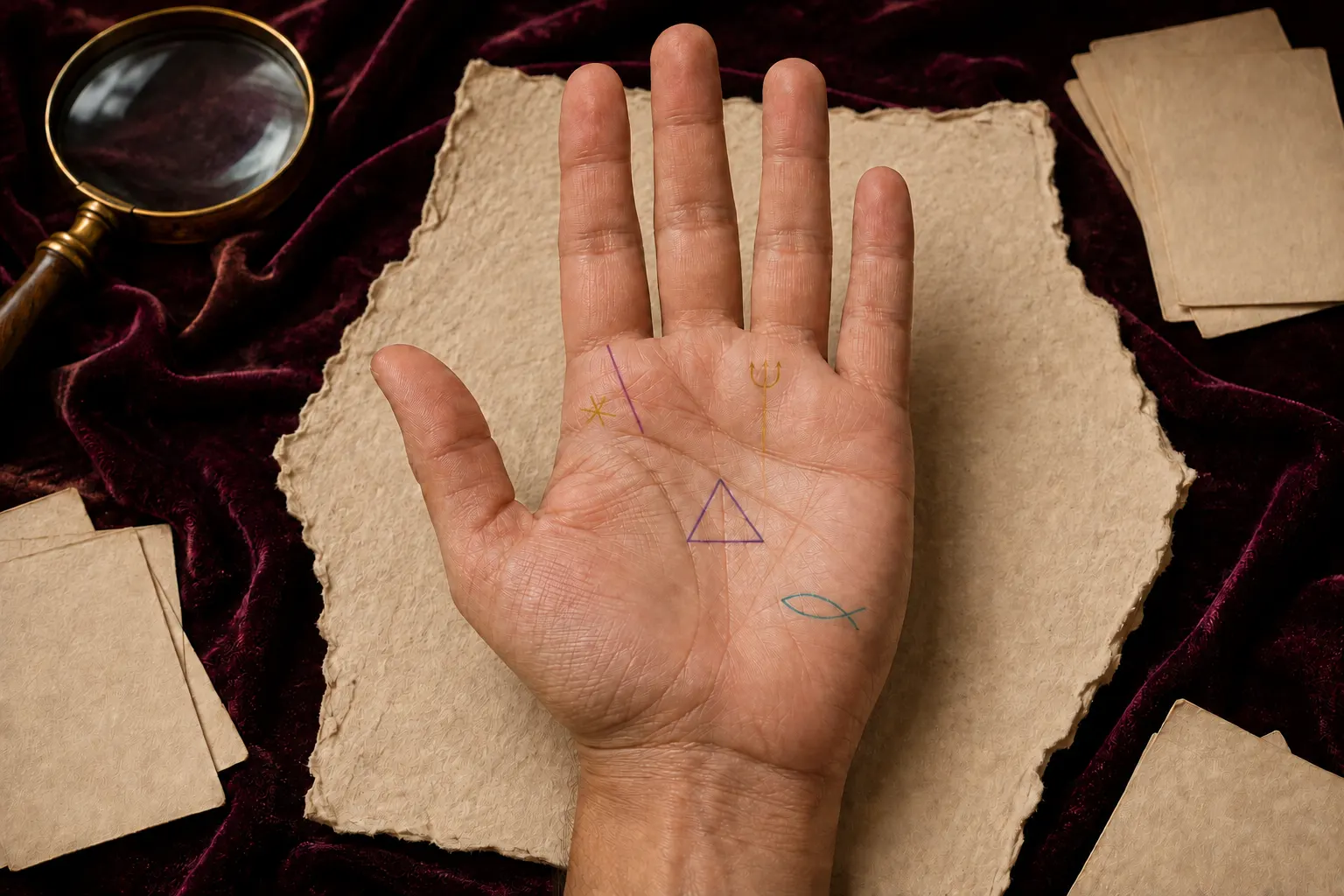
The signs most often called lucky in palmistry are a clear fish, a correctly formed star in a supportive location, a trident at the end of a strong line, a closed triangle, a protective square, upward branches, a balanced Jupiter mount, a clear Sun line, a steady fate line, and several of these features working together. A mark is not auspicious everywhere. Its meaning depends on the exact mount or line, whether the shape is complete, and whether the surrounding hand supports the same outcome.
One fish, star, triangle, square, trident, or upward branch cannot show what kind of opportunity is developing. A whole-hand reading verifies the sign, reads its location and parent line, and connects it with direction, skill, timing, support, and both palms.
“Luck” in a palm reading can mean more than sudden money. One combination may describe recognition arriving when preparation meets visibility. Another may show support from people, recovery after disruption, a useful change of direction, the ability to retain resources, or the confidence to act on an opening. Name the type of opportunity only after tracing where the sign sits and what feeds it.
No single sign means guaranteed fortune
A fish on Moon, star on Sun, or trident on a strong line can be favorable in traditional palmistry, but the whole hand shows whether the theme concerns opportunity, skill, recognition, support, protection, or sustained results. First verify the formation; then read its location, parent line, timing zone, and supporting features.
The ten-sign lucky-pattern map
| Sign or pattern | Verification cue | Traditional opportunity theme | Best support |
|---|---|---|---|
| Fish sign | Enclosed tapered body with attached two-stroke tail | Favorable development shaped by its location and direction | Clear parent lines and supportive mount |
| Star | Three or more independent lines share one center | Concentrated event, attention, or intensified mount quality | Sun or Jupiter context and clean surrounding lines |
| Trident | One stem divides into three distinct prongs | Expansion into several productive channels | Strong parent line and favorable destinations |
| Triangle | Three clean sides enclose one space | Organization, strategy, or focused use of a quality | Correct mount or major-line context |
| Square | Four sides enclose a clear space | Containment, protection, or stabilization around strain | Known disruption inside or beside it |
| Upward branch | Clean branch rises from a parent line | Growth, aspiration, recovery, or widening opportunity | Strong destination mount and intact trunk |
| Balanced Jupiter | Firm proportionate mount below index finger | Ambition, confidence, responsibility, and constructive leadership | Index finger, thumb, head and fate lines |
| Clear Sun line | Distinct vertical route toward Apollo below ring finger | Recognition, satisfaction, creative visibility, and reputation | Head, fate, and Apollo quality |
| Steady fate line | Coherent route with useful continuation | Direction, responsibility, and sustained development | Head line, Sun line, and line destination |
| Repeated combination | Three or more independent layers tell one story | Auspicious theme with a clear route and way to express it | Both palms and real question context |
Use the mount map and markings dictionary before deciding that a formation is lucky. The same triangle changes meaning on Jupiter, Sun, Moon, or Mars; a star intensifies the area it occupies rather than carrying one universal promise.
How to verify an auspicious sign before reading it
- Photograph both complete palms. Include fingertips, wrist creases, and outer edges in matching light.
- Find the exact location. Name the mount, plain, major line, or minor line beneath the formation.
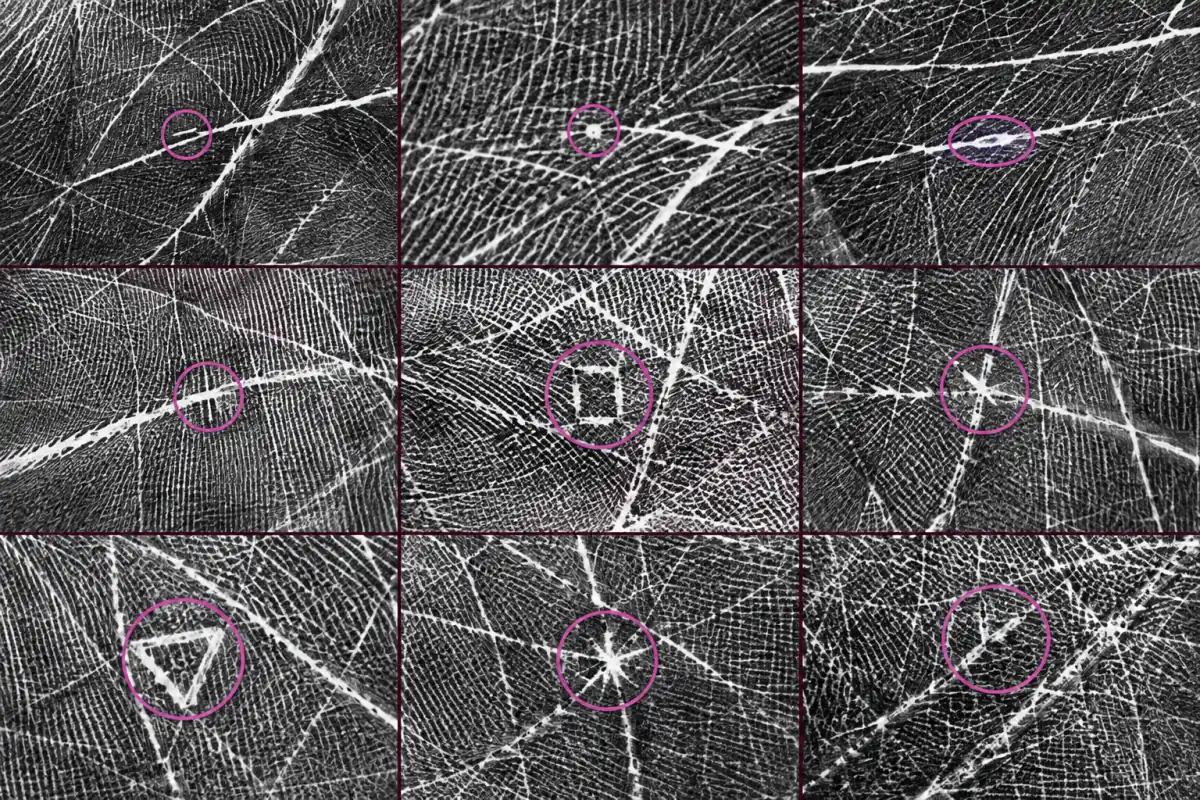
- Trace every stroke. Count the sides, rays, branches, body, tail, stem, or prongs without joining gaps mentally.
- Separate the shape from lookalikes. Rule out islands, crosses, grilles, forks, overlapping major lines, and skin ridges.
- Identify the parent line. If the sign grows from a line, trace that line's complete origin, route, quality, and destination.
- Read clarity and condition. A clean formation carries more weight than a faint, broken, chained, or heavily crossed one.
- Find independent support. Look for another line, mount, finger, thumb, or mark that repeats the same theme.
- Compare both hands. Determine whether the pattern is underlying, actively expressed, developing, or fading.
- Place it in a broad period if relevant. Use the parent line's scale and confirm timing on a second line.
- Connect it to one question. Decide whether the opportunity concerns recognition, money, work, relationships, learning, travel, or recovery.
| Verification test | Stronger formation | Reason to pause |
|---|---|---|
| Closure | Fish, triangle, or square closes visibly | A side ends before meeting the next stroke |
| Shared center | Every star ray meets one point | Several crossings sit near one another |
| Parent line | Trident prongs clearly grow from one stem | Three unrelated lines merely converge |
| Location | Formation sits fully within the named mount or line | It straddles several areas ambiguously |
| Independence | Sign remains visible without imagined connecting lines | Major lines accidentally create most of the shape |
| Photograph | Same formation appears in direct and side light | It appears only after contrast or sharpening |
Fish and star signs: favorable only after location is known
A fish sign needs an enclosed tapered body and an attached tail made of two short diverging strokes. Orientation matters because the pointed end and tail show direction. A fish on Moon is traditionally connected with imagination, travel, public contact, or inward development; on Jupiter it shifts toward guidance, learning, responsibility, or status. When it incorporates a major line, that line's subject and timing become part of the reading.
A star marking needs at least three independent strokes meeting at one shared center. It intensifies a mount or line. On Apollo or a clear Sun line, it may concentrate visibility, creative attention, or recognition. On Jupiter, it can amplify ambition, leadership, or a significant opening. A star on a stressed line or disruptive mount can describe intensity rather than simple good fortune, so the surrounding condition decides the tone.
| Location | Fish emphasis | Star emphasis | Support to check |
|---|---|---|---|
| Jupiter | Learning, guidance, aspiration, or leadership developing favorably | Concentrated ambition, status, or leadership event | Index finger, thumb, fate and head lines |
| Sun / Apollo | Creative fulfillment or recognition through developed talent | Strong attention, reputation, or expressive turning point | Sun line, ring finger, head and fate lines |
| Moon | Travel, imagination, public contact, or inward development | Intense Moon experience or visibility through the public | Head line, travel lines, fate line from Moon |
| Mercury | Communication, trade, research, teaching, or specialist skill | Concentrated Mercury opportunity or responsibility | Little finger, head line, Mercury routes |
| Major line | Favorable development enters that line's subject | A concentrated event affects that line | Line quality before and after the mark |
Fish, island, leaf, and eye lookalikes
An island is usually a split in one line that rejoins; it lacks an attached tail. A leaf shape may have a central vein or no clear directional head. An eye-like enclosure has no two-stroke tail. A fish must remain recognizable after every stroke is traced separately. If its tail is created by two unrelated major lines, describe the enclosed shape instead of upgrading it to a fish.
Star, cross, asterisk, and grille lookalikes
A cross uses two strokes. A star uses at least three lines with one shared center. A grille contains several parallel and crossing lines spread over an area. Random mesh creates several nearby intersections rather than one focal point. The shared center is the decisive test.
Triangle and square signs: organization and protection
A triangle has three sides enclosing one space. Traditional palmistry often reads it as focused or organized use of the area beneath it: strategy on Mars, structured imagination on Moon, planned communication on Mercury, or considered ambition on Jupiter. Its effect comes from containment and geometry, not from size alone.
A square has four clear sides and is commonly treated as a protective or stabilizing sign. When it surrounds a break, island, cross, or damaged portion of a line, readers may interpret it as containment around a difficult period. A square in an undisturbed area can still organize the mount's quality, but it should not be described as rescue when there is nothing to contain.
| Formation | Location or context | Traditional reading | Key check |
|---|---|---|---|
| Triangle on Jupiter | Below index finger | Strategic leadership, teaching, or organized aspiration | Balanced Jupiter and strong thumb |
| Triangle on Sun | Below ring finger or touching Sun line | Deliberate use of creative or public ability | Clear Sun route and no open side |
| Triangle on Moon | Lower outer palm | Imagination organized into study, travel, or useful perception | Head line and Moon firmness |
| Money triangle | Enclosure formed by central money-related routes | Organization or retention of resources | Every side closes and parent lines are identified |
| Square around a break | Four sides contain a disrupted line segment | Protection, support, or stabilization through difficulty | Continuation beyond the square |
| Open box or grille | Missing side or many repeated crossings | Not a verified square | Do not mentally close the gap |
For the central financial formation, use the money-triangle verification guide. It owns the exact line combinations and closure tests; this page shows where that verified triangle fits among broader auspicious patterns.
Tridents and upward branches: where growth is directed
A trident is a three-pronged termination: one clear stem divides into a middle continuation and two side branches. The stem must exist before the split, and all three prongs should have distinct routes. On the Sun line it can spread talent or recognition through several channels. On fate, it can widen responsibility or create parallel paths. On Jupiter it can divide ambition into leadership, study, and guidance themes.
An upward branch is simpler. It leaves a major line and rises toward a mount. Direction supplies meaning: toward Jupiter for ambition or advancement, Saturn for responsibility, Apollo for recognition or creative fulfillment, and Mercury for communication, commerce, teaching, or specialist skill. A downward branch, random crossing, or line that merely approaches the trunk is not an upward branch.
| Route | Traditional emphasis | What strengthens it | What changes it |
|---|---|---|---|
| Sun-line trident | Recognition or fulfillment expands into several outlets | Clear Sun stem and balanced Apollo | Broken prongs or heavy bars |
| Fate-line trident | Direction opens into more than one productive responsibility | Strong continuation and coherent destinations | Weak parent line or scattered endings |
| Branch toward Jupiter | Advancement, aspiration, leadership, or study | Firm Jupiter, index finger, and thumb | Overfull mount or cutting lines |
| Branch toward Apollo | Creative visibility, satisfaction, or reputation | Sun line and ring-finger context | Island or grille on Apollo |
| Branch toward Mercury | Communication, business, teaching, or specialist opportunity | Clear head line and proportionate little finger | Confused Mercury-area mesh |
| Life-line upward branch | Effort, recovery, and self-directed growth during its period | Clear parent line and a supportive destination | Branch that fades immediately |
Balanced Jupiter, Sun, and fate support
The Sun line is often treated as a fortune or success line, but its deeper subject is recognition, fulfillment, expression, and the ability to develop work that others can see or value. A clear route, favorable start, useful branches, and clean Apollo mount matter more than mere length. A late-starting line can show later visibility rather than missing success.
Jupiter lies below the index finger and traditionally describes aspiration, confidence, responsibility, leadership, teaching, and standards. A proportionate firm mount supports purposeful growth. Excess fullness, a grille, or a weak index/thumb combination changes the reading. A Ring of Solomon or well-formed triangle adds insight or strategy, but Jupiter still needs balance.
The fate line provides route and continuity. A strong fate line with Sun support can show work becoming visible or satisfying. A branch from fate toward Jupiter may add advancement; toward Sun, recognition; toward Mercury, skill or enterprise. The most convincing auspicious pattern connects direction, capability, and opportunity instead of promising a result from one mark.
| Combined pattern | Traditional reading | Practical interpretation |
|---|---|---|
| Clear fate + later Sun line | Recognition develops after direction becomes established | Skill and consistency may precede visibility |
| Fate branch to Jupiter + firm thumb | Advancement supported by deliberate ambition | Responsibility grows through chosen effort |
| Sun line from Moon + clear head line | Public, audience, partnership, or imagination contributes to recognition | External response meets developed judgment |
| Sun trident + strong parent line | One expressive route opens into several outlets | Recognition may spread across roles or formats |
| Full Jupiter + weak thumb | Ambition exists without equal direction or follow-through | Do not treat fullness alone as luck |
| Star on crossed Apollo | Intensity around recognition with complications | Read the surrounding disruption before calling it favorable |
What kind of “luck” does the pattern describe?
| Question area | Primary features | Helpful auspicious combination | Best sibling guide |
|---|---|---|---|
| Career and advancement | Fate, head, Jupiter, Sun, thumb | Fate branch to Jupiter with clear continuation and Sun support | Career lines |
| Money and retention | Fate, Sun, Mercury, central triangle | Closed triangle with stable direction and usable skill | Money and wealth lines |
| Recognition and creativity | Sun line, Apollo, head line | Clear Sun route ending in a clean trident | Future success signs |
| Leadership and learning | Jupiter, index finger, thumb, head line | Balanced Jupiter with upward branch, triangle, or Ring of Solomon | Finger meanings |
| Relationships and support | Heart, Venus, relationship lines, influence lines | Upward heart branches with clear supportive routes | Love and relationship reading |
| Travel and wider environment | Moon, life-line branches, fate from Moon | Verified fish or triangle on Moon with coherent outward routes | Travel and settlement lines |
| Recovery and protection | Square, Mars support, line continuation | Closed square containing a break with stronger line afterward | Major life-change signs |
Timing belongs to the parent line, not the symbol alone. If a trident ends a Sun line or a square surrounds a fate-line break, apply the palmistry timing method to that route and confirm the same broad period elsewhere.
What lucky signs on one or both hands mean
The active-and-less-active hand method treats the less-active hand as the underlying pattern and the active hand as present development. It is more useful than assigning meaning by gender.
| Two-hand pattern | Traditional reading | Next check |
|---|---|---|
| Same clear sign on both | Underlying potential and current expression reinforce one another | Compare parent-line strength and timing |
| Clearer on active hand | The favorable pattern may be more developed through choices or practice | Find what strengthened beside it |
| Clearer on less-active hand | The opportunity theme may remain private, unused, or redirected | Look for an active-hand alternative route |
| Same symbol, different mount | The emphasis has shifted to another life area | Read each location independently |
| Active hand has stronger continuation | The person may be building more durable results from the pattern | Trace where the later line ends |
| Only photograph quality differs | No symbolic change is established | Retake matched images before interpreting |
Six worked lucky-sign combinations
1. Recognition grows from an established direction
A coherent fate line reaches the head-line zone, then a clean Sun line begins and ends in a small verified trident. Apollo is firm rather than heavily crossed. The pattern connects developed work with wider visibility and several expressive outlets; it does not imply an effortless windfall.
2. Ambition becomes a leadership opening
An upward fate-line branch reaches Jupiter, where a closed triangle sits on a balanced mount. The index finger and thumb are proportionate and firm. Branch, destination, geometry, and control repeat advancement through strategy, responsibility, study, or leadership.
3. A protective square contains a difficult transition
The fate line breaks in the middle palm, but a clear square encloses the gap and a stronger shifted segment continues above it. A Mars support line covers a comparable period. The auspicious theme is protection and stabilization during change, not avoidance of change itself.
4. A Moon fish supports travel and public contact
A verified upward-facing fish lies on Moon beside a clear life-line branch to the outer palm, while a fate line begins from Moon and strengthens toward Saturn. The combination links wider environment, public connection, and developing responsibility. The destination and timing decide whether the question concerns travel, relocation, audience, or partnership.
5. A star is intense but not purely lucky
Three strokes share one center on Apollo, yet the Sun line below is broken and the mount carries a grille. The star concentrates attention around recognition, but the supporting area is disrupted. The reading should discuss reputation, pressure, and consistency rather than promising fame.
6. Resource growth is gradual and retained
A closed central triangle combines with a steady fate line, clear Mercury support, a practical head line, and a later Sun line. No rare fish or star appears. The fortunate pattern comes from organization, skill, continuity, and recognition working together, which can be more useful than one dramatic symbol.
Common mistakes when looking for lucky signs
- Calling every enclosed shape a fish.
- Counting a two-line cross as a star.
- Reading three nearby endings as a trident without one shared stem.
- Mentally closing an open triangle or square.
- Ignoring the mount or parent line beneath the sign.
- Assuming a star is favorable in every location and condition.
- Equating a clear Sun line with guaranteed fame or wealth.
- Calling a full Jupiter mount lucky without checking balance and control.
- Combining marks that belong to unrelated timing periods.
- Using one palm or one low-contrast photograph as final evidence.
Photo checklist for lucky-sign verification
- Photograph both full palms in the same diffuse light.
- Keep hands relaxed, flat, and parallel to the camera.
- Include fingertips, wrists, thumb edges, and the complete outer palm.
- Add close-ups of every fish, star, triangle, square, trident, or branch.
- Take one gently side-lit image to reveal shallow independent strokes.
- Capture enough surrounding palm to identify the mount and parent line.
- Keep images in color without tracing, filters, smoothing, or sharpening.
- State hand dominance and the opportunity question you want explored.
Questions that make a lucky-sign reading useful
- Is the shape complete, independent, and visible under more than one light angle?
- Which mount or parent line contains it?
- What do the sign's direction, rays, sides, stem, and destinations show?
- Does the surrounding line continue more strongly or become disrupted?
- Which second and third features support the same opportunity theme?
- Does the pattern concern recognition, money, work, relationships, travel, learning, or protection?
- What broad timing zone does the parent line suggest?
- Does the other palm repeat, strengthen, soften, or redirect the sign?
- Which personal quality helps turn the opening into a sustained result?
- What specific question should a complete reading answer?
Read the opportunity across the complete hand
Verify the sign, locate its mount or parent line, trace its direction and timing, then add the thumb, fingers, hand shape, major and minor lines, supporting mounts, and both palms. This shows what kind of opening appears, how it may be used, and what helps it develop into a lasting result.
The complete answer
Lucky signs in palmistry are strongest when a verified formation sits in a supportive location and repeats a wider whole-hand theme. Fish signs describe favorable development through their mount and direction; stars concentrate attention or events; tridents expand a strong line into several channels; triangles organize a quality; squares contain or protect; upward branches show growth toward the mount they reach; Jupiter adds aspiration and leadership; Sun adds recognition and fulfillment; and fate provides direction and continuity. Several independent features aligned around one question are more meaningful than a single rare mark. A Full Palm Reading maps all these important features across both hands and combines them into a holistic reading focused on your questions about opportunity, career, money, recognition, relationships, travel, learning, protection, purpose, and direction.
A Full Palm Reading
Ask what your auspicious signs mean across the complete hand
Your reading verifies fish, stars, triangles, squares, tridents, upward branches, Jupiter, Sun, fate, timing zones, supporting mounts, fingers, thumb, and both palms, then combines them into one holistic reading focused on your questions about opportunity, career, money, recognition, relationships, travel, protection, purpose, and direction.
Your Full Palm Reading maps all the important features—hand shape, skin texture, thumb, fingers, mounts, major and minor lines, markings, and the differences between both palms—and brings them together in a holistic reading focused on your questions.