
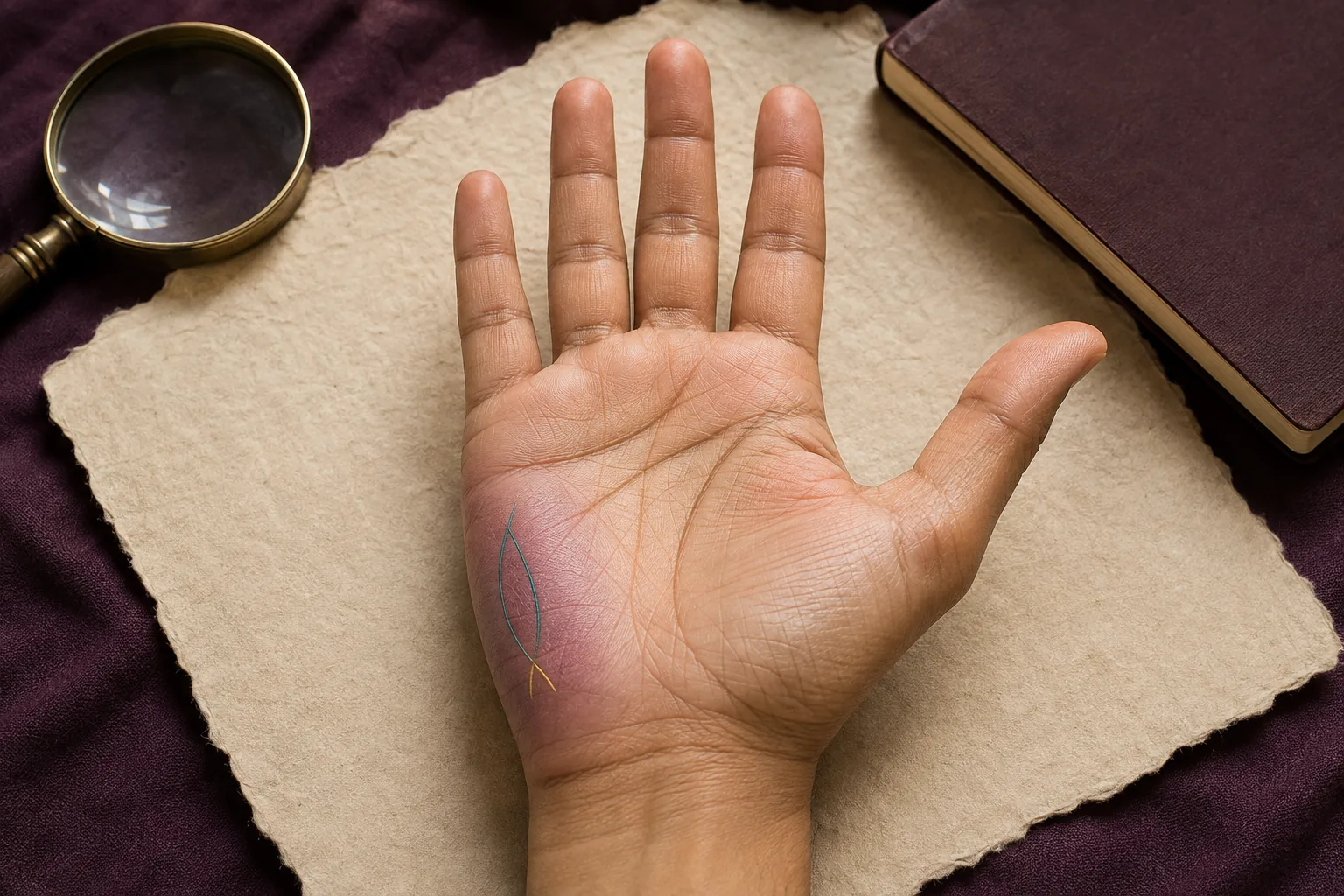
A fish sign in palmistry is a small line formation shaped like a fish: two curved lines enclose a body, meet toward a recognizable head, and join a short forked or pointed tail. It is treated as a favorable sign in traditional Indian palmistry and commonly linked with prosperity, learning, protection, spiritual development, reputation, and constructive opportunity. The actual emphasis comes from where the fish sits, which way it points, how clearly the body and tail are formed, whether a major line helps create it, and whether the pattern repeats on the other hand.
A fish-like outline becomes meaningful only after its enclosed body, attached tail, direction, and parent lines are verified. A whole-hand reading can show which mount or line contains the sign and how both palms connect it with money, work, learning, relationships, travel, recognition, or spiritual interests.
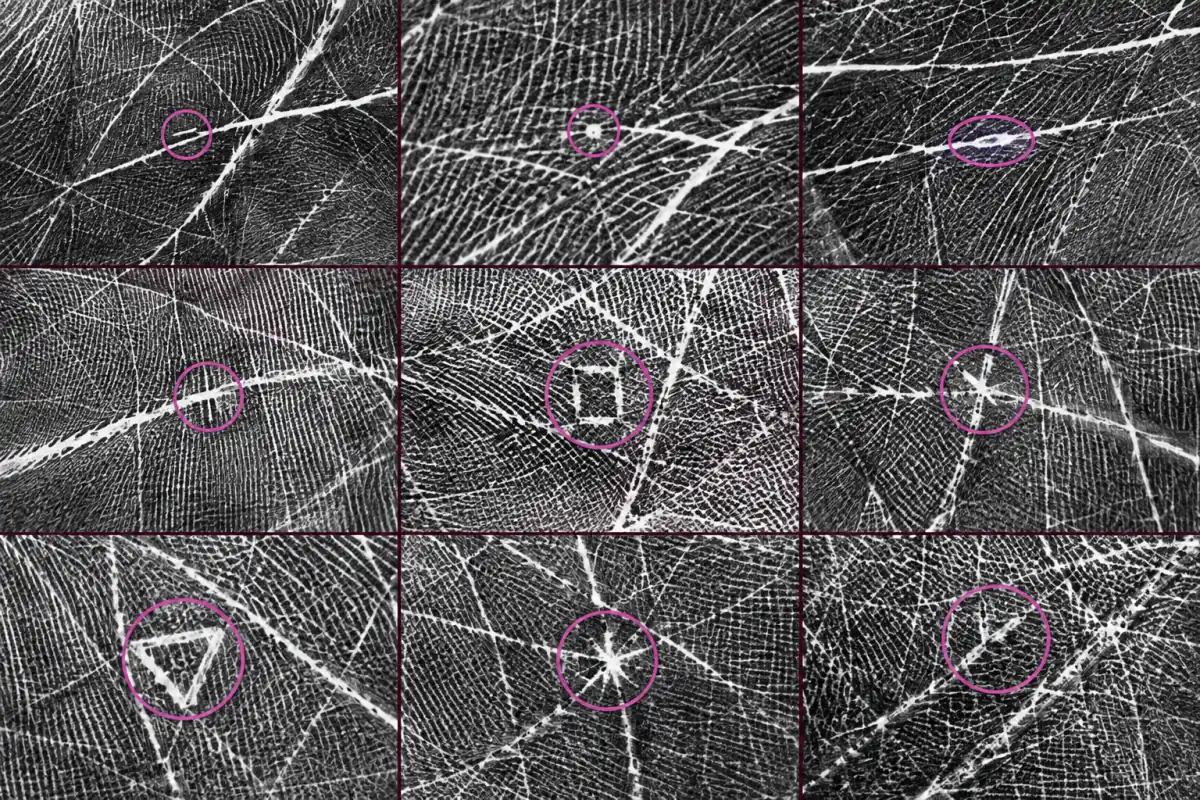
A closed oval alone is usually an island, not a fish. A triangle lacks the curved body and tail. Several crossing creases may only create a fish-like impression in a high-contrast photograph. Verification comes before interpretation.
How to identify a genuine fish sign on the palm
Begin with the complete outline rather than searching for any shape that resembles a fish. A clear example has a bounded body and a readable direction. The two sides should belong to one local formation, and the tail should attach to the body rather than float nearby.
Five-step shape test
- Find two lines that enclose a narrow oval, leaf, or spindle-shaped body.
- Trace both lines to confirm they meet at a pointed head or directional end.
- Look at the opposite end for a small fork, crossed tail, or two short diverging strokes.
- Check whether the body remains enclosed without filling gaps through imagination.
- Name the mount, line, or palm region containing the complete shape.
| Shape in the palm | Likely classification | Key distinction |
|---|---|---|
| Curved enclosed body with a connected forked or pointed tail | Complete fish sign | Both body and directional tail are traceable |
| Enclosed body with only one short tail stroke | Partial fish formation | Describe the incomplete tail rather than adding a missing branch |
| Plain oval enclosed inside a major line | Island | No separate tail or fish direction |
| Three straight enclosed sides | Triangle | Angular geometry rather than a curved body |
| Pointed oval made by two curved lines but no tail | Leaf, eye, or vesica-like shape | Body-like outline without a verified fish tail |
| Several overlapping creases create many possible outlines | Chance intersection or grille | No single dominant body and tail |
The six-point fish-sign verification map
| Check | What to observe | Why it matters |
|---|---|---|
| Enclosure | The body closes on every side | Separates a symbol from two unrelated curved lines |
| Body | The outline is narrow and organic rather than square or triangular | Establishes the fish-like geometry |
| Tail | One attached fork, crossed end, or two short diverging strokes | Separates a fish from an island or leaf |
| Direction | A readable head-to-tail orientation | Allows orientation to be compared without guessing |
| Parentage | Every side can be traced to the lines that form it | Shows whether a major line is involved and prevents gap filling |
| Visibility | The formation remains under flat and gentle side light | Rules out shadows, dry skin, filters, and temporary folds |
Use the marks-and-symbols guide to verify the body and tail, then use the mount map to identify the location.
Fish sign versus island
An island is an enclosed loop that forms on or within a line and has no attached tail. If an apparent tail is simply the parent line continuing through the oval, the formation may still be an island. A fish needs an additional directional feature that makes the body-and-tail structure clear.
Fish sign versus triangle
A triangle requires three identifiable sides and three closed corners. A fish body uses two curving sides and a tail. Do not convert a financial triangle into a fish because one corner has an extra branch.
What does a fish sign mean in palmistry?
The broad traditional meaning is favorable flow: resources, learning, recognition, helpful opportunities, family support, travel, spiritual development, or results that grow from well-directed effort. It is often described as auspicious, but it does not supply one universal promise. A fish on Moon has a different subject from one on Jupiter or Venus, and a fish attached to the fate line must include that line's direction.
Clarity shows how confidently the symbol can be identified; location shows the life area; orientation shows where the formation appears to point; and the whole hand shows whether practical ability supports the promise. A favorable mark gains credibility when the surrounding lines continue clearly rather than dissolving into breaks or a dense grille.
Does a fish sign mean wealth?
Prosperity is a common traditional association, especially near the wrist, fate line, Jupiter, Sun, or central financial formations. The fish still does not guarantee money. The complete money-reading map adds the fate, head, Sun, and Mercury lines, thumb, mounts, hand shape, and both palms to show how earning, planning, recognition, communication, and follow-through work together.
Does it mean spirituality or good fortune?
Near Moon, Jupiter, the wrist, or the end of the life line, traditional readings often emphasize spiritual interest, fortunate support, learning, travel, or a constructive later chapter. The symbol indicates a favorable tendency in its own tradition. Supporting features show whether that tendency expresses through study, intuition, service, family, career, travel, or creative work.
Fish sign meaning by location
Location carries more meaning than size. Identify the full mount or line before reading the sign, especially when it sits near a boundary between Moon and Mars, Venus and the life line, or Jupiter and the heart-line endpoint.
| Fish-sign location | Traditional emphasis | Features to combine with it |
|---|---|---|
| Moon mount on the lower outer palm | Imagination, intuition, travel, distant places, receptivity, and spiritual curiosity | Travel lines, fate origin, head-line slope, fingerprints, and both palms |
| Near the wrist or rascette area | Long-term prosperity, foundation, protection, and a constructive life current | Life-line ending, fate origin, wrist lines, and lower-palm clarity |
| Jupiter mount beneath the index finger | Leadership, learning, honor, guidance, teaching, and principled ambition | Index finger, thumb, fate line, head line, and Ring of Solomon |
| Sun or Apollo mount beneath the ring finger | Recognition, creative satisfaction, reputation, and visible accomplishment | Sun line, fate line, ring finger, and head line |
| Mercury mount beneath the little finger | Communication, commerce, analysis, teaching, negotiation, or healing traditions | Little finger, Mercury line, head line, and fingerprints |
| Venus mount around the thumb base | Family support, affection, vitality, comfort, relationships, and generous resources | Life line, influence lines, heart line, thumb, and relationship pattern |
| Saturn mount beneath the middle finger | Responsibility, study, patience, discipline, and results developed over time | Fate line, middle finger, head line, and mount balance |
| Plain or mounts of Mars | Courage, endurance, conflict management, enterprise, and constructive resilience | Mars lines, life line, thumb, fate, and head line |
Fish sign on the Moon mount
Moon is one of the most searched locations. A clean fish there can combine favorable opportunity with travel, imagination, distant connections, intuition, or work shaped by other places. Use the travel and relocation guide to distinguish a journey from a permanent move; the fish alone does not decide settlement.
Fish sign at the end of the life line
When the body or head of the fish touches the lower life line, trace the life line through the formation. A clear continuation can emphasize a supported later chapter, travel, family resources, or a widening of experience. If the shape is simply an island within the life line, read the island first rather than assigning the more favorable fish meaning.
Fish sign on the fate line
A genuine fish involving the fate line links the symbol with work, responsibility, and direction. Determine whether fate forms one side, enters the body, exits through the head, or merely passes nearby. A strong continuation above the sign supports opportunity that becomes sustained direction.
Fish sign on Jupiter, Sun, or Mercury
Under Jupiter, the theme leans toward leadership, teaching, status, ethics, or advanced learning. Under Sun, it leans toward creativity and recognition. Under Mercury, it leans toward communication, trade, analysis, instruction, or advisory work. The appropriate finger, mount, vertical line, head line, and thumb show whether the potential has a practical channel.
How shape, clarity, and direction change the reading
| Variation | Visible structure | Traditional interpretation |
|---|---|---|
| Clear complete fish | Closed curved body with a connected tail | The favorable location-based theme receives full weight |
| Fine but complete fish | Light lines form every required part | A quieter, private, or developing form of the same opportunity |
| Partial fish | Body is clear but tail is incomplete, or one side fades | The theme is present but should receive less weight than the surrounding lines |
| Large fish | Formation covers much of a mount or palm region | Verify parentage carefully; size expands the involved area but not certainty |
| Small compact fish | Complete symbol occupies a precise local zone | Location can be named more confidently |
| Body crossed by a bar | A separate line cuts through the enclosed shape | Support or opportunity meets interference from the crossing line's origin |
| Head points toward a finger mount | Directional end faces Jupiter, Saturn, Sun, or Mercury | The receiving mount helps describe where the favorable current is directed |
| Head points toward the wrist or palm edge | Formation directs downward or outward | Read foundation, travel, release, or external influence with the exact location |
Upward-facing versus downward-facing fish
Different schools give orientation different amounts of importance. Use a simple consistent method: identify the head and tail, note what the head points toward, then read the receiving mount or line. Do not reverse a favorable reading solely because the fish points downward; clarity, location, parent lines, and continuation carry more weight.
Fish with an eye, dot, or inner line
An eye-like dot is not required. A natural dot, short line, or ridge pattern inside the body can modify the appearance, but first decide whether it belongs to the skin surface, a scar, pigment, or an actual line. The outer body and tail must stand on their own.
Two fish signs
Two complete fish formations repeat the favorable theme in two locations. Read each location separately before combining them. A Moon fish and Jupiter fish might connect travel or intuition with teaching and leadership; two vague leaf shapes should not be upgraded simply because they repeat.
Fish sign on the right hand, left hand, or both palms
Use hand dominance rather than assigning one hand to women and another to men. The two-hand comparison treats the less-active hand as an underlying pattern and the active hand as the way that pattern is currently developed and expressed.
| Where the fish appears | Traditional comparison | What to inspect |
|---|---|---|
| Active hand only | The favorable pattern has developed through choices, skills, relationships, or opportunity | Which active-hand line or mount now carries the fish? |
| Less-active hand only | The underlying potential is stronger than its current visible expression | What changed in the same active-hand location? |
| Both hands in the same location | The theme repeats in background and present development | Compare clarity, size, orientation, parent lines, and continuation |
| Different locations on each hand | The favorable current shifts from one life area to another | Which mount or line receives it in each palm? |
| Complete on one, partial on the other | The same potential has strengthened, narrowed, or changed form | Which body side or tail developed or faded? |
Does the meaning change for women and men?
No separate gender rule is needed. Shape, location, clarity, direction, parent lines, supporting features, and hand dominance are read the same way for every person. The useful distinction is how the sign differs between active and less-active palms.
What can a fish sign mean for love, career, money, and travel?
- Love and family: emphasize Venus, heart, relationship, and influence lines when the fish sits near the thumb mound.
- Career: emphasize fate, Jupiter, Saturn, Sun, Mercury, head line, fingers, and thumb when the sign touches a work-related route.
- Money: add planning, commercial skill, recognition, direction, and follow-through rather than treating the fish as a cash guarantee.
- Travel: compare Moon, travel lines, life-line branches, and fate influences to distinguish movement from settlement.
- Spiritual development: compare Moon, Jupiter, Saturn, fingerprints, head-line slope, intuition line, and verified markings.
Six worked fish-sign examples
Example 1: complete fish on Moon pointing upward
A compact enclosed body and forked tail sit on the lower outer palm, with the head pointing toward the upper mounts. Travel lines are clear and fate begins from Moon. The combined reading emphasizes favorable distant connections, imagination, movement, or opportunities entering through other people and places.
Example 2: Jupiter fish with a balanced thumb
The fish sits beneath the index finger, Jupiter is firm, and the thumb combines will with reasoning. Opportunity is directed toward leadership, teaching, principled ambition, advanced learning, or advisory responsibility.
Example 3: Sun fish with a strengthening Sun line
A small fish is verified beneath the ring finger and a clear Sun line rises above it. The reading emphasizes growing satisfaction, reputation, or recognition through creative work, provided fate and the head line support sustained effort.
Example 4: Venus fish near a family influence
The formation lies within Venus and one influence line approaches the life line. The heart line is warm and relationship lines are clear. Family support, affection, partnership, or shared resources become more relevant than a general wealth interpretation.
Example 5: island mistaken for a fish on the fate line
An oval sits directly inside fate, but no attached forked tail exists. The parent line continues through the enclosure. Classify the formation as an island and read the fate-line complication and continuation rather than applying fish symbolism.
Example 6: fish on both palms in different locations
The less-active hand has a fine fish near the wrist, while the active hand has a clearer fish on Mercury. An underlying favorable foundation may now express through communication, teaching, commerce, analysis, or learned advisory skill.
Photo checklist for a fish-sign reading
- Photograph both full palms from fingertips through wrists.
- Keep each hand relaxed, flat, and at the same angle.
- Use bright indirect light plus one gentle side-lit image.
- Add a close-up that includes the complete body, head, tail, and surrounding mount.
- Capture the full parent line if any side of the fish joins it.
- Keep the image in colour so scars, pigment, and shadows remain distinguishable.
- Do not draw over, smooth, sharpen, or boost contrast around the shape.
- State hand dominance and the question you want the reading to explore.
Questions that make a fish-sign reading useful
- Is the body completely enclosed by two traceable curved lines?
- Is a forked, crossed, or pointed tail genuinely attached?
- Could the shape be an island, triangle, leaf, grille, or chance crossing?
- Which mount, line, or palm region contains the complete formation?
- Which way do the head and tail point?
- Is the fish clear, fine, partial, crossed, large, small, or repeated?
- How do the parent line and receiving mount continue beyond it?
- Is it present on the active hand, less-active hand, or both?
- What matters most now: money, work, learning, relationships, travel, recognition, spirituality, or direction?
Read the fish through its shape, location, and complete hand
Verify the outline with the marking guide, name the area with the mount map, trace any parent line, and then compare the same region on the opposite palm.
The complete answer
A fish sign is an enclosed curved body with a recognizable directional end and an attached tail. Traditional Indian palmistry treats it as a favorable symbol associated with prosperity, learning, protection, recognition, spiritual development, travel, and constructive opportunity, but the exact subject comes from its mount or parent line. A strong reading separates the fish from islands, triangles, leaf shapes, grilles, and accidental crossings, then compares clarity, completeness, direction, size, bars, major and minor lines, mounts, fingers, thumb, and both palms. A Full Palm Reading maps all these important features across both hands and combines them into a holistic reading focused on the person's questions about money, work, learning, relationships, travel, recognition, spirituality, and direction.
A Full Palm Reading
Ask what your fish sign means inside the complete hand
Your reading verifies the body, head, tail, direction, and parent lines, then adds the containing mount, nearby markings, major and minor lines, fingers, thumb, hand shape, and both palms to explore money, work, learning, relationships, travel, recognition, spirituality, and direction.
Your Full Palm Reading maps all the important features—hand shape, skin texture, thumb, fingers, mounts, major and minor lines, markings, and the differences between both palms—and brings them together in a holistic reading focused on your questions.