
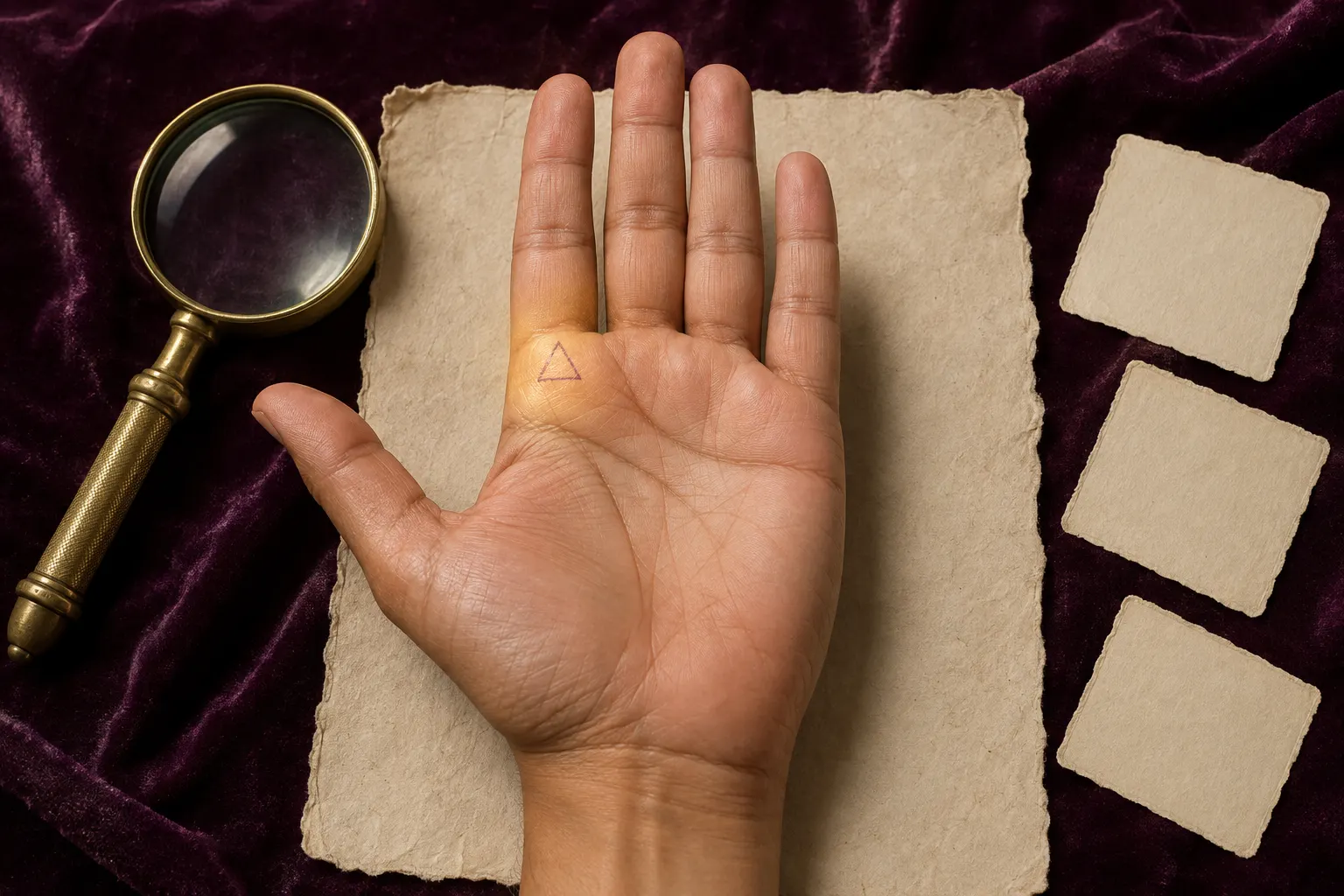
A triangle on the palm is formed by three visible lines meeting at three corners to enclose one space. In traditional palmistry, it usually describes focused, organized, or strategic use of the qualities represented by its location. A triangle below the index finger emphasizes Jupiter themes such as leadership or teaching; below the ring finger it emphasizes creative or public skill; on Moon it organizes imagination or travel-related experience; and on a major line it modifies that line's subject.
A three-sided mark becomes useful only after every corner, its exact mount or parent line, surrounding breaks and bars, timing, and the other hand are compared. A whole-hand reading can show whether the triangle modifies learning, leadership, work, money, relationships, creativity, travel, or another question.
The shape alone cannot tell you whether the triangle concerns career, money, relationships, recognition, learning, intuition, or protection. First prove that all three sides close. Then identify the mount or parent lines, judge clarity and interruptions, compare both hands, and find a second feature that supports the same theme.
Three sides, three corners, one enclosed space
Do not complete a missing side mentally. A V shape, open angle, fork, island, fingerprint triradius, or three unrelated lines that nearly meet is not the same formation. Trace each side separately before interpreting anything.
Six tests for a genuine triangle on the palm
| Test | What a verified triangle shows | Reason to pause |
|---|---|---|
| Side count | Exactly three identifiable boundaries | An extra side makes another shape; two sides make an angle |
| Corner contact | Each pair of sides visibly meets | One or more corners contain a gap |
| Enclosure | One clear interior space remains | Crossings divide the interior into a grille |
| Line continuity | Every side can be traced through its full route | Glare, shadow, or skin texture creates a false segment |
| Location | The entire shape belongs to a known mount, plain, or line | The photo crops away its context |
| Repeat view | The same corners appear in direct and side light | The triangle appears only after sharpening or tracing |
- Relax the palm fully; tension can deepen one crease and hide another.
- Use a close color photograph taken square to the hand.
- Begin at one corner and trace the first side to the next corner.
- Repeat for the second and third sides without borrowing a gap.
- Zoom out and name the mount, plain, or major line beneath it.
- Repeat the observation under gentle side light and on the other hand.
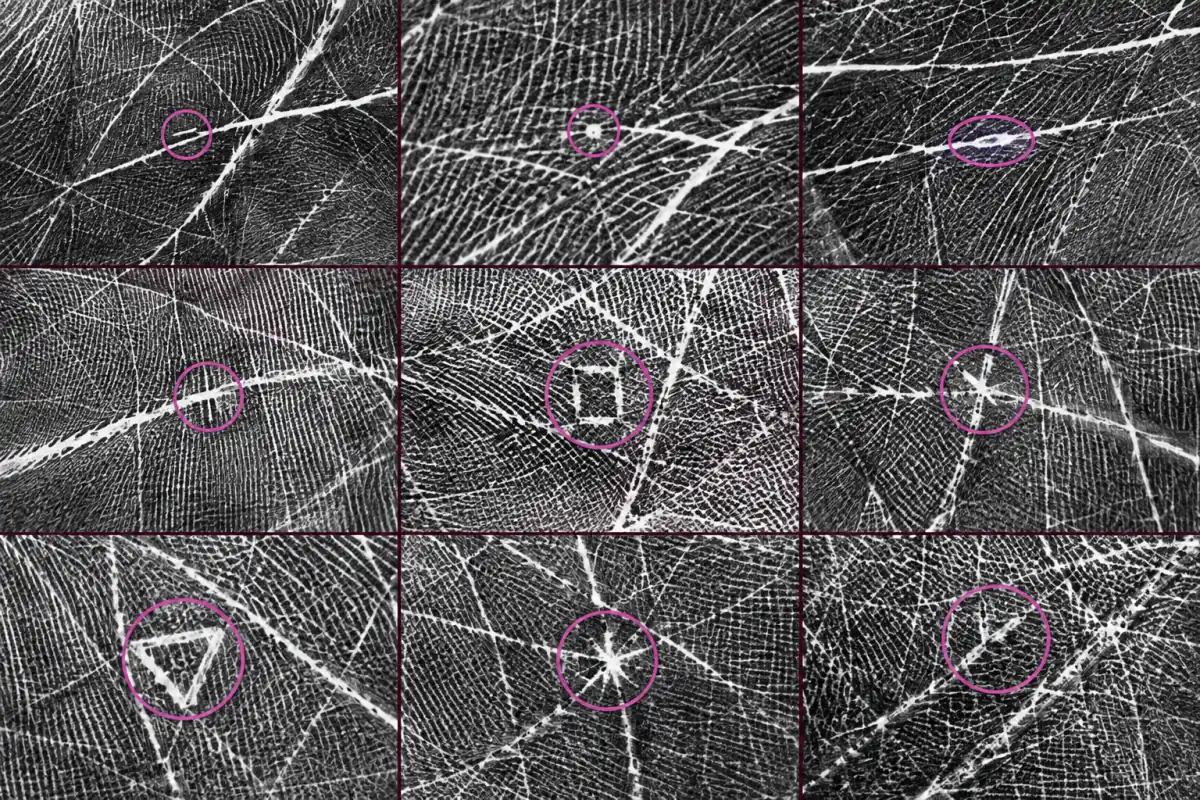
The palm-markings guide shows the basic geometry of triangles, squares, stars, islands, and forks. Use it before assigning a named triangle to a busy patch of fine lines.
Triangle lookalikes and how to separate them
The most common false positive is an open angle: two lines meet in a V while a third crease stops short. Another is an island whose pointed ends make an eye or leaf look triangular. A fork supplies two branches from one stem but does not enclose a space. A square has four sides. A star has several rays sharing one center rather than three corners around an interior.
A dermatoglyphic triradius also looks triangular in a close print. It is a friction-ridge feature where ridge flows meet from three directions, not a triangle made from palmar flexion creases. Dermatoglyphic research describes triradii as ridge-flow landmarks; the distinction is anatomical rather than symbolic. See the published dermatoglyphics explanation and the site's fingerprint-pattern guide.
| Lookalike | Visual structure | Decisive difference |
|---|---|---|
| Open angle | Two sides meet; third line is absent or stops short | No enclosed interior |
| Island | One line splits and rejoins around an oval or eye shape | Curved sides and two pointed ends rather than three corners |
| Fork | One stem divides into two branches | Open termination, not a closed figure |
| Square | Four line segments form a box | Four sides and corners |
| Star | Three or more lines intersect at one center | Rays radiate outward; there is no enclosed space |
| Triradius | Tiny friction ridges flow in three directions | Made of ridge flow, not three crease segments |
| Chance overlap | Major and minor lines almost enclose an area | One corner opens when each route is followed |
Five triangle types palmists read differently
| Triangle type | How it is formed | Traditional emphasis | Reading priority |
|---|---|---|---|
| Small independent triangle | Three short lines form a free-standing mark | Focused use of the mount or plain beneath it | Location first |
| Triangle touching one line | One side rests on or grows from a major line | Organized event or skill within that line's subject | Parent line before symbol |
| Triangle formed by major lines | Segments of two or three long lines enclose a space | Broad coordination between the participating functions | Name every contributing line |
| Open or broken triangle | One corner gaps or one side fragments | Incomplete organization, interrupted focus, or developing structure | Read the weak side |
| Double or nested triangles | Two shapes close independently or one sits inside another | Two layers, stages, or applications of the local quality | Verify each enclosure separately |
Does triangle size change the meaning?
Size changes how much of the palm the formation occupies, but it does not measure intelligence, wealth, or luck. A small clear independent triangle can be more distinctive than a large shape created accidentally by widely spaced major lines. Give priority to closure, clarity, location, parent-line quality, and supporting features.
What does an open triangle mean?
An open triangle is not fully verified as the named sign. If two sides are strong and the third is faint or broken, note the developing or interrupted structure and identify which line forms the weak boundary. Do not automatically translate the gap into loss; the parent line explains what is incomplete.
Triangle meanings by palm mount
The mounts of the palm supply the subject. Compare the marked mount with the others for relative fullness, firmness, clarity, and excess. A triangle on a balanced mount tends to organize its quality; a triangle inside a grille or heavily cut area has to be read with the surrounding complication.
| Triangle location | Where to look | Traditional meaning | Support to compare |
|---|---|---|---|
| Jupiter | Below index finger | Strategic leadership, teaching, responsibility, or organized ambition | Index finger, thumb, head and fate lines |
| Saturn | Below middle finger | Focused study, research, discipline, depth, or careful responsibility | Middle finger, fate and head lines |
| Sun / Apollo | Below ring finger | Planned creative expression, craft, reputation, or public presentation | Ring finger, Sun line, head line |
| Mercury | Below little finger | Organized communication, analysis, commerce, teaching, or specialist skill | Little finger, head and Mercury lines |
| Venus | Thumb mound inside the life line | Focused use of affection, family resources, social care, or vitality | Life and heart lines, thumb, influence lines |
| Moon | Lower outer palm opposite thumb | Structured imagination, travel planning, inward study, or intuitive perception | Head line, travel lines, fate from Moon |
| Upper Mars | Outer middle palm | Strategy under opposition, restraint, negotiation, or endurance | Head and heart lines, Mars support |
| Lower Mars | Inner palm above Venus | Directed courage, initiative, or controlled response to pressure | Life line, thumb, head line |
| Plain of Mars | Central palm | Coordination of competing duties, effort, and practical pressure | Fate, head, life and supporting lines |
Triangle under the index finger
A closed triangle on Jupiter is traditionally associated with the ability to organize ambition, lead deliberately, teach, advise, or manage responsibility. It becomes stronger when the index finger is well proportioned, the thumb balances will and judgment, and the fate or head line supplies a practical route. If Jupiter is overfull or covered by a grille, the triangle may organize a strong drive that still needs listening and proportion.
Triangle under the ring finger
On Apollo, the triangle shifts toward craft, presentation, creative strategy, or the deliberate development of reputation. A clear Sun line can connect that skill with recognition or fulfillment. A triangle alone does not promise fame; it describes a way of applying the Apollo quality.
Triangle on the Moon mount
Moon governs imagination, inner imagery, public response, and wider environments in traditional palmistry. A triangle here can show imagination being organized into writing, design, research, travel, counseling, or symbolic study. Add the head-line slope, travel lines, skin texture, and any fate line beginning from Moon before choosing the expression.
Triangle meanings on the major and minor lines
When a triangle touches or uses a palm line, trace the entire line before reading the shape. The line supplies the life area, the triangle supplies focused organization, and the condition before and after the formation shows whether that quality strengthens, changes, or remains local.
| Parent line | Traditional triangle emphasis | What to inspect |
|---|---|---|
| Life line | Focused effort, family or environmental organization, or strategy during that period | Venus, branches, Mars support, continuation |
| Head line | Structured thinking, study, specialized knowledge, or applied problem-solving | Slope, depth, branches, thumb and Mercury |
| Heart line | Deliberate emotional standards, relational learning, or organized expression of feeling | Ending, curve, branches, Venus and Mercury |
| Fate line | Focused responsibility, career strategy, or an organized change in direction | Origin, destination, breaks, branches, timing |
| Sun line | Planned creative work, reputation management, or focused public contribution | Apollo, line start, ending, clarity |
| Mercury line | Specialized communication, analysis, trade, teaching, or system-building | Little finger, head line, line direction |
| Relationship line | A structured relational phase or focused lesson within partnership | Edge view, heart line, Venus, both palms |
A triangle that merely overlaps a line is not automatically “on” that line. One side should visibly use, touch, or arise from the route. If the shape stands nearby, read it through the mount first and treat the line as supporting context.
Triangle on the palm versus the money triangle
A small independent triangle can appear anywhere. The money triangle is a specific central formation usually created by sections of the head line, fate line, and a Mercury or connecting line. Its traditional focus is the ability to organize, retain, and direct resources. It is not any triangle found below the ring or little finger.
| Feature | Independent palm triangle | Money triangle |
|---|---|---|
| Construction | Usually three short local lines | Usually segments of longer central lines |
| Location | Any mount, plain, or parent line | Central palm around head and fate routes |
| Primary meaning | Focused use of the local quality | Resource organization and retention |
| Main verification | Three sides plus exact mount or line | Three closed corners plus named contributing lines |
| Supporting context | Relevant finger, mount, line, and thumb | Head, fate, Mercury, Sun, and thumb |
| Common mistake | Forcing an open angle into a triangle | Calling every central enclosure a wealth sign |
The broader money and wealth reading adds earning direction, recognition, applied skill, judgment, and follow-through. A triangle supports that pattern only when its actual lines belong to it.
How to estimate timing for a triangle
An independent triangle on a mount has no reliable age scale by itself. Timing becomes possible when the formation touches a major or minor line with an established route. Measure the relevant point on the parent line, give a broad range, and look for a matching change elsewhere. The age-calculation guide explains the landmarks.
| Triangle context | Timing method | Confirmation |
|---|---|---|
| Independent on a mount | No standalone age; read as a quality or current feature | Compare both hands and dated photographs |
| Touching fate line | Use fate-line crossings and proportional sections | Sun, head, or life-line change in same period |
| Touching life line | Follow the curved route through broad life stages | Fate or influence line at comparable stage |
| Touching Sun line | Use the Sun line's head- and heart-level landmarks | Fate-line or Apollo change nearby |
| Touching heart line | Use a broad relationship-stage scale, not an exact date | Relationship line, Venus, and known history |
| Formation appears in matched photos | Date only the verified visibility change | Same angle, light, focus, and hand tension |
Triangle on the right hand, left hand, or both
Use hand dominance rather than gender. In the common two-hand reading method, the less-active palm shows the underlying pattern and the active palm shows how it is being expressed or developed now.
| Two-hand pattern | Traditional interpretation | What to compare |
|---|---|---|
| Same triangle on both | The focused quality is underlying and actively expressed | Clarity, size, parent line, and mount balance |
| Clearer on active hand | The skill or organization may be more developed through experience | Supporting lines that also strengthened |
| Clearer on less-active hand | The tendency may remain private, unused, or redirected | Alternative active-hand route |
| Same shape on different mounts | The method of focus may have shifted to another life area | Read both locations independently |
| Closed on one, open on the other | The organization of the theme differs between potential and practice | Which side or parent line changes |
| Visible only in one photograph | No hand difference is established | Retake matched images before interpreting |
Triangle combinations that change the reading
| Triangle plus… | Traditional synthesis | Useful question |
|---|---|---|
| Balanced Jupiter + firm thumb | Strategy supported by leadership and follow-through | Where should responsibility grow? |
| Clear Sun line + Apollo triangle | Creative or public skill organized toward visible results | Which craft or contribution needs focus? |
| Sloping head line + Moon triangle | Imagination organized into study, writing, design, or guidance | How can inner perception become useful work? |
| Fate-line triangle + upward branch | A focused transition opens toward a specific destination | What new role or direction is forming? |
| Triangle crossed by bars | Organization exists but meets repeated interference | Which obligation or pressure interrupts it? |
| Triangle inside a grille | The sign is weakened by scattered surrounding energy | Is the shape truly independent and clear? |
| Triangle + square around a break | Strategy and containment support a difficult transition | Does the parent line continue more clearly? |
The lucky-sign combination guide compares triangles with fish, stars, squares, tridents, upward branches, Jupiter, and Sun. Use the current page when the reader's real question is whether one triangular formation is genuine and what its exact location means.
Six worked triangle examples
1. Jupiter triangle with grounded leadership
A small closed triangle sits fully below the index finger. Jupiter is firm but proportionate, the index finger is well set, the thumb is strong without rigidity, and an upward fate branch approaches the mount. The combination emphasizes deliberate leadership, teaching, or management rather than status promised by the mark alone.
2. Apollo triangle with a developing Sun line
A clear triangle appears below the ring finger, while the Sun line begins at the head line and continues cleanly upward. The head line carries a practical-imaginative fork. The pattern suggests a craft or expressive ability becoming organized and visible after a period of development.
3. Moon triangle and travel planning
A closed triangle lies on Moon beside an outward life-line branch, and a fine fate line begins from the outer palm. The head line slopes gently but remains clear. The reading connects imagination, planning, wider environments, and responsibility; timing comes from the life and fate routes, not the triangle alone.
4. An open central shape mistaken for a money triangle
The head and fate lines create two sides, but the proposed Mercury connector stops before the third corner. Because the enclosure remains open, it is not a verified money triangle. The wider hand can still show good planning, earning direction, and resource management through the clear head line, firm thumb, and steady fate route.
5. Head-line triangle during specialized study
A small triangle uses a short segment of the head line near its middle. The line is deep before and after it, Mercury is clear, and Saturn is balanced. The combination supports structured learning, research, analysis, or a concentrated technical phase. A second fate-line change in the same zone can connect study with work.
6. Same triangle, stronger on the active hand
Both palms carry a triangle on Jupiter, but the active-hand version closes more clearly and is joined by a stronger upward fate branch. The underlying organizing ability appears in both hands, while present choices show more active ambition, responsibility, or confidence.
Common mistakes when reading a triangle
- Completing a missing side mentally.
- Calling a V, fork, island, square, star, or triradius a triangle.
- Reading every triangle as a money triangle.
- Assuming larger means luckier, richer, or more important.
- Ignoring the mount or parent line beneath the shape.
- Counting a shape produced mainly by normal major-line crossings as independent.
- Giving exact timing to a triangle that touches no timed line.
- Ignoring bars, grilles, breaks, and the condition after the mark.
- Using only one palm or one heavily edited photograph.
- Letting one small sign outweigh the thumb, fingers, mounts, and major lines.
Photo checklist for triangle identification
- Take full-palm images of both hands from fingertips through wrists.
- Keep each hand relaxed and parallel to the camera.
- Add a sharp close-up with enough surrounding area to identify the mount.
- Take one direct-lit and one gently side-lit close-up.
- Include the complete route of any major line that forms a side.
- Keep photographs in color and disable smoothing or portrait effects.
- Do not trace, sharpen, or draw over the suspected sides.
- State hand dominance and the life question connected with the mark.
Questions that make a triangle reading useful
- Do three traceable sides meet at three visible corners?
- Could the shape be an open angle, island, fork, square, star, or triradius?
- Which mount, plain, or parent line contains it?
- Is the triangle independent, touching one line, or formed by major lines?
- Which side is weakest, broken, crossed, or shared with another formation?
- Does the parent line continue more clearly after the triangle?
- Which finger, mount, thumb, or second line supports the same theme?
- Can a broad period be confirmed on another timed route?
- How does the corresponding area differ on the other hand?
- What question about work, learning, money, relationships, creativity, travel, or direction should the reading answer?
Read the triangle inside the complete hand
Verify all three sides, locate the mount or parent line, inspect what happens before and after it, then add the thumb, fingers, hand shape, major and minor lines, supporting marks, timing, and both palms. This turns a small geometric sign into a question-focused whole-hand interpretation.
The complete answer
A triangle on the palm has three traceable sides, three closed corners, and one enclosed space. Traditional palmistry reads it as focused, organized, or strategic use of the area beneath it: Jupiter for leadership and teaching, Saturn for study and discipline, Apollo for creative presentation, Mercury for communication and applied skill, Venus for affection and family resources, Moon for imagination and wider environments, Mars for strategy under pressure, and a major line for that line's specific subject. Open shapes, forks, islands, stars, squares, chance overlaps, and dermatoglyphic triradii require different readings. A Full Palm Reading maps the triangle and all other important features across both hands and combines them into a holistic reading focused on your questions about work, learning, money, relationships, creativity, travel, recognition, timing, purpose, and direction.
A Full Palm Reading
Ask what your triangle means across the complete hand
Your reading verifies all three sides and corners, identifies the mount or parent line, then adds line quality, timing, nearby markings, fingers, thumb, hand shape, major and minor lines, and both palms into one holistic reading focused on your questions about work, learning, money, relationships, creativity, travel, recognition, purpose, and direction.
Your Full Palm Reading maps all the important features—hand shape, skin texture, thumb, fingers, mounts, major and minor lines, markings, and the differences between both palms—and brings them together in a holistic reading focused on your questions.