
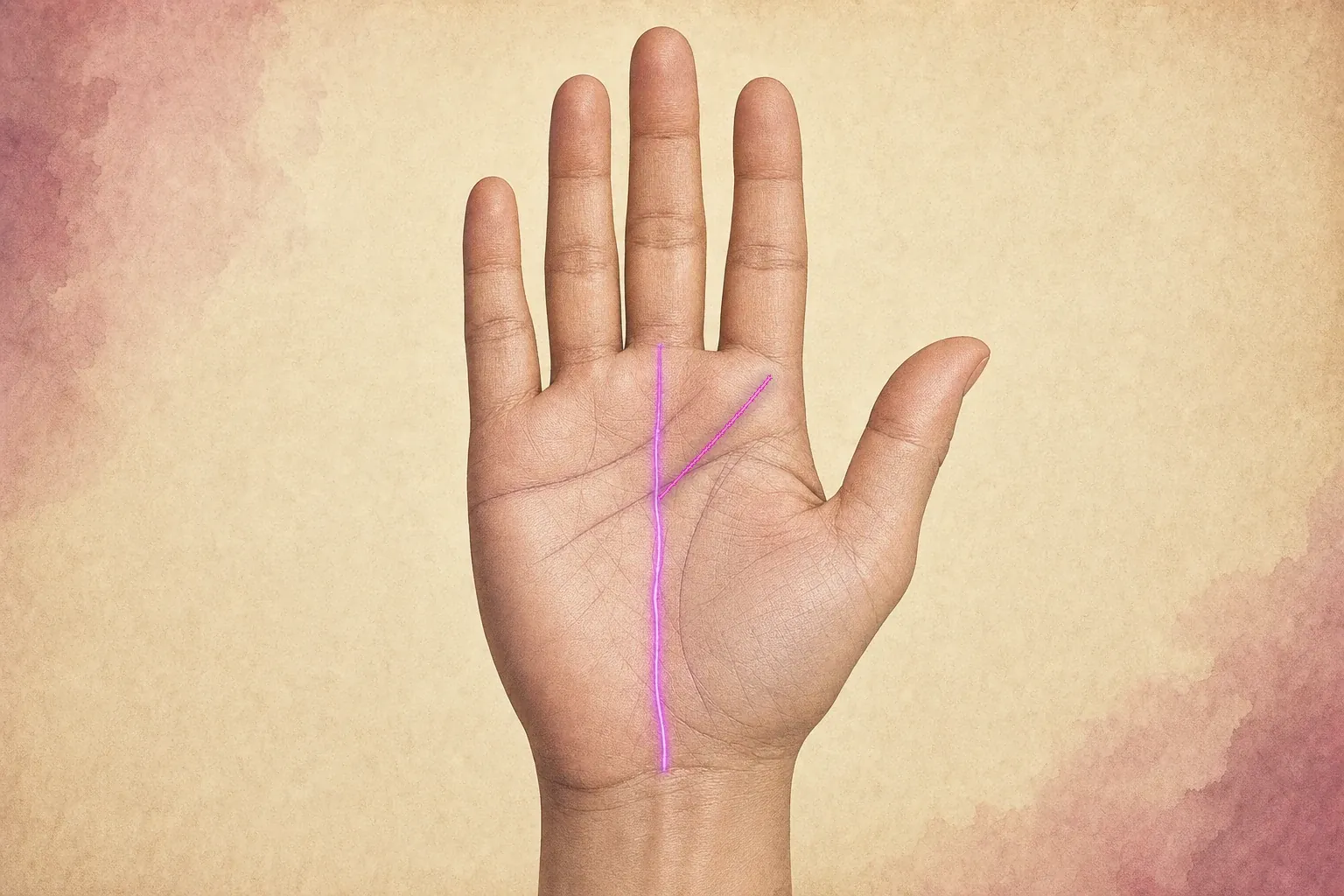
A forked palm line is one parent line that divides into two distinct prongs and does not rejoin. In traditional palmistry, the parent line supplies the subject and the two endpoints show two directions, outlets, priorities, environments, or ways of expressing it. A forked head line is read through two thinking modes; a forked fate line through two roles or directions; a lower life-line fork through two environments; and a forked heart line through two emotional aims or styles.
A fork becomes meaningful only after its parent line, shared junction, two endpoints, prong direction, relative strength, destinations, timing, supporting features, and both hands are compared. A whole-hand reading can show whether the fork connects with two roles, environments, thinking modes, emotional aims, creative outlets, or possible directions.
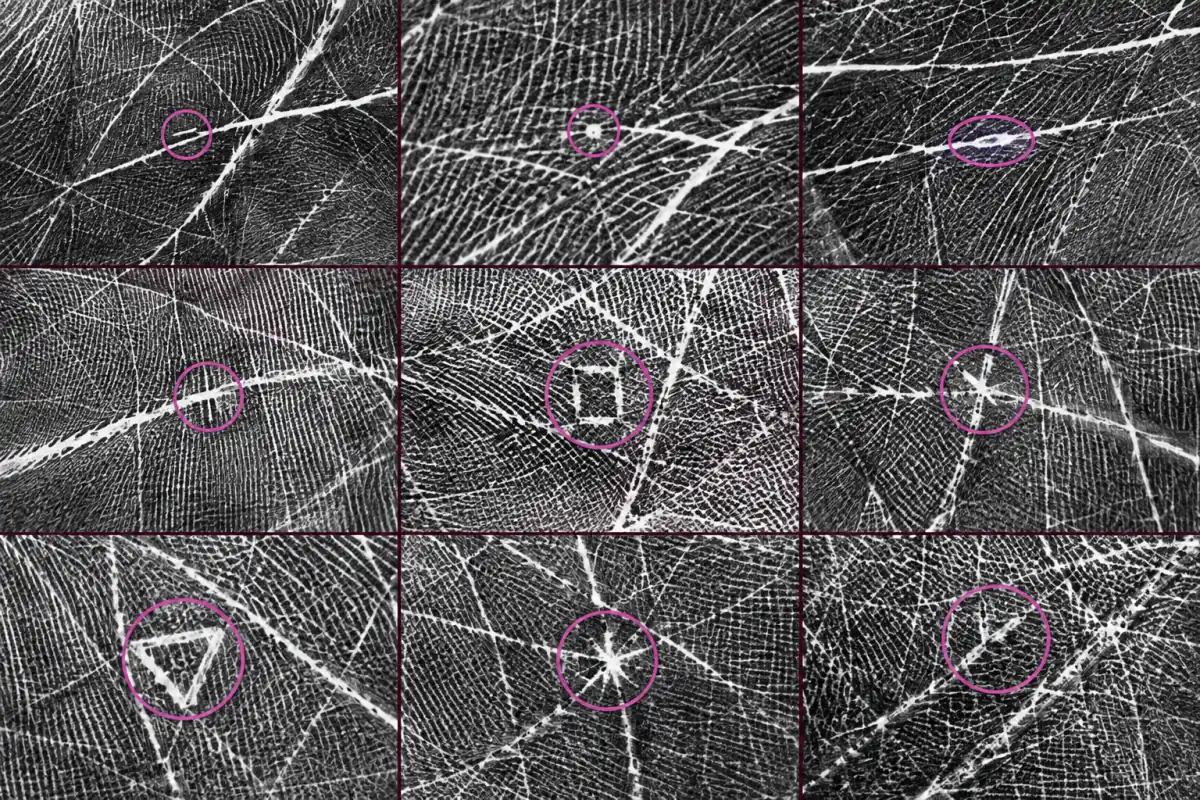
Use a seven-part fork-reading method: identify the parent line, locate the shared junction, confirm two endpoints, trace each destination, compare prong strength, place the junction along the line, and check both hands. A fork shows alternatives or simultaneous expression in palmistry; it does not guarantee a move, breakup, job change, or other event.
The destination gives each fork its meaning
“Forked line” is only the geometry. A fate-line prong toward Apollo differs from one toward Jupiter, and a life-line prong toward Moon differs from one turning inward to Venus. Follow both branches until they stop before interpreting them.
How to verify a true fork on a palm line
Trace the suspected parent from its origin to the junction. A true fork has one incoming route, one shared split point, and two outgoing endpoints. Both prongs must belong to the parent. If the parent continues beyond the junction while a small side line leaves it, the mark is better treated as a branch; if the two sides rejoin, it is an island.
| Check | True fork | Common false positive |
|---|---|---|
| Parent | One traceable line enters the junction | Two unrelated creases happen to meet |
| Junction | Both prongs share the same split point | A crossing line creates a temporary Y |
| Endpoints | Two routes finish separately | Prongs rejoin and form an island |
| Continuation | No single parent continues beyond both endpoints | One parent continues with a side branch |
| Stability | Shape remains visible under relaxed neutral light | Glare, dry skin, or finger flexion creates a split |
Use the palm-markings guide to identify the shape, then switch to the guide for the parent line. Do not name a fork from a cropped photograph that hides its origin or endpoints.
Fork versus branch, trident, tassel, island, and crossing line
| Formation | Geometry | Reading boundary |
|---|---|---|
| Fork | One parent ends in two prongs | Two endpoints or outlets |
| Branch | An offshoot leaves while the parent continues | Added influence along a continuing route |
| Trident | One stem ends in three clear prongs | Three destinations from one junction |
| Tassel | Several fine frayed endings | Diffusion rather than two defined routes |
| Island | Parent splits around a space and rejoins | Divided section with one continuation |
| Crossing line | Independent crease intersects the parent | Outside influence rather than a parent-owned prong |
| Double line | Two routes run beside each other from separate origins | Parallel support or dual pattern, not one split |
A fork with a tiny third scratch should not be upgraded automatically to a trident. The third prong must share the same junction and carry a visible route. The trident guide owns that three-prong formation.
How branch direction, strength, angle, and length change a fork
After confirming the geometry, compare the prongs. A deep, clear branch carries more emphasis than a faint one. Similar prongs suggest two active directions. A strong parent-like prong plus a fine second route suggests one main course with an additional outlet. A broad angle separates the destinations more clearly; a narrow angle keeps them closely related.
| Fork quality | Traditional emphasis | What to inspect |
|---|---|---|
| Equal clear prongs | Two substantial directions or capacities | Both destinations and support lines |
| One strong, one faint | Primary route with a secondary possibility | Whether the faint prong strengthens |
| Wide angle | More distinct environments or modes | Mounts at each endpoint |
| Narrow angle | Closely related choices or blended expression | Where the routes finally stop |
| Upward prong | Expansion toward the mount it reaches | Jupiter, Saturn, Apollo, or Mercury |
| Downward prong | Energy redirected toward inner or lower-palm concerns | Moon, Venus, Mars, wrist, and line quality |
| Broken prong | One option lacks continuity | Replacement, overlap, or support line |
Destination outranks a generic “up is good, down is bad” rule. A downward life-line prong toward Moon can describe movement or a wider environment, while an upward heart-line prong toward Jupiter can describe ideals and commitment standards. Read the subject and destination together.
Forked life, head, heart, fate, Sun, and relationship lines
| Parent line | Traditional fork theme | Key destinations |
|---|---|---|
| Life line | Two environments, lifestyles, roots, or later-life directions | Moon, Venus, wrist, fate line |
| Head line | Two thinking modes, viewpoints, or communication styles | Upper Mars, Moon, Mercury, Apollo |
| Heart line | Two emotional aims, standards, or ways of expressing affection | Jupiter, Saturn, space between |
| Fate line | Two roles, responsibilities, careers, or long-term directions | Jupiter, Saturn, Apollo, Mercury |
| Sun line | Two creative outlets, audiences, or forms of recognition | Apollo and neighboring mounts |
| Mercury line | Two channels for communication, trade, service, or applied skill | Mercury, Apollo, fate line |
| Relationship line | Diverging priorities or directions within a close bond | Upward/downward endpoint and heart line |
Forked head line and the “writer's fork”
A head line ending with one straighter prong and one descending toward Moon is traditionally called a writer's fork. It can symbolize the ability to move between practical analysis and imagination, or to translate one mode for another. It does not prove writing talent by itself. Add finger length, Mercury, Apollo, thumb, line clarity, and actual skill development.
Forked life line and travel or relocation
A lower life-line fork with one prong following Venus and another reaching Moon is often associated with two environments, extended travel, relocation, or a divided home base. The Moon-bound route, travel lines, fate-line origin, and matching signs on both hands determine how much weight the interpretation deserves. It does not guarantee foreign settlement.
Forked heart line
A heart line forking toward Jupiter and Saturn can be read as a blend of ideals and realism in emotional life. A downward prong toward the head line brings thought, communication, or difficult deliberation into the emotional pattern. On a short relationship line, a fork suggests divergent directions or priorities; it does not by itself predict separation.
Forked fate line
A fate line that divides toward Saturn and Apollo can combine sustained responsibility with creative visibility or recognition. Saturn plus Mercury can connect structured work with communication, commerce, teaching, or applied expertise. Jupiter plus Saturn can blend leadership with duty. Compare whether both prongs remain clear and whether a Sun line independently supports the Apollo route.
Forked Sun or Mercury line
A Sun-line fork suggests expression or recognition through two outlets. A Mercury-line fork may show two channels for communication, service, technical skill, or business. If one prong merely touches another independent line, keep the two routes separate rather than assuming they share one source.
Fork at the start, middle, or end of a palm line
Most forks are read at an ending, but a line can also begin from two roots that join. That is an inverted fork: two sources feeding one route. Position tells you whether the pattern concerns origins, a mid-route decision, or final destinations.
| Position | Traditional question | Timing clue |
|---|---|---|
| Two origins join one line | Which two sources feed the route? | Parent line's beginning |
| Fork near the start | Were alternatives present early in the theme? | Early proportional section |
| Fork at head-line crossing | Did a decision open two directions? | Broad head-line landmark |
| Fork at heart-line crossing | Did values or relationships reshape the route? | Broad heart-line landmark |
| Fork at the final end | Which two destinations remain active? | Later section of that line |
Use proportional timing as a range and confirm the same period elsewhere. The timing guide explains why a junction should not be assigned an exact birthday from one photograph.
Compare a fork across both hands
Photograph the same line and endpoint region on both hands. Traditional readers often use the less-active hand for underlying capacity and the active hand for present expression. A head-line fork on both hands looks more structural; one that becomes clearer on the active hand may suggest a developed second mode. A new fate-line prong on the active hand may show an additional role becoming visible. First verify that pose, pressure, and lighting have not hidden a fine branch.
Fork combinations that make the reading more specific
| Combination | Traditional reading | Confirmation |
|---|---|---|
| Head-line fork + strong Mercury | Two thinking modes expressed through communication or applied skill | Little finger, vertical Mercury lines, thumb |
| Life-line fork to Moon + Moon-origin fate line | Wider environment connects with work or direction | Travel lines and both hands |
| Fate fork to Saturn/Apollo + Sun line | Responsibility develops alongside visibility or creative fulfillment | Clarity of both prongs |
| Heart-line fork to Jupiter/Saturn | Idealism and realism both shape attachment | Venus, thumb, relationship lines |
| Fork after a break | A disrupted route reopens into alternatives | Overlap, repair line, strength after gap |
| Fork with one chained prong | One direction remains more complicated than the other | Where the clear prong ends |
Worked fork examples
Fate line divides toward Saturn and Apollo
The Saturn prong keeps responsibility and long-term structure active while Apollo adds expression, visibility, or satisfaction. A separate Sun line and balanced Apollo mount strengthen the second outlet.
Head line ends in one straight and one sloping prong
The straight route supports concrete analysis while the Moon-bound route supports association and imagination. Firm thumb phalanges and a clear Mercury area show how ideas become decisions and communication.
Lower life line forks toward Moon and the wrist
The Moon prong introduces a wider environment while the wrist-bound prong maintains continuity with the existing base. Travel lines and fate-line changes distinguish periodic movement from relocation or two home bases.
Relationship line fork appears on one hand
The fork raises a question about diverging priorities or expression, but one cropped sign cannot predict the outcome of a bond. Compare the heart line, influence lines, full relationship-line zone, both hands, and the real relationship context.
Photo checklist for a forked palm line
- Photograph both full palms in soft neutral light.
- Add a close-up showing the parent line before the junction.
- Keep both endpoints and destination mounts inside the frame.
- Relax the hand so fine prongs are not stretched away.
- Take one second angle to rule out glare and crossing creases.
- State hand dominance and the work, move, relationship, or decision question.
- Trace each prong without drawing over the original photograph.
Read both destinations inside the complete hand
A Full Palm Reading maps the parent line, shared junction, both prongs, their strength and destinations, timing, support signs, mounts, fingers, and both palms. That complete pattern shows whether the fork reflects two capacities, environments, roles, priorities, or possible directions around your question.
The complete answer
A forked palm line has one parent route that divides at a shared junction into two endpoints and does not rejoin. Traditional palmistry reads the parent line first, then each prong's direction, length, clarity, destination, timing, and supporting features: two thinking modes on the head line, two environments on the life line, two emotional aims on the heart line, two roles or directions on the fate line, and two outlets on the Sun or Mercury line. Equal prongs carry more balanced weight, while one faint prong suggests a secondary possibility. A Full Palm Reading maps the fork and all other important features across both hands and combines them into a holistic reading focused on your questions about work, relationships, decisions, relocation, creativity, recognition, purpose, timing, and direction.
A Full Palm Reading
Ask what both fork destinations mean across your complete hand
Your reading maps the parent line, shared junction, both prongs, their relative strength, direction, destinations, timing, and support signs, then adds the mounts, fingers, hand shape, and both palms into one holistic reading focused on your questions about work, decisions, relationships, relocation, creativity, recognition, purpose, and direction.
Your Full Palm Reading maps all the important features—hand shape, skin texture, thumb, fingers, mounts, major and minor lines, markings, and the differences between both palms—and brings them together in a holistic reading focused on your questions.