
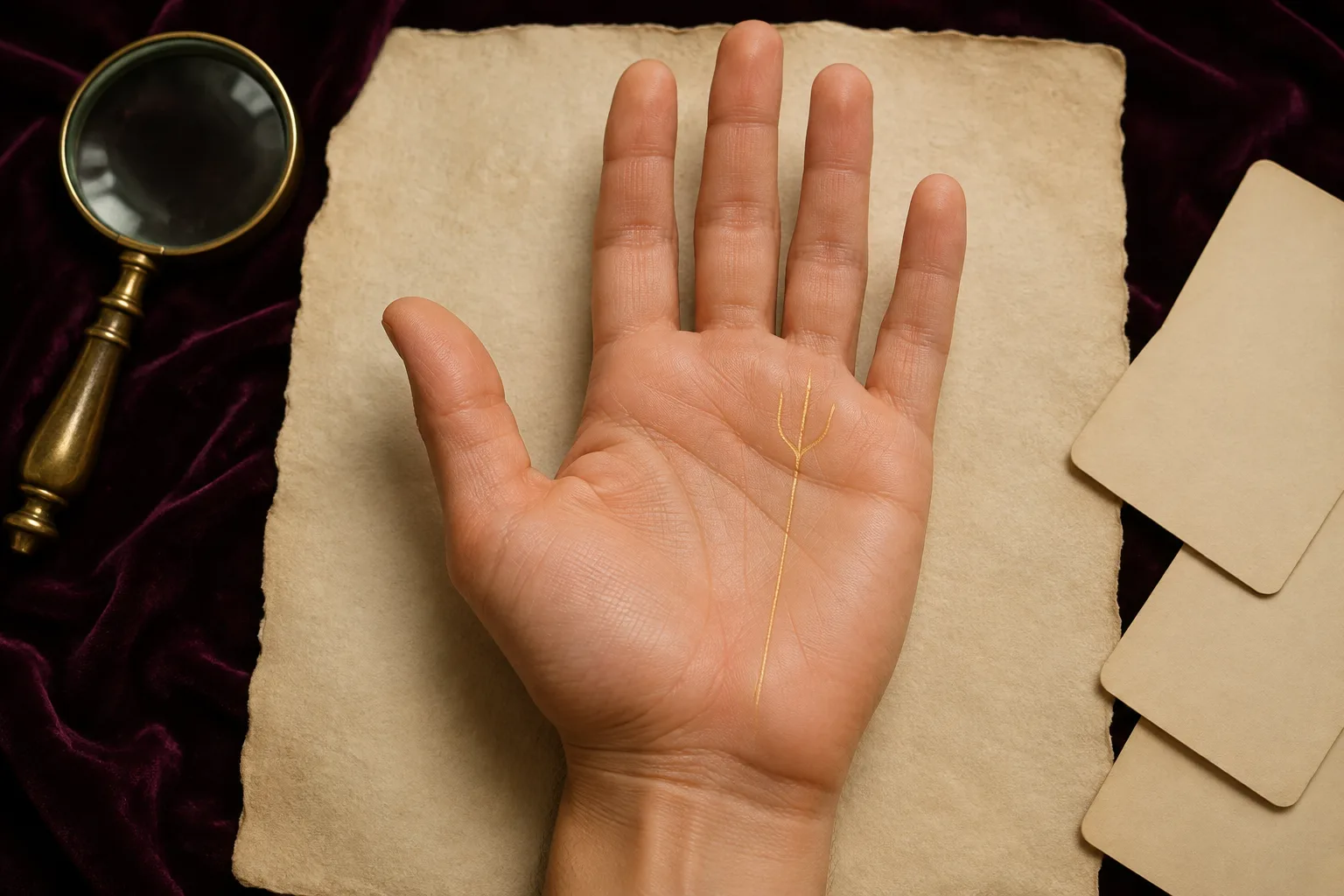
A trident on the palm is one stem that reaches a single junction and separates into three clear prongs. In traditional palmistry, it suggests that the parent line's energy has three productive outlets, especially when the prongs rise toward supportive mounts. A trident ending a Sun line is associated with recognition expressed through several channels; on a fate line, with one direction opening into distinct responsibilities or opportunities; and on a head line, with thought applied in three different ways.
A three-pronged mark becomes useful only after its stem, shared junction, parent line, branch destinations, timing, and the other hand are compared. A whole-hand reading can show which outlet leads and how the pattern affects work, recognition, relationships, communication, learning, travel, purpose, or direction.
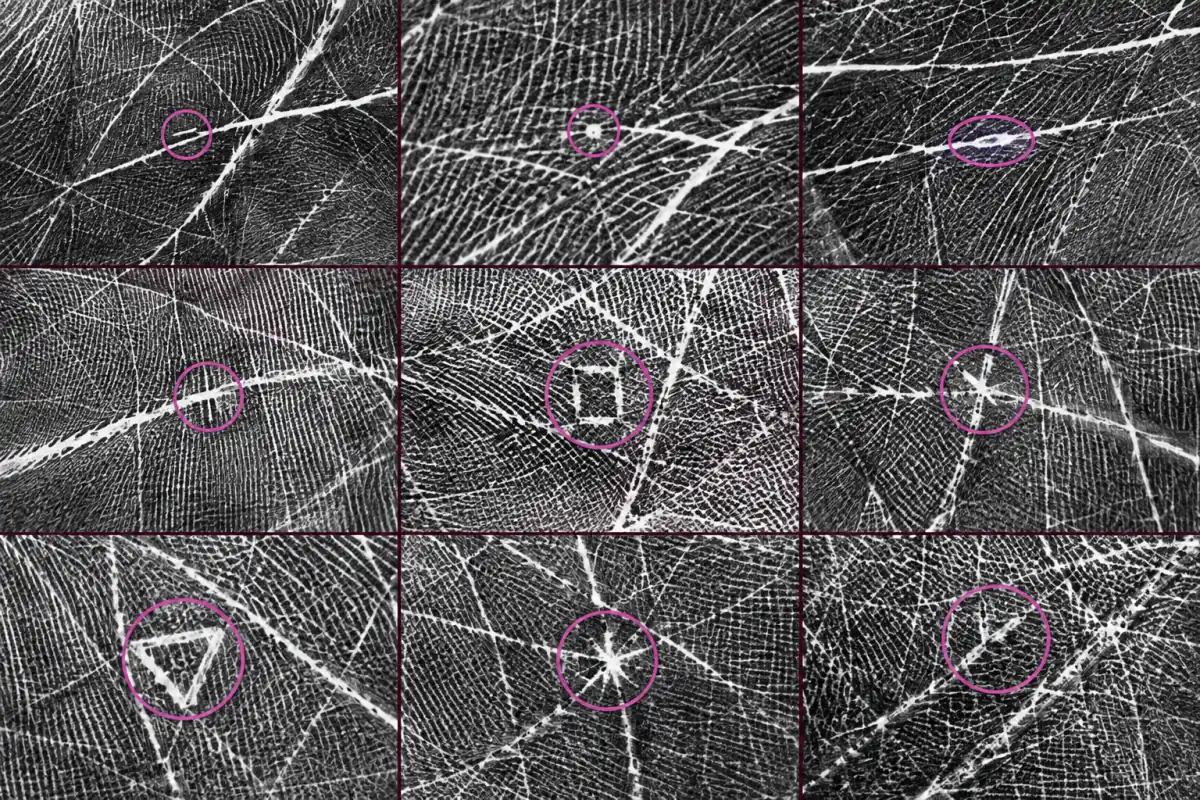
The three prongs do not mean “triple luck,” and the symbol does not have one fixed meaning wherever it appears. First trace the stem. Then count the prongs, follow each destination, inspect their depth and proportion, and read the parent line before the split. A clear upward trident on an undisturbed line carries a different traditional meaning from three weak downward branches, a frayed tassel, or unrelated creases crossing at the end of a line.
One stem must divide into exactly three prongs
Start below the suspected mark and trace one continuous parent line into one junction. From that junction, confirm a central continuation plus two separate side branches. If the stem divides into two tips, it is a fork. If it frays into four or more fine ends, it is a tassel. If several lines only cross at one point, it may be a star.
Seven-point trident verification map
| Check | What a true trident shows | Reason to pause |
|---|---|---|
| Stem | One traceable line approaches the junction | Three unrelated lines happen to sit close together |
| Junction | All three prongs begin from one compact split | Branches begin at widely separated levels |
| Prong count | Exactly three readable outlets | Two tips form a fork; four or more form a tassel |
| Central prong | The parent route continues through or beyond the junction | No prong follows the original direction |
| Side prongs | Two branches diverge without immediately rejoining | One “branch” is a crossing bar or skin ridge |
| Direction | Every prong can be followed toward a mount or line | A tight crop hides where the branches end |
| Persistence | The same structure remains under direct and side light | Glare, dryness, or hand tension supplies a false branch |
- Relax the palm and view the entire hand before zooming in.
- Find the long line that supplies the stem.
- Trace the stem toward the suspected split without jumping across gaps.
- Mark the single point where the division begins.
- Count three independent prongs from that point.
- Follow the left, center, and right prongs to their actual destinations.
- Repeat the check under gentle side light and on the other palm.
Use the palm markings dictionary if the structure is unclear. Name the visible geometry before assigning a meaning: “one stem with three upward prongs” is more useful than calling any group of three lines a trident.
Does the middle prong have to be the longest?
No. The middle prong usually continues the stem's route, but it may be shorter or lighter than a side prong. The longest and clearest branch shows where the pattern has the strongest outlet. What matters is that all three prongs genuinely share one junction and remain distinct long enough to trace.
Does a trident have to point upward?
No, but direction changes the reading. Upward prongs toward the fingers are traditionally associated with development, expression, or expansion. Downward prongs toward the wrist or lower palm are read as dispersion, competing demands, or energy redirected away from the line's expected destination. A sideways branch adds the subject of the mount or line it reaches.
Trident versus fork, tassel, star and crossing lines
| Formation | Visible structure | Main difference |
|---|---|---|
| Trident | One stem, one junction, three prongs | Three traceable outlets share one source |
| Fork | One stem divides into two tips | Only two outlets |
| Tassel | One line frays into four or more fine strands | Diffuse, feathered ending rather than three clear branches |
| Star | Three or more strokes cross at one center | Lines pass through the center instead of growing from one stem |
| Grille | Several parallel lines cross another set | Repeated mesh with many intersections |
| Rising branches | Several branches leave a line at different points | No single three-way junction |
| Accidental crossing | A bar cuts the parent line near its end | The bar continues across rather than becoming a prong |
A three-ray star can look like a trident in a cropped photo. Trace backward: a star has multiple strokes entering and leaving one center, while a trident has one incoming stem and three outgoing branches. The star-mark guide gives a shared-center test for this exact confusion.
Trident versus three rising branches
Three rising branches are still traditionally favorable when they are clear, but they describe repeated developments at different points on a route. A trident concentrates three outlets at one terminal or local junction. This difference affects timing: separate branches may belong to separate periods, while a terminal trident is read at the level where the shared split begins.
How to read the direction of all three prongs
The parent line supplies the subject and the destination supplies the outlet. Imagine the three prongs as routes, not decorative spikes. A fate-line trident with one branch toward Jupiter, one toward Saturn, and one toward Apollo links leadership, responsibility, and visible contribution. If all three remain within Saturn, the reading stays concentrated on duty and long-term direction.
| Prong destination | Where it travels | Traditional outlet | Feature to compare |
|---|---|---|---|
| Jupiter | Toward index finger | Leadership, aspiration, teaching, responsibility | Index finger, thumb, Jupiter markings |
| Saturn | Toward middle finger | Duty, discipline, specialization, sustained direction | Fate line, middle finger, texture |
| Apollo / Sun | Toward ring finger | Recognition, creativity, presentation, satisfaction | Sun line, ring finger, Apollo mount |
| Mercury | Toward little finger | Communication, commerce, analysis, applied skill | Little finger, head and Mercury lines |
| Venus | Inward toward thumb mound | Family, attachment, affection, personal involvement | Life and heart lines, thumb |
| Moon | Outward toward lower percussion | Imagination, travel, public contact, wider environment | Head line, travel lines, fate origin |
| Mars | Toward inner or outer middle palm | Courage, boundaries, endurance, negotiation | Mars line, thumb, major lines |
Upward, horizontal and downward prongs
| Direction | Traditional emphasis | What decides whether it helps |
|---|---|---|
| Three upward prongs | Expansion into several constructive channels | Depth, clean junction, supportive destinations |
| Two upward, one sideways | Growth with a practical outlet into another life area | The mount or line reached sideways |
| One upward, two downward | One clear aim alongside divided effort or competing demands | Strength of the central prong and parent line |
| Three downward prongs | Dispersion, depletion, or redirection of the line's subject | Whether other branches restore continuity |
| Uneven prongs | One outlet dominates the other two | Longest, deepest branch and its destination |
| Crossed prongs | Opportunity complicated by interference or divided execution | Bars, islands, breaks, and continuation |
Trident meanings on the fate, Sun, life, head and heart lines
Trace the complete parent line before interpreting its ending. A strong symbol cannot replace a weak, fragmented route, and a clear route can be useful without any trident. The split modifies the story already shown by the line.
| Parent line | Traditional trident meaning | Most useful next check |
|---|---|---|
| Fate line | One work or responsibility path develops several outlets | Which mounts receive the prongs? |
| Sun line | Recognition, creativity, or satisfaction expressed through several channels | Does one prong remain under Apollo? |
| Life line | Later route divides among home, movement, family, or wider environments | Are there three prongs or only a travel fork? |
| Head line | Thinking becomes versatile across practical, imaginative, or communicative uses | Is the ending clean or tasselled? |
| Heart line | Emotional expression reaches several relational ideals or modes | Where do the branches end beneath the fingers? |
| Mercury line | Applied skill branches into communication, service, analysis, or enterprise | Compare head line and little finger |
| Relationship line | A bond reaches a complex decision or several demands | Use an edge photo and distinguish fine crossing creases |
Trident on the fate line
A fate-line trident is traditionally read as one direction opening into three forms of responsibility or achievement. The most informative version ends with branches toward Jupiter, Saturn, and Apollo: leadership, sustained work, and visible contribution reinforce one another. If a branch reaches Mercury instead, communication, trade, analysis, or specialist practice enters the pattern. Read the fate line's origin, breaks, shifts, and final mount before treating the split as an outcome.
Trident on the Sun line
A clear Sun-line trident below the ring finger is one of the formations commonly grouped with auspicious signs in palmistry. It is traditionally associated with recognition or fulfillment spreading through more than one channel. The central prong should continue toward Apollo. A side branch toward Saturn adds mastery and responsibility; one toward Mercury adds communication or commercial reach; one toward Jupiter adds leadership or teaching. A weak Sun line that ends in a blurred tassel does not carry the same focused reading.
Trident at the end of the life line
Near the wrist, life-line endings often contain forks, influence lines, and wrist creases. Verify all three prongs carefully. A genuine trident is interpreted through different directions of life, family involvement, relocation, travel, or changing environments. It does not predict lifespan or a medical outcome. A strong central continuation with one branch toward Moon and another toward Venus can symbolically balance wider experience with continuing family ties.
Trident on the head line
A head-line trident suggests that the person's thinking finds three distinct applications. A central practical prong, an upward branch toward Mercury or Apollo, and a downward branch toward Moon can combine structure, communication or presentation, and imagination. The reading becomes less favorable when the line frays into many weak strands, because that is a tasselled ending associated with scattered focus rather than a clean three-way capacity.
Trident on the heart line
A heart-line trident is read through the branches' positions beneath Jupiter, Saturn, Apollo, or Mercury. Branches toward Jupiter and Saturn can combine ideals with realism; a Mercury direction can add verbal expression; a branch turning downward may show emotional energy pulled into thought or practical concerns. Compare the heart line's curve, depth, islands, breaks, Venus mount, thumb, and relationship lines before describing the pattern.
Trident meanings by mount
A free-standing trident is less common and harder to verify than one attached to a major or minor line. Locate the junction on the palm mount map, then check whether a nearby long crease actually supplies the stem.
| Junction location | Traditional theme | Supporting combination |
|---|---|---|
| Jupiter | Leadership, teaching, ambition, influence through several roles | Clear index finger, balanced thumb, upward fate branch |
| Saturn | Specialization, responsibility, patient development | Strong fate line and firm middle finger |
| Apollo | Creative expression, recognition, satisfaction, audience | Clear Sun line and balanced ring finger |
| Mercury | Communication, business, research, technical or advisory skill | Clear head line and proportionate little finger |
| Venus | Affection, family resources, social energy expressed in several directions | Clear life line, firm thumb, balanced influence lines |
| Moon | Imagination, travel, public contact, changing environments | Sloping head line, travel branches, fate line from Moon |
| Mars | Courage, strategy, recovery, negotiation under pressure | Support line, firm thumb, clear head line |
Location and destination can differ. A junction may begin on Saturn while one prong reaches Apollo and another reaches Jupiter. Record both: “fate-line trident beginning under Saturn, with branches toward Jupiter, Saturn, and Apollo” preserves far more meaning than “trident on Saturn.”
What clear, uneven, crossed and broken tridents mean
| Variation | Traditional interpretation | Reading priority |
|---|---|---|
| Three deep, balanced prongs | Several developed outlets with comparable strength | Destinations and parent line |
| One dominant prong | One outlet leads while two remain secondary | Follow the dominant branch |
| One broken prong | One route is interrupted, delayed, or less sustained | Check its continuation and support |
| Cross on the junction | A concentrated complication where the split occurs | Verify the cross independently |
| Island on one prong | Prolonged divided focus within that outlet | Which mount receives the affected branch? |
| Bars across all prongs | Several outlets meet interference | Strength above each bar |
| Faint developing trident | Possible emerging diversification | Matched photos over time |
| Deep stem, faint branches | Established foundation with options not equally developed | Other lines repeating each option |
Is a bigger trident more powerful?
No. Size can make the formation easier to see, but clarity and integration matter more. A compact trident that cleanly completes a strong Sun line can be more specific than three long creases that only appear joined in a wide crop. Large side branches also travel farther, so their destinations may add competing themes rather than greater strength.
What if only two prongs are clear?
Read the visible formation as a fork unless a third prong can be traced from the same junction. Do not promote a faint skin ridge, reflected highlight, or crossing crease into a missing branch. If the third line appears only in one photograph, retake the image under matched lighting before interpreting it.
How to time a trident without inventing an exact date
A trident can be timed only when its junction touches a line with a usable proportional scale. Use the level where the single stem first divides, not the tips' endpoints. On the fate line, compare the junction with the head- and heart-line crossings. On the life line, use a proportional arc and corroborate the broad period elsewhere. On the Sun line, use fate-line or life-line timing only when a clear connector links the features.
| Timing situation | Useful method | Avoid |
|---|---|---|
| Fate-line trident | Place the shared junction against head and heart landmarks | Assigning a date from branch length |
| Life-line trident | Use proportional position along the full arc | Reading the wrist end as a fixed age for everyone |
| Head- or heart-line trident | Use only a broad traditional section and seek another timed marker | Presenting the finger below it as a calendar |
| Free-standing mount trident | Describe the active theme without a date | Inventing timing from mount location alone |
| Different levels on both hands | Check photo consistency and compare broader periods | Averaging two positions into one exact age |
The palmistry timing guide explains landmark calibration and broad windows. Treat timing as an approximate layer of interpretation, not a deadline or guarantee.
What a trident means on the active and less-active hands
Use hand dominance rather than a gender rule. The less-active hand is often read as background pattern or earlier potential; the active hand as present expression, practiced choices, and developed direction. This is a reading convention, so compare the same feature on both palms before deciding that the pattern changed.
| Two-hand pattern | Traditional interpretation | Next comparison |
|---|---|---|
| Same trident on both | The diversified pattern is both underlying and actively expressed | Compare the dominant prong |
| Clearer on active hand | Present choices may have developed more outlets | Which supporting line also strengthened? |
| Clearer on less-active hand | Several latent outlets may have narrowed or changed form | Look for a new active-hand continuation |
| Fork becomes trident on active hand | A third channel may have developed from an existing choice | Verify with matched photographs |
| Trident becomes tassel | Focused outlets may now appear more dispersed | Check skin condition, line depth, and branches |
| Different destination on each hand | The same foundation may be expressed through a different life area | Compare mounts, fingers, and current question |
Six worked trident examples
1. Fate line toward Jupiter, Saturn and Apollo
A deep fate line rises from the center of the wrist and divides above the heart line. Its central prong ends under Saturn, one branch reaches Jupiter, and one reaches Apollo. A clear Sun line and firm open thumb repeat visibility and leadership. The traditional reading combines long-term responsibility with authority and recognized contribution rather than predicting three separate jobs.
2. Sun-line trident with a Mercury branch
A clean Sun line ends below Apollo in three prongs. The center remains under the ring finger, one short branch moves toward Saturn, and one toward Mercury. The head line is clear and Mercury is balanced. This supports creative or visible work that gains reach through mastery and communication.
3. Life-line fork mistaken for a trident
The lower life line divides into one central continuation and one branch toward Moon. A separate wrist crease crosses nearby but does not begin at the junction. This is a two-prong fork associated with a change of environment or divided base, not a trident. The independent crossing line receives its own reading.
4. Head-line trident with one weak prong
The head line has three genuine outlets: a straight central ending, a rising Mercury branch, and a faint descending Moon branch. The straight and Mercury routes dominate, suggesting practical thought and communication lead while imaginative use is present but less developed. The uneven prongs matter more than the label alone.
5. Heart-line trident beneath Jupiter and Saturn
A curved heart line ends in three clean branches spread across Jupiter and Saturn. Balanced Venus and a firm but flexible thumb support warmth with standards and practical judgment. The combination is read as several modes of emotional expression held within one coherent relationship pattern.
6. Active-hand fork develops a third outlet
The less-active hand has a fate-line fork toward Saturn and Apollo. The active hand repeats both branches and adds a clear third prong toward Jupiter, while the index finger and Sun line are stronger. After matched-photo verification, the traditional reading emphasizes leadership developing alongside established responsibility and visibility.
Common mistakes when reading a trident
- Counting the stem as one of the three prongs.
- Calling a two-prong fork a trident.
- Calling a frayed four- or five-strand tassel a trident.
- Treating a star or crossing bar as a branch.
- Ignoring where each prong actually ends.
- Assuming three prongs always mean three jobs, partners, or events.
- Reading downward, weak, or crossed prongs as identical to clear upward ones.
- Giving an exact age to a free-standing mount symbol.
- Comparing hands photographed with different tension or light.
- Letting one small sign outweigh the parent line and whole hand.
Photo checklist for trident identification
- Photograph both full palms from fingertips through wrists.
- Keep the hand relaxed and parallel to the camera.
- Add a sharp close-up that includes the entire stem and all three destinations.
- Take one direct-lit and one gently side-lit view.
- Keep the frame wide enough to identify the fingers and mounts.
- Use color and disable portrait smoothing, sharpening, and filters.
- Do not draw over a faint third prong.
- State hand dominance and the question connected with the mark.
Questions that make a trident reading useful
- Can one continuous stem be traced into one shared junction?
- Are there exactly three independent prongs after the split?
- Could the shape be a fork, tassel, star, grille, or crossing line?
- Which major or minor line supplies the stem?
- Where do the left, central, and right prongs end?
- Which prong is deepest, longest, crossed, broken, or islanded?
- Does the parent line remain clear before the split?
- Do mounts, fingers, thumb, or other lines repeat each outlet?
- Can the junction be placed in a broad period using another timed route?
- How does the same feature differ on the other hand?
- What question about work, recognition, relationships, travel, learning, purpose, or direction should the pattern answer?
Read the trident inside the complete hand
Verify the stem, junction, and three prongs; trace every destination; inspect the parent line before the split; then add line quality, timing, mounts, fingers, thumb, other markings, and both palms. This shows which outlet leads, which ones support it, and how the pattern connects with the question you are asking.
The complete answer
A trident on the palm is one stem dividing at one junction into three traceable prongs. Traditional palmistry reads clear upward prongs as three focused outlets for the parent line: the fate line for work and responsibility, Sun line for recognition and fulfillment, life line for environment and direction, head line for applied thought, and heart line for emotional expression. The destination of each branch adds Jupiter's leadership, Saturn's discipline, Apollo's visibility, Mercury's communication, Venus's attachments, Moon's wider environments, or Mars's courage and boundaries. Forks, tassels, stars, separate rising branches, and accidental crossings need different readings. A Full Palm Reading maps the trident and all other important features across both hands and combines them into a holistic reading focused on your questions about work, recognition, relationships, communication, learning, travel, timing, purpose, and direction.
A Full Palm Reading
Ask what your trident means across the complete hand
Your reading verifies the stem, shared junction, and three prongs, traces every destination and the parent line before the split, then adds line quality, timing, nearby markings, fingers, thumb, hand shape, mounts, major and minor lines, and both palms into one holistic reading focused on your questions about work, recognition, relationships, communication, learning, travel, purpose, and direction.
Your Full Palm Reading maps all the important features—hand shape, skin texture, thumb, fingers, mounts, major and minor lines, markings, and the differences between both palms—and brings them together in a holistic reading focused on your questions.