
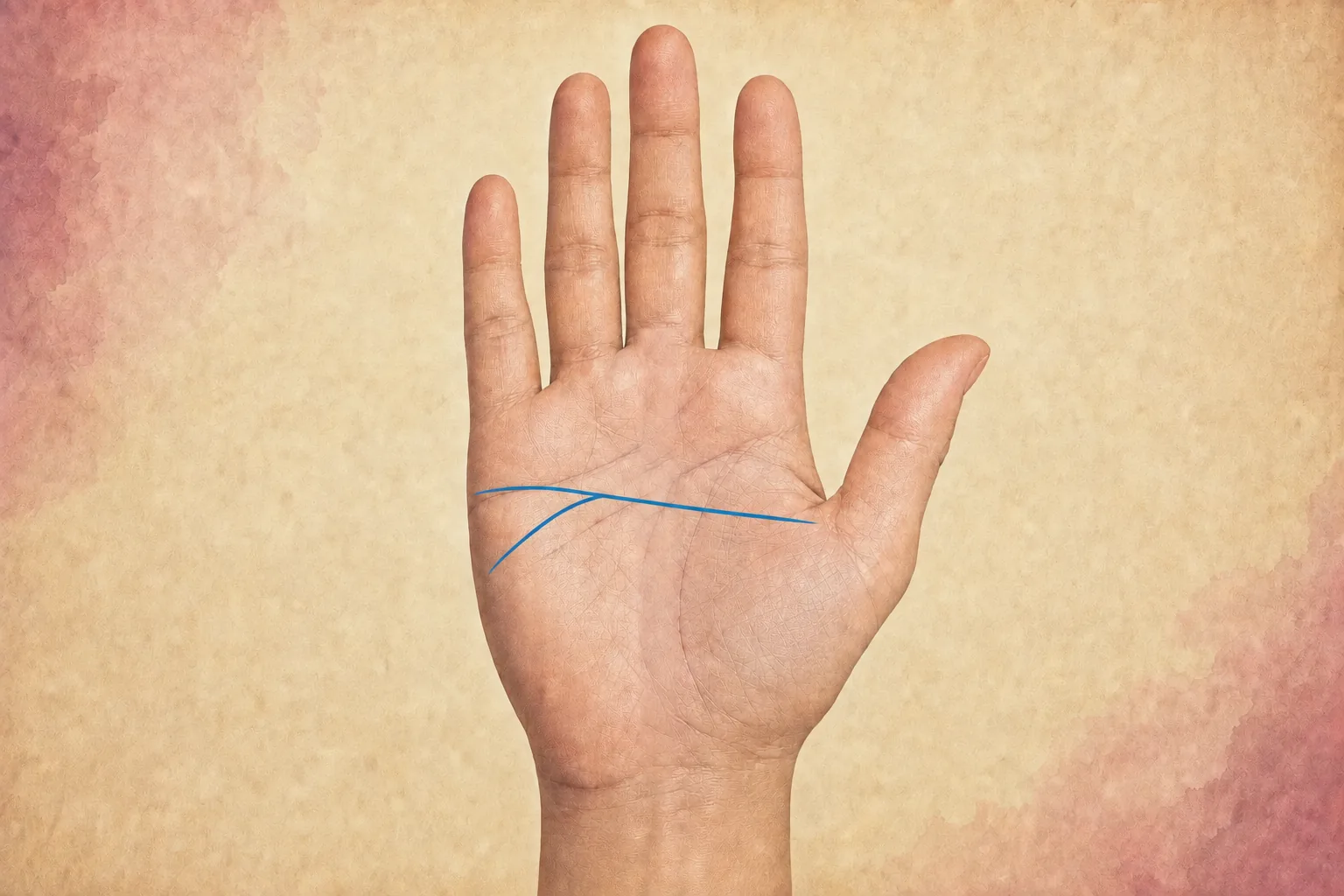
In traditional palmistry, a forked head line is one parent head line that divides near its end into two clear prongs. The best-known form has one prong continuing roughly straight and another sloping toward the Mount of Moon. It is popularly called the writer's fork and is read as the capacity to combine practical judgment with imagination, empathy, or a second point of view. It does not guarantee writing talent, a creative career, high intelligence, indecision, or a “split personality.”
A forked head line becomes meaningful only after the parent route, one terminal junction, two connected prongs, their destinations, relative depth and length, fork width, timing, supporting communication and creativity features, and both hands are compared. A whole-hand reading can show how practical judgment, imagination, empathy, expression, focus, and follow-through work together.
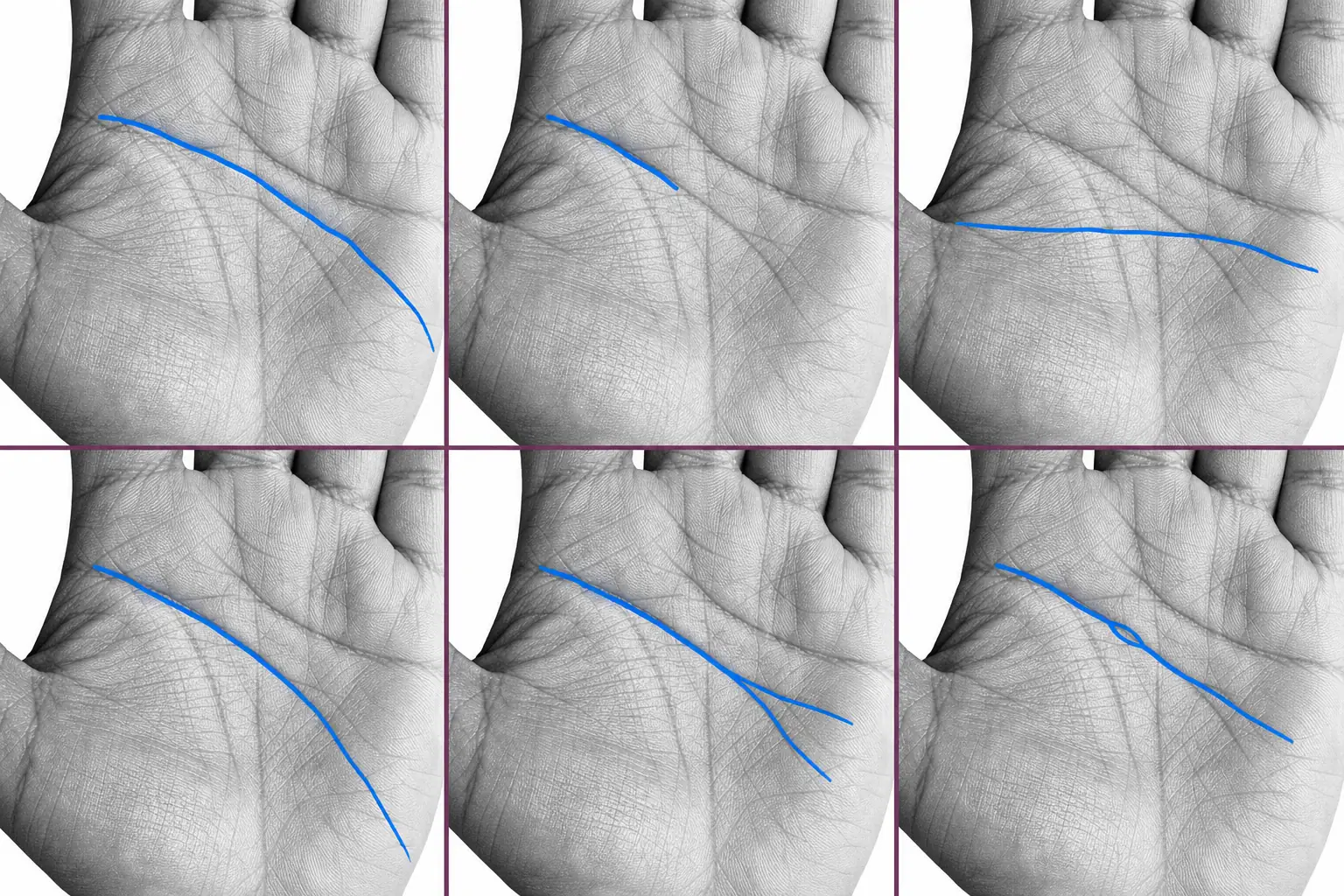
Use an eight-part forked-head-line method: trace the full parent head line, locate one terminal junction, count exactly two prongs, confirm that both remain connected to the parent, follow each prong to its destination, compare their depth and length, read the fork with the whole thinking pattern, and examine both hands. The parent line sets the baseline; the fork shows how that baseline opens into two working directions.
A fork needs one parent and two real endpoints
Do not label every small offshoot a writer's fork. A true terminal fork has one established head line that reaches a shared Y-shaped junction and separates into two traceable prongs. If the parent continues strongly and a fine side line leaves it earlier, you are looking at a branch. Three endpoints form a trident; a split that rejoins forms an island.
Where to find a fork on the head line
The head line begins near the thumb-index web, often beside or briefly joined to the life line, and crosses the middle of the palm toward the outer edge. A terminal fork appears in the outer half, usually below the ring or little finger area. Follow the line from its origin so you do not confuse it with the heart line above, a fate crossing, or a separate minor crease.
The complete head-line guide explains origin, length, slope, clarity, and endings. Those features come before the fork because a fork ending a straight head line modifies a practical baseline, while the same fork at the end of a strongly sloping line modifies an imaginative baseline.
| Feature | What to see | Reading role |
|---|---|---|
| Parent head line | One continuous route across the middle palm | Baseline thinking and decision style |
| Shared junction | One clean point where the parent divides | Confirms the fork geometry |
| Straighter prong | Continues toward the outer middle palm | Practical, factual, or structured perspective |
| Lower prong | Slopes toward the Mount of Moon | Imaginative, associative, or empathetic perspective |
| Two endpoints | Each prong finishes separately | Shows two distinct mental routes |
How to verify a true terminal fork
Start at the head-line origin and trace the same crease outward. At the suspected junction, check whether both prongs are etched clearly enough to follow and whether neither one belongs to another major line. Relax the hand, use soft side light, and compare a second photograph. Fine skin ridges can create a temporary Y shape when the palm is stretched.
| Look-alike | How it differs | Classification |
|---|---|---|
| True terminal fork | One parent divides once into two connected endpoints | Forked head line |
| Side branch | Parent continues while a smaller offshoot leaves it | Head-line branch |
| Trident | Three prongs leave one terminal area | Three-way ending |
| Island | Line splits and later rejoins | Enclosed section, not a fork |
| Overlapping crease | Separate line crosses or touches without sharing the parent | Intersection or overlay |
| Broken ending | Open skin separates the parent from a later segment | Break or restart |
| Faint feathering | Several hairline threads fray from the endpoint | Diffuse ending, not a clean fork |
The general fork guide explains the shared-parent test across every line. Here, the head line and the two mental destinations are what give the formation its specific meaning.
What is the writer's fork in palmistry?
“Writer's fork” is the popular name for a terminal head-line fork with one relatively straight prong and one prong bending toward Moon. Traditional readers connect the combination with seeing both the concrete and imagined sides of a subject. That can support writing, editing, teaching, design, research, counseling, negotiation, law, product work, storytelling, or any role that asks someone to translate between facts and human experience.
The nickname describes a potential working style rather than a profession. Writing also depends on communication features, discipline, practice, opportunity, and output. A fork with a weak Mercury area, scattered head-line quality, or an inflexible thumb may express as broad perspective without sustained communication. A clear head line, balanced fork, developed Mercury, and firm flexible thumb make the practical-creative synthesis more coherent.
| Popular claim | More useful reading | What to check |
|---|---|---|
| “You will be a writer” | You may work between structure and imagination | Mercury, Apollo, thumb, and actual interests |
| “You have two personalities” | You may hold or translate between two perspectives | Parent line quality and fork balance |
| “The fork always means indecision” | A very wide or weak fork may diffuse focus; a balanced one can add range | Prong equality and thumb |
| “Bigger is always better” | Proportion and clarity matter more than spread alone | Fork width relative to palm |
Read where each head-line prong goes
The destination of each prong defines the contrast. A prong running toward the outer middle palm or upper Moon area stays closer to practical, observable, and communicative thinking. A prong descending more deeply into Moon adds imagination, visualization, emotional inference, and sensitivity to atmosphere. Use the Mount of Moon guide to confirm whether the lower branch reaches Moon and how that mount is developed.
| Prong pattern | Traditional emphasis | Reading limit |
|---|---|---|
| Upper prong stronger | Practical or structured thought leads; imagination supports it | Strength is not superiority |
| Lower Moon prong stronger | Imaginative or associative thought leads; practical judgment supports it | Does not prove artistic work |
| Prongs nearly equal | Two mental modes carry similar weight | Check concentration and thumb |
| Lower prong reaches deep Moon | Inner imagery, empathy, or narrative thinking has greater range | Very wide spread can diffuse focus |
| Upper prong rises toward Mercury | Communication, business sense, or explanation gains emphasis | Confirm it remains a head-line fork |
| Prong rises toward Jupiter | Planning, leadership, or ambition redirects thought | This may be an upward branch rather than the classic writer's fork |
How fork width, length, and quality change the meaning
A compact, clean fork adds a second perspective without dramatically changing the parent line. A wider split gives the contrast between mental routes more importance. If the prongs are very long and pull far apart, the person may need stronger priorities to prevent competing interests from dividing attention. A tiny secondary thread may be too weak to carry equal weight.
Compare depth, clarity, color, length, and continuity rather than measuring width alone. If the parent line is deep but one prong fades quickly, the stronger destination leads. If both are deep and clean, the dual approach is more established. If the fork is chained or crossed, repeated revision or distraction may matter more than the idealized writer's-fork label.
Can a forked head line be timed?
Palmists sometimes estimate the fork's period by placing its junction along the total head-line route. A fork at the very end belongs to a later part of the symbolic sequence than a fork beginning near the center. There is no universal age scale for the head line, and angle, palm proportion, and reading system change the estimate, so use a broad chapter rather than a precise age.
Timing is most useful when calibrated with a known period in which two ways of thinking, two specialisms, or a practical and creative path began working together. The palmistry timing guide explains how to use landmarks and known events without turning a crease into a fixed date.
Forked head line on one hand or both
A similar terminal fork on both hands gives the two-perspective style more structural weight. If the active hand develops a clearer fork while the less-active hand ends in one route, experience may have strengthened flexibility, communication, or imaginative problem-solving. If the less-active hand forks but the active line becomes straighter, current demands may favor concentration and practical execution.
Compare the parent line's origin, length, slope, clarity, fork junction, prong destinations, and relative strength on both sides. The which-hand guide explains active and less-active comparison without assigning fixed meaning by gender.
Forked head-line combinations
| Combination | Traditional synthesis | Read with |
|---|---|---|
| Balanced fork + firm flexible thumb | Two perspectives can become adaptable decisions | Will and reason phalanges |
| Writer's fork + developed Mercury | Ideas may translate into speech, writing, trade, or advice | Little finger and Mercury line |
| Writer's fork + clear Apollo features | Imagination may find visible or creative expression | Sun line and Apollo mount |
| Wide fork + weak thumb | Options may compete without firm prioritization | Thumb opening and line quality |
| Moon prong + strong Moon mount | Imagination, empathy, or inner imagery gains weight | Mount firmness and markings |
| Straight parent + modest Moon prong | Practical thought gains access to creative alternatives | Relative prong strength |
The thumb guide is especially useful here because range becomes valuable when choice and follow-through can direct it. Hand shape, skin texture, fingers, mounts, and the fate line show where the mental style is most likely to be applied.
Worked examples
A straight head line ends in two equal, clean prongs
Practical thinking remains the baseline, while an equally clear Moon-directed prong adds imagination and human perspective. Strong Mercury and a firm flexible thumb would support clear communication and execution.
The lower prong is deeper and reaches far into Moon
Associative, visual, or empathetic thought carries more weight. If the upper prong remains visible, practical framing is still available; a very wide fork and weak thumb may make focus more important.
A fine line leaves the head line but the parent continues to one endpoint
This is a branch rather than a balanced terminal fork. Read the branch by its direction and timing while keeping the continuing parent as the main mental route.
Photo checklist for a forked head line
- Photograph both full palms from wrist to fingertips.
- Keep the head-line origin and outer edge in the same frame.
- Use soft side light across the terminal junction.
- Relax the hand so stretching does not create a false split.
- Trace one parent to one junction and exactly two endpoints.
- Record the destination, length, and depth of each prong.
- Take a second angle to rule out an overlapping crease.
- State hand dominance and the decision, communication, or creative question you want explored.
Read the fork inside your complete thinking pattern
A Full Palm Reading maps the head-line origin, full route, slope, terminal junction, both prong destinations, relative strength, fork width, timing, supporting communication and creativity features, and both palms. It then adds the thumb, fingers, mounts, hand shape, texture, fate, heart, Sun, and Mercury lines into one holistic reading focused on your questions.
The complete answer
A forked head line is one parent line dividing near its end into two connected prongs. The classic writer's fork combines a straighter destination with a Moon-directed branch and is traditionally associated with practical and imaginative perspectives working together. Verify a true fork rather than a branch, trident, island, overlap, or break; then read the parent baseline, prong destinations, relative strength, width, timing, combinations, and both hands. A Full Palm Reading maps this feature and all important features across both palms and combines them into a holistic reading focused on your questions about decisions, communication, creativity, study, career, relationships, purpose, and direction.
A Full Palm Reading
Ask how both sides of your head-line fork work together
Your reading maps the head-line origin, full route, slope, terminal junction, both prong destinations, relative strength, fork width, timing, supporting communication and creativity features, and both palms, then adds the thumb, fingers, mounts, hand shape, texture, fate, heart, Sun, and Mercury lines into one holistic reading focused on your questions.
Your Full Palm Reading maps all the important features—hand shape, skin texture, thumb, fingers, mounts, major and minor lines, markings, and the differences between both palms—and brings them together in a holistic reading focused on your questions.