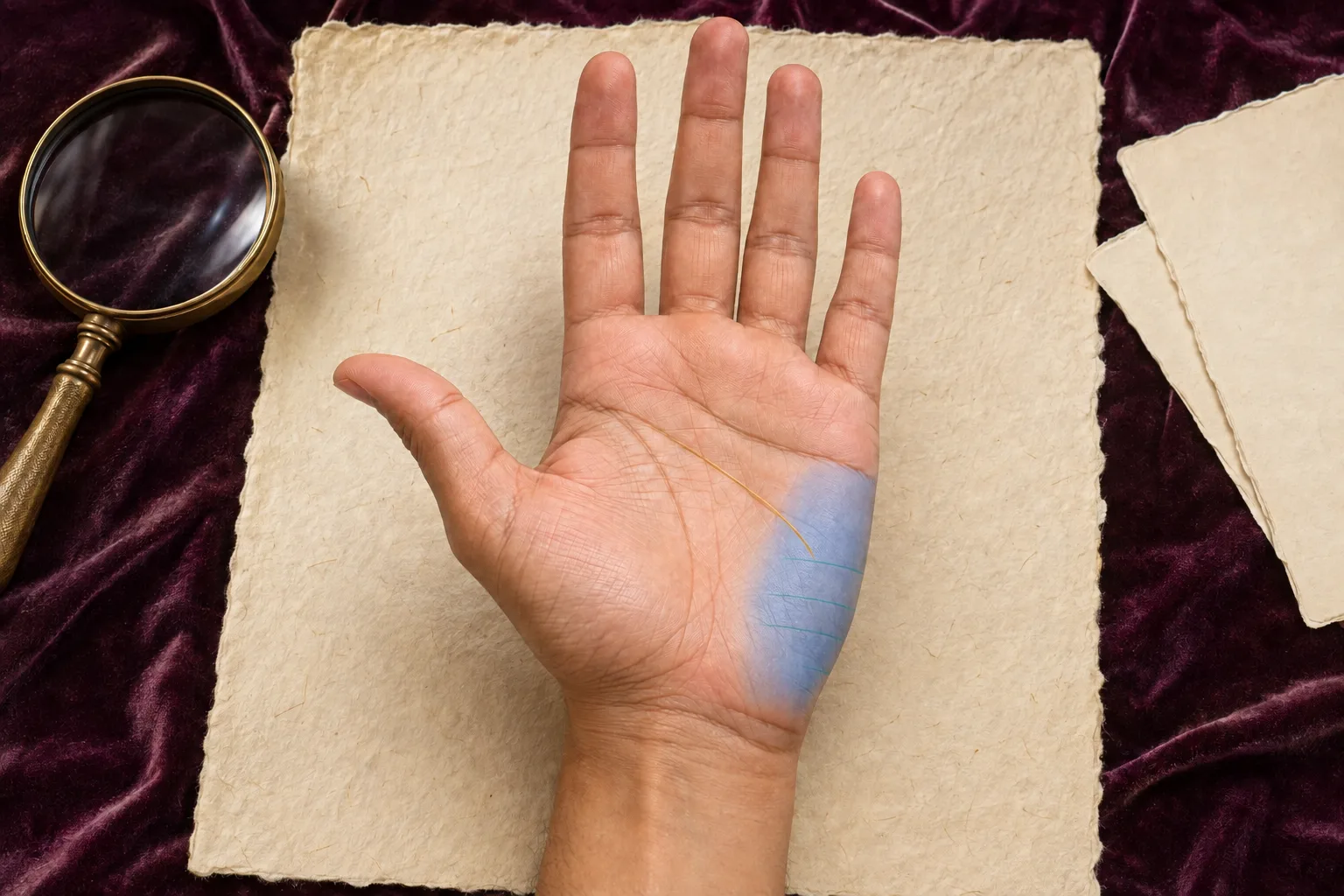
The Mount of Moon is the long padded region on the lower outer edge of the palm, opposite the thumb and below the percussion-side Mars area. It is also called the Mount of Luna. Traditional palmistry connects it with imagination, receptivity, intuition, empathy, memory, response to surroundings, travel, distance, and the ability to picture life beyond the familiar. A balanced Moon mount looks proportionate, feels resilient, and works with clear head and fate lines.
A Moon-mount reading becomes useful only after its boundaries, height, firmness, texture, travel lines, head-line ending, fate-line origin, markings, Mars boundary, and the other hand are compared. A whole-hand reading can show how imagination, environment, movement, public contact, and intuition connect with work, relationships, change, purpose, or direction.
Do not read fullness alone. A broad firm Moon, a soft bulging Moon, and a flat finely lined Moon can occupy similar-looking photographs yet carry different traditional meanings. Use a seven-part Moon mount reading sequence: locate the boundaries, compare height, test firmness, inspect texture, trace lines, verify markings, and compare the same features on both hands.
Moon describes how the hand meets the wider world
Venus gathers around close ties, familiar pleasure, and the home circle. Moon faces the outer edge of the hand and traditionally describes imagination, changing environments, journeys, distant places, inner imagery, and sensitivity to atmosphere. The head line, fate line, travel lines, and wrist show how that field is used.
Where is the Mount of Moon on the palm?
Hold the palm toward you with the fingers relaxed. Look at the outer or little-finger edge, then move down to the lower half of the palm between the central hollow and the wrist. That elongated heel-of-hand region is Moon. Its upper limit blends into Upper Mars; its inner limit blends into the Plain of Mars; its lower limit meets the wrist bracelets. The heel directly beneath the thumb is Venus, not Moon.
| Moon boundary | How to locate it | What lies beyond it |
|---|---|---|
| Outer boundary | Follow the percussion edge below the little-finger side | Side and back of the hand |
| Inner boundary | Move inward until the lower palm begins to flatten centrally | Plain of Mars and central fate-line territory |
| Upper boundary | Use the area below the heart-line level and Upper Mars | Upper Mars and Mercury-side palm |
| Lower boundary | Stop at the upper wrist bracelet | Wrist and bracelets |
| Apex | Find the fullest local point with gentle side light | Shows where the mount's emphasis gathers |
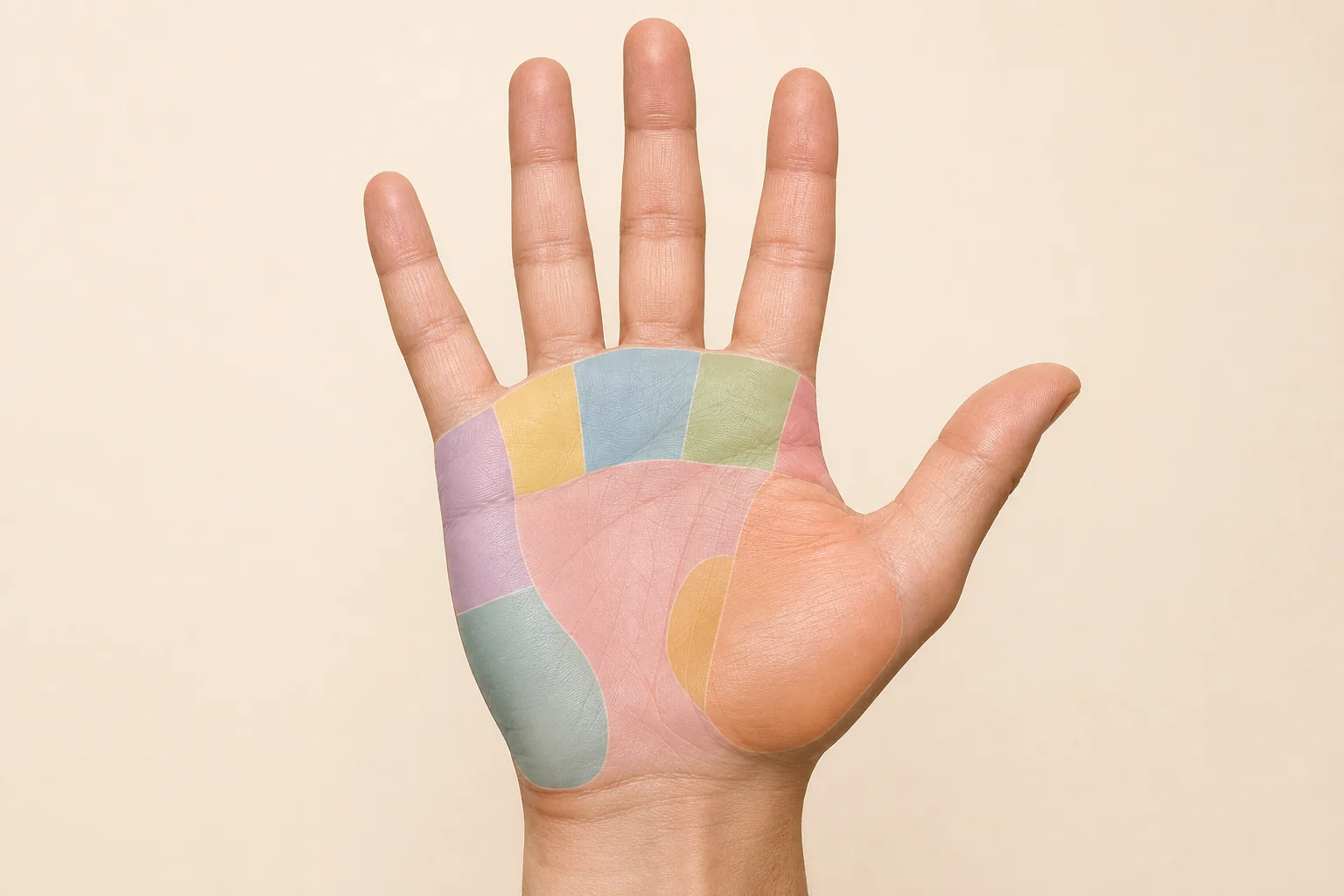
The complete palm-mount map shows Moon beside the two Mars regions and opposite Venus. Use that overview when a line or mark sits near a boundary. This guide owns the deeper Moon questions: development, texture, travel lines, line origins and endings, markings, and combinations.
Mount of Moon versus Upper Mars
Upper Mars occupies the outer middle palm, roughly between the head and heart-line zones. Moon begins below it and continues toward the wrist. A mark beside the middle of the palm may belong to Mars, where traditional reading emphasizes resilience and controlled resistance. A mark clearly lower on the heel belongs to Moon, where imagination, environment, movement, and receptivity lead.
Why the side view matters
A front-lit photograph can make the entire palm look equally flat. Add a gentle side-lit image or look across the hand at a shallow angle. This reveals whether Moon rises independently, bulges toward the edge, or simply appears wide because the palm is broad. Compare both hands in the same pose and light.
Flat, balanced, prominent and overdeveloped Moon mounts
Development is relative to the rest of the hand. Palm width, muscle, body composition, age, work, camera distance, and pressure against a surface alter the visible shape. Traditional palmistry interprets the pattern symbolically after those practical effects are controlled.
| Moon development | Visual and touch cues | Traditional emphasis | Supporting check |
|---|---|---|---|
| Flat or narrow | Little rise and a slim lower outer palm | Practicality, self-containment, familiarity, or imagination used selectively | Head-line slope and travel lines |
| Balanced | Proportionate curve with resilient padding | Imagination and empathy grounded enough to become useful | Clear head line and stable thumb |
| Prominent and firm | Distinct rise that returns after gentle pressure | Strong visualization, environmental awareness, curiosity, and attraction to wider experience | Fate line shows direction |
| Prominent and soft | Broad outer heel that compresses easily | High receptivity, changing moods, diffuse imagination, or absorption of surroundings | Head line and Mars balance |
| Very full or bulging | Moon dominates the lower outer hand | Fantasy, restlessness, escapism, or environmental sensitivity may overtake practical direction | Thumb, head line, fate line |
| Displaced upward | Fullest point sits near Upper Mars | Imagination joins strategy, defense, debate, or pressure response | Outer-middle lines |
| Displaced inward | Fullness spreads toward central palm | Inner imagery seeks visible work, routine, or public direction | Fate-line origin and course |
What does a flat Mount of Moon mean?
A flat Moon is traditionally linked with concrete thinking, preference for known surroundings, private imagination, or less need for novelty. It does not mean a person lacks intuition or creativity. A deeply sloping head line, strong Apollo area, loop fingerprints, or a clear intuition line can carry those qualities through another feature.
What does a prominent Mount of Moon mean?
A prominent resilient Moon suggests vivid imagination, empathy, curiosity, responsiveness to place, and interest in travel or unfamiliar perspectives. Firmness and supporting lines decide whether the quality becomes sustained creative work, practical movement, or simply strong inner experience.
What does an overdeveloped Mount of Moon mean?
“Overdeveloped” means Moon visually dominates the lower palm. Palmists read this as Moon qualities operating without enough counterweight: imagination may turn into fantasy, sensitivity into overwhelm, and curiosity into restlessness. A firm thumb, clear straight portion of the head line, developed Mars, and an organized fate line can direct the same strong Moon into research, art, counseling, storytelling, travel, or adaptive work.
Firmness, softness, texture and line density
Press the same central point on Moon in each hand using gentle, equal pressure. Fullness shows how much the region rises; firmness suggests how its symbolic energy is held. Texture and line density show whether the response looks concentrated or dispersed.
| Quality | Observation | Traditional reading |
|---|---|---|
| Resilient | Yields slightly, then returns | Imagination, empathy, and adaptability with usable grounding |
| Very soft | Compresses readily | Absorbs atmosphere and impressions; needs stronger selection or structure |
| Hard | Resists gentle pressure | Fixed inner picture, intense environmental preferences, or determined movement |
| Fine texture | Delicate skin grain and fine lines | Nuanced sensitivity and subtle perception |
| Coarse texture | Broader grain and fewer deep routes | Direct sensory experience and practical response to environment |
| Clear surface | Open skin between a few readable lines | Focused imagination and fewer competing impressions |
| Dense grille | Many lines cross into small cells | Scattered attention, porous boundaries, restlessness, or many environmental demands |
Color is especially unreliable in photographs because temperature, pressure, circulation, lighting, and white balance change it. Some traditions assign meanings to pale, pink, yellow, or red tones, but structure, touch, and persistent line routes provide a more stable reading. Do not use palm color as a health assessment.
Travel lines on the Mount of Moon
Travel lines are usually fine horizontal or slightly rising lines entering from the outer edge of Moon. They may describe journeys, repeated movement, exposure to distant places, a wider social environment, or a period when life expands beyond the familiar. They do not guarantee migration or specify a country. Strength, route, connection, and repetition decide their weight.
| Moon line | How it appears | Traditional reading | Next feature to trace |
|---|---|---|---|
| Short edge line | Enters Moon and fades locally | A trip, outside influence, curiosity, or periodic movement | Depth and repetition |
| Long clear travel line | Crosses much of Moon toward the center | A stronger journey or wider environment becomes significant | Destination and timing zone |
| Rising travel line | Angles upward from the outer edge | Movement tied to opportunity, learning, visibility, or growth | Mount or line it approaches |
| Falling line | Angles downward toward wrist | Withdrawal, return, fatigue around movement, or private retreat | Wrist and life-line ending |
| Line meets fate line | Travel route continues into central vertical line | Place, travel, or outside contact alters work and direction | Fate line above the meeting |
| Line meets life-line branch | Outer route connects with an outward life-line branch | Relocation or changed base becomes more plausible in the traditional system | Both hands and continuation |
| Many faint edge lines | Numerous shallow creases without a dominant route | Frequent movement, interest, or environmental sensitivity rather than one major journey | Find the deepest persistent line |
Our travel and foreign-settlement guide explains the full combination: Moon lines, outward life-line branches, fate lines rising from Moon, wrist routes, and both-hand repetition. A single short Moon crease should remain a minor clue.
Can Moon lines show foreign settlement?
Not by themselves. A stronger traditional settlement pattern may combine a long clear Moon line, an outward life-line branch, a fate-line shift or origin from Moon, and repetition on the active hand. Even then, palmistry describes a pattern of movement and environmental change rather than proving a legal, geographic, or permanent outcome.
Head-line endings and fate-line origins on Moon
Moon becomes clearer when a major line begins, ends, or receives support there. The head line shows how imagination enters thought; the fate line shows whether people, public contact, travel, or changing environments feed life direction.
| Connection with Moon | Traditional meaning | Important modifier |
|---|---|---|
| Head line slopes gently to upper Moon | Imaginative, visual, intuitive, or associative thinking | Depth and clarity show focus |
| Head line descends deeply into lower Moon | Strong inner imagery, empathy, fiction, symbolism, or immersion | Thumb and straight opening section add grounding |
| Head line forks toward Moon | Ability to combine practical and imaginative viewpoints | Trace both branches to real endings |
| Fate line starts on Moon | Direction shaped by the public, clients, travel, distant contacts, or changing surroundings | Continuation above head and heart lines |
| Travel line joins fate | A journey or outside influence intersects work or purpose | Fate-line quality after meeting |
| Life-line branch reaches Moon | Independence, relocation, or wider horizons move away from the familiar base | Length, timing, and both hands |
| Mercury or intuition line rises from Moon | Perception is translated into communication, service, or applied skill | Mercury mount and line quality |
Read the head line from its start, not just its ending. A long sloping line that remains deep and clean differs from one that becomes chained or fragmented on Moon. Likewise, read the fate line above its Moon origin: a clear continuation suggests sustained direction; repeated breaks suggest changing chapters or environments.
Does a fate line from Moon mean public success?
It suggests direction influenced by other people, clients, audiences, travel, or circumstances beyond the family base. Recognition requires Sun support; communication requires Mercury; leadership requires Jupiter and thumb support. Moon can bring the wider world into the story without deciding the result alone.
Star, cross, triangle, square, grille, circle and mole on Moon
First confirm that the shape is made by persistent creases rather than fingerprint ridges, lighting, dry skin, or several unrelated lines. Moon supplies the subject—imagination, intuition, travel, environment, and receptivity—while the mark describes how that subject concentrates or changes.
| Mark on Moon | Traditional emphasis | Verification priority |
|---|---|---|
| Star | Sudden concentrated attention around travel, imagination, or environment | Three independent lines meeting at one center |
| Cross or X | A conflict, decision, or intense experience involving movement or sensitivity | Two distinct strokes and exact center |
| Triangle | Imagination, navigation, research, or perception organized into method | Three closed sides and clean corners |
| Square | Containment, protection, boundaries, or recovery around a Moon difficulty | Four closed sides and the feature inside |
| Grille | Many impressions, divided attention, restlessness, or porous environmental boundaries | Several crossing lines rather than one symbol |
| Circle | A rare closed concentration of a Moon theme | Separate crease circle from ridge loop and island |
| Mole or spot | Traditional location symbolism attached to Moon themes | It is a skin mark; map its center without calling it a crease sign |
| Island on a line | A divided or diffused phase in that line's subject | Trace the parent line into and out of the enclosure |
Use the dedicated guides for a star, triangle, square, cross, or circle before adding Moon's location meaning. A symbol that fails its shape test should be read as ordinary line texture.
What can the Mount of Moon answer?
Moon is useful when the question involves imagination, place, travel, public contact, intuition, or the need for a different environment. Match the question to a feature combination instead of searching for one decisive mark.
| Reader question | Moon evidence to compare | Other features needed |
|---|---|---|
| Why do I absorb the mood around me? | Softness, fine texture, grille, intuition line | Thumb, Mars, head and heart lines |
| Is creativity central to my path? | Development, head-line ending, clear surface | Apollo, Sun line, fingers, fate line |
| Will travel change my work? | Long travel line meeting fate or fate origin on Moon | Fate continuation, life-line branch, timing |
| Do I need a different environment? | Moon development, outward routes, both-hand change | Life line, fate shifts, Venus and Mars |
| How does intuition work for me? | Texture, head-line slope, intuition and Mercury lines | Jupiter, thumb, fingerprints, opposite hand |
| Is relocation stronger than travel? | Deep repeated line, life-line branch, fate connection | Both hands, wrist routes, line continuation |
The intuition-sign guide shows why Moon needs grounding and expression features. Sensitivity becomes useful when the head line, thumb, Mercury, Mars, and fate line show how impressions are tested, communicated, bounded, and directed.
Compare the Mount of Moon on both hands
Use the same pose, light, camera distance, and gentle touch. Many modern readers treat the less-active hand as background tendency and the active hand as developed expression. Hand use is more useful than fixed gender rules.
| Two-hand pattern | Traditional interpretation |
|---|---|
| Similar Moon development and lines | Underlying receptivity and current expression broadly agree |
| More developed on active hand | Imagination, travel, public contact, or environmental awareness has become more expressed |
| Flatter or clearer on active hand | Experience has focused, bounded, or made the Moon response more selective |
| More travel lines on active hand | Movement or outside exposure is more active in the current pattern |
| Fate line begins on Moon only in active hand | Present direction depends more on clients, public contact, distance, or a changed environment |
| Deep head-line slope only on less-active hand | Strong imaginative background may now be expressed through a more practical route |
Differences do not prove that one event occurred at a precise date. They show where a traditional reader would investigate development. Compare stable photographs over time before calling a crease new or changed, and place any shift inside the larger change pattern.
Worked Mount of Moon combinations
Example 1: balanced firm Moon with a gently sloping head line
The mount is proportionate and resilient, with open skin and a clear head line ending on upper Moon. Traditional palmistry reads imaginative and empathetic thinking that stays coherent. A firm thumb and clear fate line would strengthen the picture of ideas becoming decisions and sustained work.
Example 2: prominent soft Moon with a dense grille
Fullness supplies strong receptivity, softness increases absorption, and the grille divides attention among many impressions. This may feel like rich imagination mixed with environmental overwhelm. Mars, thumb, and a straight opening section of the head line show whether the person can set boundaries and select what matters.
Example 3: long travel line joins a clear fate line
A strong line enters from the Moon edge and meets the central fate line. The fate line grows clearer above the meeting. Palmists may read a journey, distant contact, audience, or changed environment strengthening direction. A life-line branch toward Moon and repetition on the active hand would add weight.
Example 4: fate line starts from Moon but the mount is flat
The flat mount suggests Moon is not the broadest personality emphasis, yet the fate origin says outside people or changing surroundings still shape work. This can describe practical service, client work, remote collaboration, public response, or one important move without a highly dreamy temperament.
Example 5: deep head line descends to Moon with a firm thumb
The head line emphasizes inner imagery and associative thinking; the thumb adds selection and follow-through. Traditional reading may connect this with writing, design, counseling, strategy, research, or storytelling. Apollo, Mercury, and fate-line support show the likely outlet.
Example 6: square encloses a break in a Moon travel line
The travel line supplies the movement theme, the break shows interruption, and the verified square traditionally suggests containment or protection around that disruption. Trace the line after the square. A clear continuation carries more weight than an enclosure that ends the route entirely.
Example 7: active-hand Moon is clearer than the less-active hand
Both mounts have similar fullness, but the active hand has fewer crossing lines and one defined travel-to-fate route. A palmist may read experience organizing sensitivity into a clearer outward direction. This is a development reading, not a promise that a specific trip will occur.
Photo and touch checklist for the Mount of Moon
- Photograph both full palms from fingertips through wrists in neutral light.
- Keep both hands equally open without pressing them flat against a surface.
- Add a gently side-lit view of each lower outer palm to show elevation.
- Take one close-up that includes Upper Mars, all of Moon, and the wrist.
- Keep images in color without smoothing, sharpening, filters, or drawn lines.
- Press the same central point gently on each Moon mount to compare firmness.
- Trace travel lines inward from the edge and major lines outward to their true endings.
- State hand dominance and the travel, creativity, intuition, work, or environment question you want explored.
Questions that make a Moon reading useful
- Where does Moon end and Upper Mars begin?
- Is the mount flat, balanced, prominent, soft, firm, hard, or displaced?
- Does the surface stay clear or contain a dense grille?
- Which lines enter from the outer edge, and where do they end?
- Does the head line end on upper or lower Moon?
- Does the fate line start from Moon or receive a Moon line?
- Do symbols pass their exact shape tests?
- How does Moon differ on the active and less-active hands?
- What question about travel, place, creativity, intuition, work, or direction should the reading answer?
Read Moon inside the complete hand
Map the mount's boundaries, compare height, firmness, texture, travel lines, connected major lines, and markings, then add Mars, Venus, the thumb, fingers, hand shape, timing, and both palms. This shows how imagination, environment, movement, public contact, and intuition connect with the question you are asking.
The complete answer
The Mount of Moon, or Luna, is the lower outer palm opposite the thumb. Traditional palmistry associates it with imagination, intuition, empathy, memory, changing environments, travel, and the wider world. A balanced resilient Moon suggests sensitivity with grounding; a flat mount suggests selective or practical use of imagination; a prominent firm mount strengthens visualization and curiosity; and a very soft, bulging, or heavily grilled mount may diffuse the same qualities. Horizontal edge lines add travel or outside influence, a head line ending on Moon adds imaginative thinking, and a fate line beginning there connects direction with clients, public contact, distance, or changing surroundings. Marks must pass a strict shape test before Moon's location meaning is added. A Full Palm Reading maps Moon and all other important features across both hands and combines them into a holistic reading focused on your questions about travel, place, creativity, intuition, work, relationships, change, purpose, and direction.
A Full Palm Reading
Ask what your Mount of Moon means across the complete hand
Your reading maps the mount's boundaries, height, firmness, texture, travel lines, connected major lines, and markings, then adds Mars, Venus, the thumb, fingers, hand shape, timing, and both palms into one holistic reading focused on your questions about travel, place, creativity, intuition, work, relationships, change, purpose, and direction.
Your Full Palm Reading maps all the important features—hand shape, skin texture, thumb, fingers, mounts, major and minor lines, markings, and the differences between both palms—and brings them together in a holistic reading focused on your questions.