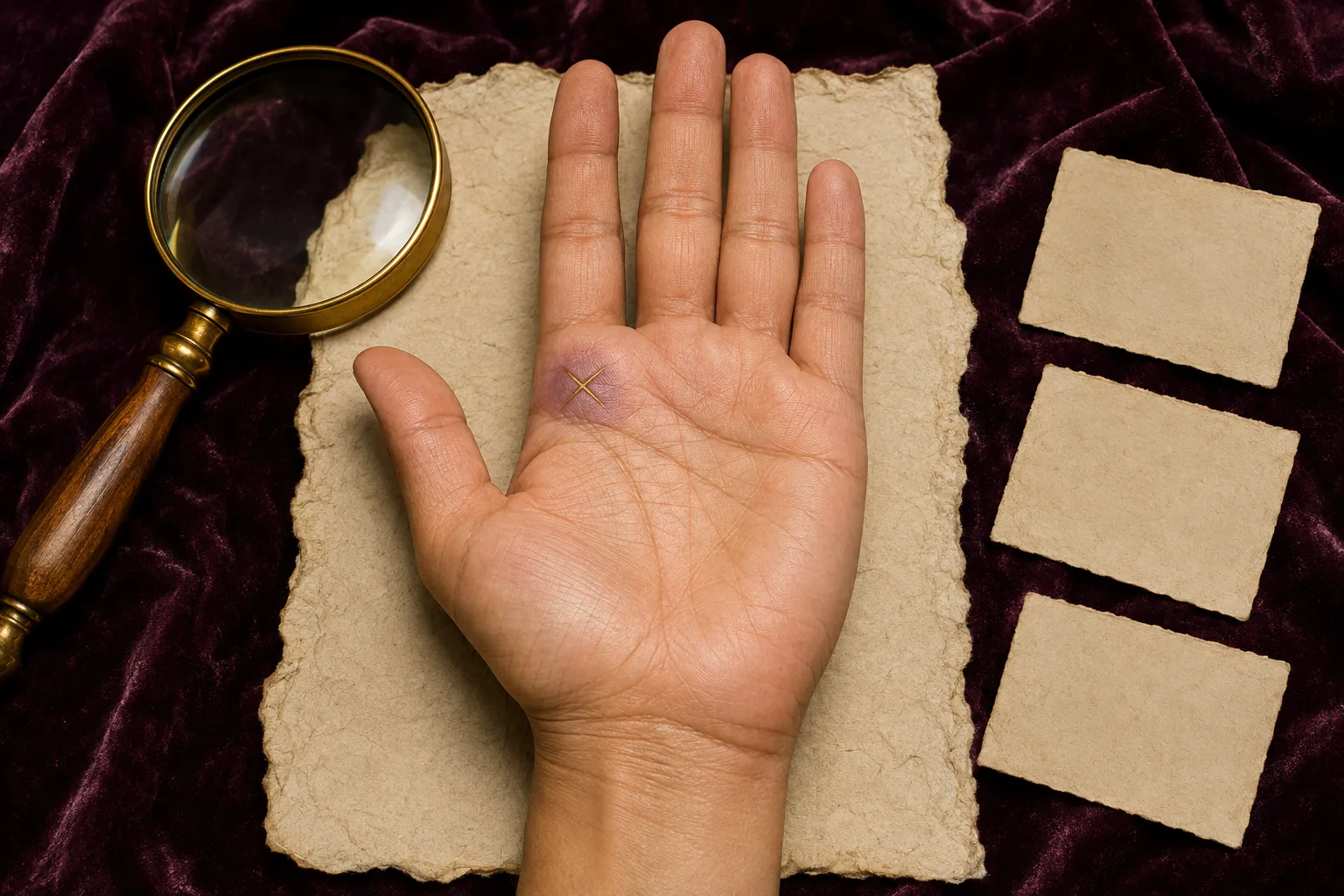
A cross or X mark on the palm is formed by two traceable strokes meeting at one intersection. Traditional palmistry reads it as a point of concentration, tension, decision, contact, or redirection within the line or mount where it appears. A cross on a fate line is interpreted through work and responsibility; on a heart line, through emotional or relationship patterns; on Jupiter, through ambition, commitment, leadership, or teaching; and in the central quadrangle, only an independent correctly placed X may qualify for the separate mystic-cross interpretation.
A cross becomes useful only after both strokes, the exact center, parent lines, continuation, timing, and the other hand are compared. A whole-hand reading can show what meets at the intersection and how it affects work, relationships, commitment, creativity, communication, travel, purpose, or direction.
The mark is not automatically lucky or unlucky. First determine whether both strokes are short and independent, whether one stroke belongs to a major line, or whether two established routes simply intersect. Then locate the exact crossing point, trace both strokes beyond it, inspect what happens before and after the intersection, and compare the same area on the other hand. That structure shows what the cross actually modifies.
Two visible strokes must meet at one point
Do not complete a faint arm mentally. A genuine X has two continuous strokes that enter and leave one central intersection, producing four readable arms. If three or more independent strokes share the center, test for a star. If several lines cross repeatedly, test for a grille. If one short bar cuts a major line, read the parent line first.
Seven-point cross and X verification map
| Check | What a verified cross shows | Reason to pause |
|---|---|---|
| Stroke count | Exactly two traceable lines | A third line creates a star-like center |
| Intersection | Both strokes meet at one compact point | The strokes end near each other without crossing |
| Four arms | Each stroke continues visibly past the center | One line only touches the side of another |
| Independence | Each arm can be separated from skin ridges and glare | A ridge shadow supplies the faint arm |
| Parent line | Any major or minor line involved can be traced | A tight crop hides the longer route |
| Location | The center can be placed on one line, mount, or plain | The photo angle shifts the apparent region |
| Persistence | The X remains under direct and side light | Dryness, pressure, or hand tension changes it completely |
- Relax the hand and photograph the full palm before zooming in.
- Trace the first stroke from one end through the intersection to the other end.
- Trace the second stroke in the same way.
- Confirm that both lines cross rather than merely touch.
- Decide whether either stroke belongs to a major or minor line.
- Locate the central point relative to the fingers, mounts, and nearby lines.
- Repeat the check under gentle side light and on the other palm.
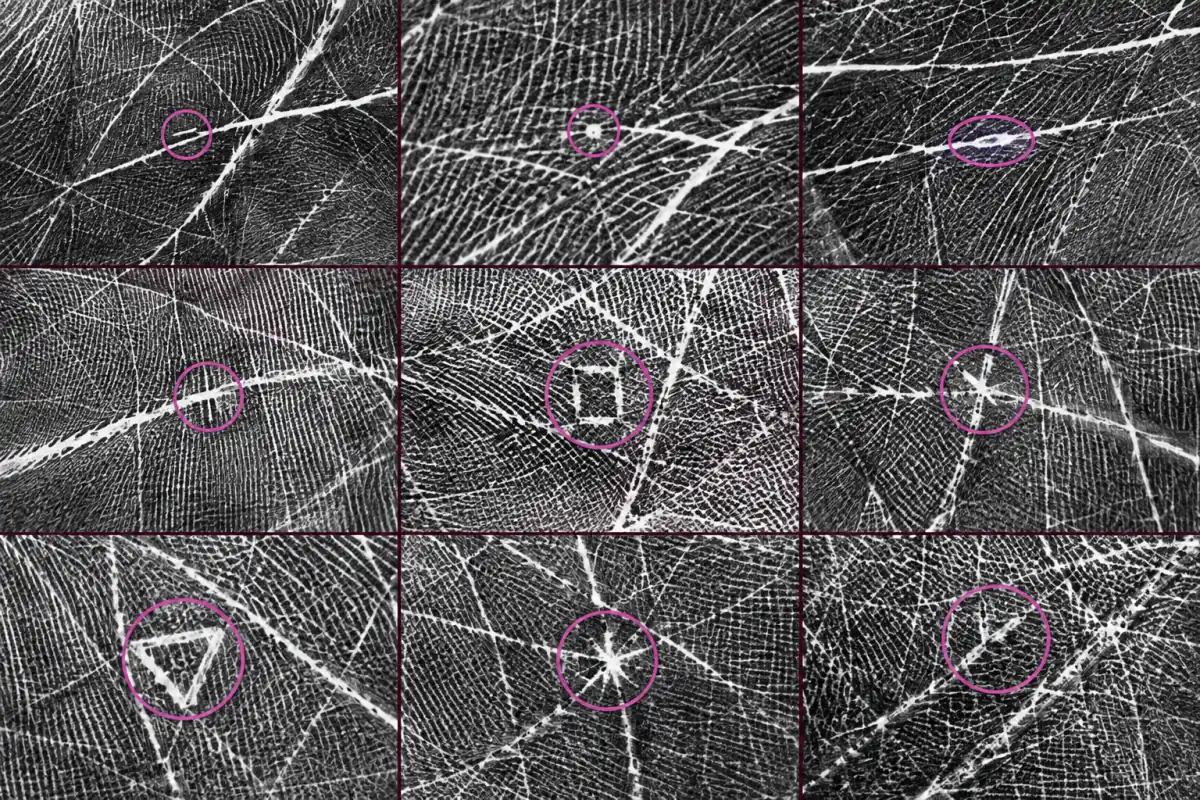
The palm markings dictionary gives the basic shape test for crosses, stars, grilles, bars, islands, triangles, and squares. Use a neutral visual description first: “two short independent strokes cross on Jupiter” is more precise than “a lucky X.”
Does the X need equal arms?
No. Natural creases rarely produce perfect symmetry. One diagonal may be longer or deeper, but both strokes should remain visible on each side of the center. When one stroke is a long parent line and the other is a short bar, the mark is still cross-shaped; its interpretation begins with the parent line rather than with a free-standing symbol.
Do a cross and an X mean different things?
In most palmistry descriptions, “cross” and “X mark” name the same two-stroke formation. The angle does not create a separate symbol. A narrow X, broad X, or almost upright cross is read through independence, location, depth, parent-line involvement, and supporting features. Use “bar” when a short line cuts directly across a longer route without forming a balanced independent X.
Four cross types that require different readings
| Cross type | How it appears | Reading order |
|---|---|---|
| Independent cross | Two short strokes form an X away from major routes | Mount or plain first, then nearby features |
| Cross on a line | One short stroke cuts a long parent line | Parent line, crossing level, continuation |
| Route intersection | Two established lines cross and continue | Identify both routes and their subjects |
| Cross made by branches | Branches from nearby lines meet at one point | Trace each branch back to its source |
An independent cross concentrates the mount's theme. A cross on a line interrupts or redirects that line's route. An intersection connects two subjects: for example, an influence line from Moon meeting the fate line may describe outside people, movement, or environment affecting direction. Calling all three structures simply “an X” loses the most useful information.
Cross lookalikes: star, grille, triangle, trident and chance overlap
| Possible formation | Visible structure | How it differs from a cross |
|---|---|---|
| Star | Three or more independent strokes share one center | At least six arms radiate from the intersection |
| Grille | Several parallel lines cross another set | Repeated intersections form a mesh |
| Open triangle | Two sides meet while a third stops short | The apparent X may be two corners seen together |
| Trident | One stem divides into three outgoing prongs | Branches grow from one source instead of crossing through it |
| Fork | One stem divides into two tips | No second complete stroke crosses the junction |
| Chance overlap | Two long unrelated routes happen to intersect | Both lines continue well beyond the supposed local symbol |
| Skin-ridge triradius | Fine ridge flows meet in a tiny three-way pattern | Dermatoglyphic texture, not two crease strokes |
A two-line cross has four arms; a verified star has three or more strokes and at least six arms. A trident has one incoming stem and three outgoing prongs. Count the complete strokes rather than the visible tips, because a nearby line may create an extra ray without belonging to the center.
When is an X only an accidental crossing?
“Accidental” does not mean invisible or meaningless; it means the shape is produced by two longer routes rather than an independent symbol. Trace each stroke beyond the X. If one is the fate line and the other is a long influence line from Moon or Venus, interpret their meeting. If the head and fate lines cross, that is a normal landmark used for timing, not a separate cross symbol.
Cross or X meanings by mount
The exact center of the X determines the location. Use the mount map, then compare the mount's fullness, firmness, texture, finger, and other markings. A cross changes the way a mount is expressed; it does not replace the rest of the hand.
| Cross location | Where to look | Traditional meaning | Support to compare |
|---|---|---|---|
| Jupiter | Below index finger | Concentrated ambition, commitment, leadership, teaching, or a decisive alliance | Index finger, thumb, fate and heart lines |
| Saturn | Below middle finger | A serious turning point, obstacle, or weight of responsibility | Fate line, middle finger, line continuation |
| Apollo / Sun | Below ring finger | Tension or redirection around recognition, creativity, reputation, or satisfaction | Sun line, ring finger, head line |
| Mercury | Below little finger | A complex choice around communication, trade, analysis, or trust | Little finger, head and Mercury lines |
| Venus | Thumb mound inside life line | An intense attachment, family influence, or relationship pressure | Life and heart lines, thumb, influence lines |
| Moon | Lower outer palm | A point of tension in imagination, travel, public contact, or emotional atmosphere | Head line, travel lines, fate origin |
| Upper Mars | Outer middle palm | Conflict, resistance, or a decision requiring boundaries | Head and heart lines, Mars support |
| Lower Mars | Inner palm above Venus | Pressure on courage, reaction, or immediate self-assertion | Life line, thumb, head line |
| Plain of Mars | Central palm | Competing duties, practical conflict, or a central turning point | Fate, head, heart, and support lines |
Traditional texts often call crosses on Saturn, Apollo, Mercury, Moon, or Mars obstacles, but that word is too broad to be useful by itself. Specify the subject, structure, and continuation: “a short independent X on Apollo beside a clear Sun line” differs from “a heavy bar crossing and breaking the Sun line.” The first concentrates a creative or visibility decision; the second directly interrupts the route.
Cross meanings on the life, head, heart, fate and Sun lines
When a cross touches a major line, read that line before the mark. Trace its origin, depth, route, breaks, branches, destination, and quality after the crossing. Then identify the source of the second stroke. A local bar, a Moon influence, a Venus influence, and another major line each create a different combination.
| Parent line | Traditional cross emphasis | What to inspect next |
|---|---|---|
| Life line | A concentrated pressure or change in lifestyle, family setting, energy, or environment | Continuation, Mars line, branches, Venus influence |
| Head line | A demanding decision, changed outlook, or interruption in focus | Line strength after the mark, slope, fork, thumb |
| Heart line | An emotional turning point, conflicting needs, or relationship pressure | Curve, ending, branches, Venus, relationship lines |
| Fate line | A work, duty, or direction path meets another influence or obstacle | Source of crossing line and upper continuation |
| Sun line | A visibility, creative, reputation, or fulfillment route is redirected | Apollo mount, bars, branches, line above the X |
| Mercury line | A decision in communication, work systems, analysis, or specialist practice | Head line, little finger, continuation |
| Relationship line | A significant bond meets strain, outside influence, or a decision point | Edge photo, fork or break, heart line, both hands |
Cross on the life line
A short bar crossing the life line is traditionally read as concentrated pressure affecting routine, home, family, vitality, or environment at that level. It does not predict death or diagnose illness. Look for an intact continuation, overlapping repair, parallel Mars support line, or a branch toward Moon or fate to understand how the route changes.
Cross on the head line
On the head line, an X or bar can mark a period of difficult choice, changed mental direction, competing ideas, or interrupted concentration in traditional reading. A clear line that resumes strongly suggests continuity after the turning point. A shifted upper or outer segment may show a new method or outlook. Palm creases cannot diagnose cognitive or neurological conditions.
Cross on the heart line
A heart-line cross is read through emotional expression and relationships. A Venus influence line crossing it may connect family or attachment pressure with the emotional route; a downward branch from above may show thought or practical concerns entering the pattern. It is not by itself a sign of breakup, divorce, or a fixed romantic outcome.
Cross on the fate line
The source of the second stroke is crucial. A line from Moon can represent public contact, travel, relocation, or another person's influence meeting the work path; a line from Venus can connect family or close relationships with responsibility. If the fate line stops at the cross, the pattern is read as interruption. If it continues strongly or shifts, the emphasis is redirection or reorganization. The major life-change guide shows how to combine route, subject, timing, and continuation.
Cross on the Sun line
A cross directly cutting the Sun line can suggest a challenge involving visibility, confidence in one's work, creative satisfaction, or reputation. If the Sun line resumes clearly, the difficulty is bounded to one phase. If an upward branch begins after the mark, the expression may find another channel. A free-standing X nearby on Apollo is related to the mount but does not interrupt the line unless it actually touches.
Why the cross on Jupiter is treated differently
Many palmistry traditions give the independent cross on Jupiter a more constructive interpretation than crosses on other mounts. Because Jupiter represents aspiration, leadership, teaching, ideals, status, and commitment, a clean X below the index finger is associated with a decisive alliance, fulfilled ambition, meaningful commitment, or support that advances a goal.
The favorable reading depends on location and support. The center should sit on Jupiter rather than in the quadrangle below it, on Saturn beside it, or on the index-finger joint crease above it. A balanced Jupiter mount, proportionate index finger, clear thumb, upward fate or life-line branch, and coherent heart line help show whether the emphasis falls on leadership, teaching, partnership, or personal ideals.
| Jupiter-cross context | Traditional emphasis | Feature that clarifies it |
|---|---|---|
| Independent X centered on Jupiter | Focused ambition, commitment, or meaningful alliance | Index finger and thumb |
| X touched by an upward fate branch | Responsibility or work supports leadership | Fate-line origin and continuation |
| X reached by a heart-line branch | Ideals and commitment shape relationships | Heart-line ending and Venus |
| X inside a grille | Ambition or ideals are complicated by scattered effort | Full grille and mount balance |
| X partly on Saturn | Leadership combines with duty or caution | Exact center and strongest arm |
| X below Jupiter in quadrangle | Test for an independent mystic cross | Head and heart line boundaries |
A Jupiter cross does not guarantee marriage, promotion, fame, or success. It identifies a traditional theme that should be matched to the reader's actual question and repeated elsewhere in the hand.
When an X is a mystic cross
A mystic cross is a specific subtype, not a name for every X. It must be a small independent two-stroke cross inside the quadrangle between the head and heart lines, usually in the central Saturn area. Its arms should not simply be pieces of the fate, Sun, head, or heart lines. Traditional palmistry connects it with sustained interest in symbolism, intuition, spiritual study, or interpretive systems.
| Question | Ordinary cross/X | Mystic-cross requirement |
|---|---|---|
| Location | Can occur on any line, mount, or plain | Inside the central quadrangle |
| Independence | May include a parent line or route intersection | Both strokes should be locally independent |
| Main subject | Comes from its line or mount | Symbolic interest, intuition, or spiritual study |
| Supporting evidence | Depends on local fingers, mounts, and lines | Moon, head-line slope, intuition line, Jupiter, fingerprints |
Use the dedicated mystic-cross verification guide for its exact boundaries, false positives, variations, and supporting intuition pattern. This page owns the wider question of crosses by mount and parent line.
How to time a cross without treating it as a fixed event
A cross can be placed in a broad period only when its center touches a line with a usable proportional scale. On the fate line, compare the intersection with the head- and heart-line landmarks. On the life line, use its position along the full arc and seek another timed marker. On heart, head, or relationship lines, keep the range broad. A free-standing mount cross has no reliable date by location alone.
| Cross position | Useful timing method | Avoid |
|---|---|---|
| On fate line | Use the center against head and heart crossings | Timing from arm length |
| On life line | Use proportional arc position and corroboration | Calling the cross a lifespan marker |
| On head or heart line | Use broad traditional sections only | Turning finger position into an exact date |
| On relationship line | Use a clear edge view and relative position | Promising a calendar year |
| Independent on mount | Describe the theme without timing | Inventing an age from mount location |
The timing-lines guide explains proportional scales, calibration, and broad windows. The useful question is what develops before and after the intersection, not whether one tiny X can supply an exact date.
What an X means on the active and less-active hands
Use hand dominance rather than a gender rule. Palmists often treat the less-active hand as background pattern or earlier potential and the active hand as present expression and developed choices. This is a reading convention, so first rule out differences caused by angle, lighting, skin condition, and hand tension.
| Two-hand pattern | Traditional interpretation | Next check |
|---|---|---|
| Same cross in same location | The concentrated theme remains both underlying and active | Compare depth and parent-line continuation |
| Clearer on active hand | A present decision, pressure, or focus may be more developed | Which supporting feature also changed? |
| Clearer on less-active hand | The underlying issue may be redirected or expressed differently now | Look for an active-hand branch or shifted route |
| Cross disappears from active hand | The intersection may no longer organize the current route | Verify with matched photographs |
| Independent X becomes line crossing | A local theme may now connect directly with a major life area | Identify the new parent line |
| Different mount on each hand | The point of concentration may have moved to another subject | Compare fingers, mounts, and current question |
Six worked cross and X examples
1. Independent cross on Jupiter
Two short strokes form a clean X below the index finger without touching the heart line or finger crease. Jupiter is balanced, the index finger is proportionate, the thumb opens firmly, and a fate branch rises toward the mount. The traditional reading emphasizes commitment, leadership, teaching, or a meaningful alliance supporting ambition.
2. Moon influence crossing the fate line
A long line begins on Moon and crosses a central fate line before continuing inward. The fate line becomes stronger above the intersection. Rather than reading a free-standing X, trace two routes: wider environment, travel, public contact, or another person influences work and direction, which then develops more clearly.
3. Life-line bar with Mars support
A short diagonal bar cuts the middle life line, creating a cross-shaped point. A parallel Mars line covers the same section and the life line resumes clearly. The combination suggests concentrated pressure around lifestyle, home, family, or energy with support and continuity, not a prediction of physical harm.
4. Apollo X beside the Sun line
A small independent cross sits on Apollo but does not touch the clear Sun line. It concentrates a choice or tension involving presentation, reputation, creative satisfaction, or audience. Because the Sun line remains undisturbed and rises past the mark, the reading differs from a bar that cuts and stops the line.
5. Fate line mistaken for a mystic-cross arm
A vertical fate line meets one short diagonal crease in the quadrangle. The result looks like an X, but one arm belongs to the long fate route. It should be read as a crossing influence on direction. It fails the independence test required by the mystic-cross guide.
6. Active-hand heart crossing becomes lighter
The less-active hand shows a heavy bar cutting the heart line, while the active hand repeats the location with a lighter bar and clearer upward branches after it. With matched photographs, the traditional reading suggests the underlying emotional turning point remains visible while present expression shows more constructive outlets.
Common mistakes when reading a cross or X
- Calling two lines a cross when they only touch or stop near each other.
- Ignoring that one arm belongs to a major line.
- Calling a three-stroke star a cross.
- Reading a normal head-and-fate intersection as a separate symbol.
- Calling every quadrangle crossing a mystic cross.
- Applying the favorable Jupiter meaning to an X centered on Saturn or the quadrangle.
- Assuming every cross predicts a negative event.
- Ignoring the parent line's continuation above the mark.
- Giving an exact date to a free-standing mount X.
- Letting one small intersection outweigh the complete hand.
Photo checklist for cross identification
- Photograph both full palms from fingertips through wrists.
- Keep each hand relaxed, flat, and parallel to the camera.
- Add a sharp close-up with enough context to identify the mount.
- Take one direct-lit and one gently side-lit image.
- Include the complete route of every line that enters the X.
- Keep images in color and disable smoothing, sharpening, and filters.
- Do not trace, circle, or darken a faint arm.
- State hand dominance and the question connected with the location.
Questions that make a cross reading useful
- Can two complete strokes be traced through one central intersection?
- Does the mark have four visible arms?
- Could it be a star, grille, fork, trident, open triangle, or ridge pattern?
- Is the X independent, attached to a parent line, or formed by two long routes?
- Which line, mount, or plain contains the exact center?
- Where does the second stroke begin and end?
- What happens to the parent line before and after the crossing?
- Does another line, mount, finger, or thumb feature repeat the same subject?
- Can the crossing level be placed in a broad corroborated period?
- Does the other hand repeat, deepen, fade, or redirect the pattern?
- What question about work, relationships, commitment, creativity, travel, communication, purpose, or direction should the mark answer?
Read the cross inside the complete hand
Verify both strokes and the four arms, locate the exact center, trace every parent line and influence route, then add continuation, timing, mounts, fingers, thumb, other markings, and both palms. This shows what meets at the intersection, whether the route stops or changes, and how it connects with the question you are asking.
The complete answer
A cross or X on the palm is made by two traceable strokes meeting at one point and creating four visible arms. Traditional palmistry reads it as concentration, tension, decision, contact, or redirection within its location. Jupiter can emphasize ambition, commitment, leadership, or alliance; Saturn responsibility; Apollo recognition; Mercury communication; Venus attachment; Moon wider environments; and Mars boundaries or conflict. On a major line, the mark modifies that line's subject and must be read through the source of the crossing stroke and the continuation afterward. Only a small independent X in the central quadrangle qualifies for the separate mystic-cross interpretation. Stars, grilles, forks, tridents, ridge patterns, and ordinary line intersections need different readings. A Full Palm Reading maps the cross and all other important features across both hands and combines them into a holistic reading focused on your questions about work, relationships, commitment, creativity, travel, communication, timing, purpose, and direction.
A Full Palm Reading
Ask what your cross means across the complete hand
Your reading verifies both strokes and four arms, locates the exact center, traces every parent line and influence route, then adds continuation, timing, nearby markings, fingers, thumb, hand shape, mounts, major and minor lines, and both palms into one holistic reading focused on your questions about work, relationships, commitment, creativity, communication, travel, purpose, and direction.
Your Full Palm Reading maps all the important features—hand shape, skin texture, thumb, fingers, mounts, major and minor lines, markings, and the differences between both palms—and brings them together in a holistic reading focused on your questions.