
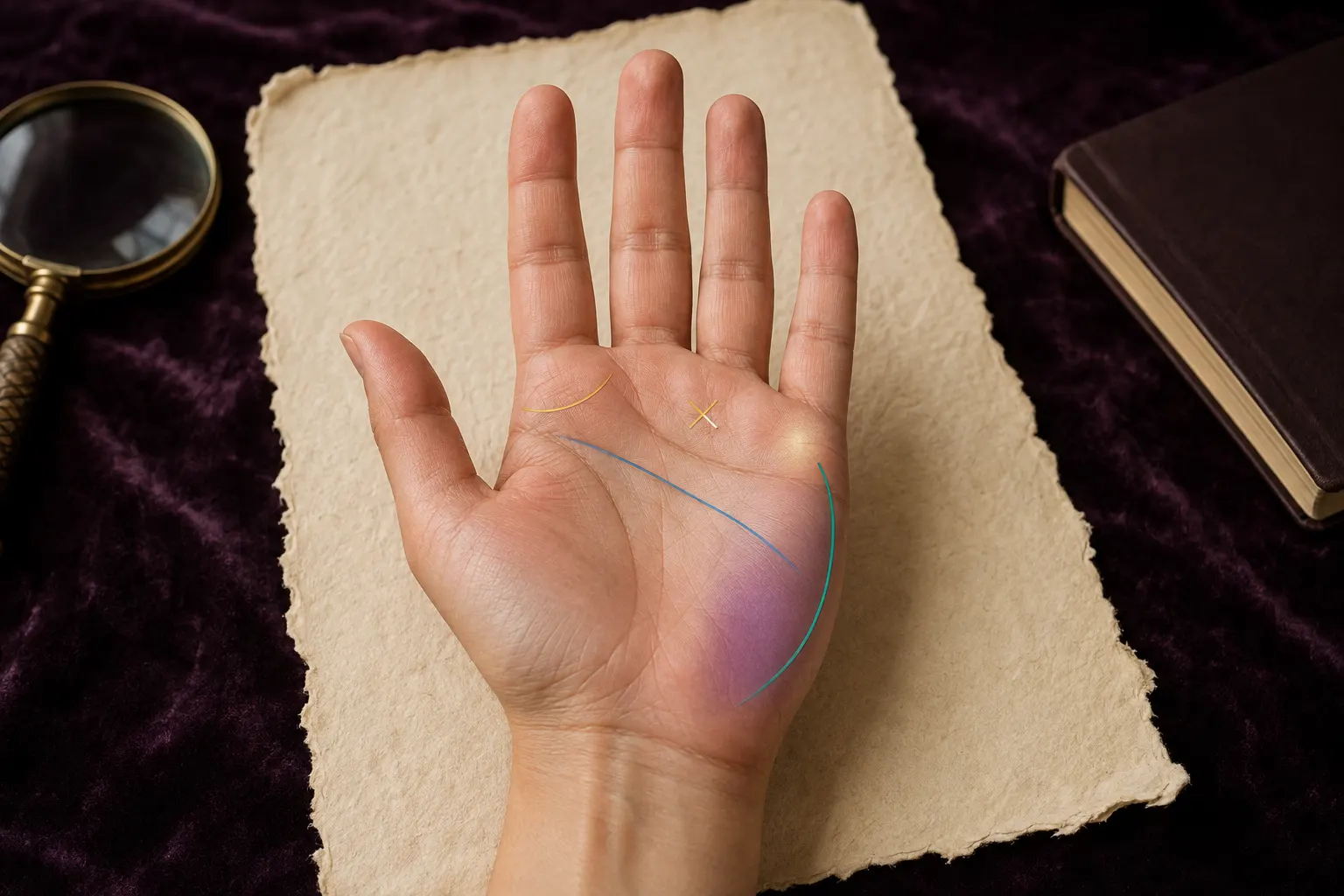
The strongest psychic or intuition signs in palmistry are a combination, not one special line. Palmists look for fine or responsive skin, a developed Moon mount, a head line that slopes toward Moon, a clear intuition line, receptive fingerprint patterns, a verified mystic cross, a Ring of Solomon, and enough Mercury strength to express an impression clearly. Three or more independent features telling the same story carry more weight than a single cross, curve, or unusual crease.
One cross or curved line cannot show how intuition works. A whole-hand reading compares receptivity, imagination, discernment, expression, grounding, and both palms to show how your intuitive pattern operates in relationships, choices, creativity, work, boundaries, and spiritual practice.
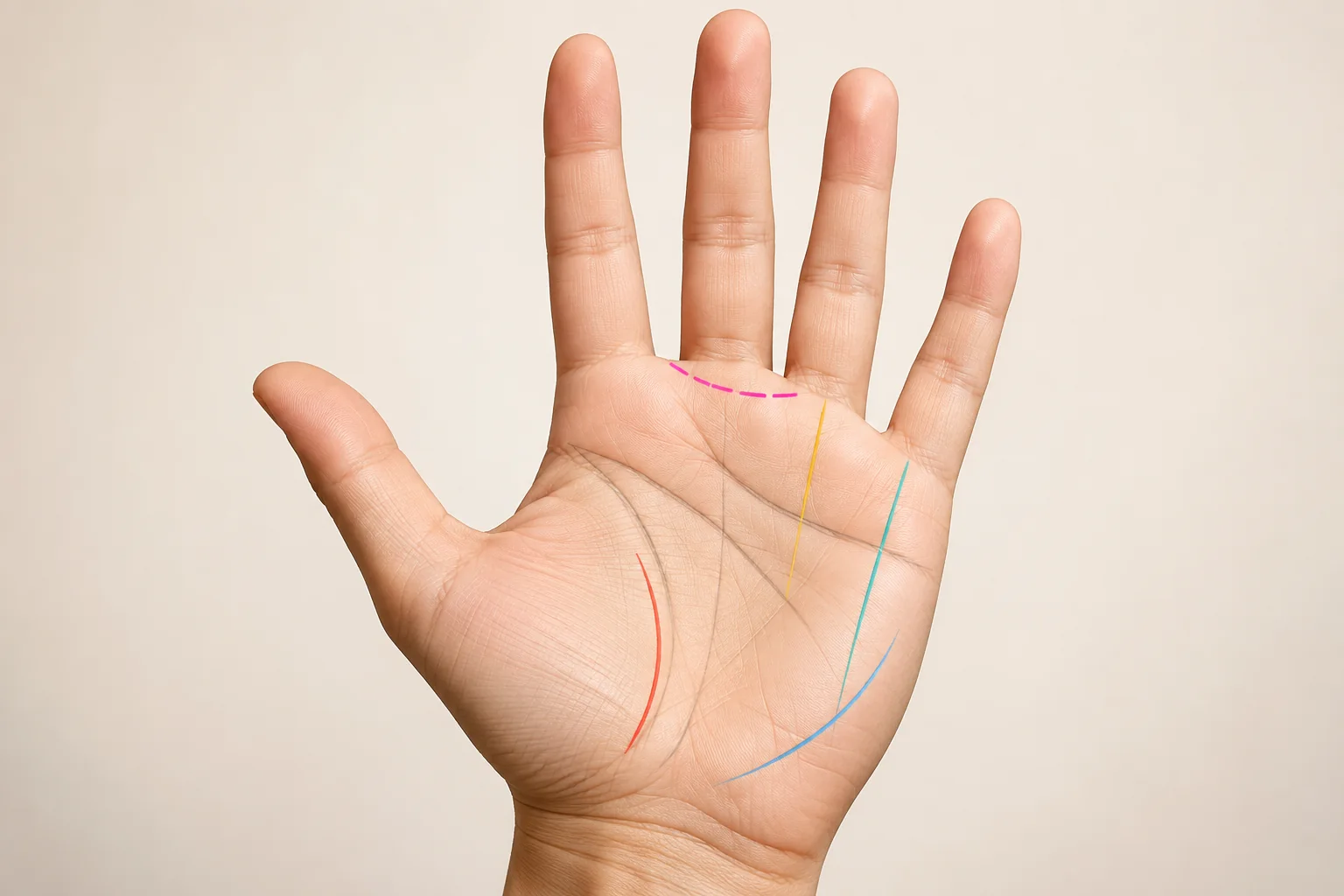
These features answer different questions. Texture describes receptivity. Moon supplies imagination and inner imagery. The head line shows how the mind processes information. The intuition line suggests a repeated instinctive channel. Fingerprints modify the person's stable response style. The mystic cross shows interest in symbolic or spiritual systems, while the Ring of Solomon emphasizes insight into people. Mercury shows whether private impressions can become language, analysis, teaching, or guidance.
First separate intuition from imagination
A full Moon mount and sloping head line can produce a vivid imagination without a separate intuition line. A mystic cross can show symbolic interest without unusual sensitivity. Read a “psychic” pattern only when receptivity, inner perception, discernment, and expression reinforce one another across the hand.
The eight-feature intuition and psychic-sign map
| Feature | Where to look | Traditional emphasis | What must confirm it |
|---|---|---|---|
| Fine skin texture | Center of palm and finger pads | Receptivity to nuance, mood, and atmosphere | Head line, thumb, and Moon balance |
| Moon mount | Lower outer palm opposite the thumb | Imagination, images, dreams, and inward awareness | Firmness, markings, and head-line direction |
| Sloping head line | Major line crossing toward the outer palm | Associative, imaginative, and symbolic thought | Depth, clarity, branches, and thumb |
| Intuition line | Outer palm from Moon toward Mercury | Instinctive impressions and pattern recognition | Clear crescent route and supportive context |
| Fingerprints | Finger pads; sometimes palm ridge patterns | Responsive, independent, or mixed processing style | Repeated patterns and the finger involved |
| Mystic cross | Quadrangle between head and heart lines | Interest in symbolism, spirituality, or hidden systems | A clean independent X in the correct location |
| Ring of Solomon | Curved arc on Jupiter below the index finger | Insight into motives, counsel, and guidance | Jupiter quality, head line, and Mercury |
| Mercury support | Little finger, Mercury mount, and related lines | Translation of impressions into words or skill | Clarity, proportion, and practical grounding |
Do not count two parts of the same formation as two confirmations. A sloping head line ending on Moon and the Moon area it reaches form one connected clue until a separate feature supports them. An independent intuition line, fine texture, or repeated loop pattern adds genuinely new evidence.
How to read intuitive signs in the right order
- Photograph both hands clearly. Include fingertips, outer edges, and wrists; add close-ups of ridge patterns and small marks.
- Record texture and hand shape. These set the person's broad level of receptivity and pace before any special sign is named.
- Locate Moon and Mercury. Compare their fullness with the other mounts instead of judging either in isolation.
- Trace the head line. Note whether it runs straight, slopes gently, bends deeply, forks, or becomes weak.
- Verify the intuition line. Look for an independent outer crescent and rule out Mercury, travel, and fate-line fragments.
- Check stable modifiers. Read fingerprint types by finger and note any clear loops or whorls in the palm.
- Verify named marks. A mystic cross and Ring of Solomon must meet their own shape and location tests.
- Test expression and grounding. Add Mercury, thumb strength, finger setting, and line clarity.
- Compare both palms. Separate the underlying tendency from the quality currently expressed.
- Answer one real question. Explain how the pattern affects relationships, decisions, creativity, work, or spiritual practice.
If you are new to the map, use the beginner palm-reading sequence and the complete mount guide before interpreting the smaller signs.
Moon mount and head-line slope: the imaginative foundation
The Moon mount occupies the lower outer side of the palm, opposite Venus. In traditional palmistry it describes imagination, inward imagery, empathy, travel of mind, and sensitivity to atmosphere. Relative fullness matters more than absolute size: compare Moon with Venus, Mars, and the mounts under the fingers. A firm, proportionate Moon is read differently from a soft, overfull, heavily crossed, or flat area.
The head line shows how that imaginative material is handled. A straight route emphasizes concrete, sequential processing. A gentle slope toward Moon adds association and visualization. A deep bend can make symbols, impressions, stories, and inner images central to thought. Clarity determines whether the process is sustained; islands, bars, or fragmentation complicate it.
| Moon and head-line combination | Traditional reading | What it does not establish alone |
|---|---|---|
| Balanced Moon + gently sloping clear head line | Imagination integrated with usable judgment | A separate intuition channel |
| Full Moon + deeply sloping head line | Vivid inner imagery and strong associative thinking | Accuracy of every impression |
| Full Moon + straight head line | Imagination filtered through practical analysis | Mystical interest |
| Flat Moon + sloping head line | Creative or reflective thinking without strong Moon emphasis | High environmental receptivity |
| Heavily crossed Moon + fragmented head line | Many competing impressions or difficulty organizing them | Reliable intuition |
| Sloping head line with upward fork | Ability to move between imaginative and practical modes | A prediction about career or outcome |
How to tell a slope from a drooping branch
Trace the main head-line trunk from its origin near the thumb. If the entire trunk descends gradually, the line is sloping. If the trunk stays level while one offshoot drops toward Moon, read the main style and the imaginative branch separately. A fork with one straight and one descending branch often shows access to both practical and imaginative processing.
How to identify the intuition line
The intuition line is traditionally described as a clear crescent on the outer palm. It rises from the lower Moon area and curves toward the Mercury mount below the little finger, with the bow following the percussion side of the hand. It may be complete or partial, but its direction should be coherent and it should remain distinguishable from surrounding creases.
Use the minor-lines location map before naming it. Small outer-palm creases are common, and a normal photograph can merge separate fragments into a convincing curve. Side lighting and an edge close-up help show whether the line actually continues.
| Possible line | Typical route | How it differs |
|---|---|---|
| Intuition line | Crescent hugging the outer palm from Moon toward Mercury | Curved, independent, and outer-edge oriented |
| Mercury line | More upright route toward the Mercury mount | Usually sits farther toward the palm center and is less crescent-shaped |
| Travel line | Short horizontal or diagonal line entering Moon from the edge | Does not make the long upward crescent |
| Fate line from Moon | Moves from Moon toward Saturn below the middle finger | Travels into the central palm rather than ending at Mercury |
| Head-line branch | Leaves the head line and descends into Moon | Shares a visible origin with the head line |
| Chance crease or fragments | Several unrelated short marks | No single continuous route or destination |
Variations of the intuition line
A clear, unbroken crescent is traditionally read as steadier access to instinctive impressions. A faint but coherent line can show a subtle or private tendency. Breaks suggest that access is intermittent or develops in phases. Islands and many interfering bars weaken clarity. A doubled line intensifies the theme only after both routes are verified as independent. The absence of the line does not mean a person lacks intuition; Moon, texture, head line, prints, and experience may carry the pattern in other ways.
Skin texture and fingerprints: how receptivity is filtered
The skin-texture guide treats fine ridges as more receptive to subtle stimulation and coarse ridges as more comfortable with tangible, direct input. That distinction changes the expression of every Moon or head-line sign. Fine texture may notice tone and atmosphere quickly; firmer grain can turn the same imaginative feature toward making, action, or practical problem-solving.
Fingerprints are read as stable style modifiers in traditional hand analysis. The fingerprint guide explains loops, whorls, arches, and composites in detail. Read each print on its finger: a loop on Mercury modifies communication, a whorl on Jupiter modifies leadership, and a composite on Apollo modifies creative expression.
| Texture or print | Traditional intuition-related quality | Balancing feature |
|---|---|---|
| Silk-fine texture | Strong receptivity to subtle changes in mood and atmosphere | Firm thumb and clear head line for boundaries |
| Paper-fine texture | Receptivity through words, images, patterns, and ideas | Mercury and head-line organization |
| Grainy texture | Fast response that seeks movement or application | Moon and heart line for nuance |
| Coarse texture | Direct, tangible, action-led perception | Sloping head line or fine markings for subtlety |
| Ulnar loop | Adaptive, receptive response to people and environment | Finger meaning and repeated pattern |
| Whorl | Independent, concentrated, internally referenced processing | Flexibility elsewhere in the hand |
| Composite | Capacity to hold competing viewpoints or mixed impressions | A clear head line for synthesis |
Why ordinary palm photos miss this layer
A full-palm image shows proportions and major routes but often loses friction-ridge detail. Add close-ups of every fingertip and the central palm, taken square to the camera under diffuse light. Do not use smoothing, portrait mode, contrast filters, or drawn overlays. A print that cannot be seen clearly should be left out of the reading rather than guessed.
Mystic cross and Ring of Solomon: two different signs
A mystic cross is a small, independent X in the quadrangle between the head and heart lines. Its two strokes should cross cleanly and should not simply be fragments of the fate, Sun, or other vertical lines. Palmists traditionally connect it with interest in spiritual, symbolic, esoteric, or interpretive systems. It does not by itself prove sensitivity, foresight, or skill.
The Ring of Solomon is a curved arc on the Jupiter mount beneath the index finger. It follows part of the finger base without being the ordinary joint crease. Traditionally it emphasizes insight into motives, guidance, teaching, and counsel. A clear head line and balanced Jupiter area help distinguish considered insight from assumption or overconfidence.
| Mark | Correct test | Best-supported meaning | Common false positive |
|---|---|---|---|
| Mystic cross | Independent two-stroke X inside the quadrangle | Symbolic curiosity and spiritual study | Fate-line crossing or random mesh |
| Ring of Solomon | Distinct arc across Jupiter below index finger | Perception of people, counsel, and guidance | Finger joint crease or Jupiter grille |
| Triangle on Moon | Three clean sides enclosing one space | Organized use of imagination or inward perception | Open angle formed by unrelated creases |
| Star on Moon | Three or more strokes sharing one center | Concentrated Moon event or quality | Cross, grille, or coincidental tangle |
| Vertical Mercury lines | Independent fine lines below little finger | Specialized communication or service interests | Skin ridges or crease fragments |
Use the markings dictionary and rare-sign verification guide when a supposed triangle, star, cross, or ring is ambiguous.
Mercury shows whether an impression can be expressed
Mercury includes the little finger, its mount, and the routes that approach it. In a psychic-sign reading, Mercury does not create intuition. It shows how a person names, tests, communicates, or applies an impression. A proportionate little finger, clear Mercury area, and organized head line can help translate Moon sensitivity into conversation, counseling, analysis, teaching, writing, or skilled observation.
| Mercury pattern | Possible expression | Check before concluding |
|---|---|---|
| Clear Mercury + fine texture | Notices nuance and can describe it | Head-line clarity and little-finger setting |
| Strong Mercury + straight head line | Tests impressions through questions and evidence | Moon or intuition-line support |
| Strong Moon + weak Mercury expression | Rich private impressions that are hard to explain | Thumb, confidence, and active-hand development |
| Ring of Solomon + clear Mercury | Insight expressed through advice, teaching, or counsel | Balanced Jupiter and listening indicators |
| Many confused lines below Mercury | Several channels competing for attention | Whether the lines are real, clear, and independent |
The historically named Mercury line is also called the Health line in older palmistry. Read it here only for its traditional communication, organization, and working-style associations; a palm crease cannot diagnose health.
How strong is the complete intuition pattern?
| Evidence level | What appears | How to phrase the reading |
|---|---|---|
| Single clue | One cross, curve, full mount, or sloping line | “This feature may add symbolic interest or imagination.” |
| Moderate pattern | Two or three independent features across different layers | “Several features repeat a receptive or intuitive theme.” |
| Strong pattern | Receptivity, imagination, discernment, and expression all supported | “The whole hand consistently emphasizes intuitive processing.” |
| Strong but ungrounded | High receptivity and Moon emphasis with weak clarity or control | “Impressions may be vivid, while filtering and boundaries need attention.” |
| Grounded intuition | Moon and fine texture balanced by clear head line and firm thumb | “Sensitivity is organized through judgment and deliberate action.” |
| Contradictory pattern | One special sign conflicts with the dominant hand | “Keep the sign as a minor modifier rather than the headline.” |
The thumb matters because it modifies boundaries, judgment, persistence, and adaptability. The thumb guide can show whether a sensitive pattern is directed firmly, adjusted flexibly, or left diffuse. The complete personality-traits guide helps place intuition inside the person's wider temperament.
What the active and less-active hands add
Use the two-hand method: the less-active hand is commonly read as the underlying tendency, while the active hand shows present expression and development. Hand dominance is more useful here than a gender rule.
| Two-hand pattern | Traditional reading | Useful question |
|---|---|---|
| Signs repeat clearly on both | Underlying receptivity is also actively expressed | Where is it most useful now? |
| Stronger on active hand | The quality has been developed through attention or experience | What practice strengthened it? |
| Stronger on less-active hand | The tendency may remain private, unused, or selectively expressed | What blocks or protects its expression? |
| Moon strong in both, Mercury stronger active | Private impressions have become easier to communicate | Where has confidence or vocabulary grown? |
| Mystic cross appears only active | Symbolic or spiritual interest may have become more central | When did that interest develop? |
| Photo quality differs | No comparison is ready | Can both hands be retaken in matched light? |
Six worked intuition-pattern examples
1. Sensitive and imaginative, with usable boundaries
Silk-fine texture, a balanced Moon mount, a gently sloping clear head line, and a firm open thumb repeat receptivity, imagery, clarity, and boundaries. No named mystical mark is required. The reading focuses on noticing atmosphere quickly while choosing deliberately how to respond.
2. The intuitive counselor pattern
A clear Ring of Solomon appears with balanced Jupiter, fine texture, a proportionate Mercury finger, and a head line that combines slope with an upward branch. Insight into people is supported by communication and practical synthesis. The pattern suits questions about mentoring, teaching, listening, or relationship guidance.
3. Symbolic interest without a broad sensitivity pattern
A verified mystic cross appears, but the skin is coarse, Moon is flat, and the head line runs straight. The cross remains meaningful as curiosity about spiritual or symbolic systems, yet it should not be expanded into a claim of exceptional psychic sensitivity.
4. Creative imagination mistaken for an intuition line
A deeply sloping head line reaches a full Moon mount, but the supposed intuition line is actually three short travel lines. The hand strongly supports storytelling, visualization, and inward thought. It does not contain the named crescent, so the reading stays with imagination unless other independent features confirm intuition.
5. Private receptivity becomes active expression
Both hands have fine texture and Moon emphasis. The less-active hand has a faint intuition line, while the active hand has a clearer crescent plus stronger Mercury support. The underlying sensitivity appears to have become more organized and communicable over time.
6. Vivid impressions with weak filtering
Very fine skin, a full crossed Moon, deeply sloping fragmented head line, and many Mercury-area lines create a highly receptive but crowded pattern. The reading should emphasize filtering, verification, rest, and boundaries rather than treating every impression as accurate.
Common mistakes when reading psychic signs
- Calling any curved outer-palm crease the intuition line.
- Reading a fate line from Moon as an intuition line.
- Counting an accidental X anywhere on the palm as a mystic cross.
- Mistaking an index-finger joint fold for the Ring of Solomon.
- Equating imagination with reliable intuition.
- Using one rare mark as proof of a complete psychic pattern.
- Ignoring texture, thumb, head-line clarity, and Mercury expression.
- Guessing fingerprint patterns from a soft full-palm photograph.
- Treating a heavily crossed mount as automatically stronger.
- Reading only one hand or comparing unmatched photographs.
Photo checklist for an intuition-sign reading
- Take one sharp full-palm photograph of each hand from fingertips to wrists.
- Keep palms relaxed, open, and parallel to the camera.
- Add a straight-on close-up of the outer Moon-to-Mercury edge.
- Add close-ups of the quadrangle and Jupiter mount.
- Photograph every fingertip closely enough to see ridge patterns.
- Use bright diffuse light plus one gently side-lit image for shallow lines.
- Keep color natural and disable smoothing, filters, and sharpening.
- State which hand is active and what intuitive question matters to you.
Questions that make an intuition reading useful
- Is the mark a true intuition line, a Mercury line, a fate line from Moon, or separate fragments?
- Does the pattern emphasize receptivity, imagination, discernment, communication, or several of these?
- Which features help filter an impression before action?
- Does intuition operate through people, images, words, dreams, creativity, or practical pattern recognition?
- How do the thumb and head line affect boundaries and judgment?
- Do the mystic cross or Ring of Solomon pass their location and shape tests?
- Which fingerprint patterns repeat the theme, and on which fingers?
- What is stronger, softer, or newly expressed in the active palm?
- How does the pattern affect relationships, work, decisions, creativity, or spiritual practice?
- What specific question should the full reading connect these signs to?
Read intuition across the complete hand
Begin with texture and Moon, trace the head and intuition lines, verify prints and named marks, then add Mercury, Jupiter, thumb, hand shape, major lines, and both palms. The result shows how an impression is received, processed, tested, expressed, and applied.
The complete answer
Psychic and intuition signs in palmistry form a layered pattern. Fine skin suggests receptivity; Moon and a sloping head line add imagination and symbolic processing; a verified intuition line describes a recurring instinctive channel; fingerprints modify response style; the mystic cross adds symbolic or spiritual interest; the Ring of Solomon emphasizes insight into people; and Mercury shows how impressions become words, analysis, guidance, or skill. The pattern becomes convincing when several independent features align, remain clear, and are balanced by judgment and boundaries. A Full Palm Reading maps all these important features across both hands and combines them into a holistic reading focused on your questions about intuition, relationships, decisions, creativity, work, boundaries, spiritual practice, and direction.
A Full Palm Reading
Ask how your intuitive pattern works across the complete hand
Your reading maps skin texture, Moon, head-line slope, the intuition line, fingerprints, the mystic cross, Ring of Solomon, Mercury, thumb, supporting lines, and both palms into one holistic reading focused on your questions about insight, boundaries, relationships, work, creativity, spiritual practice, and decision-making.
Your Full Palm Reading maps all the important features—hand shape, skin texture, thumb, fingers, mounts, major and minor lines, markings, and the differences between both palms—and brings them together in a holistic reading focused on your questions.